
Quiz
Membrane Potentials
Dieses Quiz enthält Fragetypen, die sich im gewohnten Player öffnen.
Fragen in diesem Quiz (25)
1When we record the intracellular membrane potential, we place an electrode [blank_start]across[blank_end] the cell membrane to measure from outside to inside. The external potential is taken as [blank_start]0[blank_end]mV. We then measure the [blank_start]difference[blank_end] between this value and the potential of the [blank_start]inner[blank_end] membrane.
- Aacross
- B0
- Cdifference
- Dinner
2When we record the extracellular membrane potential, we bring an electrode [blank_start]close to[blank_end] the cell membrane. We also measure from a distant point. The potential at this distant point is taken as [blank_start]0[blank_end]mV.
- Aclose to
- B0
3Which method of measuring membrane potential will record a smaller action potential waveform?
- AIntracellular
- BExtracellular
4If we record membrane potential intracellularly or extracellular the waveform of voltage over time will be the same for both measurements.
- ARichtig
- BFalsch
5Fill in the blanks below to describe the technique of patch clamping when measuring membrane potentials.
1. The electrode tip is broken off and [blank_start]smoothed[blank_end] in a Bunsen flame.
2. The tip is brought down onto the [blank_start]membrane[blank_end].
3. A small amount of [blank_start]suction[blank_end] is applied via the pipette.
4. This creates a [blank_start]high resistance[blank_end] seal so that all ions flowing when a single ion channel opens must flow into the [blank_start]pipette[blank_end]. This allows measurement of [blank_start]single-channel[blank_end] currents.- Asmoothed
- Bmembrane
- Csuction
- Dhigh resistance
- Epipette
- Fsingle-channel
6This image shows the recorded membrane potential over a single ion channel. The decrease in potential shows the channel is open.

- ARichtig
- BFalsch
7Why is the plasma membrane described as being a capacitor?
- AIt stores ionic charges on its inner and outer surfaces
- BIt stores ionic charges on its outer surface only
- CIt contains ion channels
- DIt prevents the movement of ions from diffusing freely across, allowing the intra and extracellular fluids to have differing potentials
8Fill in the blanks to describe the action of the ATPase sodium-potassium pump.
1. [blank_start]3[blank_end] Na+ and [blank_start]1[blank_end] ATP molecule bind at the [blank_start]cytosolic[blank_end] binding site
2. [blank_start]ADP[blank_end] is released causing a conformational shape change
3. [blank_start]3[blank_end] Na+ are released into the extracellular space and [blank_start]2[blank_end] K+ bind on the same side
4. [blank_start]Inorganic phosphate[blank_end] is released causing another conformational shape change
5. [blank_start]2[blank_end] K+ are released into the cytosol- A3
- B1
- Ccytosolic
- DADP
- E3
- F2
- GInorganic phosphate
- H2
9What is the typical intracellular concentration of potassium?
- A140mM
- B10mM
- C2mM
- D4mM
10What is the typical intracellular concentration of sodium?
- A140mM
- B10mM
- C4mM
- D40mM
11What is the extracellular concentration of potassium?
- A4mM
- B140mM
- C10mM
- D110mM
12What is the typical extracellular concentration of sodium?
- A140mM
- B10mM
- C4mM
- D15mM
13An electrochemical gradient is a store of potential energy that can do what?
- ABe used to do work in the form of ions moving across the membrane
- BKill a cell
- COpen a ligand-gated ion channel
- DStimulate mitosis
14Why is the membrane potential at 0 here?

- AThere are no open ion channels so charge cannot transfer across the membrane
- BEach size has equal amounts of positive and negative charge
- CBecause the inside is more positive than the outside
- DBecause there is no action potential
15The open ion channel here must be selective for [blank_start]potassium[blank_end]. Therefore, this ion crosses the membrane from the [blank_start]inside[blank_end] of the cell to the region of lower concentration [blank_start]outside[blank_end] the cell. This ion 'sits' on the external membrane layer due to its property of [blank_start]capacitance[blank_end]. The cytosol is now [blank_start]more[blank_end] negative than the extracellular fluid, so the membrane potential is [blank_start]negative[blank_end].

- Apotassium
- Binside
- Coutside
- Dcapacitance
- Emore
- Fnegative
16In this image, another ion pair has come to sit across the membrane. The membrane potential becomes even more [blank_start]negative[blank_end] because there are even more [blank_start]negative[blank_end] charges aligned on the [blank_start]inner[blank_end] membrane. The green region represents a 'shell' of [blank_start]charge[blank_end] developing across the membrane.
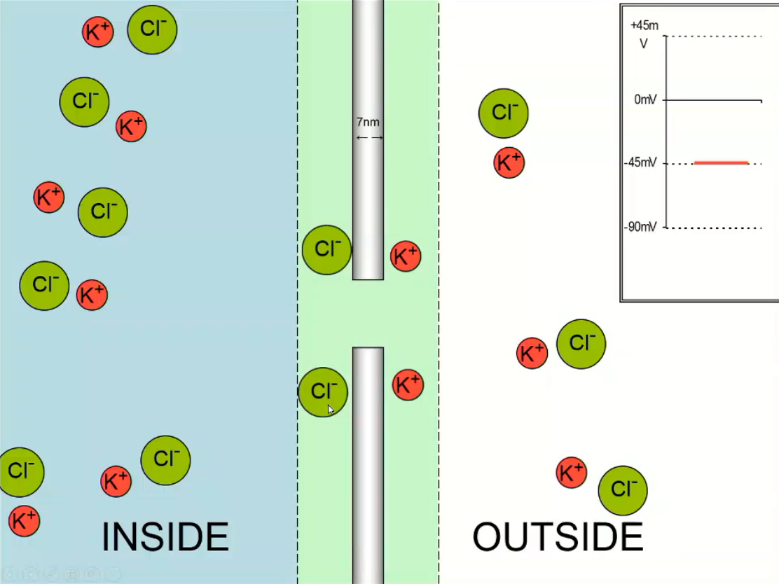
- Anegative
- Bnegative
- Cinner
- Dcharge
17Why do we need to do work in order to rearrange ions across the membrane?
- AOppositely charged ions are attracted to one another but we need to overcome this attraction to separate them across the membrane
- BWe need energy to open the ion-specific channels
- CWe need energy to move the ions against their concentration gradients
18How do we determine the gradient of a positive ion across a membrane?
- A[external] / [internal]
- B[internal] / [external]
- C[internal] x [external]
- DR x T / z x F
19Fill in the blanks to explain this diagram.
The Na+/K+ pump drives ions in one direction to create a [blank_start]concentration gradient[blank_end]. However, this creates electrical drag-back in the [blank_start]opposite[blank_end] direction. Oppositely charged ions [blank_start]attract[blank_end] one another, so will prevent each other from leaving the cell. At the point where the force of the [blank_start]concentration gradient[blank_end] pushing an ion out of its cell matches the electrical force pulling it back in there will be no net [blank_start]movement[blank_end].
- Aconcentration gradient
- Bopposite
- Cattract
- Dconcentration gradient
- Emovement
20What is the equilibrium potential?
- AThe electrical force in voltage required to balance the osmotic force of an ion
- BThe difference in voltage in a cell's cytosol compared to the extracellular fluid
- CThe minimum potential required to stimulate an action potential
- DThe lowest voltage a cell reaches during an action potential firing
21How do we calculate electrical work across a cell?
- AEquilibrium potential x valence of ion x conversion factor
- BEquilibrium potential x valence of ion / conversion factor
- CEquilibrium potential / conversion factor x valence of ion
- DEquilbirium potential x valence of ion
22How do we calculate osmotic work across a cell?
- AGas constant x temperature x ln[gradient]
- BGas constant / temperature x ln[gradient]
- CGas constant x temperature x log[gradient]
- DGas constant x temperature / ln[gradient]
23At the equilibrium potential of an ion, the electrical work done is equal to osmotic work done.
- ARichtig
- BFalsch
24How do we calculate equilibrium potential?
- ART/zF x ln[gradient]
- BRz/TF x ln[gradient]
- CRT/zF x log[gradient]
- DE x z x F
25How do we simplify the Nernst equation to calculate the equilibrium potential of a single charged ion?
- AE = 61.5 x log([external]/[internal])
- BE = 30.75 x log([external]/[internal])
- CE = 61.5 x ln([external]/[internal])
- DE = 30.75 x ln([external]/[internal])
Informationen
- Beschreibung
- Principles of Physiology and Pharmacology Quiz am Membrane Potentials, erstellt von Charlotte Jakes am 27/11/2019.
- Autor
- Charlotte Jakes
- Sprache
- English
- Aufrufe
- 22
- Verlauf
- Erstellt am 27 Nov 2019 · aktualisiert am 27 Nov 2019
- Schlagwörter
- Bewertung
- Noch keine Bewertungen Bewerte dieses Quiz
Mehr zu Resting Membrane Potential