
Quiz
ISTQB Foundation Level - 500 questions
Fragen in diesem Quiz (200)
1Q. 1: Given the following state transition table Which of the test cases below will cover the following series of state transitions? S1 SO S1 S2 SO
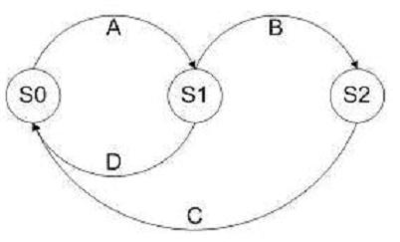
- AA. D, A, B, C.
- BB. A, B, C, D.
- CC. D, A, B.
- DD. A, B, C.
2Q. 2: From a Testing perspective, what are the MAIN purposes of Configuration
Management?:
i) Identifying the version of software under test.
ii) Controlling the version of testware items.
iii) Developing new testware items.
iv) Tracking changes to testware items.
v) Analysing the need for new testware items.- AA. ii, iv and v.
- BB. ii, iii and iv.i
- CC. i, ii and iv.
- DD. i, iii and v.
3Q. 3: Which of the following is a MAJOR task of test planning?
- AA. Scheduling test analysis and design tasks.
- BB. Initiating corrective actions.
- CC. Monitoring progress and test coverage.
- DD. Measuring and analyzing results.
4Q. 4: Which of the following BEST describes the difference between an inspection and a
walkthrough?- AA. Both inspections and walkthroughs are led by the author.
- BB. An inspection is led by a moderator and a walkthrough is led by the author.
- CC. Both inspections and walkthroughs are led by a trained moderator.
- DD. A walkthrough is led by the author. The author is not present during inspections.
5Q. 5: Where may functional testing be performed?
- AA. At system and acceptance testing levels only.
- BB. At all test levels.
- CC. At all levels above integration testing.
- DD. At the acceptance testing level only.
6Q. 6: What is the MAIN objective when reviewing a software deliverable?
- AA. To identify potential application failures by use of a test specification.
- BB. To identify defects in any software work product.
- CC. To identify spelling mistakes in a requirements specification.
- DD. To identify standards inconsistencies in the code.
7Q. 7: Who would USUALLY perform debugging activities?
- AA. Developers.
- BB. Analysts.
- CC. Testers.
- DD. Incident Managers.
8Q. 8: Which of the following would you NOT usually find on a software incident report?
- AA. The name and/or organisational position of the person raising the problem.
- BB. Version of the Software Under Test.
- CC. Suggestions as to how to fix the problem.
- DD. Actual and expected results.
9Q. 9: Which of the following defines the expected results of a test?
- AA. Test case specification.
- BB. Test design specification.
- CC. Test procedure specification.
- DD. Test results.
10Q. 10: Some tools are geared more for developer use. For the 5 tools listed, which
statement BEST details those for developers
i) Performance testing tools.
ii) Coverage measurement tools.
iii) Test comparators.
iv) Dynamic analysis tools.
v) Incident management tools.- AA. i, iii. and iv. are more for developers.
- BB. ii. and iv. are more for developers.
- CC. ii, iii. and iv. are more for developers.
- DD. ii. and iii. are more for developers.
11Q. 11: Which of the following is correct?
- AA. Impact analysis assesses the effect on the system of a defect found in regression testing.
- BB. Impact analysis assesses the effect of a new person joining the regression test team.
- CC. Impact analysis assesses whether or not a defect found in regression testing has been
fixed correctly. - DD. Impact analysis assesses the effect of a change to the system to determine how much
regression testing to do.
12Q. 12: As part of which test process do you determine the exit criteria?
- AA. Test planning.
- BB. Evaluating exit criteria and reporting.
- CC. Test closure.
- DD. Test control.
13Q. 13: Given the following state transition diagram Which of the following series of
state transitions contains an INVALID transition which may indicate a fault in the system
design?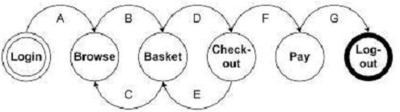
- AA. Login Browse Basket Checkout Basket Checkout Pay Logout.
- BB. Login Browse Basket Checkout Pay Logout.
- CC. Login Browse Basket Checkout Basket Logout.
- DD. Login Browse Basket Browse Basket Checkout Pay Logout.
14Q. 14: Which of the following is a MAJOR task of test implementation and execution?
- AA. Measuring and analyzing results.
- BB. Reporting discrepancies as incidents.
- CC. Identifying test conditions or test requirements.
- DD. Assessing if more tests are needed.
15Q. 15: What is beta testing?
- AA. Testing performed by potential customers at the developers location.
- BB. Testing performed by potential customers at their own locations.
- CC. Testing performed by product developers at the customer's location.
- DD. Testing performed by product developers at their own locations.
16Q. 16: Given the following fragment of code, how many tests are required for 100%
decision coverage?
if width > length
then
biggest_dimension = width
if height > width
then
biggest_dimension = height
end_if
else
biggest_dimension = length
if height > length
then
biggest_dimension = height
end_if
end_if- AA. 3
- BB. 4
- CC. 2
- DD. 1
17Q. 17: You have designed test cases to provide 100% statement and 100% decision
coverage for the following fragment of code.
if width > length
then
biggest_dimension = width
else
biggest_dimension = length
end_if
The following has been added to the bottom of the code fragment above.
print "Biggest dimension is " & biggest_dimension
print "Width: " & width
print "Length: " & length
How many more test cases are required?- AA. One more test case will be required for 100 % decision coverage.
- BB. Two more test cases will be required for 100 % statement coverage, one of which will be
used to provide 100% decision coverage. - CC. None, existing test cases can be used.
- DD. One more test case will be required for 100" statement coverage.
18Q. 18: A thermometer measures temperature in whole degrees only. If the temperature
falls below 18 degrees, the heating is switched off. It is switched on again when the
temperature reaches 21 degrees. What are the best values in degrees to cover all
equivalence partitions?- AA. 15, 19 and 25.
- BB. 17, 18 and 19.
- CC. 18, 20 and 22.
- DD. 16, 26 and 32.
19Q. 19: Which activity in the fundamental test process creates test suites for efficient
test execution?- AA. Implementation and execution.
- BB. Planning and control.
- CC. Analysis and design.
- DD. Test closure.
20Q. 20: Which of the following is TRUE?
- AA. Confirmation testing is testing fixes to a set of defects and Regression testing is testing
to establish whether any defects have been introduced as a result of changes. - BB. Confirmation testing is testing to establish whether any defects have been introduced as
a result of changes and Regression testing is testing fixes to a set of defects. - CC. Confirmation testing and Regression testing are both testing to establish whether any
defects have been introduced as a result of changes. - DD. Confirmation testing and Regression testing are both testing fixes to a set of defects.
- AA. Confirmation testing is testing fixes to a set of defects and Regression testing is testing
21Q. 21: Given the following decision table: Which of the following test cases and
expected results is VALID?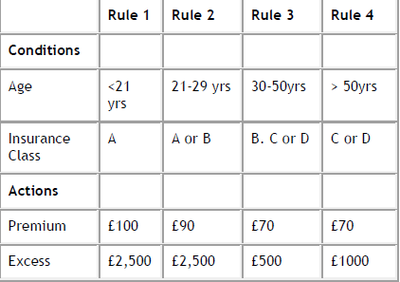
- AA. 23 year old in insurance class A Premium is 0 and excess is,500.
- BB. 51 year old in insurance class C Premium is 0 and excess is 00.
- CC. 31 year old in insurance class B Premium is 0 and excess is ,500.
- DD. 43 year old in insurance class C Premium is 0 and excess is ,000.
22Q. 22: When should configuration management procedures be implemented?
- AA. During test planning.
- BB. During test analysis.
- CC. During test execution.
- DD. When evaluating exit criteria
23Q. 23: Which of the following are characteristic of regression testing ?
i) Regression testing is run ONLY once
ii) Regression testing is used after fixes have been made
iii) Regression testing is often automated
iv) Regression tests need not be maintained- AA. ii, iv.
- BB. ii, iii.
- CC. i, iii, iv.
- DD. iii.
24Q. 24: A wholesaler sells printer cartridges. The minimum order quantity is 5. There is
a 20% discount for orders of 100 or more printer cartridges. You have been asked to
prepare test cases using various values for the number of printer cartridges ordered.
Which of the following groups contain three test inputs that would be generated using
Boundary Value Analysis?- AA. 5, 6, 20
- BB. 4, 5, 80
- CC. 4, 5, 99
- DD. 1, 20, 100
25Q. 25: Which of the following activities should be performed during the selection and
implementation of a testing tool?
i) Investigate the organisation's test process.
ii) Conduct a proof of concept.
iii) Implement the selected tool on a project behind schedule to save time.
iv) Identify coaching and mentoring requirements for the use of the selected tool.- AA. i, ii, iii.
- BB. ii, iii, iv.
- CC. i, iii, iv.
- Div.
26Q. 26: What is the MAIN benefit of designing tests early in the life cycle?
- AA. It is cheaper than designing tests during the test phases.
- BB. It helps prevent defects from being introduced into the code.
- CC. Tests designed early are more effective than tests designed later.
- DD. It saves time during the testing phases when testers are busy.
27Q. 27: Which of the following benefits are MOST likely to be achieved by using test
tools?
i) Easy to access information about tests and testing.
ii) Reduced maintenance of testware.
iii) Easy and cheap to implement.
iv) Greater consistency of tests.- AA. ii and iv
- BB. ii and iii
- CC. i and iv
- DD. i and iii
28Q. 28: What is the KEY difference between preventative and reactive approaches to
testing?- AA. Preventative tests and reactive tests are designed as early as possible.
- BB. Preventative tests are designed early; reactive tests are designed after the software has
been produced. - CC. Preventative testing is always analytical; reactive testing is always heuristic.
- DD. Preventative tests are designed after the software has been produced; reactive tests are
designed early in response to review comments.
29Q. 29: What is the purpose of exit criteria?
- AA. To define when a test level is complete.
- BB. To determine when a test has completed.
- CC. To identify when a software system should be retired.
- DD. To determine whether a test has passed.
30Q. 30: What determines the level of risk?
- AA. The cost of dealing with an adverse event if it occurs.
- BB. The probability that an adverse event will occur.
- CC. The amount of testing planned before release of a system.
- DD. The likelihood of an adverse event and the impact of the event.
31Q. 31: With which of the following categories is a test comparator tool USUALLY
associated?- AA. Tool support for performance and monitoring.
- BB. Tool support for static testing.
- CC. Tool support for test execution and logging.
- DD. Tool support for the management of testing and tests.
32Q. 32: Which activities form part of test planning?
i) Developing test cases.
ii) Defining the overall approach to testing.
iii) Assigning resources.
iv) Building the test environment
v) Writing test conditions.- AA. i, ii & iv are true, iii & v are false.
- BB. ii & iii are true, i, iv & v are false.
- CC. iv & v are true, i, ii & iii are false.
- DD. i, ii & iii are true iv & v are false.
33Q. 33: Match the following terms and statements.
1.Decision Table Testing
2.Decision Testing
3.State Transition Testing
4.Exploratory Testing
W. Testing carried out w boxes to achieve specific test objectives, possibly to complement
structured testing.
X. A test technique used which may be used to verify different system re depending on
current conditions or previous history.
Y. A test technique which combines combinations of inputs that might not otherwise have
been exercised during testing.
Z. A form of control flow testing based on decision outcomes.- AA. 1Y, 2Z, 3X, 4W.
- BB. 1X ,2W, 3Z, 4Y.
- CC. 1Z, 2X, 3W, 4Y.
- DD. 1Z, 2Y, 3X, 4W.
34Q. 34: Which type of test design techniques does the following statement best describe
a procedure to derive test cases based on the specification of a component?- AA. Black Box Techniques.
- BB. White Box Techniques.
- CC. Glass Box Techniques.
- DD. Experience Based Techniques.
35Q. 35: For which of the following would a static analysis tool be MOST useful?
- AA. Supporting reviews.
- BB. Validating models of the software.
- CC. Testing code executed in a special test harness.
- DD. Enforcement of coding standards.
36Q. 36: Which of the following types of defects is use case testing MOST LIKELY to
uncover?
i) Defects in the process flows during real-world use of the system.
ii) Defects in the interface parameters in integration testing.
iii) Integration defects caused by the interaction and interference of different components.
iv) Defects in the system as it transitions between one state and another.- AA. ii, iii.
- BB. i, iii.
- CC. iii, iv.
- DD. i, ii
37Q. 37: Which of the following is MOST important in the selection of a test approach?
- AA. Availability of tools to support the proposed techniques.
- BB. The budget allowed for training in proposed techniques.
- CC. Available skills and experience in the proposed techniques.
- DD. The willingness of the test team to learn new techniques.
38Q. 38: Which of the following is a benefit of test independence?
- AA. It does not require familiarity with the code.
- BB. It is cheaper than using developers to test their own code.
- CC. It avoids author bias in defining effective tests.
- DD. Testers are better at finding defects than developers.
39Q. 39: The above diagram represents the following paths through the code.
A. vwy
B. vwz
C. vxy
D. vxz
What is the MINIMUM combination of paths required to provide full statement coverage?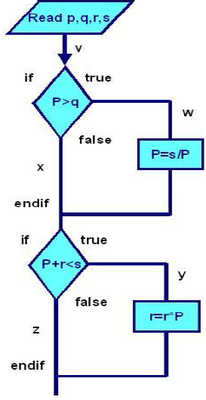
- AA. A
- BB. ABD
- CC. ABCD
- DD. ACD
40Q. 40: Which of the following is MOST characteristic of specification based (black-box)
techniques?- AA. Test cases can be easily automated.
- BB. Test cases are independent of each other.
- CC. Test cases are derived systematically from models of the system .
- DD. Test cases are derived systematically from the delivered code.
41Q. 41: Which of the following combinations correctly describes a valid approach to
component testing:
i) Functional testing of the component in isolation.
ii) Structure-based testing of the code without recording incidents.
iii) Automated tests that are run until the component passes.
iv) Functional testing of the interfaces between modules.- AA. i and ii.
- BB. I, ii and iii
- CC. iii.
- DD. ii and iv
42Q. 42: Which of the following is a purpose of the review planning phase?
- AA. Log defects.
- BB. Explain the documents to the participants.
- CC. Gather metrics.
- DD. Allocate the individual roles.
43Q. 43: A defect arrival rate curve:
- AA. Shows the number of newly discovered defects per unit time
- BB. Shows the number of open defects per unit time.
- CC. Shows the cumulative total number of defects found up to this time.
- DD. Any of these, depending on the company.
44Q. 44: Which is the best definition of complete testing:
- AA. You have discovered every bug in the program.
- BB. You have tested every statement, branch, and combination of branches in the program.
- CC. You have completed every test in the test plan.
- DD. You have reached the scheduled ship date.
45Q. 45: Complete statement and branch coverage means:
- AA. That you have tested every statement in the program.
- BB. That you have tested every statement and every branch in the program.
- CC. That you have tested every IF statement in the program.
- DD. That you have tested every combination of values of IF statements in the program
46Q. 46: There are several risks of managing your project's schedule with a statistical
reliability model. These include (choose one or more of the following):- AA. Testers spend more energy early in the product trying to find bugs than preparing to do
the rest of the project's work more efficiently - BB. Managers might not realize that the testing effort is ineffective, late in the project,
because they expect a low rate of bug finding, so the low rate achieved doesn't alarm
them. - CC. It can increase the end-of-project pressure on testers to not find bugs, or to not report
bugs. - DD. All of the above
- AA. Testers spend more energy early in the product trying to find bugs than preparing to do
47Q. 47: Typical defects that are easier to find in reviews than in dynamic testing are:
- AA. Deviations from standards,
- BB. Requirement defects,
- CC. Design defects,
- DD. Insufficient maintainability and incorrect interface specifications.
- EE. All of the above.
48Q. 48: Reviews, static analysis and dynamic testing have the same objective
- AA. Identifying defects.
- BB. Fixing defects.
- CC. A. and B
- DD. None of the above
49Q. 49: We can achieve complete statement coverage but still miss bugs because:
- AA. The failure occurs only if you reach a statement taking the TRUE branch of an IF
statement, and you got to the statement with a test that passed through the FALSE branch. - BB. The failure depends on the program's inability to handle specific data values, rather than on the program's flow of control.
- CC. We are not required to test code that customers are unlikely to execute.
- DD. All of the above
- AA. The failure occurs only if you reach a statement taking the TRUE branch of an IF
50Q. 50: Measurement dysfunction is a problem because:
- AA. Even though the numbers you look at appear better, to achieve these numbers, people
are doing other aspects of their work much less well. - BB. We don't know how to measure a variable (our measurement is dysfunctional) and so we don't know how to interpret the result.
- CC. You are measuring the wrong thing and thus reaching the wrong conclusions.
- DD. All of the above.
- AA. Even though the numbers you look at appear better, to achieve these numbers, people
51Q. 51: Important consequences of the impossibility of complete testing are (Choose one
or more answers):- AA. We can never be certain that the program is bug free.
- BB. We have no definite stopping point for testing, which makes it easier for some managers to argue for very little testing.
- CC. We have no easy answer for what testing tasks should always be required, because every task takes time that could be spent on other high importance tasks.
- DD. All of the above.
52Q. 52: Poor software characteristics are
- AA. Only Project risks
- BB. Only Product risks
- CC. Project risks and Product risks
- DD. Project risks or Product risks
53Q. 53: System testing should investigate
- AA. Non-functional requirements only not Functional requirements
- BB. Functional requirements only not non-functional requirements
- CC. Non-functional requirements and Functional requirements
- DD. Non-functional requirements or Functional requirements
54Q. 54: Contract and regulation testing is a part of
- AA. System testing
- BB. Acceptance testing
- CC. Integration testing
- DD. Smoke testing
55Q. 55: Find the correct flow of the phases of a formal review
- AA. Planning, Review meeting, Rework, Kick off
- BB. Planning, Individual preparation, Kick off, Rework
- CC. Planning, Review meeting, Rework, Follow up
- DD. Planning, Individual preparation, Follow up, Kick off
56Q. 56: Which is not the testing objectives
- AA. Finding defects
- BB. Gaining confidence about the level of quality and providing information
- CC. Preventing defects.
- DD. Debugging defects
57Q. 57: Maintenance releases and technical assistance centers are examples of which of
the following costs of quality?- AA. External failure
- BB. Internal failure
- CC. Appraisal
- DD. Prevention
58Q. 58: Which is not the project risks
- AA. Supplier issues
- BB. Organization factors
- CC. Technical issues
- DD. Error-prone software delivered
59Q. 59: Bug life cycle
- AA. Open, Assigned, Fixed, Closed
- BB. Open, Fixed, Assigned, Closed
- CC. Assigned, Open, Closed, Fixed
- DD. Assigned, Open, Fixed, Closed
60Q. 60: Who is responsible for document all the issues, problems and open point that
were identified during the review meeting- AA. Moderator
- BB. Scribe
- CC. Reviewers
- DD. Author
61Q. 61: ‘X’ has given a data on a person age, which should be between 1 to 99. Using
BVA which is the appropriate one- AA. 0,1,2,99
- BB. 1, 99, 100, 98
- CC. 0, 1, 99, 100
- DD. –1, 0, 1, 99
62Q. 62: Which is not a testing principle
- AA. Early testing
- BB. Defect clustering
- CC. Pesticide paradox
- DD. Exhaustive testing
63Q. 63: A project that is in the implementation phase is six weeks behind schedule.
The delivery date for the product is four months away. The project is not allowed to slip
the delivery date or compromise on the quality standards established for his product. Which
of the following actions would bring this project back on schedule?- AA. Eliminate some of the requirements that have not yet been implemented.
- BB. Add more engineers to the project to make up for lost work.
- CC. Ask the current developers to work overtime until the lost work is recovered.
- DD. Hire more software quality assurance personnel.
64Q. 64: The ___________ Testing will be performed by the people at client own
locations- AA. Alpha testing
- BB. Field testing
- CC. Performance testing
- DD. System testing
65Q. 65: Which of the following is the standard for the Software product quality
- AA. ISO 1926
- BB. ISO 829
- CC. ISO 1012
- DD. ISO 1028
66Q. 66: Which is not a black box testing technique
- AA. Equivalence partition
- BB. Decision tables
- CC. Transaction diagrams
- DD. Decision testing
67Q. 67: Find the mismatch
- AA. Test data preparation tools – Manipulate Data bases
- BB. Test design tools – Generate test inputs
- CC. Requirement management tools – Enables individual tests to be traceable
- DD. Configuration management tools – Check for consistence
68Q. 68: Use cases can be performed to test
- AA. Performance testing
- BB. Unit testing
- CC. Business scenarios
- DD. Static testing
69Q. 69: Purpose of test design technique is
- AA. Identifying test conditions only, not Identifying test cases
- BB. Not Identifying test conditions, Identifying test cases only
- CC. Identifying test conditions and Identifying test cases
- DD. Identifying test conditions or Identifying test cases
70Q. 70: One person has been dominating the current software process improvement
meeting. Which of the following techniques should the facilitator use to bring other
team members into the discussion?- AA. Confront the person and ask that other team members be allowed to express their
opinions. - BB. Wait for the person to pause, acknowledge the person’ s opinion, and ask for someone
else’ s opinion. - CC. Switch the topic to an issue about which the person does not have a strong opinion.
- DD. Express an opinion that differs from the person’ s opinion in order to encourage others to express their ideas.
- AA. Confront the person and ask that other team members be allowed to express their
71Q. 71: Stochastic testing using statistical information or operational profiles uses the
following method- AA. Heuristic testing approach
- BB. Methodical testing approach
- CC. Model based testing approach
- DD. Process or standard compliant testing approach
72Q. 72: A software model that can’t be used in functional testing
- AA. Process flow model
- BB. State transaction model
- CC. Menu structure model
- DD. Plain language specification model
73Q. 73: Arc testing is known as
- AA. Branch testing
- BB. Agile testing
- CC. Beta testing
- DD. Ad-hoc testing
74Q. 74: The purpose of exit criteria is
- AA. Define when to stop testing
- BB. End of test level
- CC. When a set of tests has achieved a specific pre condition
- DD. All of the above
75Q. 75: The ___________ technique can be used to achieve input and output coverage
- AA. Boundary value analysis
- BB. Equivalence partitioning
- CC. Decision table testing
- DD. State transition testing
76Q. 76: The __________ testing is performed at the developing organization’s site
- AA. Unit testing
- BB. Regression testing
- CC. Alpha testing
- DD. Integration testing
77Q. 77: What is the main purpose of Informal review
- AA. Inexpensive way to get some benefit
- BB. Find defects
- CC. Learning, gaining understanding, effect finding
- DD. Discuss, make decisions, solve technical problems
78Q. 78: Which is not a Component testing
- AA. Check the memory leaks
- BB. Check the robustness
- CC. Check the branch coverage
- DD. Check the decision tables
79Q. 79: The software engineer's role in tool selection is
- AA. To identify, evaluate, and rank tools, and recommend tools to management
- BB. To determine what kind of tool is needed, then find it and buy it
- CC. To initiate the tool search and present a case to management
- DD. To identify, evaluate and select the tools
80Q. 80: Which is not the fundamental test process
- AA. Planning and control
- BB. Test closure activities
- CC. Analysis and design
- DD. None
81Q. 81: The ________ and ________ are used within individual workbenches to produce
the right output products.- AA. Tools and techniques
- BB. Procedures and standards
- CC. Processes and walkthroughs
- DD. Reviews and update
82Q. 82: Which is not the software characteristics
- AA. Reliability
- BB. Usability
- CC. Scalability
- DD. Maintainability
83Q. 83: The principle of Cyclomatic complexity, considering L as edges or links, N as
nodes, P as independent paths- AA. L-N +2P
- BB. N-L +2P
- CC. N-L +P
- DD. N-L +P
84Q. 84: FPA is used to
- AA. To measure the functional requirements of the project
- BB. To measure the size of the functionality of an Information system
- CC. To measure the functional testing effort
- DD. To measure the functional flow
85Q. 85: A _____ is the step-by-step method followed to ensure that standards are met
- AA. SDLC
- BB. Project Plan
- CC. Policy
- DD. Procedure
86Q. 86: Which is not a test Oracle
- AA. The existing system (For a bench mark)
- BB. The code
- CC. Individual’s knowledge
- DD. User manual
87Q. 87: PDCA is known as
- AA. Plan, Do, Check, Act
- BB. Plan, Do, Correct, Act
- CC. Plan, Debug, Check, Act
- DD. Plan, Do, Check, Accept
88Q. 88: Which is the non-functional testing
- AA. Performance testing
- BB. Unit testing
- CC. Regression testing
- DD. Sanity testing
89Q. 89: A Test Plan Outline contains which of the following:
i. Test Items
ii. Test Scripts
iii. Test Deliverables
iv. Responsibilities- AA. i,ii,iii are true and iv is false
- BB. i,iii,iv are true and ii is false
- CC. ii,iii are true and i and iv are false
- DD. i,ii are false and iii , iv are true
90Q. 90: Testing where in we subject the target of the test , to varying workloads to
measure and evaluate the performance behaviors and ability of the target and of the
test to continue to function properly under these different workloads.- AA. Load Testing
- BB. Integration Testing
- CC. System Testing
- DD. Usability Testing
91Q. 91: Which of the following is the task of a Tester?
i. Interaction with the Test Tool Vendor to identify best ways to leverage test tool on the project.
ii. Prepare and acquire Test Data
iii. Implement Tests on all test levels, execute and log the tests.
iv. Create the Test Specifications- AA. i, ii, iii is true and iv is false
- BB. ii,iii,iv is true and i is false
- CC. i is true and ii,iii,iv are false
- DD. iii and iv is correct and i and ii are incorrect
92Q. 92: What can static analysis NOT find?
- AA. The use of a variable before it has been defined
- BB. Unreachable ("dead") code
- CC. Memory leaks
- DD. Array bound violations
93Q. 93: White Box Techniques are also called as:
- AA. Structural Testing
- BB. Design Based Testin
- CC. Error Guessing Technique
- DD. Experience Based Technique
94Q. 94: Reviewing the test Basis is a part of which phase
- AA. Test Analysis and Design
- BB. Test Implementation and execution
- CC. Test Closure Activities
- DD. Evaluating exit criteria and reporting
95Q. 95: Component Testing is also called as :-
i. Unit Testing
ii. Program Testing
iii. Module Testing
iv. System Component Testing .- AA. i,ii,iii are true and iv is false
- BB. i,ii,iii,iv are false
- CC. i,ii,iv are true and iii is false
- DD. all of above is true
96Q. 96: Which of the following is not a major task of Exit criteria?
- AA. Checking test logs against the exit criteria specified in test planning.
- BB. Logging the outcome of test execution.
- CC. Assessing if more tests are needed.
- DD. Writing a test summary report for stakeholders.
97Q. 97: Which of the following is true about Formal Review or Inspection:-
i. Led by Trained Moderator (not the author).
ii. No Pre Meeting Preparations
iii. Formal Follow up process.
iv. Main Objective is to find defects- AA. ii is true and i,iii,iv are false
- BB. i,iii,iv are true and ii is false
- CC. i,iii,iv are false and ii is true
- DD. iii is true and I,ii,iv are false
98Q. 98: The Phases of formal review process is mentioned below arrange them in the
correct order.
i. Planning
ii. Review Meeting
iii. Rework
iv. Individual Preparations
v. Kick Off
vi. Follow Up- AA. i,ii,iii,iv,v,vi
- BB. vi,i,ii,iii,iv,v
- CC. i,v,iv,ii,iii,vi
- DD. i,ii,iii,v,iv,vi
99Q. 99: Testing activity which is performed to expose defects in the interfaces and in the
interaction between integrated components is :- AA. System Level Testing
- BB. Integration Level Testing
- CC. Unit Level Testing
- DD. Component Testing
100Q. 100: Methodologies adopted while performing Maintenance Testing:-
- AA. Breadth Test and Depth Test
- BB. Re-testing
- CC. Confirmation Testing
- DD. Sanity Testing
101Q. 101: The Switch is switched off once the temperature falls below 18 and then it is
turned on when the temperature is more than 21. When the temperature is more than
21. Identify the Equivalance values which belong to the same class.- AA. 12,16,22
- BB. 24,27,17
- CC. 22,23,24
- DD. 14,15,19
102Q. 102: What is an equivalence partition (also known as an equivalence class)?
- AA. A set of test cases for testing classes of objects
- BB. An input or output range of values such that only one value in the range becomes a test
case - CC. An input or output range of values such that each value in the range becomes a test case
- DD. An input or output range of values such that every tenth value in the range becomes a
test case.
103Q. 103: Which of the following is not a part of the Test Implementation and Execution
Phase- AA. Creating test suites from the test cases
- BB. Executing test cases either manually or by using test execution tools
- CC. Comparing actual results
- DD. Designing the Tests
104Q. 104: Link Testing is also called as :
- AA. Component Integration testing
- BB. Component System Testing
- CC. Component Sub System Testing
- DD. Maintenance testing
105Q. 105: Who are the persons involved in a Formal Review :-
i. Manager
ii. Moderator
iii. Scribe / Recorder
iv. Assistant Manager- AA. i,ii,iii,iv are true
- BB. i,ii,iii are true and iv is false.
- CC. ii,iii,iv are true and i is false.
- DD. i,iv are true and ii, iii are false.
106Q. 106: Which of the following statements regarding static testing is false:
- AA. Static testing requires the running of tests through the code
- BB. Static testing includes desk checking
- CC. Static testing includes techniques such as reviews and inspections
- DD. Static testing can give measurements such as cyclomatic complexity
107Q. 107: Designing the test environment set-up and identifying any required
infrastructure and tools are a part of which phase- AA. Test Implementation and execution
- BB. Test Analysis and Design
- CC. Evaluating the Exit Criteria and reporting
- DD. Test Closure Activities
108Q. 108: A Type of functional Testing, which investigates the functions relating to
detection of threats, such as virus from malicious outsiders.- AA. Security Testing
- BB. Recovery Testing
- CC. Performance Testing
- DD. Functionality Testing
109Q. 109: A Person who documents all the issues, problems and open points that were
identified during a formal review.- AA. Moderator.
- BB. Scribe
- CC. Author
- DD. Manager
110Q. 110: The Test Cases Derived from use cases
- AA. Are most useful in uncovering defects in the process flows during real world use of the
system - BB. Are most useful in uncovering defects in the process flows during the testing use of the
system - CC. Are most useful in covering the defects in the process flows during real world use of the
system - DD. Are most useful in covering the defects at the Integration Level
- AA. Are most useful in uncovering defects in the process flows during real world use of the
111Q. 111: One of the fields on a form contains a text box which accepts alpha numeric
values. Identify the Valid Equivalence class- AA. BOOK
- BB. Book
- CC. Boo01k
- DD. book
112Q. 112: In a Examination a candidate has to score minimum of 24 marks inorder to clear
the exam. The maximum that he can score is 40 marks. Identify the Valid Equivalance
values if the student clears the exam.- AA. 22,23,26
- BB. 21,39,40
- CC. 29,30,31
- DD. 0,15,22
113Q. 113: Verification involves which of the following :-
i. Helps to check the Quality of the built product
ii. Helps to check that we have built the right product.
iii. Helps in developing the product
iv. Monitoring tool wastage and obsoleteness.- AA. Options i,ii,iii,iv are true.
- BB. i is true and ii,iii,iv are false
- CC. i,ii,iii are true and iv is false
- DD. ii is true and i,iii,iv are false.
114Q. 114: A Project risk includes which of the following :
- AA. Organizational Factors
- BB. Poor Software characteristics
- CC. Error Prone software delivered.
- DD. Software that does not perform its intended functions
115Q. 115: Which of the following is a Key Characteristics of Walk Through
- AA. Scenario , Dry Run , Peer Group
- BB. Pre Meeting Preparations
- CC. Formal Follow Up Process
- DD. Includes Metrics
116Q. 116: Which of the following techniques is NOT a White box technique?
- AA. Statement Testing and coverage
- BB. Decision Testing and coverage
- CC. Condition Coverage
- DD. Boundary value analysis
117Q. 117: Reporting Discrepancies as incidents is a part of which phase :-
- AA. Test Analysis and Design
- BB. Test Implementation and execution
- CC. Test Closure Activities
- DD. Evaluating exit criteria and reporting
118Q. 118: In a risk-based approach the risks identified may be used to :
i. Determine the test technique to be employed
ii. Determine the extent of testing to be carried out
iii. Prioritize testing in an attempt to find critical defects as early as possible.
iv. Determine the cost of the project- AA. ii is True; i, iii, iv & v are False
- BB. i,ii,iii are true and iv is false
- CC. ii & iii are True; i, iv are False
- DD. ii, iii & iv are True; i is false
119Q. 119: Incidents would not be raised against:
- AA. Requirements
- BB. Documentation
- CC. Test cases
- DD. Improvements suggested by users
120Q. 120: The Planning phase of a formal review includes the following :
- AA. Explaining the objectives
- BB. Selecting the personnel, allocating roles.
- CC. Follow up
- DD. Individual Meeting preparations
121Q. 121: Test Implementation and execution has which of the following major tasks?
i. Developing and prioritizing test cases, creating test data, writing test procedures and
optionally preparing the test harnesses and writing automated test scripts.
ii. Creating the test suite from the test cases for efficient test execution.
iii. Verifying that the test environment has been set up correctly.
iv. Determining the exit criteria.- AA. i,ii,iii are true and iv is false
- BB. i,,iv are true and ii is false
- CC. i,ii are true and iii,iv are false
- DD. ii,iii,iv are true and i is false
122Q. 122: One of the fields on a form contains a text box which accepts numeric values in
the range of 18 to 25. Identify the invalid Equivalance class- AA. 17
- BB. 19
- CC. 24
- DD. 21
123Q. 123: Exhaustive Testing is
- AA. Is impractical but possible
- BB. Is practically possible
- CC. Is impractical and impossible
- DD. Is always possible
124Q. 124: Hand over of Testware is a part of which Phase
- AA. Test Analysis and Design
- BB. Test Planning and control
- CC. Test Closure Activities
- DD. Evaluating exit criteria and reporting
125Q. 125: Which one is not comes under international standard
- AA. IEC
- BB. IEEE
- CC. ISO
- DD. All of the above
- AA. IEC
126Q. 126: In which phase static tests are used
- AA. Requirements
- BB. Design
- CC. Coding
- DD. All of the above
127Q. 127: What's the disadvantage of Black Box Testing
- AA. Chances of having repetition of tests that are already done by programmer.
- BB. The test inputs needs to be from large sample space.
- CC. It is difficult to identify all possible inputs in limited testing time. So writing test cases is
slow and difficult - DD. All above
128Q. 128: Static analysis tools are typically used by
- AA. Testers
- BB. Developers
- CC. Testers & Developers
- DD. None
129Q. 129: Majority of system errors occur in the _________ phase
- AA. Requirements Phase.
- BB. Analysis and Design Phase
- CC. Development Phase
- DD. Testing Phase
130Q. 130: The specification which describes steps required to operate the system and
exercise test cases in order to implement the associated test design- AA. Test Case Specification
- BB. Test Design Specification
- CC. Test Procedure Specification
- DD. None
131Q. 131: How much percentage of the life cycle costs of a software are spent on
maintenance.- AA. 10%
- BB. 30%
- CC. 50%
- DD. 70%
132Q. 132: When a defect is detected and fixed then the software should be retested to
confirm that the original defect has been successfully removed. This is called- AA. Regression testing
- BB. Maintenance testing
- CC. Confirmation testing
- DD. None of the above
133Q. 133: Equivalence testing divides the input domain into classes of data from which
test cases can be derived to reduce the total number of test cases that must be
developed.- AA. True
- BB. False
134Q. 134: When to stop Testing?
- AA. Stop when scheduled time for testing expires
- BB. Stop if 75% of the pre-defined number of errors is detected.
- CC. Stop when all the test cases execute with detecting few errors.
- DD. None above
135Q. 135: With thorough testing it is possible to remove all defects from a program prior
to delivery to the customer.- AA. True
- BB. False
136Q. 136: Structure is unknown for which type of development project
- AA. Traditional system development
- BB. Iterative development
- CC. System maintenance
- DD. Purchased/contracted software
137Q. 137: ________indicates how important it is to fix the bug and when it should be
fixed- AA. Severity
- BB. Priority
- CC. All of the above
- DD. None of the above
138Q. 138: The person who leads the review of the document(s), planning the
review,running the meeting and follow-up after the meeting- AA. Reviewer
- BB. Author
- CC. Moderator
- DD. Auditor
139Q. 139: Performs sufficient testing to evaluate every possible path and condition in the
application system. The only test method that guarantees the proper functioning of the
application system is called as _____________- AA. Regression Testing
- BB. Exhaustive Testing
- CC. Basic Path Testing
- DD. Branch Testing
140Q. 140: Quality Assurance is the process by which product quality is compared with the
application standards and the action taken when nonconformance is detected.- AA. True
- BB. False
141Q. 141: A formal assessment of a work product conducted by one or more qualified
independent reviewer to detect defects.- AA. Inspection.
- BB. Walkthrough.
- CC. Review
- DD. Non Conformance
142Q. 142: Test Case are grouped into Manageable (and scheduled) units are called as
- AA. Test Harness
- BB. Test Suite
- CC. Test Cycle
- DD. Test Driver
143Q. 143: Configuration and compatibility testing are typically good choices for
outsourcing- AA. True
- BB. False
144Q. 144: What type of tools to be used for Regression Testing
- AA. Performance
- BB. Record/Playback
- CC. A. & B.
- DD. None
145Q. 145: System Integration testing should be done after
- AA. Integration testing
- BB. System testing
- CC. Unit testing
- DD. Component integration testing
146Q. 146: During this event the entire system is tested to verify that all functional
information structural and quality requirements have been met. A predetermined
combination of tests is designed that when executed successfully satisfy management
that the system meets specifications- AA. Validation Testing
- BB. Integration Testing
- CC. User Acceptance Testing
- DD. System Testing
147Q. 147: What is the normal order of activities in which software testing is organized?
- AA. Unit, integration, system, validation
- BB. System, integration, unit, validation
- CC. Unit, integration, validation, system
- DD. None of the above
148Q. 148: The goal of a software tester is to find bugs, find them as early as possible and
make sure they get fixed.- AA. True
- BB. False
149Q. 149: Beta testing is performed at developing organization's site where as Alpha
testing is performed by people at their own locations.- AA. True
- BB. False
150Q. 150: The principal attributes of tools and automation are
- AA. Speed & efficiency
- BB. Accuracy & precision
- CC. All of the above
- DD. None of the above
151Q. 151: In ______ testing doesn't know anything about the sofware being tested; it just
clicks or types randomly.- AA. Random testing
- BB. Gorilla testing
- CC. Adhoc testing
- DD. Dumb monkey testing
152Q. 152: A series of probing questions about the completeness and attributes of an
application system is called- AA. Checklist
- BB. Checkpoint review
- CC. Decision table
- DD. Decision tree
153Q. 153: The testing technique that requires devising test cases to demonstrate that
each program function is operational is called- AA. Black-box testing
- BB. Glass-box testing
- CC. Grey-box testing
- DD. White-box testing
154Q. 154: A white box testing technique that measures the number of or percentage of
decision directions executed by the test case designed is called- AA. Condition coverage
- BB. Decision/Condition coverage
- CC. Decision Coverage
- DD. Branch coverage
155Q. 155: Which summarizes the testing activities associated with one or more test design
specifications.- AA. Test Summary report
- BB. Test Log
- CC. Test Incident Report
- DD. Test Script
156Q. 156: Testing with out a real plan and test cases is called ---
- AA. Gorilla testing
- BB. Monkey testing
- CC. Adhoc testing
- DD. All of the above
157Q. 157: Which rule should not be followed for reviews
- AA. Defects and issues are identified and corrected
- BB. The product is reviewed not the producer
- CC. All members of the reviewing team are responsible for the result of the review
- DD. Each review has a clear predefined objective
158Q. 158: Verification can be termed as 'Are we building the product right?"
- AA. True
- BB. False
159Q. 159: Which testing is used to verify that the system can perform properly when
internal program or system limitations have been exceeded- AA. Stress Testing
- BB. Load Testing
- CC. Performance Testing
- DD. Volume testing
160Q. 160: Defects are recorded into three major purposes. They are:
1.To correct the defect
2.To report status of the application
3.To improve the software development process- AA. True
- BB. False
161Q. 161: Drivers are tools used to control and operate tge software being testeD.
- AA. True
- BB. False
162Q. 162: Typical defects discovered by static analysis includes
- AA. Programming standard violations
- BB. Referring a variable with an undefined value
- CC. Security vulnerabilities
- DD. All Above
163Q. 163: EULA stands for
- AA. End Usability License Agreement
- BB. End User License Agreement
- CC. End User License Arrangement
- DD. End User License Attachment
164Q. 164: ________is a very early build intended for limited distribution to a few key
customers and to marketing for demonstration purposes.- AA. Alpha release
- BB. Beta release
- CC. Test release document
- DD. Build
165Q. 165: CAST stands for
- AA. Computer Aided Software Testing
- BB. Computer Aided Software Tools
- CC. Computer Analysis Software Techniques
- DD. None
166Q. 166: The tool modifies the program code or manipulates tge operating environment
in any way is considered non-invasive- AA. True
- BB. False
167Q. 167: Which test may not mimic real world situations
- AA. Functional testing
- BB. Structural Testing
- CC. All of the above
- DD. None of the above
168Q. 168: _______ includes both Black box and White Box Testing features
- AA. Gray Box Testing
- BB. Hybrid Testing
- CC. A. & B.
- DD. None
169Q. 169: Exhaustive testing is possible
- AA. True
- BB. False
170Q. 170: Tool which stores requirement statements, check for consistency and allow
requirements to be prioritized and enable individual tests to be traceable to
requirements, functions and features.- AA. Incident management tools
- BB. Requirements management tools
- CC. Configuration management tools
- DD. None
171Q. 171: The number of tests to test all control statements equals the cyclomatic
complexity- AA. True
- BB. False
172Q. 172: Boundary value analysis can only be used during white-box testing.
- AA. True
- BB. False
173Q. 173: Which of these are objectives for software testing?
- AA. Determine the productivity of programmers
- BB. Eliminate the need for future program maintenance
- CC. Eliminate every error prior to release
- DD. Uncover software errors
174Q. 174: Failure is _________
- AA. Incorrect program behaviour due to a fault in the program
- BB. Bug found before product Release
- CC. Bug found after product Release
- DD. Bug found during Design phase
175Q. 175: During the software development process, at what point can the test process
start?- AA. When the code is complete.
- BB. When the design is complete.
- CC. When the software requirements have been approved.
- DD. When the first code module is ready for unit testing
176Q. 176: "How much testing is enough?"
- AA. This question is impossible to answer
- BB. This question is easy to answer
- CC. The answer depends on the risk for your industry, contract and special requirements
- DD. This answer depends on the maturity of your developers
177Q. 177: Which of the following tools would be involved in the automation of regression
test?- AA. Data tester
- BB. Boundary tester
- CC. Capture/Playback
- DD. Output comparator.
178Q. 178: Incorrect form of Logic coverage is:
- AA. Statement Coverage
- BB. Pole Coverage
- CC. Condition Coverage
- DD. Path Coverage
179Q. 179: Code Coverage is used as a measure of what?
- AA. Defects
- BB. Trends analysis
- CC. Test Effectiveness
- DD. Time Spent Testing
180Q. 180: Fault Masking is
- AA. Error condition hiding another error condition
- BB. Creating a test case which does not reveal a fault
- CC. Masking a fault by developer
- DD. Masking a fault by a tester
181Q. 181: Which of the following is not a quality characteristic listed in ISO 9126
Standard?- AA. Functionality
- BB. Usability
- CC. Supportability
- DD. Maintainability
182Q. 182: One Key reason why developers have difficulty testing their own work is :
- AA. Lack of technical documentation
- BB. Lack of test tools on the market for developers
- CC. Lack of training
- DD. Lack of Objectivity
183Q. 183: Statement Coverage will not check for the following.
- AA. Missing Statements
- BB. Unused Branches
- CC. Dead Code
- DD. Unused Statement
184Q. 184: Given the Following program
IF X <>= Z
THEN Statement 2;
END
McCabe’s Cyclomatic Complexity is :- AA. 2
- BB. 3
- CC. 4
- DD. 5
185Q. 185: To test a function, the programmer has to write a _________, which calls the
function to be tested and passes it test data.- AA. Stub
- BB. Driver
- CC. Proxy
- DD. None of the above
186Q. 186: Pick the best definition of quality
- AA. Quality is job one
- BB. Zero defects
- CC. Conformance to requirements
- DD. Work as designed
187Q. 187: Boundary value testing
- AA. Is the same as equivalence partitioning tests
- BB. Test boundary conditions on, below and above the edges of input and output equivalence
classes - CC. Tests combinations of input circumstances
- DD. Is used in white box testing strategy
188Q. 188: An input field takes the year of birth between 1900 and 2004
The boundary values for testing this field are- AA. 0,1900,2004,2005
- BB. 1900, 2004
- CC. 1899,1900,2004,2005
- DD. 1899, 1900, 1901,2003,2004,2005
189Q. 189: How many test cases are necessary to cover all the possible sequences of
statements (paths) for the following program fragment? Assume that the two conditions
are independent of each other:
if (Condition 1)
then statement 1
else statement 2
fi
if (Condition 2)
then statement 3
fi- AA. 2 Test Cases
- BB. 3 Test Cases
- CC. 4 Test Cases
- DD. Not achievable
190Q. 190: A common test technique during component test is
- AA. Statement and branch testing
- BB. Usability testing
- CC. Security testing
- DD. Performance testing
191Q. 191: In a review meeting a moderator is a person who
- AA. Takes minutes of the meeting
- BB. Mediates between people
- CC. Takes telephone calls
- DD. Writes the documents to be reviewed
192Q. 192: Acceptance test cases are based on what?
- AA. Requirements
- BB. Design
- CC. Code
- DD. Decision table
193Q. 193: Which one of the following are non-functional testing methods?
- AA. System testing
- BB. Usability testing
- CC. Performance testing
- DD. Both B & C
194Q. 194: Independent Verification & Validation is
- AA. Done by the Developer
- BB. Done by the Test Engineers
- CC. Done By Management
- DD. Done by an Entity Outside the Project’s sphere of influence
195Q. 195: Defect Management process does not include
- AA. Defect prevention
- BB. Deliverable base-lining
- CC. Management reporting
- DD. None of the above
196Q. 196: Which of the following could be a reason for a failure
1) Testing fault
2) Software fault
3) Design fault
4) Environment Fault
5) Documentation Fault- AA. 2 is a valid reason; 1,3,4 & 5 are not
- BB. 1,2,3,4 are valid reasons; 5 is not
- CC. 1,2,3 are valid reasons; 4 & 5 are not
- DD. All of them are valid reasons for failure
197Q. 197: Test are prioritized so that:
- AA. You shorten the time required for testing
- BB. You do the best testing in the time available
- CC. You do more effective testing
- DD. You find more faults
198Q. 198: When a new testing tool purchased, it should be used first by:
- AA. A small team to establish the best way to use the tool
- BB. Everyone who may eventually have some use for the tool
- CC. The independent testing team
- DD. The vendor contractor to write the initial scripts
199Q. 199: During which test activity could faults be found most cost effectively?
- AA. Execution
- BB. Design
- CC. Planning
- DD. Check Exit criteria completion
200Q. 200: What is the difference between testing software developed by contractor
outside your country, versus testing software developed by a contractor within your
country?- AA. Does not meet people needs
- BB. Cultural difference
- CC. Loss of control over reallocation of resources
- DD. Relinquishments of control
Informationen
- Beschreibung
- 500 Questions, simulation exam
- Autor
- milopz
- Sprache
- Español
- Aufrufe
- 3.098
- Schlagwörter
- Bewertung
- Noch keine Bewertungen Bewerte dieses Quiz