
Quiz
Topic 3 Thermal Physics: Quiz 1 Thermal Concepts
Dieses Quiz hat ein Zeitlimit und öffnet sich deshalb im gewohnten Player.
Fragen in diesem Quiz (11)
1Why is there a constriction in a clinical thermometer?
- AA to give the thermometer a smaller temperature range
- BB to make the thermometer more sensitive
- CC to prevent the mercury breaking the bulb when it expands
- DD to stop the mercury from going back to the bulb
2In a liquid-in-glass thermometer, the liquid column is 2.0 cm long at 0°C and it expands 10.0 cm when heated to 100 °C.
Measuring from P, how long is the liquid column at 30 °C?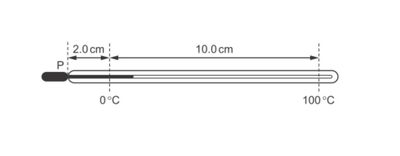
- A2.3 cm
- B3.0 cm
- C5.0 cm
- D7.0 cm
3Which substance in the table is liquid at 20 °C?
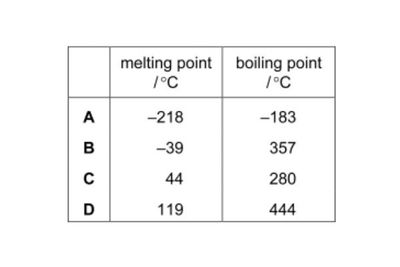
- AA
- BB
- CC
- DD
4Which statement about boiling and evaporation is correct?
- AA Boiling can only occur at the surface of a liquid.
- BB Evaporation can only occur at a fixed temperature.
- CC Only boiling involves a change of phase.
- DD When some of a liquid evaporates, the rest of the liquid becomes cooler.
5There is one temperature, about 0.01 °C, at which water, water vapour and ice can co-exist in equilibrium.
Which statement about the properties of the molecules at this temperature is correct?- AA Ice molecules are closer to one another than water molecules.
- BB The mean kinetic energy of water molecules is greater than the mean kinetic energy of ice
molecules. - CC Water vapour molecules are less massive than water molecules.
- DD Water vapour molecules have the same mean speed as both ice and water molecules.
6A crystalline solid is heated at a constant rate and the change of temperature with time is shown in the graph.
Which statement about the particles in the material is correct?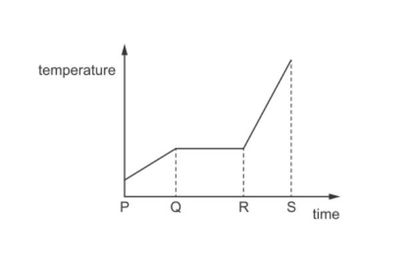
- AA In the time from P to Q, the particles are arranged randomly.
- BB In the time from Q to R, some particles are arranged regularly and some particles are arranged randomly.
- CC In the time from R to S, the particles are widely spaced.
- DD The arrangement of the particles is the same in the time from P to S.
7 Below are four short paragraphs describing the molecules in a beaker of water at 50 oC.
Which paragraph correctly describes the molecules?- AA The molecules all travel at the same speed. This speed is not large enough for any of the
molecules to leave the surface of the water. There are attractive forces between the molecules. - BB The molecules have a range of speeds. Some molecules travel sufficiently fast to leave the
surface of the water. There are no forces between the molecules. - CC The molecules have a range of speeds. The fastest molecules are unable to leave the surface of the water. There are attractive forces between the molecules.
- DD The molecules have a range of speeds. Some molecules travel sufficiently fast to leave the surface of the water. There are attractive forces between the molecules.
- AA The molecules all travel at the same speed. This speed is not large enough for any of the
8The diagram shows the atoms of a substance with the atoms at the corners of a cube. The average separation of the atoms at a particular temperature is 15 nm.
When the temperature changes so that the average separation becomes 17 nm, by which factor will the density of the substance change?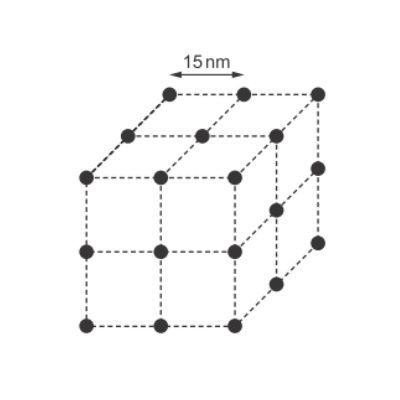
- AA 0.61
- BB 0.69
- CC 0.78
- DD 0.88
9A swimmer climbs out of a swimming pool on a warm, dry day. Almost immediately he begins to
feel cold. Why is this?- AA The water allows a convection current to remove heat from his skin.
- BB The water takes latent heat from his body in order to evaporate.
- CC The water on his skin is a good conductor of heat.
- DD The water prevents infra-red radiation from reaching his body.
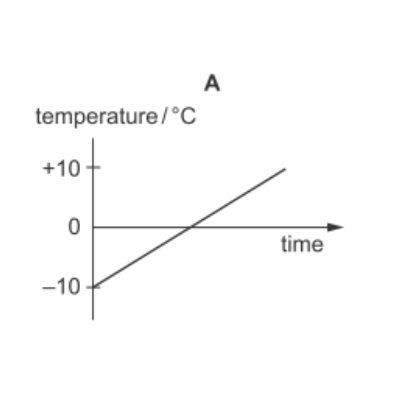
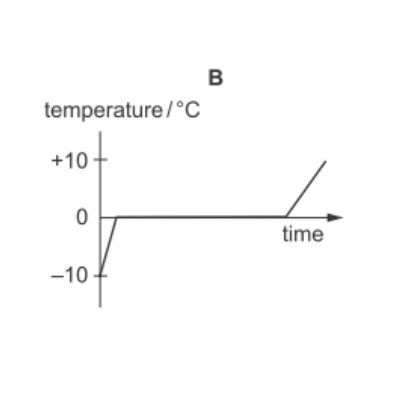
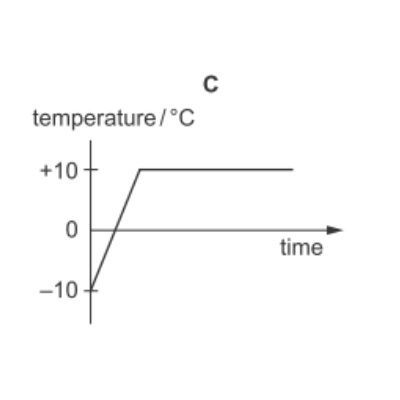
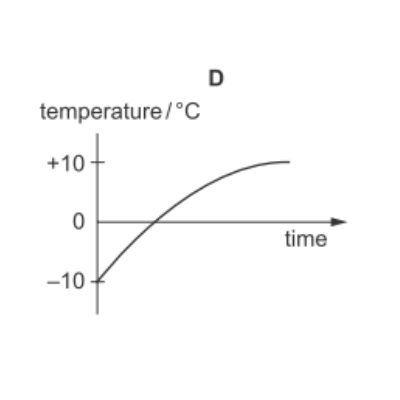
10Ice at –10 °C is heated at a constant rate until it is water at +10 °C.
Which graph shows how the temperature changes with time?- AA
- BB
- CC
- DD
- AA
11An ice cube is floating in water.
Both the ice cube and the water are at 0 °C.
Which statement correctly compares the molecular properties of the ice and those of the water?- AA The mean inter-molecular potential energies are the same for both the ice molecules and the water molecules.
- BB The mean inter-molecular separations are the same for both the ice and the water.
- CC The mean kinetic energies are the same for both the ice molecules and the water molecules.
- DD The mean total energies are the same for both the ice molecules and the water molecules.
Informationen
- Beschreibung
- Short quiz for section 3.1 of Topic 3
- Autor
- Jeffrey Piggott
- Sprache
- English
- Aufrufe
- 357
- Verlauf
- Erstellt am 19 Okt 2015 · aktualisiert am 30 Dez 2016
- Schlagwörter
- Bewertung
- 5,0 von 5 · 1 Bewertung Bewerte dieses Quiz