
Quiz
Lenses
Dieses Quiz enthält Fragetypen, die sich im gewohnten Player öffnen.
Fragen in diesem Quiz (18)
1Converging Lenses:
- Converging lenses bulge [blank_start]outwards[blank_end].
- Rays parallel to the principle axis of the lens converge onto a point called the [blank_start]principal[blank_end] [blank_start]focus[blank_end].
- [blank_start]Parallel[blank_end] rays that aren't parallel to the principle axis converge somewhere else on the [blank_start]focal[blank_end] p[blank_start]lane[blank_end].
- The [blank_start]focal[blank_end] [blank_start]length[blank_end], f, is the distance between the lens [blank_start]axis[blank_end] and the focal [blank_start]plane[blank_end].
- f is p[blank_start]ositive[blank_end] for a converging lens because it is [blank_start]in[blank_end] [blank_start]front[blank_end] of the lens.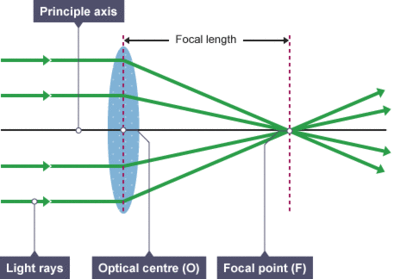
- Aoutwards
- Bprincipal
- Cfocus
- DParallel
- Efocal
- Ffocal
- Glength
- Haxis
- Iplane
- Jositive
- Kin
- Lfront
- Mlane
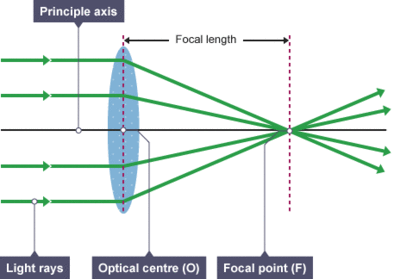
2Lenses change the direction of light rays by [blank_start]refraction[blank_end].
- Arefraction
3Diverging Lenses:
- Diverging lenses cave [blank_start]inwards[blank_end].
- The principal focus of a diverging lens is at a point [blank_start]behind[blank_end] the lens.
- The principal focus is the point that rays from a [blank_start]distant[blank_end] object, assumed to be [blank_start]parallel[blank_end] to the principal axis, appear to have [blank_start]come[blank_end] from.
- The dotted lines in the diagram show [blank_start]virtual[blank_end] rays. The light doesn't actually follow this path, but [blank_start]appears[blank_end] to have done so.
- The focal length, f, is the distance between the [blank_start]lens[blank_end] axis and the [blank_start]principal[blank_end] focus.
- f is n[blank_start]egative[blank_end] for a diverging lens because it is [blank_start]behind[blank_end] the lens.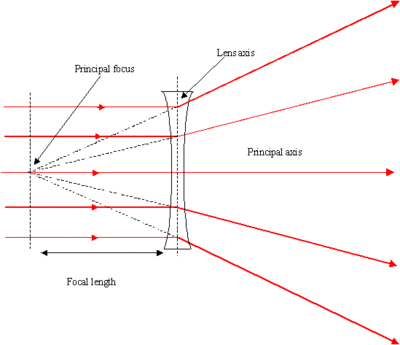
- Ainwards
- Bbehind
- Cdistant
- Dparallel
- Ecome
- Fvirtual
- Gappears
- Hlens
- Iprincipal
- Jegative
- Kbehind
4Real and Virtual Images:
- A [blank_start]real image[blank_end] is formed when light rays from a point on an object are made to pass through [blank_start]another[blank_end] point in space. The light rays are [blank_start]actually[blank_end] there, and the image [blank_start]can[blank_end] be captured on a [blank_start]screen[blank_end].
- A virtual image is formed when light rays from a point on an object [blank_start]appear[blank_end] to have come from another point in space. The light rays [blank_start]aren't really[blank_end] where the image appears to be, so the image [blank_start]can't[blank_end] be captured on a screen.
- Converging lenses can form [blank_start]both real and virtual[blank_end] images, depending on [blank_start]where[blank_end] the object is. If the object is further than the focal length away from the lens, the image is [blank_start]real[blank_end]. If the object's closer, the image is [blank_start]virtual[blank_end].
- A diverging lens will always form a [blank_start]virtual image[blank_end] - the position of the object in relation to the focal length will [blank_start]not[blank_end] affect the [blank_start]type[blank_end] of image formed.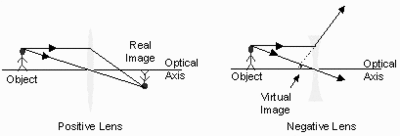
- Atype
- Banother
- Cactually
- Dcan
- Escreen
- Fcan't
- Gboth real and virtual
- Hwhere
- Ireal
- Jvirtual
- Kreal image
- Lvirtual image
- Mnot
- Nappear
- Oaren't really
5Ray Diagrams - Converging Lenses:
Ray diagrams show where an [blank_start]image[blank_end] will be formed. If an object sits on the principal axis, [blank_start]so will[blank_end] the image.
- Draw 3 rays from the [blank_start]same point[blank_end] on the object (usually the [blank_start]top[blank_end]): one [blank_start]parallel[blank_end] to the [blank_start]principal axis[blank_end] which passes through the [blank_start]principal focus[blank_end]; one passing through the [blank_start]optical centre[blank_end] so it doesn't get [blank_start]refracted[blank_end]; and one parallel to the principal axis which goes through the principal focus on the [blank_start]other side[blank_end] of the lens (this is a [blank_start]check ray[blank_end]).
- The image will form where the 3 rays [blank_start]meet[blank_end] if the image is [blank_start]real[blank_end].
- If the rays don't meet, the image is [blank_start]virtual[blank_end]. Extend the rays back (draw virtual rays with [blank_start]dotted[blank_end] lines) to locate where the rays [blank_start]appear[blank_end] to have come from and hence locate the virtual image.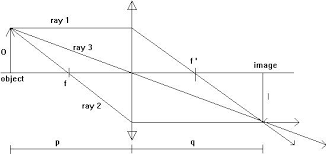
- Aimage
- Bsame point
- Ctop
- Dso will
- Eparallel
- Fprincipal axis
- Gprincipal focus
- Hoptical centre
- Irefracted
- Jother side
- Kcheck ray
- Lmeet
- Mreal
- Nvirtual
- Odotted
- Pappear
6Ray Diagrams - Converging Lens:
Converging lenses are represented by two arrows pointing outwards.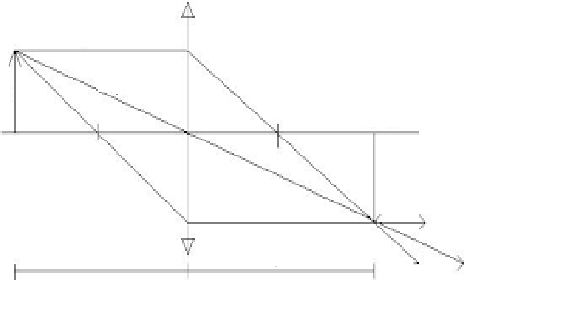
- AConverging lens
- BObject
- CImage
- Du
- Ev
- FPrincipal focus
- Gf
- HOptical centre
- ILight rays
7Ray Diagrams - Diverging Lenses:
- Draw 3 rays from the [blank_start]same point[blank_end] on the object (usually the [blank_start]top[blank_end]): one [blank_start]parallel[blank_end] to the [blank_start]principal axis[blank_end] which refracts at the [blank_start]centre[blank_end] of the lens so that it appears to come from the [blank_start]principal focus[blank_end]; one through the [blank_start]optical centre[blank_end] without getting [blank_start]refracted[blank_end]; and one parallel to the principal axis on the [blank_start]other side[blank_end] which passes through the [blank_start]other[blank_end] principal focus.
- Use [blank_start]dotted[blank_end] lines/virtual rays for refracted rays you have [blank_start]extended[blank_end].
- The image will form where the real and virtual rays [blank_start]meet[blank_end] (this will be on the [blank_start]same side[blank_end] of the lens as the object).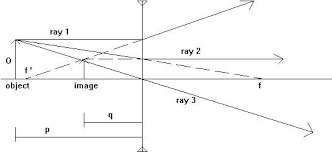
- Asame point
- Btop
- Cparallel
- Dprincipal axis
- Ecentre
- Fprincipal focus
- Goptical centre
- Hrefracted
- Iother side
- Jother
- Kdotted
- Lextended
- Mmeet
- Nsame side
8Diverging Lens Ray Diagram:
Diverging lenses are represented by arrows pointing inwards.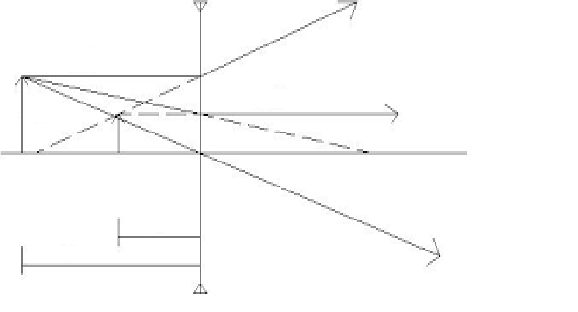
- ADiverging lens
- BObject
- CImage
- Dv
- Eu
- FPrincipal focus
- GLight rays
- Hf
9Ray Diagrams:
f = [blank_start]focal[blank_end] length = distance between lens [blank_start]axis[blank_end] and principal [blank_start]focus[blank_end]. Positive for [blank_start]converging[blank_end] lenses and negative for [blank_start]diverging[blank_end] lenses.
u = distance between [blank_start]object[blank_end] and lens axis.
v = distance between [blank_start]image[blank_end] and lens axis. Positive for [blank_start]real[blank_end] images and negative for [blank_start]virtual[blank_end] images.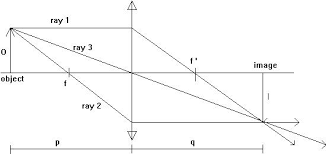
- Afocal
- Bobject
- Cimage
- Dreal
- Evirtual
- Fconverging
- Gdiverging
- Haxis
- Ifocus
10The Lens Equation:
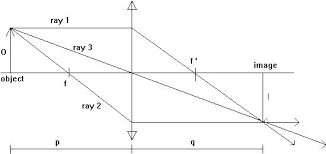
- A1/f = 1/u + 1/v
- B1/f = 1/u - 1/v
- COnly works for thin lenses
- DOnly works for thick lenses
- EPlotting 1/v against 1/u will produce a straight line graph. If you apply the lens equation to y = mx + c you will find that the intercepts on the graph are represented by 1/f.
- FPlotting 1/v against 1/u will produce a straight line graph. If you apply the lens equation to y = mx + c you will find that the gradient of the line is represented by 1/f.
11Converging Lens:
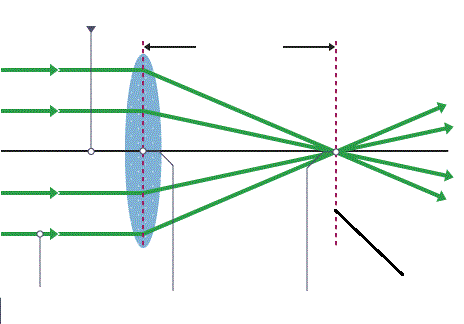
- ALight rays
- BOptical centre
- CFocal point
- DPrincipal axis
- EFocal length
- FFocal plane
- GLens axis
12Magnification:
A lens can produce a [blank_start]magnified[blank_end] image.
- Magnification is a r[blank_start]atio[blank_end] so has no [blank_start]units[blank_end].
- m = [blank_start]image[blank_end] [blank_start]height[blank_end] / [blank_start]object[blank_end] [blank_start]height[blank_end]
- m = [blank_start]v[blank_end] / [blank_start]u[blank_end]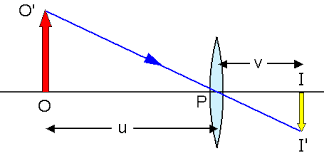
- Amagnified
- Batio
- Cunits
- Dv
- Eu
- Fimage
- Gobject
- Hheight
- Iheight
13Power:
- You can calculate the power of a lens, which tells you the lens' ability to b[blank_start]end[blank_end] light. The higher the power, the [blank_start]more[blank_end] the lens will refract light.
- P = [blank_start]1[blank_end] / [blank_start]f[blank_end]
- Power is measured in [blank_start]dioptres[blank_end] (D). SI unit is [blank_start]m[blank_end]^-1 because f is measured in m.
- Power is increased by using a lens material with a [blank_start]higher[blank_end] refractive index and by using a lens with increased c[blank_start]urvature[blank_end].
- If you have two or more [blank_start]thin[blank_end] lenses in a line with their principal [blank_start]axes[blank_end] lined up, if they are touching or very close together the [blank_start]total[blank_end] power of the lenses is found by [blank_start]adding[blank_end] all the powers together.
- P = P1 + P2 + P3 + ...
- The more powerful the lens, the shorter the [blank_start]focal[blank_end] [blank_start]length[blank_end].
- Powerful lenses are often bi-[blank_start]convex[blank_end].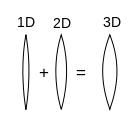
- Aadding
- Bend
- Cmore
- D1
- Ef
- Fdioptres
- Ghigher
- Hurvature
- Ithin
- Jaxes
- Ktotal
- Lfocal
- Mlength
- Nconvex
- Om
14When describing an image you need to say whether it's:
- R[blank_start]eal[blank_end] or [blank_start]virtual[blank_end]
- U[blank_start]pright[blank_end] or [blank_start]inverted[blank_end]
- M[blank_start]agnified[blank_end] or [blank_start]diminished[blank_end]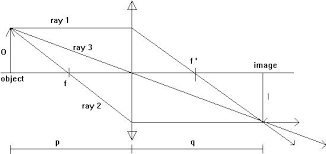
- Aeal
- Bpright
- Cagnified
- Dvirtual
- Einverted
- Fdiminished
15How do we see a virtual image produced by a converging lens (i.e. when the object is less than one focal length away from the lens axis)?
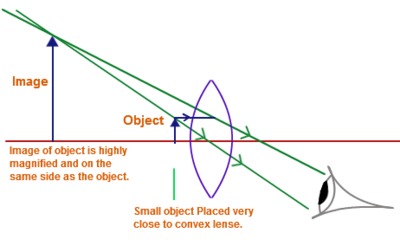
- ABy looking through the lens we can see the virtual image.
- BBy projecting the image onto a screen we can see the virtual image.
16Chromatic aberration / Chromatic dispersion:
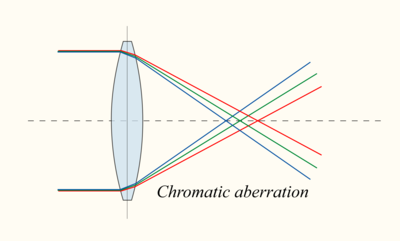
- ADifferent colours are focussed at different focal points in the focal plane.
- BDifferent colours are focussed at the same focal point in the focal plane.
- CIt causes blurriness and extra colours to be seen around the edges.
- DIt makes the image more clear and well-defined.
17Instead of P total = P1 + P2 + ...
you can use 1/f total = 1/f1 + 1/f2 + ...
because P = 1 / f
This means you can find the total focal length.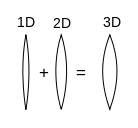
- ARichtig
- BFalsch
18Eyes:
- Short-sighted people use [blank_start]diverging[blank_end] lenses because their eyes focus the light [blank_start]in front of[blank_end] the retina so the light needs to be [blank_start]spread out[blank_end] more so it focusses [blank_start]further back[blank_end]. This can be due to a problem with their eye lens or that their eyeball is too [blank_start]long[blank_end].
- Short-sighted people struggle to see [blank_start]far away[blank_end] things. They can only see things [blank_start]close up[blank_end].
-Long-sighted people use [blank_start]converging[blank_end] lenses because their eyes focus the light [blank_start]behind[blank_end] the retina so the light needs to be focussed [blank_start]sooner[blank_end]. This can be due to a problem with their eye lens or that their eyeball is too [blank_start]short[blank_end].
- Long-sighted people struggle to focus on things [blank_start]close up[blank_end] but can see things [blank_start]in the distance[blank_end].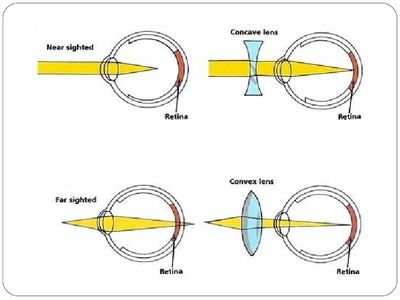
- Adiverging
- Bconverging
- Cconverging
- Ddiverging
- Efar away
- Fclose up
- Gclose up
- Hfar away
- Iclose up
- Jin the distance
- Kin the distance
- Lclose up
- Mshort
- Nlong
- Olong
- Pshort
- Qin front of
- Rbehind
- Sbehind
- Tin front of
- Usooner
- Vfurther back
- Wspread out
- Xconverged
- Yfurther back
- Zsooner
Informationen
- Beschreibung
- AS - Level Sally's Physics (Waves and Particle Nature of Light) Quiz am Lenses, erstellt von Sally Lancaster am 20/04/2016.
- Autor
- Sally Lancaster
- Sprache
- English
- Aufrufe
- 7
- Schlagwörter
- Bewertung
- Noch keine Bewertungen Bewerte dieses Quiz