
Quiz
General Systems (GS)
Erstelle ein kostenloses Konto, um dieses Quiz zu beenden
Speichere deinen Fortschritt und sieh dir dein Endergebnis an.
oder mit deiner E-Mail registrieren
Schon ein Konto? Anmelden
Fragen in diesem Quiz (64)
1Select the correct response(s):
- AWater hammer is negligible in hydraulic system pipe installation.
- BWater hammer is an important parameters which used to dimensionate pipes.
- CHydraulic Pumps generally used in aircraft hydraulic systems are gear type and capable to provide roughly same pressure at any flow demand (if below specified max flow demand).
- DHydraulic Pumps generally used in aircraft hydraulic systems are piston type and capable to provide roughly same pressure at any flow demand (if below specified max flow demand).
- EAcceleration of fluid is not negligible for the calculation of the necessary pressure of hydraulic pressurized reservoirs.
2If the aircraft hydraulic system supply the services that control the direction of the aircraft on the ground (e.g. nosewheel steering and differential braking):
- A, the emergency braking system must have differential control.
- B, consideration shall be given to supplying the nosewheel steering and normal brakes from different hydraulic systems.
3Common use Aerospace Hydraulic Pumps:
- Awhen engine driven, are installed in engine gearbox. Its suction line and fire shut-off valve in suction line are fire proof tested
- Bwhen engine driven, are installed in engine gearbox. Its suction line is fire resistant (5 min) and fire shut-off valve in suction line is fire proof tested (15 min).
4Common use Hydraulic Reservoirs :
- ADo not need pressurization. Vented type reservoir is sufficient whenever located above the pump.
- BUtilizes the system pressure, acting on a differential piston, to achieve the required tank pressure.
- CThe pressure required in the reservoir to supply fluid to the pump should be calculated using the guidelines in AIR1922.
- DThis pressure must be sufficient to avoid pump cavitation at Pcrit.
- EEach reservoir should be equipped with pressure regulating valves and a filter.
- FNo Hydraulic Reservoirs shall be located in a designated fire zone.
5CFG main advantages compared with VFG are:
- ABetter reliability.
- BSimpler
- CCheaper.
- DLess volume and weight for for the same power delivered.
- ESeveral suppliers able to design and produce them.
- FFixed output frequency, with fixed efficiency and capability.
- GNo overvoltage event potentially leading to common failures.
6The emergency system shall power the services necessary to complete a flight and make a safe landing. The services to be powered must include:
- AThose required for descent, approach and Landing.
- BThose required for immediate safety
- CThose required for continued controlled flight
7New high voltage levels (270 Vdc and 230 Vac) are applicable to civil and military electrical systems since they permit to:
- AIncrease hydraulic Systems.
- BIncrease Electric Systems.
- CIncrease Pneumatic Systems.
- DIncrease Mechanical Systems.
- EReduce electrical power demand.
- FDecrease the losses in the feeders and distribution wiring.
8Electrical power quality is determined by:
- AThe electrical consumers.
- BThe interactions of all the electrical generation and supplied equipments.
9Li-Ion battery technology main advantages compared with Ni-Cd one are:
- ALess susceptible to abuse conditions.
- BLess weight for the same power delivered.
- CMaintenance free and higher service life. This, plus the improved reliability, leads to an important Direct Maintenance Cost (DMC) reduction.
- DBetter control of the SOC. No memory effect.
- ENo mounting restrictions
10LED technology main advantages compared with HID one are:
- AHigher reliability.
- BHigher maximum operating temperature.
- CPower consumption.
- DCost.
11What of the following exterior lights have their illumination performances covered by the EASA Part 25 requirements?
- ANavigation lights.
- BLanding lights.
- CTurn-Off/Taxi lights.
- DLogo lights.
- EAnticolision lights (Beacon & Strobe).
- FWing/Engine Scan Lights.
12The biggest problem in humans associated to exposure at high altitudes is:
- AReduction in temperature.
- BReduction of O2 partial pressure.
- CLack of oxygen (hypoxia)
13Aerodynamic heating is given, basically, by the total temperature of the air computed as follows Ttot = Tambient (1+ 0.2 Mach2). Given an ISA atmosphere, the heating is maximum in one of the following conditions:
- A40 kft, Mach=0.8.
- BSL, Mach=0.4.
14Minimum standard ventilation to maintain CO2 levels in enclosed spaces is (at SL, 15ºC) according to ASHRAE:
- A1.5 kg/min of air.
- B1 kg/min of air.
- C0.5 kg/min of air.
15Being one of the most efficient cooling systems, why liquid cooling is not so used:
- ACost.
- BTemperature range.
- CWeight.
- DEfficiency.
- EComplexity
16Redundancy in cabin pressurization outflow valves is requested:
- ASometimes.
- BNever.
- CAlways.
17In a wing profile section, ice accretion impingement limits will be most extended in the following case:
- AThick profile, low speed, small droplets.
- BThin profile, low speed, big droplets.
- CThin profile, high speed, big droplets.
18A deicing system is basically sized to limit quantity of ice accreted. What is the worst flying condition in terms of design:
- ALow speed, high Outside Ambient Temperature.
- BLow speed, low Outside Ambient Temperature
- CHigh speed, high Outside Ambient Temperature
- DHigh speed, low Outside Ambient Temperature
19Which are the aircraft key operational cases that are normally considered for the sizing of the APU on large civil aircrafts for passenger transport?
- AMain Engine Start In Flight at 30 kFt.
- BOn Ground Electrical power demands only.
- COn Ground Electrical & Pneumatic power demands from the A/C systems
20The APU model PW980 in the AIRBUS A380 is steadily supplying bleed air for the aircraft pneumatic systems (MES or ECS) on ground. In a matter of a couple of seconds, such demand is significantly reduced. What would be the expected immediate reaction from the APU control system?
- AThe ECB commands the Bleed Valve to close and the APU electrical generator to absorb more shaft power in order to avoid a Load Compressor over speed.
- BTo command the opening of the Anti-surge Valve and the closure of the Inlet Guide Vanes, to alleviate the bleed pressure raise & reduce the bleed airflow supply.
- CThe command to the aircraft’s fuel system to shut off completely the fuel supply to the APU and stop it to prevent the burst of the aircraft’s bleed piping.
21The APU model PW980 in the AIRBUS A380 is steadily supplying bleed air for the aircraft pneumatic systems (ECS) on ground. In a matter of a couple of seconds , such demand signal from the ECS is significantly reduced . Which of these cannot be a normal reaction of the APU Ctrl system under such situation:
- ATo keep fully open the Bleed Shut-off Valve while correspondingly closing the Load Compressor IGVs.
- BTo automatically shut down the APU in case an oil system overtemperature is sensed by the APU ECB.
- CTo correspondingly close the Load Compressor IGVs to reduce the bleed flow, while keeping constant the fuel flow to maintain a constant L/C speed.
- DTo keep the Surge Valve fully closed while progressively reducing the fuel flow to avoid an APU rotors overspeed condition potentially leading to a rotor burst.
22For the start of the APU engine on large civil aircrafts for passenger transport, the most commonly used system consists on:
- AAn electrical 12VDC Starter/Generator.
- BAn electrical 28VDC Starter/Generator.
- CAn electrical 28VDC Starter Motor.
- DAn air turbine starter.
23Which of the following is not a true statement related to APU in-flight start reliability :
- AThe A350 flight test campaign (Honeywell HGT1700) is already showing in 2013, APU in- flight restart reliabilities of around 98%.
- BThe A330 fleet (Honeywell 331-350 APU) has already shown APU in-flight restart reliabilities of 97%or higher.
- CThe APU shall be operative without permanent presence of operator.
- DThe APU in its installed configuration shall have an adequate in- flight start reliability (not less than 95%) throughout the flight envelope taking account of all approved fuel types and temperatures
- EThe APU in its installed configuration shall have an adequate in- flight start reliability (not less than 83%) throughout the flight envelope taking account of all approved fuel types and temperatures
- FThe APU shall be capable to pressurize the aircraft and maintain an adequate cockpit and cabin environment in one-engine inoperative cruise conditions, taking into account one engine operative requirements, up to 30,000 ft.
- GThe A350 shall be capable to start any engines - regardless of engine starting sequence or engine type (RR or GE) - on ground using battery power supply.
24Which of the following statements is/are not correct? :
- ASame as in a propulsive power plant, the APU shall be installed in a Fire Compartment.
- BThe APU engine shall be mounted on the A/C structure with a Suspension System designed to withstand the corresponding inertial loads.
- CThe APU Air Intake usually has an electrically actuated flap door that is kept closed while the APU is not operating.
- DThe Exhaust Muffler outlet at the very rear end point of the fuselage is the most favorable location for its pressure effect for in-flight APU starts
- EThe Cooling Inlet function is to convey the necessary atmospheric air flow into the APU for both the : Power Unit and Load Compressor
25The installation of the APU in the fuselage tailcone section on large civil aircrafts for passenger transport, presents as a significant drawback:
- AThe impacts on the aircraft in case of rotor burst.
- BThe noise projection on the ground.
- CThe in-flight aerodynamic conditions.
- DThe accessibility for ground maintenance operations
26The installation of the APU in the fuselage section 19.1 on AIRBUS’s large civil aircrafts for passenger transport, presents a main advantage (when compared to an APU installed in the wing root or main landing gear zones), that is:
- AThe length of fuel supply line, bleed air pipe & electrical cables lengths.
- BMaintenance tasks and APU replacement are easier.
- CThe noise projection on the ground.
27Which one is not a key feature for the fire protection design strategy in an typical APS installation? :
- AAn adequate APU compartment drainage system.
- BA manual (non-automatic) APU fire detection & extinguishing system for APU ground use.
- CThe use of fireproof titanium firewalls of 0.4 mm thickness.
- DThe installation of the APU in a fire compartment with a fire detection & extinguishing system.
28Which are the key features for the fire protection design strategy in an typical APS installation?
- AThe fire detection & fire extinguishing systems only.
- BThe installation of the APU in the fuselage tailcone area, and the limitation of the APU use mostly for ground.
- CThe fireproof design of the APU compartment & components, the ventilation, the drainage, and the fire detection & fire extinguishing systems.
29The primary step for the Certification of the APU system in the aircraft is:
- ATo achieve the certification of the aircraft electrical & pneumatic systems to be supplied by the APU.
- BTo achieve the APU Qualification obtained by the manufacturer for the engine by TSO C77B.
- CThe Compatibility & the Flight Test campaigns.
30Which is the primary test platform for certification of the integrated A/C & APU system? :
- AThe APU engine test cells
- BThe Flight Tests aircrafts
- CThe Compatibility Tests rig.
- DThe Icing Tests rig
31The normal duration of the development cycle for a new APU system in a large transport aircraft is:
- AThe duration of the typical A/C’s: Electrical duty cycle + ECS duty cycle – the MES time
- BMinimum 10 years
- C6 to 7 years
32Which are the aircraft key operational cases that are normally considered for the sizing of the APU on large civil aircrafts for passenger transport? :
- AOn Ground Electrical & Pneumatic power demands from the A/C systems
- BIn-Flight Electrical power demands
- CMain engine start in flight at 22Kft
33The APU is steadily operating on Max ECS supply condition on ground. Due to an incorrect tightening of the clamp that couples the APU Bleed Valve and the ATA36 pneumatic duct, an air leak takes place in fuselage section 19.1. Which of these statements is correct at that instant? :
- AThe Surge Control Valve ( SCV ) will be commanded to ‘close’ since the L/C operating condition reaches the cracking line.
- BThe L/C IGVs control logic will command the closing of the SCV to further increase the flow towards the ECS.
- CThe APU lubrication system heat exchanger will remain air cooled by airflow pumped by the APU exhaust eductor or a gearbox driven fan.
- DThe APU Inlet door position regulated by the ECB will be further opened to increase the airflow through the APU Load Compressor.
- EThe surge control logic will command the closing of the SCV to further increase the flow towards the ECS.
34Which of the following functions correspond to the FCS?
- AStability augmentation
- BThrust setting
- CPositions aerodynamic control surfaces according to pilot, autopilot or stability augmentation inputs
- DProvides the pilot with the required force feedback
- EFlight Envelope Protection
- FLoad alleviation (manoeuvre and gust).
- GFlutter suppression.
- HThrust vectoring.
- IAbnormal position recovery, including post stall
35Two of the following statements are correct. Which ones are they?
- AArtificial feel systems are required to provide good handling qualities in irreversible FCS systems
- BIn an “irreversible” FCS, pilot cannot reconfigure the system after a failure.
- CIn an irreversible FCS aerodynamic loads are not fed back to the pilot inceptor
36Identify two drawbacks of the Fly By Wire systems in the list below.
- AThey require the use of hydraulic systems to provide power to the actuators.
- BThey require a high degree of redundancy.
- CHigh development cost and high system clearance effort.
- DSW development complexity and inherent computing delays.
- ESafety critical SW certified against Common Mode Failures (testing +
specification). - FEMI susceptibility
- GEvolving regulation.
37Which of the following statements are true for all types of Fly By Wire FCS:
- AA mechanical back-up system is required to control the aircraft after a total FBW system failure.
- BConfiguration changes are easy to implement in comparison with mechanically signaled FCS.
- CMay be Active control technology (ACT) or Control configured vehicle (CCV)
- DDirect mechanical link are replaced by an electrical signalling system
- EPilot control aircraft dynamics parameters instead of aircraft surface position
- FImprove aircraft natural dynamic behaviour
- GCockpit layout design flexibility
- HReduced maintenance and operational cost
- IReduced weight, increased reliability
38Which of the following statements do not apply to the concept of Control Configured Vehicles:
- ARequires a careful balance between stick force and control authority at low and high speed.
- BProvides automatic prevention of stall departure and spinning.
- CConcurrent and complementary design of the basic airframe together with FCS to achieve performance improvements.
- DAllows improved aircraft performance and manoeuvrability.
- EAutomatic structural protection and gust alleviation enhancing safety and reduce pilot’s workload.
- FRequire full authority FCS with aircraft response feedback.
- GUse of the FCS to actively compensate for deficiencies in the aerodynamics of the basic airframe.
39What is the main disadvantage of the Electro Mechanical Actuator for its application in Primary FCS?
- AIf there is a mechanical jamming, control surface remains in the last commanded position.
- BThe mechanical signaling circuit is prone to jamming.
40Identify two inputs to the FCS design from the following list:
- AInterface Documents.
- BCompliance Check List.
- CMaintenance concept
- DTechnical Direction (Compatibility with A/C Concept and other systems and Target Cost)
- EPreliminary Design (Control Surface Definition, Space Envelope, Target Weight)
- FFlight Physics (Functional def., Suf. deflexion, Actuation rate, Trim charact./artificial feel, Failures criticality)
- GLoads (Hinge moment and Surface deflexion limits)
- HRegulation (Certification basis and Safety criteria)
- IReliability (Failure rate target)
- JMaintenance (Maintenance Concept and Failure detection level)
41Identify why kerosene type fuels (Jet A-1/JP-8) are safer than wide-cut fuel types (JetA/JP-4) (choose one):
- AKerosene Type Fuels have higher freezing temperature.
- BDensity of Kerosene Type Fuels is higher.
- CKerosene Type Fuels is less flammable than Wide-Cut Fuel Types
- DKerosene Type Fuels have lower volatility / Vapor Pressure than Wide- Cut Fuel Types.
42Identify what is the purpose of the fuel vent subsystem (choose two):
- AAllow fuel thermal expansion inside the tanks without external leakage.
- BMaintain the fuel tank temperature.
- CAvoid fuel tank overpressure or under-pressure during climbs and dives.
43For certification of the fuel system is essential to demonstrate that (choose one):
- AThe fuel reserves are higher than 5% of the fuel tank contents.
- BThe aircraft can be refueled in flight.
- CThe fuel supply of the engines is maintained across all the flight envelope
44What are the advantages of the Boom/Receptacle Air Refuelling Systems compared with probe and drogue Air Refueling System systems (choose two):
- AIt allows simultaneous air refuelling of two receiver aircraft.
- BReduces the receiver pilot work load when in contact.
- CNone, they are fully compatible between them.
- DAllows reverse refuelling .
- EPossibility to refuel aircrafts with probe.
- FHigher flow rates and then less time to complete refueling.
- GA tanker with flying boom can be adapted with a probe-adapter
45What are the advantages of the Probe and Drogue Air Refuelling Systems compared with Boom/Receptacle Air Refueling System systems (choose three):
- AIt would allow simultaneous air refuelling of two receiver aircraft.
- BNormally minimizes the modification of the aircraft and fuel system due to the Air Refueling Installation
- CNone, they are fully compatible between them.
- DSimpler and cheaper design.
- EAllows A/Cs not originally designed as tanker to be converted.
- FAllows higher fuel transfer flow rates minimizing the time in contact.
- GNo BOOM operator is needed.
- HCan be used to refuel helicopters.
46In terms of safety, which is the main concern in air refuelling operations?
- ATransferring fuel is always the big safety concern.
- BLack of fuel transfer in flight will not allow the receiver to make a safe landing.
- CAAR operations requires two aircraft flying in close formation.
In addition to the danger of flying in close formation, there are risks associated with the dispense devices. - DCoupling detached & Uncontrolled hose movement.
- ERequires two aircraft flying in close formation
- FSeveral aircraft are flying in close proximity, increasing the pilot workload and hence the risk of collision.
- GIn addition to the danger of flying in close formation, there are risks associated with the dispense devices.
47The purpose of fire detection systems is:
- ATo eliminate the possibility of a fire in the aircraft
- BTo sense and indicate the presence of overheat, smoke or fire
- CTo signal presence and locate fire in the aircraft
- DTo extinguish the fire in the aircraft.
48Why current fire extinguishing substances (Halon based) have to be replaced in the future? (choose one)
- AThey are considered risk substances for human health.
- BDensity of halon is too high compared with new substances considered equivalent for fire extinguishing.
- CWhen used, or escape to the atmosphere, they are substances that contribute to destroy the ozone layer of the upper atmosphere.
- DThe Montreal Protocol of 1987 identified Halon 1301 and Halon 1211 as two of a number of halogenated agents requiring limitations of use and production.
49What is the purpose of the self sealing fuel tanks? (choose one)
- AThe avoid fuel tank explosion sealing the tank after projectile impact.
- BThey reduce the risk of fire in hot areas around the fuel tanks by minimizing fuel leakage in case of a thread impact
- CTo conserve inerting performances by keeping the tank sealed.
50What are the two main factors to be considered in the selection of foams?
- AColour.
- BResistance to fuel exposure.
- CConductivity
51What are the differences today between OBIGGS for civil airliners and OBIGGS for military airplane (choose two)
- ACivil ones are more demanding than military one.
- BThere is not any difference.
- CMilitary: The objective is to reduce vulnerability and enhance the ability to survive enemy fire into a possibly explosive fuel tank.
- DCivil: Active protection on center wing or body style tanks reasons of being unused by operators and are prone to be heated due to the usual closeness of heat sources like the air conditioning packs.
- EThe purpose of civil ones is to minimize the risk of tank explosion in case of fuel system failures and military ones is to minimize the risk of tank explosion in case of external military threats.
- FFor military application Limiting Oxygen Concentration LOC =9% and civil LOC=12%.
52Ground testing allows:
- ATest individual elements .
- BTest all aspects of the complete a/c and of the man/machine interface.
- CModeling, simulation, individual elements or the complete a/c are tested as far as possible to find design deviations as soon as possible.
53Identify what tests are performed during pre-flight test phase:
- AStructural loads tests .
- BFunctional tests
- CTaxi tests.
- DWind Tunnel tests
- ESimulation tests.
- FGround vibration tests.
- GGain margin tests.
- HWeight & Balance.
- IPropulsion tests.
54The Nose Wheel arrangement of an airplane is shown in attached figure:
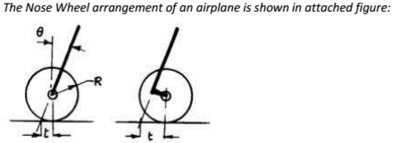
- AStatically neutral, Dynamically neutral suitable only for steered mounting and shimmy damper required.
- BStatically neutral, Dynamically stable, Stable in reverse when wheel casters right around, Normally Shimmy damper required unless twin wheels coupled in rotation used.
- CStatically unstable. Dynamically Stable. Unstable in reverse. Must be locked or steered.
55Brake by wire system control typically has critical partitions as:
- ABrake by wire systems do not use brake order computer control. The command is mechanically transmitted by to the Brake Valve. Only Antiskid computer is used to carry on antiskid function.
- BBeside non-commanded brake order generated from computer caused by SW error or HW failure at take-off, brake availability at landing could also be critical. A back up brake control (emergency system) torque limited (without antiskid protection) is normally needed.
56For aircraft designs required to operate in unpaved airfields:
- ARadial tyres are normally used because they are lighter than Bias Tyres.
- BBias tyres are normally used because sidewall thickness and better retreadability. Sidewall thickness contributes to minimize punches when operating underinflated when sidewall is more exposed to ground contamination
57Which are the key features of the Solid State Power Controller?
- AElectronic component based on power semiconductors
- BMechanical trip device activated by the heating
- CProtects installations from short circuits and overloads.
- DRemote control/monitor capability
- EHigh Mean Time Between Failure-MTBF.
- FIs a wiring protection device as circuit breaker (CB), Arc Fault Circuit Breakers (AFCB), Remote Controlled Circuit Breakers (RCCB).
58The purpose of electrical distribution systems is:
- AEnsure a maximum availability of the bus-bars.
- BMechanical disconnection (mechanically disconnect it from the engine).
- CParticipate in the connection/disconnection of the power sources.
- DEnsure the electrical network reconfigurations.
- EEnsure the protection against short circuit, over voltage, …
- FEnsure the electrical protections in order to avoid power source paralleling (AC) and propagation of defaults.
59Identify two drawbacks of the conventional protection devices (fuse and Circuit breakers):
- AThey require a high volume.
- BThey are general use devices.
- CInfluenced by ambient temperature.
- DNo monitor capability.
- EComplex to monitor.
- FSlow response.
- GNo reset capability.
- HNo arc-fault detection capability.
60What type of main generator disconnection could perform crew with cockpit push-buttons?
- AElectrical disconnection (line contactor opening).
- BMechanical disconnection ( generator mechanically disconnected from the engine).
61Regulated converters advantages compared with unregulated converters are:
- AHigher efficiency
- BOutput voltage regulation (thinner range).
- CNo power source rating imposed limit.
- DLower ripple.
62Why large aircrafts generally use Hydraulic Powered Actuation Systems?
- AHigh hydro-mechanical stiffness and associated high frequency response is relevant for flight control actuation. Additional typical factors are good response time, efficiency, reliability and robustness of hydro-mechanical systems when compared with another systems.
- BHigh hydro-mechanical stiffness and associated high frequency response is relevant for flight control actuation. Additional typical factors are response time and efficiency but not reliability and robustness, when compared with another Systems
- CHigh Power Transmission vs. System Weight.
- DHigh Efficiency.
- ERobustness & Reliable.
- FShared Power Generation System.
63Generally, with regards to the number of hydraulic systems used in a civil typecertified large aircraft under Part 25 – EASA Airworthiness Regulations:
- AThe use of EHAs or EMAs for PFC may allow using only two hydraulic systems. This is dependent on having sufficient redundancy within the electrical power generation system.
- BIf there are a large number of services that are powered hydraulically, four independent hydraulic systems may be a design solution in order to reduce the size of pumps.
- CThere is no any aircraft using two hydraulic systems. If any primary flight control is required to be hydraulically powered, definitively three hydraulic systems are required.
- DLarge aircrafts with two engines and three hydraulic systems normally requires a PTU (Power Transfer Unit) to transfer hydraulic power between the hydraulic systems in determined failure cases or for ground taxing with one engine shut down.
64Indicate which of the following statement(s) regarding the FCS is (are) correct:
- AIn a “direct link” FCS, there is a linear relation between control surface displacement and stick forces.
- BIn a “fly by wire” FCS, pilot controls parameters rather than surface position.
- CArtificial feel systems are required to provide good handling qualities in irreversible FCS systems
- DIn an “irreversible” FCS, pilot cannot reconfigure the system after a failure.
Informationen
- Beschreibung
- Masters MASI Quiz am General Systems (GS), erstellt von Miguel Angel Veg1927 am 10/06/2016.
- Autor
- Miguel Angel Veg1927
- Sprache
- English
- Aufrufe
- 178
- Schlagwörter
- Bewertung
- 4,6 von 5 · 8 Bewertungen Bewerte dieses Quiz