
Quiz
C++ 2
Erstelle ein kostenloses Konto, um dieses Quiz zu beenden
Speichere deinen Fortschritt und sieh dir dein Endergebnis an.
oder mit deiner E-Mail registrieren
Schon ein Konto? Anmelden
Fragen in diesem Quiz (30)
1This directive is used to create an "include guard," which allows a program to be conditionally compiled. This prevents a header file from accidentally being included more than once
- A#include
- B#guard
- C#ifndef
- D#endif
- ENone of these
2The constructor function's return type is ________.
- Aint
- Bfloat
- Cchar
- Dstructure pointer
- ENone of these
3A C++ class is similar to one of these.
- Ainline function
- Bheader file
- Clibrary function
- Dstructure
- ENone of these
4What is the output of the following program?
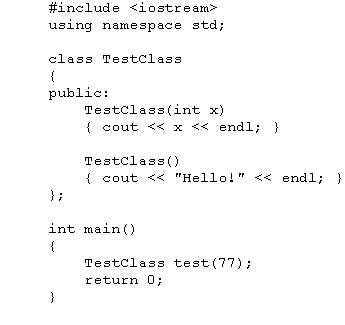
- AThe program runs, but with no output.
- B77
- CHello!
- DThe program will not compile.
5When using smart pointers to dynamically allocate objects in C++ 11, it is unnecessary to delete the dynamically allocated objects because the smart pointer will automatically delete them.
- ARichtig
- BFalsch
6Class objects can be defined prior to the class declaration.
- ARichtig
- BFalsch
7When an object is defined without an argument list for its constructor, the compiler automatically calls the object's default constructor.
- ARichtig
- BFalsch
8The constructor function may not accept arguments.
- ARichtig
- BFalsch
9Members of a class object are accessed with the ________.
- Adot operator
- Bcin object
- Cextraction operator
- Dstream insertion operator
- ENone of these
10The process of object-oriented analysis can be viewed as the following steps:
- AIdentify objects, then define objects' attributes, behaviors, and relationships
- BDefine data members and member functions, then assign a class name
- CDeclare private and public variables, prototype functions, then write code
- DWrite the main() function, then determine which classes are needed
- ENone of these
11You may overload any C++ operator, and you may use the operator function to define non-standard operators, such as @ and ^.
- ARichtig
- BFalsch
12To overload the + operator, you would write a function named ________.
- Aoverload +
- Boperator +
- Cfunction +
- Doperator.overload(+)
- ENone of these
13If a member variable is declared ________, all objects of that class have access to that variable.
- Astatic
- Bdynamic
- Cinline
- Ddefault
- ENone of these
14A static member function does not need to be called by a specific object of the class.
- ARichtig
- BFalsch
15This operator may be used to assign one object to another.
- A=
- B==
- C<>
- D@
- ENone of these
16A member function that is declared ________ may not access any non-static data members in the class.
- Aprivate
- Bpublic
- Cstatic
- Dinline
- ENone of these
17A static member variable can be used when there are no objects of the class in existence.
- ARichtig
- BFalsch
18Each object of a class has its own copy of the class's ________.
- Amember functions
- Bmember variables
- Cconstructor and destructor functions
- DAll of these
- ENone of these
19The this pointer is a special built-in pointer that is automatically passed as a hidden argument to all non-static member functions.
- ARichtig
- BFalsch
20When you redefine the way a standard operator works when it is used with class objects, you have ________ the operator.
- Areassigned
- Breformatted
- Coverloaded
- Doverwhelmed
- ENone of these
21Protected members of a base class are like ________, but they may be accessed by derived classes.
- Aconstructor functions
- Bstatic members
- Cprivate members
- Dpublic members
- ENone of these
22The term ________ means the ability to take many forms.
- Ainheritance
- Bpolymorphism
- Cmember function
- Dencapsulation
- ENone of these
23A member function of a derived class may not have the same name as a member function of a base class.
- ARichtig
- BFalsch
24In C++ 11, if a derived class attempts to override a final member function, the compiler generates an error.
- ARichtig
- BFalsch
25________ members of a base class are never accessible to a derived class.
- APublic
- BPrivate
- CProtected
- DPublic, Private, and Protected
- ENone of these
26A derived class may become a base class, if another class is derived from it.
- ARichtig
- BFalsch
27________ to a base class may be assigned the address of a derived class object.
- AAccess specifiers
- BStatic members
- CPrivate members
- DPointers
- ENone of these
28A virtual function is a member function that expects to be ________ in a derived class.
- Aignored
- Bcalled frequently
- Coverridden
- Dprivate
- ENone of these
29The ________ constructor is called before the ________ constructor.
- Abase, derived
- Bderived, base
- Cpublic, private
- Dprivate, public
- ENone of these
30A virtual function is declared by placing the key word ________ in front of the return type in the base class's function declaration.
- Avirtual
- Bprivate
- Cpublic
- Dprotected
- ENone of these
Informationen
- Beschreibung
- C++ 2 Quiz am C++ 2, erstellt von Ummm No am 23/09/2016.
- Autor
- Ummm No
- Sprache
- English
- Aufrufe
- 7
- Schlagwörter
- Bewertung
- Noch keine Bewertungen Bewerte dieses Quiz