
Quiz
EDS 2
Dieses Quiz enthält Fragetypen, die sich im gewohnten Player öffnen.
Fragen in diesem Quiz (27)
1For simple linear regression:
[blank_start]Standardised coefficient[blank_end]; Used to find out which variables are more important. Allows comparisons.
[blank_start]Unstandardised coefficient[blank_end]: tell you how the "y" unit changes for every unit change in "x"
[blank_start]Beta coefficient:[blank_end] given for the independent variable. Shows effect size.- AStandardised coefficient
- BUnstandardised coefficient
- CBeta coefficient:
- DZ coefficient
- EResidual coefficient
2y = a + bx
a is the [blank_start]y-intercept[blank_end]
b is the [blank_start]gradient[blank_end]
x is the [blank_start]independent variable[blank_end]
y is the [blank_start]dependent variable[blank_end]- Ay-intercept
- Bx-intercept
- Cgradient
- Dindependent variable
- Edependent variable
- Fstandardised coefficient
- Gunstandardised coefficient
3R squared of 0.068 means the model explains what percentage of the data?
- A6.8%
- B68%
- C680%
- D0.68%
- E0.068%
4Cook’s distance provides a measure of the overall influence of a data point on the overall model. What value is a cause for concern?
- A>1
- B>0.5
- C<1
- D<5
- E>5
- F<0.5
5Greater than what leverage value may be a cause for concern?
- A0.1
- B0.2
- C0.3
- D0.4
- E0.5
6Multiple linear regression:
Y is the [blank_start]dependent[blank_end]/[blank_start]predicted[blank_end] variable
X is the [blank_start]independent[blank_end]/[blank_start]predictor[blank_end] variable- Adependent
- Bpredicted
- Cpredictor
- Dindependent
7In multiple regression, increasing the number of predictors:
- Aeach takes up a degree of freedom
- Bimproves fit
- CIncreases R squared
- Dmeans you can have more predicted variables
- Emakes other slope coefficients more unstable
- Fensures there is a linear relationship
8Assumptions for multiple linear regression
- ADependent variable must be continuous and quantitative
- BIndependent variable must be categorical and quanititative
- CDependent variable must be qaulitiative and quanititative
- DDependent variable must be categorical and quanititative
- EIndependent variable must be continuous and qualitative
9Why is colinearity a problem?
- ALimits the ability to get a significant R squared value
- BContribuition of predictors is unclear
- CCoefficients are unstable
- DContribution of predicted variables are unclear
- EThe model becomes incorrect
10An unpaired t-test is the same as:
- ASimple regression
- BMultiple regression
- COne-way idependent ANOVA
- DTwo-way repeated measures ANOVA
- ENon-linear regression
11Multiple regression for categorical variables is the same as:
- Aone-way ANOVA
- BTwo-way ANOVA
- CMixed model ANOVA
- Dpaired t-test
- Eunpaired t-test
- FChi-squared
12If there is no equality of variance, ANOVA with unequal sample sizes will perform badly. What correction do you use?
- AWelch's
- BTukey
- CSidak
- DGreenhouse-Geisser
- EBonferronni
13Doing multiple t-tests increases [blank_start]type 1[blank_end] error rate. Post hocs control [blank_start]type 1[blank_end] error rate while still allowing multiple comparisons. If you perform too many post hoc tests, you will increase [blank_start]type 2[blank_end] error rate
- Atype 1
- Btype 2
- Ctype 2
- Dtype 1
- Etype 1
- Ftype 2
14Use when there is no specific hypothesis to be tested: [blank_start]post hoc[blank_end]
Which is more powerful, post hocs or planned contrasts? [blank_start]Planned contrasts[blank_end]
Which controls type 2 error rate better? [blank_start]planned contrasts[blank_end]
Use when there is a specific hypothesis: [blank_start]Planned contrasts[blank_end]- Apost hoc
- Bplanned contrasts
- CPlanned contrasts
- Dpost hoc
- Eplanned contrasts
- Fpost hoc
- GPlanned contrasts
- Hpost hoc
15Orthogonal contrasts are (multiple):
- Aindependent
- Brepeated measures
- Cdon't inflate type 1 error rate
- Ddon't inflate type 2 error rate
- Eproduces trustworthy p-values
- Fproduces robust confidence intervals
16Issues with non-orthogonal contrasts:
- Ainflates p-values
- Bincreases type 1 error rate
- Cincreases type 2 error rate
- Ddeflates p-values
17Are interactions and main effects occurring here? (two lines are sex: one for each - male and female)
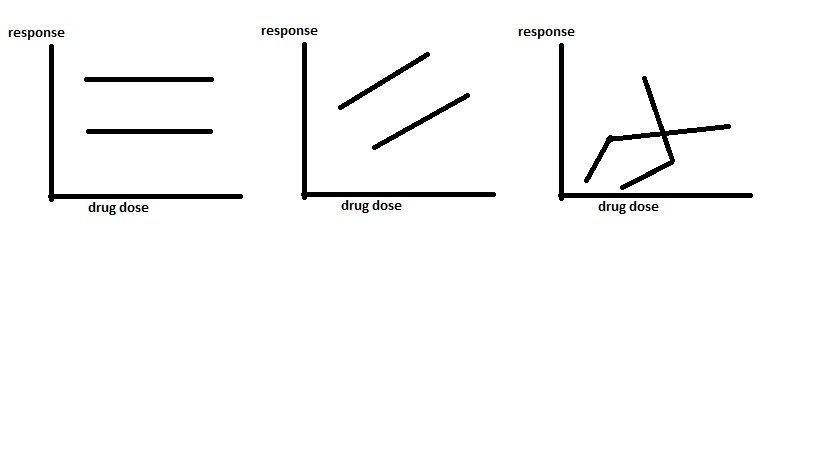
- Ainteraction
- Bmain effect of sex
- Cmain effect of drug
- Dmain effect of sex or drug
- Emain effect of sex + drug and interactio
- FNothing
- Gmain effect of drug and interaction
- Hmain effect of sex and interaction
- Iinteraction
- Jmain effect of sex
- Kmain effect of drug
- Lmain effect of drug and sex
- Mnothing
- Nmain effect of sex and interaction
- Omain effect of drug and interaction
- Pall three
- Qinteraction
- Rmain effect of sex
- Smain effect of drug
- Tnothing
18Shapiro wilk of 0.68. Can you assume normality?
- Ayes
- Bno
19Levene's test of 0.04. Can you assume equality of variance?
- Ayes as the test is not significant
- Bno as the test is significant
- Cno as the test is not significant
- Dyes as the test is significant
20Mauchy's test is 0.55. Can you assume sphericity?
- AYes as the test is not significant
- BYes as the test is significant
- CNo as the test is not significant
- DNo as the test is significant
21Durbin Watson test of 3.7. Are the residuals independent?
- AYes
- BNah
22r = [blank_start]0.1[blank_end], d = [blank_start]0.2[blank_end] (small effect)
r = [blank_start]0.3[blank_end], d = [blank_start]0.5[blank_end] (medium effect)
r = [blank_start]0.5[blank_end], d = [blank_start]0.8[blank_end] (large effect)- A0.1
- B0.2
- C0.5
- D0.3
- E0.5
- F0.8
23What does the permutation test do (there's multiple bebz)?
- ATests for differences between means
- BTests for differences between medians
- Ccalculates robust confidence intervals
- DProduces effect sizes
- EGives p-values
24Parametric -> non-parametric:
One-sample t-test -> [blank_start]Wilcoxon signed rank or sign test[blank_end]
Unpaired t-test -> [blank_start]Mann-Whitney U[blank_end]
Paired t-test -> [blank_start]Wilcoxon signed rank[blank_end]
Independent one-way ANOVA -> [blank_start]Kruskal-Wallis[blank_end]
Repeated measures one-way ANOVA -> [blank_start]Friedman's test[blank_end]
Factorial ANOVA -> [blank_start]nothing bruh[blank_end]
Chi-squared -> [blank_start]Fischer's exact[blank_end]
Pearson's correlation coefficient -> [blank_start]Spearman's rank[blank_end]- AWilcoxon signed rank or sign test
- BMann-Whitney U
- CWilcoxon signed rank
- DKruskal-Wallis
- EFriedman's test
- Fnothing bruh
- GFischer's exact
- HSpearman's rank
25You have a negative skew. How do you transform the data?
- ASquare
- BCube
- CLog10
- DSquare root
- EYou can't do anything
26You have a positive skew to the data?
- ASquare
- BCube
- CLog10
- DSquare root
27Log10(x) = 5. x = ? (^ means "to the power of" fyi)
- A10^5
- B1
- C1^5
- D10
- E100
- F50
- G5
- H5^5
- I5^-5
- JI don't fackin know
Informationen
- Beschreibung
- Experimental Design and Statistics Quiz am EDS 2, erstellt von Emma Jackson am 12/01/2017.
- Autor
- Emma Jackson
- Sprache
- English
- Aufrufe
- 12
- Schlagwörter
- Bewertung
- Noch keine Bewertungen Bewerte dieses Quiz