
Quiz
BIOSCI101 Evolution - Lecture 5
Dieses Quiz enthält Fragetypen, die sich im gewohnten Player öffnen.
Fragen in diesem Quiz (18)
1NATURAL SELECTION
Natural selection is the process in which [blank_start]individuals[blank_end] with certain [blank_start]heritable[blank_end] traits survive and reproduce at a [blank_start]higher[blank_end] rate than those without said traits.- Aindividuals
- Bpopulations
- Cheritable
- Dnon-heritable
- Ehigher
- Flower
2Which of these statements is FALSE with regards to natural selection?
- ASelection acts on the genotype, not the phenotype (trait); it can act only indirectly on the phenotype.
- BThe heritability of phenotypic characters, sets the limits of natural selection.
- CPhenotypic characters or traits can be controlled by single genes or by polygenic inheritance.
- DIt is populations and not individuals that evolve.
- EIn terms of genetics, selection results in changes in gene frequencies from one generation to the next.
3If an individual is physically strong and lives a long life but has no offspring, it is still sit in a Darwinian sense.
- ARichtig
- BFalsch
4FITNESS
Darwinian fitness refers to the ability to [blank_start]survive[blank_end] and reproduce, it considers both [blank_start]viability[blank_end] and [blank_start]fecundity[blank_end]. Fitness depends on the [blank_start]environment[blank_end], the fittest individual during an ice age is probably not the fittest individual once the ice age is over. [blank_start]Absolute fitness (W)[blank_end] is a measure of the total number of offspring an individual produces. [blank_start]Relative fitness (w)[blank_end] is the contribution an individual makes to the gene pool of the next generation relative to the contribution of other individuals. Although it is often referred to as the relative fitness of a genotype, it is the [blank_start]whole organism[blank_end] that is subject to selection not the [blank_start]genotype[blank_end].- Asurvive
- Bdie
- Cviability
- Dgene pool
- Efecundity
- Fpopulation size
- Genvironment
- Hgovernment
- Iera
- JAbsolute fitness (W)
- KRelative fitness (w)
- LRelative fitness (w)
- MAbsolute fitness (W)
- Nwhole organism
- Ogenotype
- Pgenotype
- Qwhole organism
5CALCULATING RELATIVE FITNESS
Relative fitness is the absolute fitness of an individual relative to the absolute fitness of the fittest individual in the population (w), w can range from 0 to 1.- ARichtig
- BFalsch
6MAJOR TYPES OF NATURAL SELECTION
Natural selection can change the frequency distribution of a heritable trait in three ways:
1. [blank_start]Directional selection[blank_end] occurs when one of the extremes is favoured, driving the population in a particular direction. Directional selection is common when an environment changes or when individuals move to a new environment.
2. [blank_start]Disruptive selection[blank_end] occurs when the extreme phenotypes are selected at the expense of intermediate forms.
3. [blank_start]Stabilising selection[blank_end] acts against both extreme phenotypes and favours intermediates.- ADirectional selection
- BDisruptive selection
- CStabilising selection
- DNatural selection
7Match the type of natural selection with the corresponding graph.
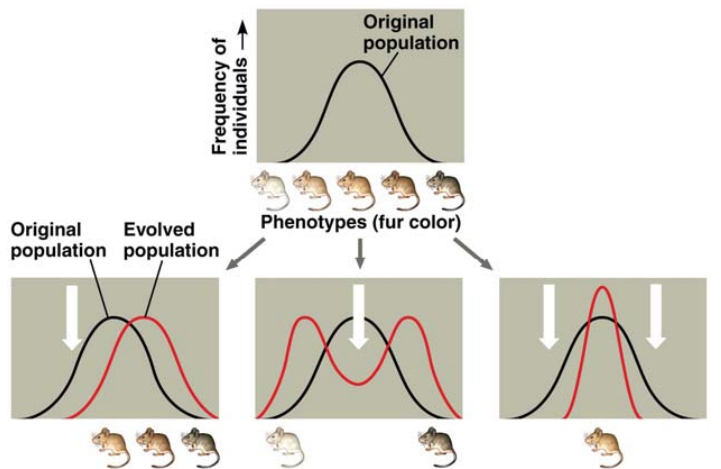
- ADirectional selection
- BDisruptive selection
- CStabilizing selection
8A selective sweep occurs when a favourable allele reaches fixation.
- ARichtig
- BFalsch
9SEXUAL SELECTION
Darwin described a second form of selection - [blank_start]sexual[blank_end] selection. This form of selection is the result of competition between individuals for [blank_start]mates[blank_end]. Sexual selection is argued to result in sexual di[blank_start]morph[blank_end]ism in some species.- Asexual
- Bmates
- Cmorph
10Sexual selection can operate in two ways:
1. [blank_start]Intrasexual[blank_end] selection: individuals of the same sex competing directly, and is thought to occur between males in many species.
2. [blank_start]Intersexual[blank_end] selection: or mate choice, occurs between different sexes, and is typically argued to occur when females select males.- AIntrasexual
- BIntersexual
11HETEROZYGOTE ADVANTAGE
Heterozygote advantage occurs when individuals that are [blank_start]heterozygous[blank_end] have a greater fitness than do either kind of [blank_start]homozygote[blank_end].- Aheterozygous
- Bhomozygous
- Chomozygote
- Dheterozygote
12One example of heterozygote advantage is sickle-cell anaemia, in which heterozygotes are protected against the severe effects of malaria.
Although sickle-cell disease is lethal if not treated in some areas the sickle-cell allele has a frequency of 15-20%.- ARichtig
- BFalsch
13FREQUENCY DEPENDENT SELECTION
In frequency-dependent selection, the fitness of a phenotype depends on how [blank_start]common[blank_end] it is in a population.- Acommon
- Bbeneficial
- Clucky
- Dchoice as bruh
14WHY NATURAL SELECTION CANNOT FASHION PERFECT ORGANISMS
Natural selection can lead to adaptation but there are many non-adaptive traits.
1. Selection can only act on [blank_start]existing variation[blank_end]. New advantageous alleles [blank_start]do not arise on demand[blank_end].
2. Evolution is limited by [blank_start]historical constraints[blank_end]. Evolution co-opts existing structures and adapts them to [blank_start]new situations[blank_end] e.g. birds and bats have not grown new limbs to serve as wings but have
modified the forelimb.
3. Adaptations are often [blank_start]compromises[blank_end]. Each organism must do many things, that is, there can be many competing selective forces operating at the same time [blank_start]e.g. sexual verses natural selection[blank_end].
4. Not all evolutionary change is [blank_start]adaptive[blank_end]. There are forces acting in evolution that do not result in adaptation [blank_start]e.g. genetic drift[blank_end].
5. Chance, natural selection and the environment interact. Chance events can affect the evolution of a
population. For example, not all the alleles in a [blank_start]founder population[blank_end] are better suited to the new environment than the alleles ‘left behind’. Environments may [blank_start]change rapidly and unpredictably[blank_end] limiting the extent to which natural selection can result in adaptation.- Aexisting variation
- Bdo not arise on demand
- Chistorical constraints
- Dnew situations
- Ecompromises
- Fe.g. sexual verses natural selection
- Gadaptive
- He.g. genetic drift
- Ifounder population
- Jchange rapidly and unpredictably
15ADAPTATION AND EXAPTATION
[blank_start]Adaptations[blank_end] are characteristics or traits that have evolved by natural selection for their current function.
[blank_start]Exaptations[blank_end] are the complement of adaptations, as they are traits that have been co-opted or enlisted for a new use.- AAdaptations
- BExaptations
16New characteristics or traits cannot arise when structures that originally had one function are used for a different function.
- ARichtig
- BFalsch
17Exaptations demonstrate that a characteristic or traits current function does not always explain its origin.
- ARichtig
- BFalsch
18Some biologists believe that exaptation may play a much more important role in evolution than has generally been thought.
- ARichtig
- BFalsch
Informationen
- Beschreibung
- Stage I The University of Auckland BIOSCI 101 Quiz am BIOSCI101 Evolution - Lecture 5, erstellt von Eilidh Young am 09/06/2017.
- Autor
- Eilidh Young
- Sprache
- English
- Aufrufe
- 122
- Schlagwörter
- Bewertung
- Noch keine Bewertungen Bewerte dieses Quiz