
Guide to Analysing Texts
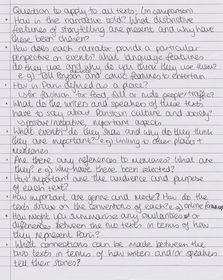
Folien in diesem Satz (12)
-
-
Mode, Audience, Purpose and Genre
- Identify the field of the discourse. What is the subject matter?
- Identify the mode of the piece. (Is it written, spoken or multi-modal?)
- Identify the audience. (Who is this piece written for?) Texts often target specific demographics such as age and gender. To identify the audience, look at the subject matter and language (sentence structure, sophistication of vocabulary etc.)
- How might this particular audience receive this text?
- How well does this text meet the needs of its intended audience?
- Identify the purpose of this piece. (Does it inform, educate or persuade the reader?) Is the piece successful in achieving this purpose? (Note that texts often have more than one purpose).
- What is significant about the individual local effects (or purposes of different elements) of the text?
- Identify the genre of the piece. Is it like a novel (arranged in chapters, fictional narrative, with a clear protagonist and climax) or travel writing? (true experiences of the author's travels, informal style, usually first person).
- Other choices for genre may include; newspaper report, text message, email or blog.
- How typical is the text in terms of others within the genre? Is it generic or not?
- What sort of reception does the genre create?
-
- How does the text present Paris?
- How about Parisians themselves?
- And their culture?
- How are events characterised in the text?
-
- Which
- contextual factors are significant to this passage (i.e. in relation to
- the context of conception production and the context of reception and
- interpretation)?
- Is
- there anything of historical, social or cultural importance?
- Is
- there anything you need to research?
- How are
- these factors important in relation to the text? How might they have
- affected production and/or reception?
- How do
- attitudes towards concepts mentioned in the text differ now compared to
- when the text was written?
- How
- might the zeitgeist of the audience affect the reception of the text?
- To what extent is this text context bound?
- Consider
- any additional meaning that the context of the text reveals (social relationships, power differences, societal position of author and reader/listener, historical and cultural etc.)
- Are there are any social power
- relationships relating to the text? Are they instrumental or influential power
- relationships?
- Can you identify any uses of
- ideological language? (Hint: look for judgemental values and binary
- pairs). What
- is the effect of this?
-
- Identify any:
- declarative sentences
- anaphoric references
- demonstrative spatial pronouns
- evaluative adjectives and adverbs
- verbs of perception and sensory experience
- Anglo-French vocabulary
- deixis
- intensifiers
- What do they add to the piece and what is their desired effect on the audience? (e.g. engaging readers, moving them emotionally,
- surprising, attracting or entertaining them or creating authority or trust.)
- Comment on the register of the piece. Is it formal or informal? How does this relate to the theme and purpose of the piece? (Hint:
- examples are often shown through field-specific lexis.)
- Identify any language techniques. (e.g. list of three, alliteration) What is the effect of them?
- Examine the nouns within the piece. What types are they (proper, common, collective or abstract)? What does this add to the piece and what is the desired effect?
- What person is the text written in (1st, 2nd or 3rd) and why?
- Which tense is the text written in and why? How is this useful in terms of audience and purpose?
- Can the piece be described as 'above the line' or 'below the line'? Give evidence to support your answer.
- How do the verbs, nouns and adjectives chosen tell you about the subject being discussed?
- Identify the different language levels used in the piece and comment on their effect. (formal, colloquial, descriptive, specific and non-verbal)
- What
- can be said about the form of the lexis in the text? (shape and sound)
- Can you
- identify any semantic fields within the text? Are there any examples of a particular
- semantic field being used to describe another?
- Can you
- identify any ways in which the producer of the text has used sound
- patterns for effect? (e.g. alliteration, assonance, rhyme, tone,
- onomatopoeia, slang and taboo language)
- Identify
- the tenor of the discourse. How are the relationships being developed
- throughout this discourse? (e.g. friendliness, objectivity and solidarity)
- Are the power relationships present within the discourse symmetrical or
- asymmetrical?
-
- Does the piece have a clear and distinct structure? What does this say about the piece as whole in relation to its genre, audience and purpose?
- How is the piece structured? Why is this important?
- Is the piece written from memory? If so, what elements are emphasised, and what could be left out?
-
- Can you identify anything that is in the foregrounding of the narrative? Why is this particular aspect being highlighted?
- What perspective is the narrative told from? (protagonist, secondary role, witness or second hand)
- Identify the actors, actions and circumstances within the narrative.
- Can you identify any of Labov's six stages of storytelling within the piece? (abstract, orientation, complication, evaluation, resolution and coda)
- Where
- can you identify spatial and psychological point of view? (Remember,
- spatial POV relates to the physical position of the narrator, and psychological
- POV relates to what the narrator feels)
- How far
- would you say the narrator is objective? How can you tell?
- Is the
- narrator omniscient, or a ‘real-world’ narrator? How can you tell?
-
- Spoken language typically:
- is in informal register
- is fluid
- is unstructured and spontaneous
- is transient (impermanent) as the speaker corrects themselves as they speak
- is useful for immediate interactions
- allows the speaker to receive immediate feedback through facial expressions, body language and utterances of the listener
- requires shared context and insider knowledge to play a major role - with vital detail left unsaid or indirectly implied
- How does is this piece similar or different to typical spoken language?
- Comment on the use of pragmatics within the piece. What extra meaning can be inferred from the social
- force of the utterance as well as the semantic value of the text?
- Is there an ironic edge (contrast between literal
- and additional pragmatic meaning)?
- Identify the following features of spoken language and explain the effect;
- phatic language
- paralanguage (includes timing, tone, volume and timbre)
- tags or tag questions
- slang (vocabulary only used in spoken language)
- prosodic features (includes stress, intonation and pitch)
- turn taking
- adjacency pair
- back channelling
- running repair
- topic markers and shifters
- interrupted construction
- false starts
- hesitation indicators and fillers
- latch-ons
- overlaps
- glottal stops
- non-fluency features
- vocatives
- elision
- code switching
- received pronunciation
- accent and regional dialect
- sociolects
- idiolects (hint:
- presents itself by lexical choices, pronunciation and grammatical patterns)
-
- Written language is typically:
- more formal
- edited over a long period of time and structured
- permanent (hard to change once printed or written out)
- able to communicate over space and time for as long as a particular language and writing system is understood
- complex (with longer sentences and many subordinate clauses, punctuation and graphology of texts have no spoken equivalent)
- unable to give writers immediate feedback
- unable to rely on shared context and insider knowledge (everything must be explained fully)
- easy to read repeatedly and be analysed
- How does is this piece similar or different to typical written language?
- Can you identify any grammatical constructions that wouldn't be used in spoken language?
- How
- does the graphology of the text help the text achieve its purpose and meet
- the needs of the audience? Consider the use of text boxes and other layout
- features, font face, the use of colour, italics, bold, underline, letter
- headings, headlines, columns, tables, bullet points and all other aspects
- of a text’s visual form, as well as the age of the audience.
- How
- does the graphology of the text affect its reception/interpretation, in
- relation to genre conventions?
- What is
- significant about the text’s graphology as the first thing the reader sees
- initially?
- How
- might graphological aspects trigger a conditioned response to the text
- itself?
-
Advantages and Disadvantages of Media
- What are the advantages of the media the text is written in? (e.g. letters are generally better planned than emails or texts)
- What are the disadvantages of the media the text is written in? (e.g. letters take a long time to deliver)
-
- Does the text make use of Standard or non-standard
- grammar?
- What is the effect or purpose of this type of
- grammar? Consider the type of discourse (i.e. text messages tend to be
- non-standard)
- Is it being used in divergence or convergence?
- Does it suggest ‘hypercorrection’?·
- Can you identify any inaccurate grammar?
- Is Paris described passively or actively within the
- text? What is the effect of this?
- Which kind of sentence structure is most common
- within the text? (simple, complex, compound or compound-complex) What does this
- suggest about the text as a whole?
- Can you identify any minor sentences, and what is their effect?
- Identify different sentence types (declarative, imperative, interrogative) and explain their effect.
-
- Stylistic Analysis Guide Part 1
- Stylistic Analysis Guide Part 2
Informationen
- Beschreibung
- According to the AQA A-level English Language and Literature assessment objectives
- Erstellt von
- Summer Pearce
- Aufrufe
- 73
- Bewertung