
Diapositivas de Modal Verbs
Folien in diesem Satz (8)
-
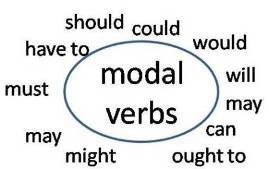
- MODAL VERBS
- The modal verbs include can, could, may, might, will, would, should. They are used with other verbs to express ability, obligation, possibility, and so on.
-
- Indicates
- skills or possibility.•Examples:Ø I
- can speak englishØThe
- doctor
- can see you at 3:00 pmØCan
- you
- speak
- german?•
- Structure:
- Affirmative: subject
- + can
- + verb
- Negative: subject
- + can not
- / can't
- + verb
- Question: can + subject + verb?
- Short answer: Yes, subject
- +
- can / No, subject
- +
- can't
-
- It`s the past of can. It`s also used to ask for something,
- but more politely than can.
- Examples:
- ØCould
- you
- speak Japonese before you went to Japan?
- ØTony
- could swim when he was six.
- ØCould
- you help me?
- •Structure:
- Affirmative: subject +
- could + verb
- Negative: subject +
- could not / couldn't + verb
- Question: could + subject
- +
- verb?
- Short answer: Yes, subject
- +
- could / No, subject +
- couldn't
-
- :
- We use it to say that something is possible or very
- likely. We use it with the present or future. It`s also used to ask for
- something but more politely than with the could. To express wishes/ hopes.
- Example:
- ØI
- may stay at home or I may go to a disco.
- ØMay
- I use your dictionary?
- ØMay
- you both be very happy
- •Structure:
- Affirmative: subject
- + may
- + verb
- Negative: subject
- + may+ not
- Question: May + subject
- + verb?
-
- It`s may`s
- past. It is also used to express an eventuality but more likely.
- Example:
- ØBe
- careful. You might burn yourself.
- •Structure:
- Affirmative: subject
- +
- might
- + verb
- Negative: subject
- +
- might
- not
- / mightn't
-
- :
- would be used in general for conditional sentences. We
- also use it for prediccions, offers and to ask for something politely.
- Example:
- ØI
- told you that I would see you
- tomorrow.
- ØWould
- you
- like
- coffe?
- •Structure:
- Affirmative: subject
- +
- would
- + verb
- Short affirmative: subject
- +
- 'd
- + verb
- Negative: subject
- +
- would
- not
- / wouldn't+
- verb
- Question:
- would
- +
- subject
- +
- verb?
- Short answer:
- Yes,
- subject
- +
- would
- / No, subject
- +
- wouldn't
-
- :
- we used “should” to express degree of possibility or
- probability, as well as for a weak obligation.
- •Example:
- ØYou should tell Miss Baker the
- truth.
- ØNick shouldn't be
- working.
- ØShould we worry?
- •Structure:
- Affirmative: subject +
- should +
- verb
- Negative: subject + should
- not/ shouldn‘t +
- verb
- Question: Should
- +
- subject + verb?
-
- Modals are auxiliary verbs. They do not need an additional
- auxiliary in negatives or questions. For example: Must
- I come?
- (Do I must come?), or: He shouldn't smoke (He doesn't should smoke).
Informationen
- Beschreibung
- Explicacion de los modal verbs
- Erstellt von
- Maria Camila Contreras Causado
- Aufrufe
- 700
- Tags
- Bewertung