
Karteikarten
Edexcel A level/AS Physics Chapter 3 - Electricity
Karten in diesem Stapel (37)
- 1What is Electric Current?The rate of flow of charged particles
I=Q/t - 2What is the charge of an electron?1.6 x 10^-19
This can also be used to calculate the charge of an ion - 3What Direction does Current flow?-Conventional Current travels from positive to negative
-The electrons actually move from negative to positive - 4What is Potential Difference?Potential Difference is a measure of the energy provided to a component
per unit of charge.
V=E/Q - 5What is the EMF of a Circuit?-Electromotive Force
-the work done by a battery per unit of charge. (essentially the potential difference of the battery) - 6What is an Electronvolt?-An electronvolt is a unit of energy used for subatomic particles
-It comes from V=E/Q when Q is 1.6 x 10^-19
-Therefore, one electronvolt is 1.6 x 10^-19 J - 7What does Ohm's Law state?-The current in an ohmic conductor is directly proportional to the potential difference across it, provided that temperature and other physical factors are kept constant
-V=IR, but ONLY in ohmic conductors - 8How does Increasing Temperature affect Resistance?As temperature increases, the metal's lattices vibrate more and so the electrons bump into them more often, thereby increasing resistance
- 9Why do we use Resistivity?-Resistance doesn't take the length or cross sectional area of a wire, and so varies with different wires of the same metal
-So instead we use resistivity - 10What is Resistivity?-A measure of how much a material opposes the flow of charge
-\[\rho\]=RA/l
It's divided by a lowercase L
-The units are ohm meters - 11Why is Resistivity Quoted at a Specific Temperature?-Resistivity is dependent on resistance, which changes with temperature.
-Therefore resistivity also changes with temperature - 12What are Semiconductors?Materials that act as insulators at absolute 0, but can sometimes conduct electricity
- 13How can Semiconductors Conduct?-In solids, because atoms are packed so closely together, they form energy bands rather than levels.
-The band of outermost electrons is called the valence band
-If the electron is provided with enough energy, it can jump over the energy gap into the conduction band where it is free to move and so can carry charge - 14How do the Valence and Conduction Bands Interact in Conductors and Insulators?-In metals, the valence and conduction band overlap
-In insulators the energy gap is too large, the material is damaged before electrons have enough energy to move into the conduction band - 15What is a "Hole"?When an electron moves from the valence band to the conduction band, it leaves behind a hole in the valence band, which acts as a positive charge carrier
- 16Why does Resistance Decrease as Temperature Increases in a Thermistor?In a Negative Temperature Coefficient Thermistor:
-Even though the more vibrations in the metal lattice increase resistance
-This is outweighed by the fact that the thermal energy causes electrons in the semiconductor to move from the valence band to the conduction band
-This allows more current to flow through the semiconductor, thereby reducing the resistance - 17What reduces the resistance in an LDR?-Resistance in an LDR reduces with Light Intensity
-Because the light energy causes electrons to move from the valence band to the conduction band
-This means that a larger current can flow as there are more charge carriers free to move
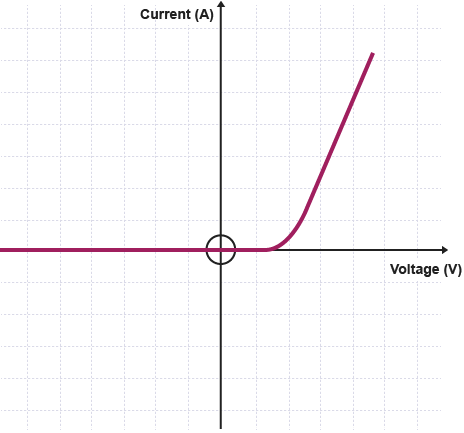
-So there is a smaller resistance - 18How do Semiconductor Diodes work?-Semiconductor Diodes are made by joining different kinds of semiconductors.
-This creates an energy barrier that can be overcome by a small forwards p.d. (0.6v in silicon) but needs a very large reverse p.d. to overcome
-Only a very tiny leakage current makes it out in the reverse direction - 19How can you make a Superconductor?-Resistance in a metal decreases as temperature decreases
-If you cool a metal beneath it's critical temperature, it has 0 resistance and is a superconductor - 20Why are Superconductors used?Superconductors are used because when a large current is needed, a normal conductor would waste a lot of energy and damage it's surroundings due to the heat energy dissapated
- 21What is Drift Velocity?Drift Velocity is the slow net movement of electrons
I=nAVe - 22Current in CircuitsKirchhoff's first law - the sum of current leaving any junction is always equal to the sum of the current that entered it
-This is due to the CONSERVATION ON CHARGE
-So current is added in parallel and the same in series - 23P.d. in CircuitsKirchhoff's second law - the total voltage across a circuit loop is equal to the sum of the voltage drops across components
-This is due to the CONSERVATION OF ENERGY and V=E/Q
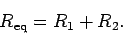
-So P.d. is the same in parallel and added in series - 24Resistance in Series Equation
- 25Resistance in Series Derivation

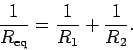
- 26Resistance in Parallel Equation
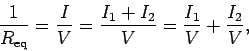
- 27Resistance in Parallel Derivation
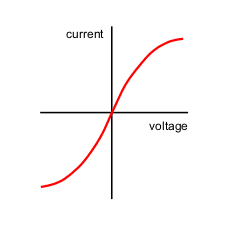
- 28V I Graph for a Filament Lamp
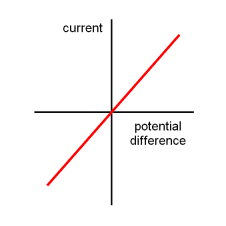
- 29V I Graph for Ohmic Conductor
- 30V I Graph for Semiconductor Diode
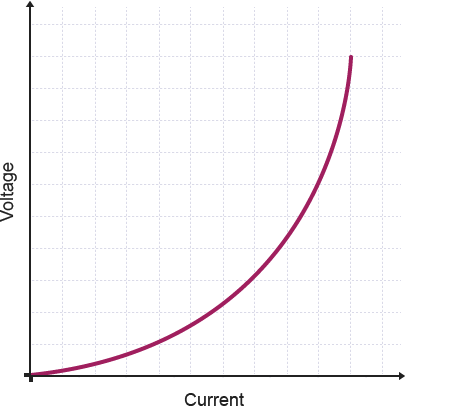
- 31V I Graph for Thermistor
- 32How does P.d. Vary Along a Wire?Along a uniform, current-carrying wire, the longer it is, the larger the resistance, so the potential difference also increases.
- 33What is a Potential Divider Circuit?-In a series circuit, the p.d. is split in proportion to the resistance of the components.
-This allows one to chose a specific voltage across a component and it's parallel branch.
-This creates a potential divider circuit - 34What is the Equation used for a Potential Divider Circuit?V(out) = V(in) x R(2) / (R(1) + R(2))
- 35What happens when a potential Divider Circuit has a Sensor Component in it?-If one of the resistors is sensor component such as a LDR or Thermistor, this resistance will vary.
-This can be used to control external circuits by placing these in parallel with the sensor component - 36What is Internal Resistance?The resistance of a battery
- 37How does the Internal Resistance Affect the Circuit?-The internal resistance means that the emf can't supply it's maximum potential difference.
-This p.d. that never makes it to the circuit is referred to as lost volts
-The emf minus the lost volts leaves us with the terminal p.d. of the circuit
-When r is internal resistance, and R is resistance in the Circuit, EMF = V + Ir
Informationen
- Beschreibung
- Covers the electricity section for Edexcel A level year 1 / AS physics
- Erstellt von
- Natalia Cliff
- Aufrufe
- 74
- Tags
- Bewertung