Karteikarten
Cisco ICND1
Karten in diesem Stapel (40)
- 1What does BASE mean in 100BASE-T and 1000BASE-TBASE in 100BASE-T and 1000BASE-T refers to the baseband signaling method.
Baseband is a network technology in which only one carrier frequency is used. This
means that when a device transmits, it uses the entire bandwidth on the wire and
does not share it during the single time interval. - 2What is carrier sense multiple access collision detect (CSMA/CD)CSMA/CD describes the Ethernet access method.
In CSMA/CD, many stations can transmit on the same cable, and no station has priority over any other. Before a station transmits, it listens on the wire (carrier sense)
to make sure that no other station is transmitting. If no other station is transmitting,
the station transmits across the wire. If a collision occurs, the transmitting stations
detect the collision and run a random backoff algorithm. The random backoff algorithm is a random time that each station waits before retransmitting - 3What is UTP cabling?Unshielded twisted-pair (UTP) cabling is a type of twisted-pair cable that relies
solely on the cancellation effects produced by the twisted wire pairs to limit electromagnetic interference (EMI) and radio frequency interference (RFI).
UTP cable is often installed using an RJ-45 connector, and UTP cabling must follow
precise specifications dictating how many twists are required per meter of cable. The
advantages of UTP are ease of installation and low cost. A disadvantage of UTP is
that it is more prone to EMI than other types of media. - 4What is the maximum cable length for UTPThe maximum length is 100 meters or 328 feet.
- 5What is a straight-through Ethernet cable, and when would you use it?A straight-through Ethernet cable is wired the same way at both ends. This cable
uses pins 1, 2, 3, and 6. The send and receive wires are not crossed.
You should use a straight-through Ethernet cable when connecting dissimilar devices
(for example, data terminal equipment [DTE] to data communications equipment
[DCE]). Examples include connecting PCs (DTE) to switches or hubs (DCE) or a
router (DTE) to a switch or a hub (DCE). - 6What is a crossover Ethernet cable, and when would you use it?A crossover Ethernet cable is a cable that has the send and receive wires crossed at
one of the ends. In a Category 5 cable, the 1 and 3 wires are switched and the 2 and
6 wires are switched at one end of the cable.
You should use a crossover cable when connecting similar devices (DCE to DCE or
DTE to DTE), such as connecting a router to a router, a switch to a switch or hub, a
hub to a hub, or a PC to a PC.
NOTE In today’s networks, most Catalyst switches have auto-mdix, which can
automatically detect the type of cable connected to the interface and automatically
configure the connection appropriately. - 7What are the different UTP categoriesThe categories of UTP cable are as follows:
■ Category 1: Used for telephone communications.
■ Category 2: Capable of data transmission speeds of up to 4 Mbps.
■ Category 3: Used in 10BASE-T networks. Speeds up to 10 Mbps.
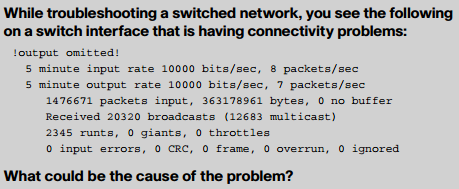
■ Category 4: Used in Token Ring networks. Speeds up to 16 Mbps.
■ Category 5: Capable of data transmission speeds of up to 100 Mbps.
■ Category 5e: Supports speeds of up to 1 Gbps.
■ Category 6: Consists of four pairs of 24-gauge copper wires. Speeds up to 1 Gbps.
■ Category 6a: Supports speeds up to 10 Gbps. - 8What is the differenct between single-mode fiber (SMF) and multimode fiber (MMF)The primary difference between SMF and MMF is the ability of the fiber to send
light for a long distance at high bit rates. In general, MMF supports shorter distances
than SMF. - 9What are three ways that LAN traffic is transmitted?Unicast: Unicasts are the most common type of LAN traffic. A unicast frame is a
frame intended for only one host
Broadcast: Broadcast frames are intended for all hosts within a broadcast domain.
Stations view broadcast frames as public service announcements. All stations
receive and process broadcast frames.
Multicast: Multicasts are traffic in which one transmitter tries to reach only a subset, or group, of the entire segment. - 10How many bits are in an Ethernet address?48 bits. Also called a MAC address, an Ethernet address is the Layer 2 address associated
with the Ethernet network adapter. Typically burned into the adapter, the MAC
address is usually displayed in a hexadecimal format, such as 00-0d-65-ac-50-7f - 11What portion of the MAC address is vendor specificThe first half or first 24 bits of the MAC address are vendor specific.
A MAC address is 48 bits and is displayed in hexadecimal. The first half of the
address identifies the vendor or manufacturer of the card. This is called the
Organizational Unique Identifier (OUI). The last half of the address identifies the
card address. - 12What poriton of the MAC address is vendor assigned?The last 24 bits are vendor assigned
- 13What are the first 24 bits in a MAC address called?These bits are the Organizational Unique Identifier (OUI).
- 14What is an example of a layer 2 address?An example is a MAC address.
- 15What is an example of a Layer 3 address?An example is an IP address.
- 16If a sending device does not know the MAC address of the destination device, what protocol is used to find the MAC address of the receiving device?Address Resolution Protocol (ARP) is used to find the MAC address of the receiving
device.
ARP is a local broadcast sent to all devices on the local segment to find the MAC
address of a host. - 17Host A wants to send data to host B. Hose B is on a different segment from host A. The two segments are connected to each other through a router. What will host B see as the source MAC address fro all frames sent from host A?Because host B is on a different segment that is separated by a router, the MAC
address of all frames sent from host A will be the MAC address of the router.
Anytime a frame passed through a router, a router rewrites the MAC address to the
MAC address of the router’s exit interface for the segment and then sends the frame
to the local host.
In this case, the router will change the source MAC address of the frame sent from
host A with the MAC address of its interface connecting to the segment host B is on.
Host B will see that the frame came from the MAC address of the router with the IP
address of host A - 18Switching uses a process outlined by the IEEE as transparent bridging. What are the five processes transparent bridges use for determining what to do with a frame?The five processes of transparent bridging as defined in IEEE 802.1d are
1. Learning
2. Flooding
3. Filtering
4. Forwarding
5. Aging - 19What is the transparent bridging learning process?When a frame enters a switch, the switch adds the source Ethernet MAC address and
source port into its MAC address table. The process of recording the source MAC
address and the source port in the table whenever a switch sees a frame is called the
learning process. - 20What is the transparent bridging flooding process?When a switch receives a unicast frame and it does not have the destination MAC
address and port in its bridging table, or a broadcast or multicast frame, the switch
will forward this frame out all ports, except the port it received the unicast frame on.
This is called the flooding process. - 21What is the transparent bridging filtering processWhen a switch receives a unicast frame and it does not have the destination MAC
address and port in its bridging table, or a broadcast or multicast frame, the switch
will forward this frame out all ports, except the port it received the unicast frame on.
This is called the flooding process. - 22What is the transparent bridging forwarding process?A switch forwards a frame when the destination address is in the switch’s MAC
address table and the source and destination are on different interfaces. This is the
forwarding process. - 23What is the transparent bridging aging process?When a switch learns a source address, it time-stamps the entry in the MAC address
table. Every time the switch sees a frame from the same source, the timestamp is
updated. The aging process occurs when the switch does not see a frame from the
source before the aging timer expires. When this happens, the switch removes the
entry from the MAC address table. - 24For what two purposes does the Ethernet protocol use physical addresses?Ethernet uses physical addresses to
Uniquely identiffy devices at Layer 2 and Allow communication between different devices on the same Layer 2 network - 25What will an Ethernet switch do if it receives a unicast frame with a destination MAC that is listed in the switch table?The switch will forward the frame to a specific port.
Switches use the transparent bridging process to determine how to handle frames.
The process is as follows:
1. A frame is received.
2. If the destination is a broadcast or multicast, the switch will forward the frame to
all ports except to the port the frame was received.
3. If the destination is a unicast and the address is not in the MAC address table,
the switch forwards the frame to all ports except the receiving port.
4. If the destination is a unicast, the address is in the MAC address table, and the
associated interface in the MAC address table is not the receiving interface, the
switch forwards the frame to the correct interface.
5. If the above rules do not occur, filter the frame. - 26Under what conditions would a switch flood a frame?A switch will flood a frame if the MAC address table is full, if the destination MAC
address has not been learned by the switch, or if the frame is a broadcast or multicast frame - 27What is the switch MAC address table used for?The switch MAC address table forwards traffic out the appropriate interface.
Because switches operate at Layer 2 of the OSI model, they switch traffic by MAC
address. Instead of flooding traffic out all interfaces, a switch learns the MAC
address of devices on each interface and only forwards traffic destined to the host
on the interface. The learned MAC addresses are stored in the switch’s MAC address
table - 28Describe full-duplex transmissionFull-duplex transmission is achieved by setting switch interfaces, router ports, and
host NICs to full duplex. Microsegmentation, where each network device has its
own dedicated segment to the switch, ensures that full duplex will work properly.
Because the network device has its own dedicated segment, it does not have to
worry about sharing the segment with other devices. With full-duplex transmission,
the device can send and receive at the same time, effectively doubling the amount of
bandwidth between nodes.
Three points to remember about the operation of full-duplex communication are
There are no collisions in full-duplex mode
A dedicated switch port is required for each full-duplex node
The host network card and the switch port must be capable of operating in full duplex mode. - 29What are the advantages of using full-duplex Ethernet instead of half-duplexFull-duplex provides faster data transfer by being able to send and receive simultaneously and operates without collisions.
NOTE By enabling full-duplex on a port, you are disabling CSMA/CD on the
segment. - 30How does replacing a hub with a switch affect CSMA/CD behavior in an Ethernet network?It effectively eliminates collisions.
Replacing a hub with a switch effectively eliminates collisions because each switch
port is a separate collision domain. One device per switch port and configured for
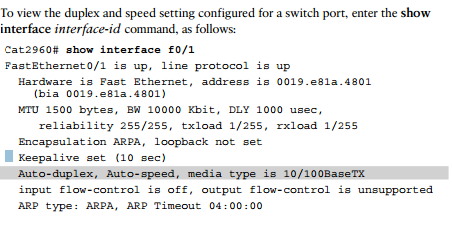
full-duplex operation eliminates the need for CSMA/CD. - 31What command allows you to view the duplex and speed settings configured for a switch port?
- 32Can a network hub be connected to switch port in full-duplex mode?No. Because a hub shares access to the segment, it must connect to a switch port in
half-duplex mode to be able to detect collisions.
NOTE CSMA/CD is not enforced when full-duplex is configured. - 33When troubleshooting a switch interface operating in full-duplex mode, which error condition can be immediately ruled out?Collisions can be ruled out.
Remember, collisions occur only on half-duplex links. There are no collisions on full duplex links. - 34An end user complains of slow access to the network. You issue the show interface command on the port the end user is connected to and you see a lot of collisions and runts on the interface. What is most likely the cause of the problem?A duplex mismatch is most likely the cause.
Although there are many things that can cause network slowness, the key here is
when you issue the show interface command, you see many collisions and runts. A
duplex mismatch will not only cause the end user to experience network slowness
but also cause many collisions and runts on the switch interface. - 35An end user complains of slow access to the network. You issue the show interface command on the port the user is connected to and you see a lot of collosions and cyclic redundancy check (CRC) errors on the interface. What ca be several causes for the problem?The most likely causes of the problem are a bad network cable, damaged media, or
EMI.
Excessive collisions and CRC errors usually indicate a problem with the network
cable attached to the port, or outside interference. - 36You connect two switches using a straight-through UTP Cat 6 cable. The port link lights between the switches are not coming on. What is the problem?The problem is with the cable. A straight-through cable is used to connect data terminal equipment (DTE) devices to data communications equipment (DCE) devices. A
switch is considered a DCE device, and so are hubs. DTE devices include computers,
printers, servers, and routers. For two like devices to connect to each other, a crossover cable is needed. In this case, replacing the cable with a crossover cable will fix
the problem. - 37You have a port on your switch that is not working properly. You enter the show interface command on the faulty port and the port status says "errDisable." What are some possible causes for this error?If you are having connectivity issues and the port state shows “errDisable,” the following issues can be causing this error:
EtherChannel misconfiguration
Duplex mismatch.
Bridge protocol data unit (BPDU) port guard has been enabled on the port.
Unidirectional Link Detection (UDLD).
A native VLAN mismatch. - 38—The switch port is receiving a lot of late collisions. The problem can be a duplex mismatch or a faulty port, or the distance between the two switches might exceed the
cable specifications.
NOTE Duplex mismatches occur when the connecting ends are set to different
duplex modes, or when one end’s duplex is configured and the other end is set to
autonegotiation.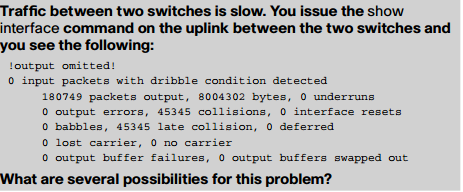
- 39What is the cause of multiple collisions on a port?Multiple collisions are the number of times the transmitting port had more than one collision before successfully transmitting a frame. If you experience multiple collisions on a port, the problem usually lies with an oversaturated medium.
- 40—The switch is receiving a lot of runts. Runts are frames smaller than 64 bytes with a
bad frame check sequence (FCS). Bad cabling or inconsistent duplex settings usually
cause runts.