
Karteikarten
Defence against Pathogens
Karten in diesem Stapel (12)
- 1Name 6 primary non-specific animal defencesSkin
Mucous membranes
Blood clotting
Expulsive reflexes
Inflammation
Wound repair - 2How does the skin act as a defence against pathogens?The skin acts as a physical and chemical barrier (produces chemicals that are antimicrobial and can lower pH, inhibiting pathogen growth)
- 3Complete the sentences: Skin cells secrete ________ _______ that can kill bacteria and lower _____ of the skin. Skin cells also secrete _________ that catalyses the breakdown of _____________ in bacterial cell walls).Skin cells secrete FATTY ACIDS that can kill bacteria and lower pH of the skin.
Skin cells also secrete LYSOZYMES that catalyses the breakdown of CARBOHYDRATES in bacterial cell walls). - 4How do mucous membranes act as a defence against pathogens?Some membranes secrete mucous (traps pathogens and contains antimicrobial enzymes). Pathogens will be trapped in the mucous lining the lung epithelium.
These have cilia (beats and moves mucous up the trachea) - 5How do expulsive reflexes act as a defence against pathogens?A sneeze happens when the mucous membranes int he nostrils are irritated. A cough stems from irritation in the respiratory tract. Both are attempts to expel foreign objects (including pathogens) automatically
- 6How does inflammation act as a defence against pathogens?Inflammation includes swelling, pain, heat and redness. It can be triggered by tissue damage; the damaged tissue releases molecules which increase the permeability of the blood vessels, so they can leak fluid into the surrounded area. This causes swelling and helps to isolate pathogens. The molecules also cause vasodilation, increasing blood flow (including white blood cells)
- 7How does wound repair act as a defence against pathogens?The surface is repaired by the outer layer of skin cells dividing and migrating tot he edges of the wound. The tissue below the wound then contracts to bring the edges closer together. It is repaired using collagen fibres (too many = scar)
- 8What are the two types of plant defences?Chemical
Physical - 9What are the chemical defences in plants?Plants produce antimicrobial chemicals (including antibiotics) which kill pathogens/inhibit their growth.
Other chemicals are toxic to insects; this reduces insect-feeding and therefore reduces risk of infection by insect vectors - 10Describe the function of two examples of chemical plant defenceSaponins - destroy cell membranes of fungi and other pathogens
Phytoalexins - inhibit growth of fungi and other pathogens - 11What are the physical defences in plants?Most plant leaves and stems have a waxy cuticle (provides physical barrier and stops water collecting on the leaf, reducing risk of infection)
Plant cells have cell walls (forms physical barrier)
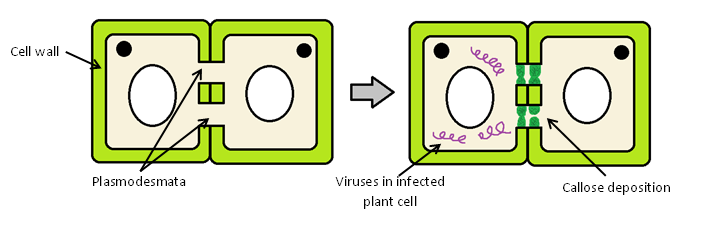
Plants produce a polysaccharide called callose which makes it harder for pathogens to enter cells - 12How does callose deposition provide a defence against pathogens?Callose gets deposited between plant cell walls and plasma membranes during times of stress. Callose deposition at the plasmodesmata limits the spread of viruses between cells
Informationen
- Beschreibung
- Der Nutzer hat seine Fachbereichs-Information gelöscht. Karteikarten am Defence against Pathogens, erstellt von Gelöschter Nutzer am 05/03/2018.
- Erstellt von
- Gelöschter Nutzer
- Aufrufe
- 23
- Verlauf
-
- Erstellt von Yinka F · 5 Feb 2018
- Kopiert von Yinka F · 5 Mär 2018
- Bewertung