
Karteikarten
AP Human Geography - Key Concepts
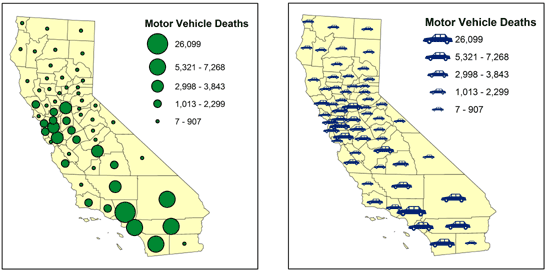
Karten in diesem Stapel (101)
- 1Graduated Symbol Map
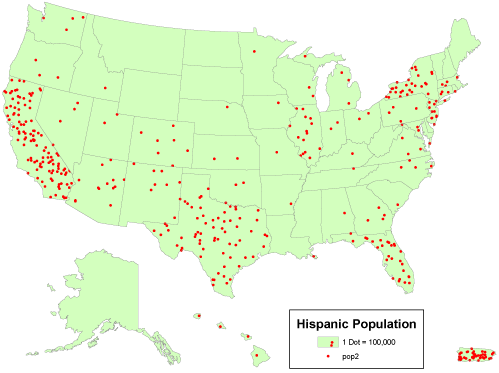
- 2Dot Map
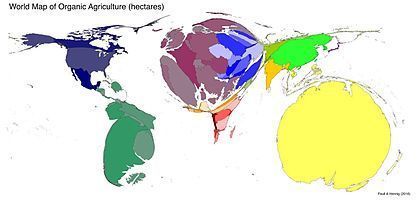
- 3Cartogram
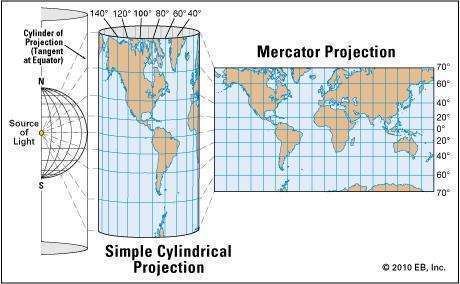
- 4Mercator Projection
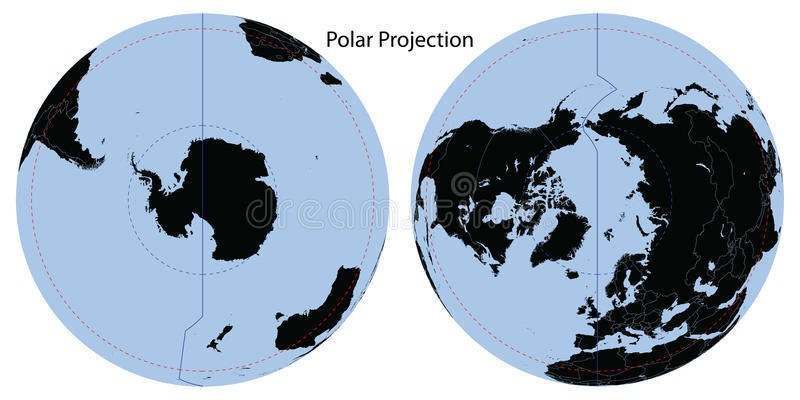
- 5Polar Projection
- 6Formal RegionA region with a shared characteristic; aka - uniform or homogenous region.
- 7Functional RegionA region centered around a node, and is defined by an activity rather than a characteristic. The importance of the node diminishes as you move away from the node.
- 8Perceptual RegionA region defined by people's feelings and attitudes about an area.
- 9Sequent OccupanceRefers to the successive groups of people that have left an imprint on the cultural landscape.
- 10Arithmetic DensityTotal population/Total land area
- 11Physiological DensityThe number of people per unit of arable land.
- 12Agricultural DensityThe number of farmers per unit of arable land.
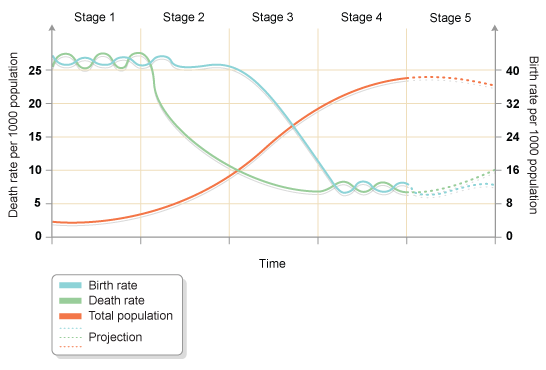
- 13Demographic Transition Model
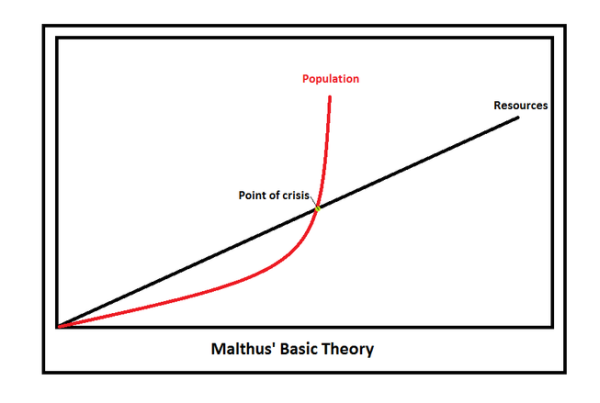
- 14Malthusian Theory
- 15Epidemiologic TransitionAs countries progress through the demographic transition, the primary causes of death shift away from contagious diseases towards problems with old age.
- 16Pro-natalist PoliciesGovernment policies that attempt to increase fertility rates. (i.e. free healthcare, child care, tax incentives, etc...)
- 17Anti-natalist PoliciesGovernment policies which seek to decrease fertility rates (i.e. the One Child policy, etc...)
- 18AsylumShelter and protection in one state for refugees from another country.
- 19Internally displaced personIndividuals who are uprooted within the boundaries of their own country because of conflict or human rights abuse.
- 20RemittancesMoney sent by immigrants to friends and family in their home country.
- 21Step MigrationMigration to a distant destination that occurs in stages.
- 22Chain MigrationMigration due to relatives/others of the same nationality.
- 23Contagious DiffusionThe rapid, widespread diffusion of a trait throughout the population.
- 24Hierarchical DiffusionAn idea of innovation that spreads from larger to smaller places, or from people of influence to the general population.
- 25Stimulus DiffusionOccurs when the innovative idea diffuses from its hearth outward, but the original idea is changed by the new adopters.
- 26Relocation DiffusionThe spread of an idea through the physical movement of people from one place to another.
- 27Reverse Hierarchical DiffusionWhen an idea spreads from a place of less influence to a larger place.
- 28DialectA particular form of a language used by people in a specific region or social group; often distinguished by pronunciation, cadence, and vocabulary.
- 29ImperialismA state policy and action of extending territorial influence by direct territorial acquisition or by gaining policies and economic control of other areas.
- 30ColonialismImplanting of settlements in a distant territory; a form of Imperialism.
- 31AcculturationThe process of adopting cultural patterns or traits from another culture.
- 32AssimilationThe process whereby a minority group gradually adopts the culture of the majority.
- 33Ethnic religionsReligion that is particular to an ethnic group; does NOT seek converts; examples: Judaism and Hinduism
- 34Universalizing ReligionsReligions that appeal to all people; Examples: Islam and Christianity
- 35Folk CultureCulture that begins in rural, isolated places; only diffuses through relocation diffusion; remains small; is usually practiced in the same location as the hearth.
- 36Popular CultureCulture that is widespread, practiced by people of varying ethnicity, and diffuses through expansion diffusion.
- 37Nation-stateA country which is inhabited by one specific cultural/ethnic group.
- 38Stateless NationA nationality that inhabits several states, but is the minority in every state in which they live.
- 39Multinational StateA single country with multiple nationalities dwelling in it.
- 40Multi-state NationOften, the same as a stateless nation. The nation lives in multiple states/nations. (i.e. the Kurds or Palestinians)
- 41Autonomous RegionA dependent territory of a country that has some degree of self governance.
- 42Heartland TheoryA geopolitical theory developed by MacKinder in 1904 stating that whoever controlled the heartland (Eastern Europe) could easily gain control on the World Island (Europe, Asia, and Africa), then control the world.
- 43Rimland TheoryA geopolitical theory developed in 1942 by Nichols Spyman stating that those who controlled the Rimland could then control the World Island (Europe, Asia, and Africa) then the rest of the world.
- 44Organic TheoryTheorized in 1897 by Friedrich Ratzel stating that countries behave a lot like organisms. Countries seek "nourishment" in the form of gaining new territory in order to survive.
- 45TerritorialityThe effort to control pieces of the Earth's surface for personal, political, or social ends.
- 46The Law of the SeaBody of international law that seeks to define how how states must interact in the oceanic space.
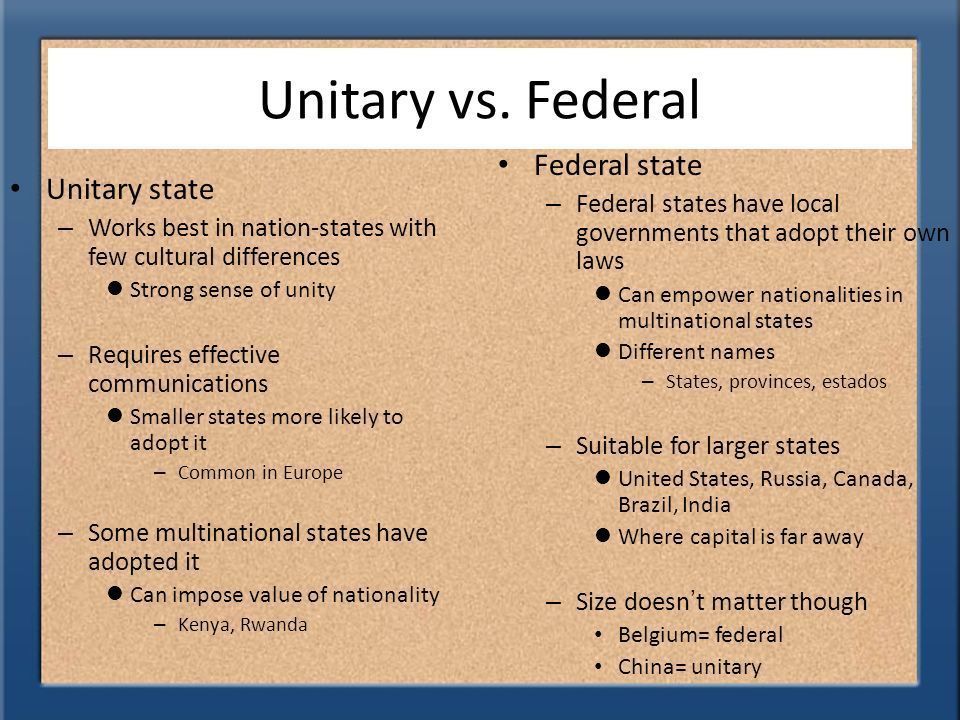
- 47Federal StatesA country that is a union of self-governing states or provinces. These countries give more local control to varying geographic regions and ethnic groups.
- 48Unitary StatesA country that maintains control in a singular, central government.
- 49UNITARY VS. FEDERAL
- 50SupranationalismThe movement of power towards a collaboration of countries working together for a common political, economic, or cultural purpose. (i.e. NAFTA, NATO, UN, EU)
- 51DevolutionThe transfer of power away from the central government towards subnational governments.
- 52NunavutA new territory created in Canada with the intent to give more autonomy to the Inuit people.
- 53BalkanizationA geopolitical term used to describe the process of division of a state into smaller states that are often hostile and uncooperative with one another (i.e. the breakup of Yugoslavia)
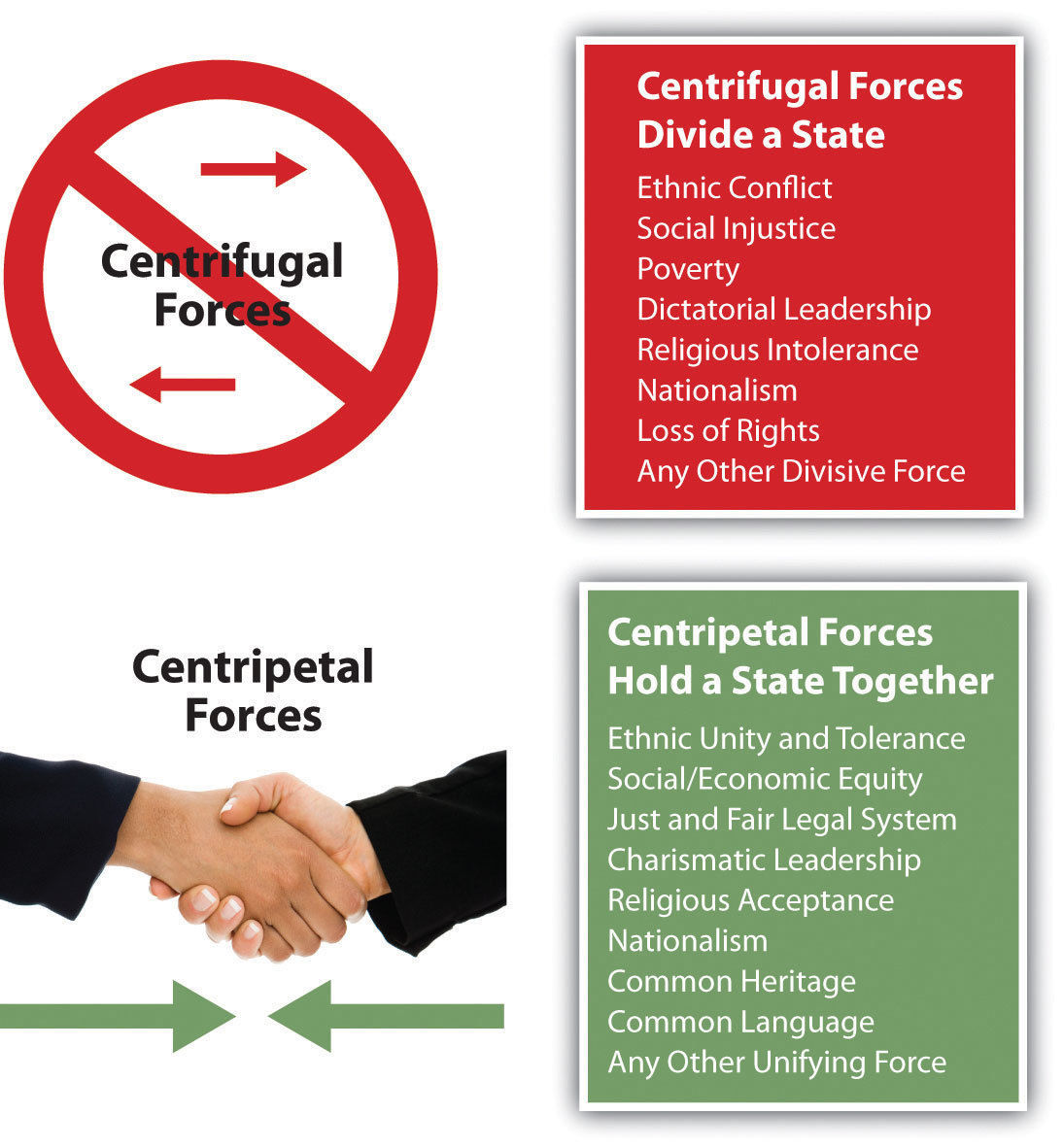
- 54Centrifugal ForcesA force pushing away from the center; in geography it refers to forces that divide a country physically, culturally, and/or politically.
- 55Centripetal ForcesA force holding things together; in geography it refers to unifying physical, cultural, and/or political forces.
- 56CENTRIFUGAL VS. CENTRIPETAL FORCES
- 57ShatterbeltA region that finds itself under constant cultural/political stress, and often fragmented by political rivals.
- 58Superimposed BoundaryA boundary forced on a group of people without regard to cultural differences; often creates multinational states and an atmosphere for conflict.
The boundary is drawn by an outside group. - 59Relic BoundaryA boundary that no longer exists, but still has an impact on the cultural landscape.(i.e. East and West Germany)
- 60Antecedent BoundaryA political boundary that existed prior to the cultural landscape emerging in a region. (i.e. the western boundary between the U.S and Canada)
- 61Columbian ExchangeThe widespread transfer of plants, animals, ideas, culture, human populations, and technology between Europe and the Americas between the 15th and 16th centuries; related to European colonization and trade following Columbus' exploration.
- 62Green RevolutionA large increase in food production in less developed countries due to an increase in the use of fertilizers, pesticides, and high yield varieties (GMOs).
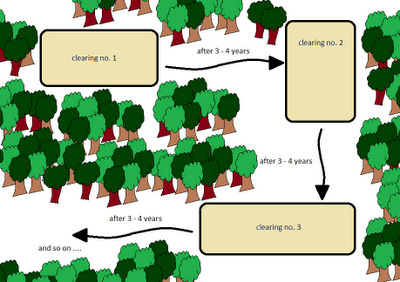
- 63Shifting CultivationA form of subsistence agriculture found in less developed countries with a tropical climate; characterized by slash and burn farming, then moving to new land after several years (though the village still remains in the same location).
- 64Extensive Farming PracticesUtilizes small inputs relative to the amount of land being farmed; large tracts of land are used. (i.e. livestock ranching, grain farming)
- 65Intensive Farming PracticesAgricultural intensification that seeks to maximize yields through machinery and pesticides; often refers to smaller tracts of land where each piece of the land must be productive.
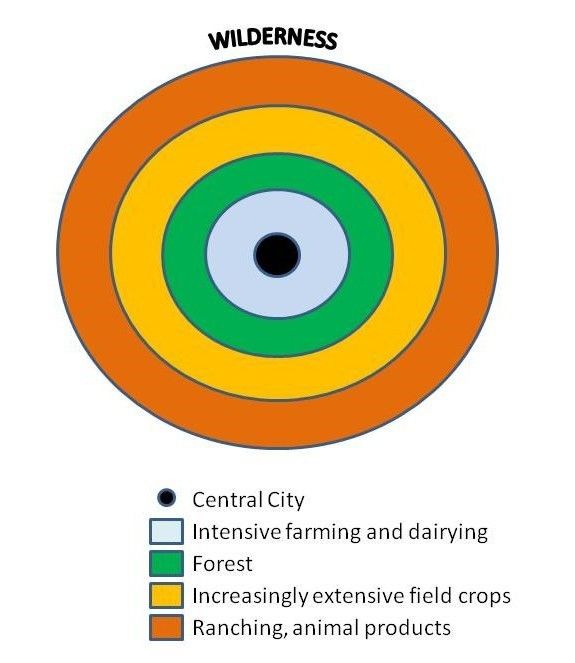
- 66Von Thunen ModelModel of rural land use showing that proximity to the market is a large factor in choosing crops; proximity to the market determines two important costs: transportation and the cost of land.
- 67HorticultureThe art and science of growing plants (fruits, vegetables, and flowers).
- 68AquacultureThe rearing of aquatic animals or plants for food.
- 69Quaternary SectorThe knowledge based part of the economy; jobs are often involved in information technology, media, research and development, or consultation.
- 70Quinary SectorThe highest levels of decision making in society or economy; (i.e. top executives, government leaders, university deans, and non-profit leaders.)
- 71Weber's Model (aka Least Cost Theory)A theory of industrial location that states that businesses will seek to minimize the costs of transportation and labor costs and maximize the benefits of agglomeration.
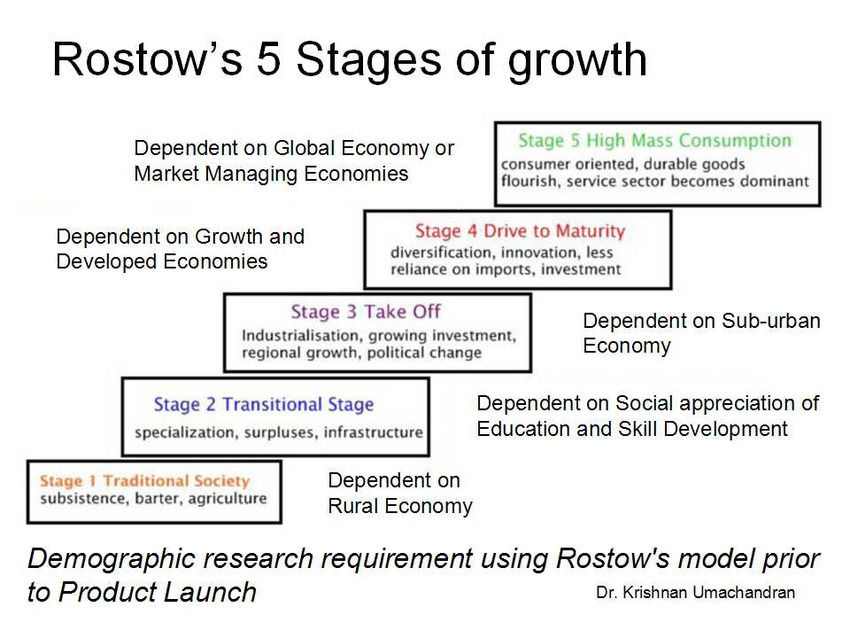
- 72Rostow's ModelA model for economic growth; argues that countries will develop through international trade.
- 73Wallerstein's World Systems TheoryA three tiered system that describes the core, semi-periphery, and periphery; economic and political systems are influenced by this system.
- 74U.N Millennium Development Goals
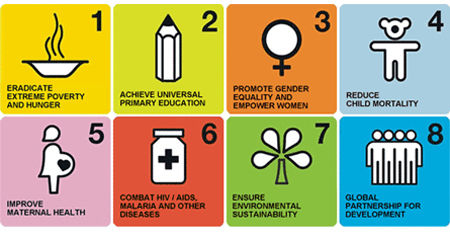
- 75MicroloansSmall loans often given to women in less developed countries to assist in starting/expanding small businesses.
- 76ComplementarityWhen two regions through trade can assist one another to satisfy each other's needs.
- occurs when one area has a surplus of one item demanded by a second area. - 77Comparative AdvantageThe ability of a region or country to carry out an economic activity better or at a smaller price than other regions/countries.
- 78Special Economic ZonesAreas in which businesses and trade laws are different than the rest of the country. The SEZ is often found near the border/coast of the country, and the purpose is to increase trade, international investment, and job creation.
- 79Research TriangleAn eight county region in North Carolina that is anchored by the University of North Carolina, Duke, and NC state. It comprises Raleigh, Durham, and Chapel Hill. This region is especially known for high levels of education leading to high technology industries and medical facilities and jobs.
- 80EcotourismA form of tourism to often exotic locations to observe wild life, rare vegetation, and beautiful environments. (Costa Rica is especially known for ecotourism)
- 81Hotelling ModelA model in economic geography that argues that industries will make their products more similar and locate closer to one another.
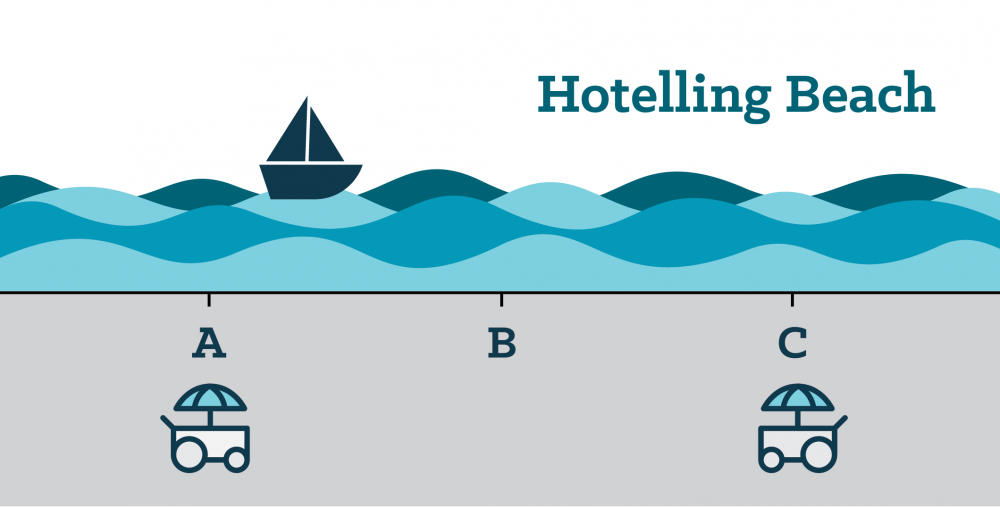
- 82Dependency TheoryThe idea that the capitalist, rich, core countries enjoy wealth at the expense of peripheral countries whose resources are sent to core countries.
- 83Vertical IntegrationAn approach typical of traditional mass production in which a company controls all phases of a highly complex production process.
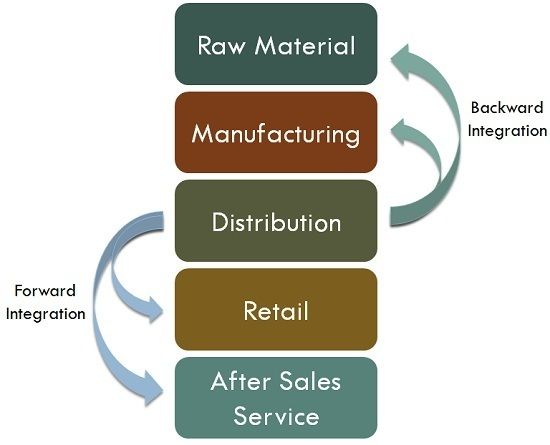
- 84Horizontal IntegrationOwnership by the same firm of a number of companies that exist at the same point on a commodity chain (e.g., PepsiCo owns Gatorade, Frito-Lay, Quaker, ... YUM! owns Taco Bell, KFC, A&W, ...).
- 85Brochert's Epoch of Urban GrowthJohn Borchert's model: (1967); recognized four epochs in the evolution of the American metropolis based on the impact of transportation & communication:
• 1) Sail-Wagon Epoch (1790-1830) - associated with low technology
• 2) Iron Horse Epoch (1830-70); steam-powered locomotive & spreading rails
• 3) Steel-Rail Epoch (1870-1920); full impact of Ind. Rev. (steel), hinterlands expand
• 4) Auto-Air-Amenity Epoch (1920-70); gas-powered internal combustion engine
• High Technology Epoch (1970-today ); expansion of service & information industries (not part of Brochert's model)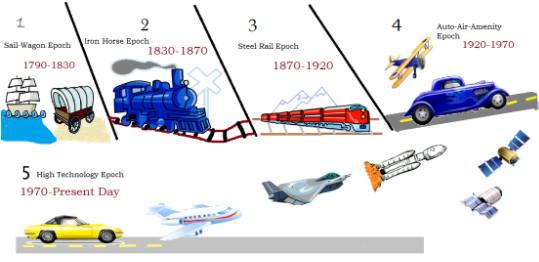
- 86World CitiesCities that link major economic activities in the global economy. (i.e. Los Angeles, New York, London, etc...)
- 87Rank-Size RuleA model that attempts to predict the size of the population of cities in the urban hierarchy; states that the size of a city is inversely related to its rank; the second largest city is 1/2 the largest, the third largest city is 1/3 the largest, etc...
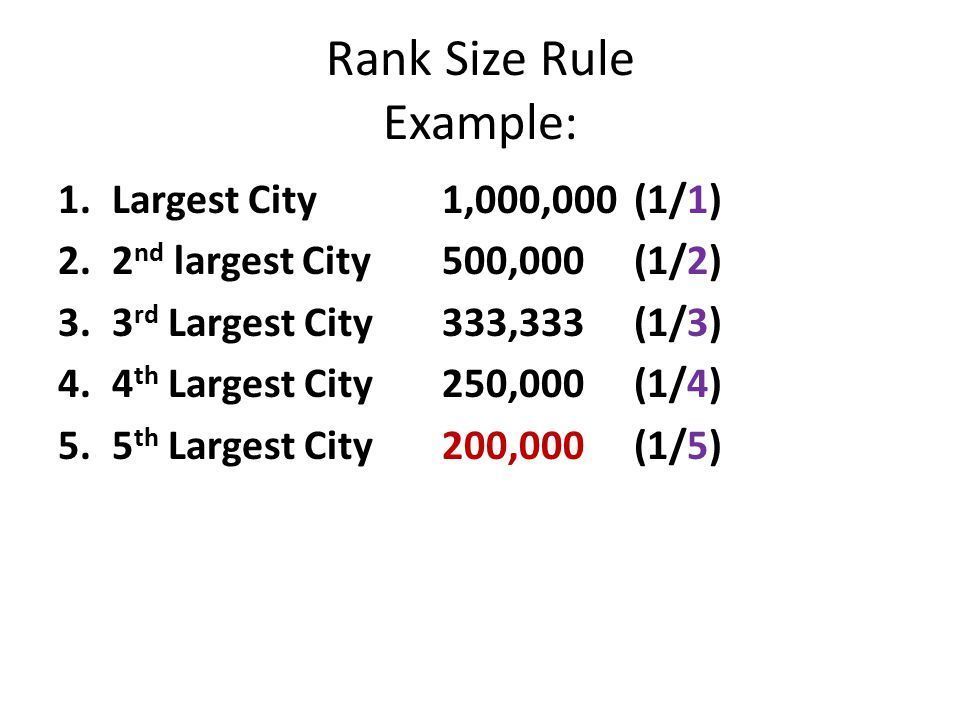
- 88Primate CityThe largest is at least double the size of the next largest city; it is also the most culturally/economically expressive of the country, and is often the capital city.
- 89Christaller's Central Place TheoryA theory that seeks to explain the number, size, and location of human settlements in urban systems; the settlements serve as "central places" serving the surrounding areas.
- Range = the maximum distance a person is willing to travel for a service.
- Threshold = the minimum number of people needed to support a service.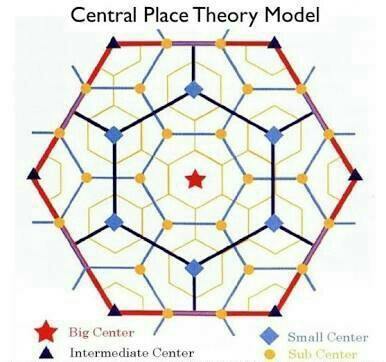
- 90Burgess Concentric Zone Model
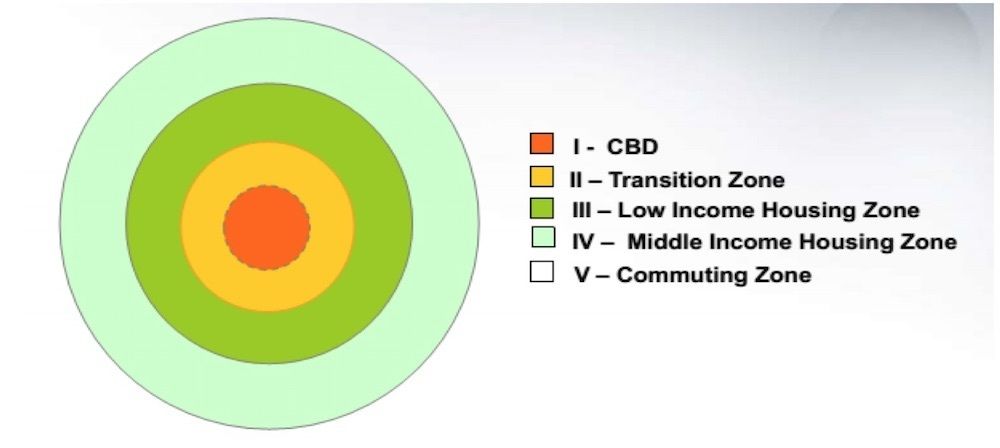
- 91Hoyt Sector Model
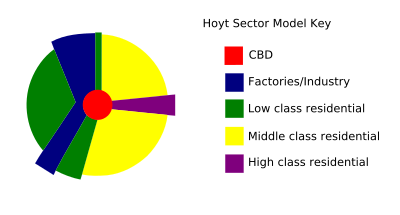
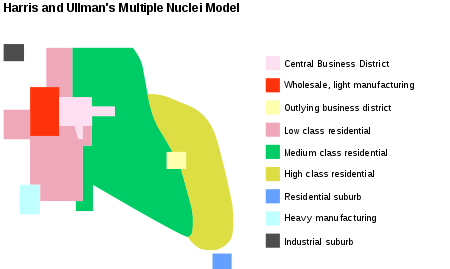
- 92Harris and Ullman Multiple Nuclei Model
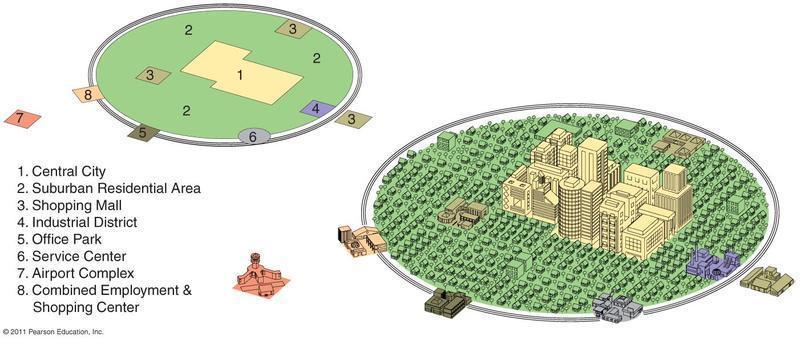
- 93Galactic City ModelThis model especially emphasizes the growth of edge cities in the urban system.
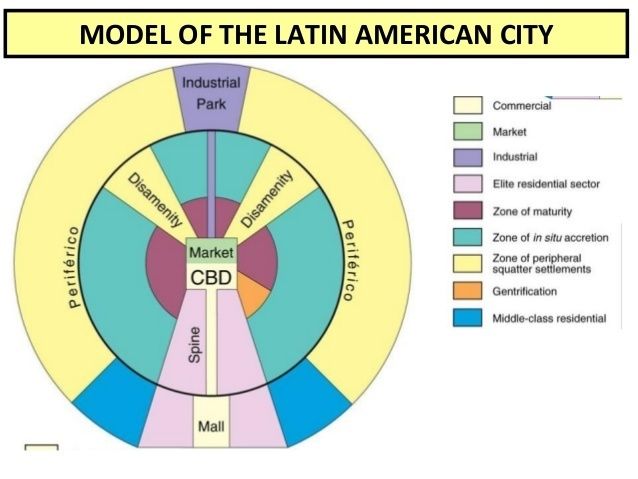
- 94Latin American City Model
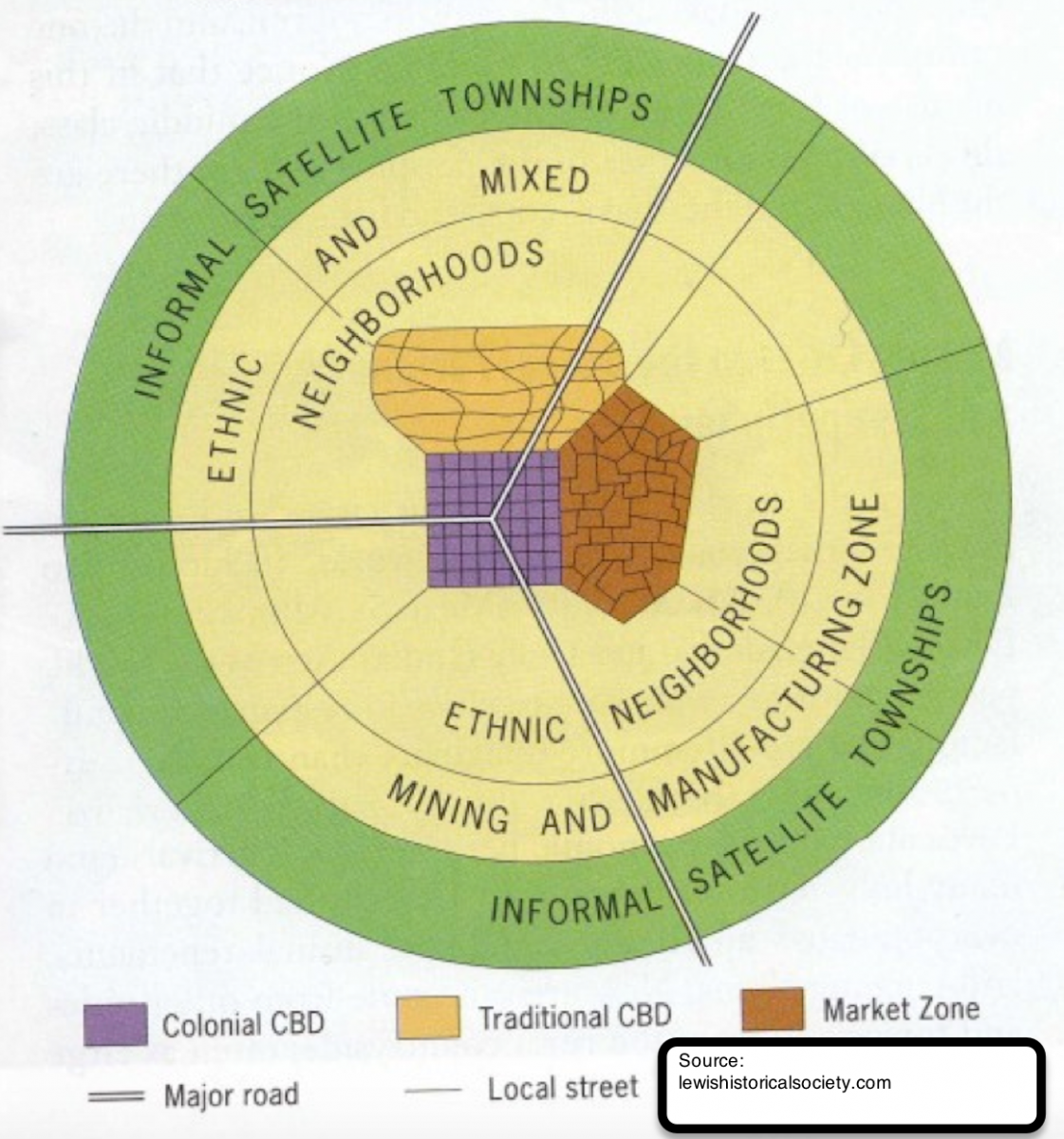
- 95African City Model
- 96Mixed Use ZoningZoning Laws that mark areas to be used for commercial and residential purposes.
- 97New UrbanismAn urban concept that promotes walkability, closer sense of community, proximity to work, public green space, and less time commuting through mixed use development.
- 98GreenbeltsAn area of open land around a city on which building is restricted.
- 99Disamenity SectorThe very poorest parts of cities that in extreme cases are not served by city services and are controlled by gangs and drug lords.
- 100GentrificationThe process of changing a neighborhood from low income to middle income through the addition of homebuyers willing to renovate properties often attracting businesses that serve the new demographic.
- 101Brown FieldsOld, abandoned industrial sites that may have left the soil contaminated; have left a portion of the city with a less than desirable site.
Informationen
- Beschreibung
- AP Human Geography Karteikarten am AP Human Geography - Key Concepts, erstellt von I'm a mess. am 11/05/2018.
- Erstellt von
- I'm a mess.
- Aufrufe
- 366
- Tags
- Bewertung