
Karteikarten
the nucleus
Karten in diesem Stapel (18)
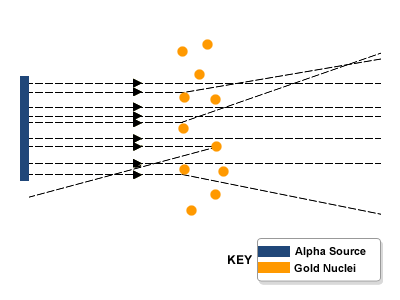
- 1Describe the process in which Rutherford discovered the modern nucleus--in the next few cards.
- 2Physicist Ernest Rutherford decided to use alpha particles to probe inside atoms.• the apparatus was in a vacuum chamber to prevent air molecules from absorbing the alpha particles
• the detector consisted of a microscope focused on a small glass plate - 3the results showed that:• most of the alpha particles passed straight through
• a minority of the alpha particles were deflected through small angles
• a minority of particles were also deflected through larger angles- above 90 - 4Rutherford deduced from the results that:• there is a positively charged nucleus at the centre of every atom
• the nucleus is much smaller than the atom
• it is where most of the mass of the atom is located
• the rest of the atom is mostly just space - 5Describe this diagram. (6)
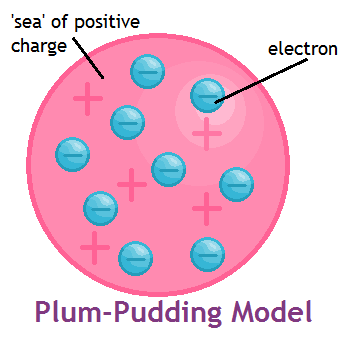
- 6What is the plum pudding model?a sphere of positive charge (fluid- the pudding) with negatively charged electrons spread through it (the plums)
- 7What was the effect of Rutherford's discovery on the plum pudding model?the discovery meant that it was no longer accepted by scientists
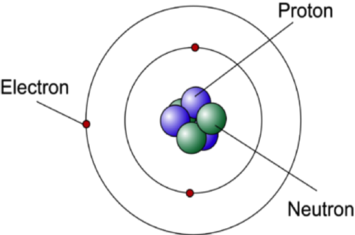
- 8What is Bohr's model?the theory that the electrons orbit the nucleus, which is made up of protons and neutrons, at specific distances and specific energy levels
- 9the plum pudding modelBohr's model
- 10atomic numberthe number of protons (or electrons) an element has
- 11mass numberthe number of protons plus neutrons an electrons has
- 12isotopesatoms of the same element with different numbers of neutrons- they have the same atomic number bu a different mass number
- 13A nucleus contains positively charged protons- and positives repel each other, so why doesn't it explode?there is a strong nuclear force which provides a force against the repulsion of the protons called binding energy
- 14What is a stable atom?an atom that has enough binding energy to hold the nucleus together permanently
- 15What is an unstable atom?the strong nuclear forces do not have enough binding energy to overcome the repulsion
- 16What determines whether a nucleus will be stable or not?the balance of protons and neutrons
- 17All elements with atomic numbers greater than ____ are radioisotopes and have unstable radioactive nuclei83
- 18Nuclei are unstable if:• the proton/neutron ratio is too large or too small (Carbon-14, e.g.)
• the nuclei is too large for the nuclear force to hold it together (elements larger than Bismuth-209)
Informationen
- Beschreibung
- • 7.2: the discovery of the nucleus • 7.3: changes in the nucleus
- Erstellt von
- Farha Idrees
- Aufrufe
- 1
- Bewertung