
17347797
Beschreibung

Erzeugt von Alexandra Bozan
|
|
Erstellt von Alexandra Bozan
vor mehr als 7 Jahre
|
|
| Frage | Antworten |
| valence bond theory | - defines a chemical bond as the overlap between 2 half-filled atomic orbitals - treats valence electrons as residing in quantum-mechanical atomic orbitals -orbitals can be s,p,d,f, etc. or hybridized atomic orbitals |
| hybridized atomic orbitals | a blend of 2 or more standard atomic orbitals |
| if the energy is _____ because of interactions between electrons/nucleus then a chemical bond formed. If energy is _____ then a chemical bond is not formed. | lowered raised |
| a chemical bond results from the _____ of 2 _____-_____ orbitals and spin-pairing of the 2 valence electrons (or less commonly the overlap of a completely _____ orbital with an _____ orbital) | overlap half-filled overlap filled empty |
| hybridization | when standard atomic orbitals are combined to form hybrid orbitals |
| hybrid orbitals | - new atomic orbitals - correspond more to actual distribution of e- in chemically bonded atoms - have different shapes/energies from standard atomic orbitals - all have the same energy: degenerate |
| hybrid orbitals allow greater _____ because the electron density in it is concentrated along a single directional _____. | overlap lobe |
| hybrid orbitals _____ the energy of the molecule by _____ the orbital overlap in a bond. | minimize maximizing |
| Number of standard atomic orbitals added together always ____ the number of hybrid orbitals formed. | equal |
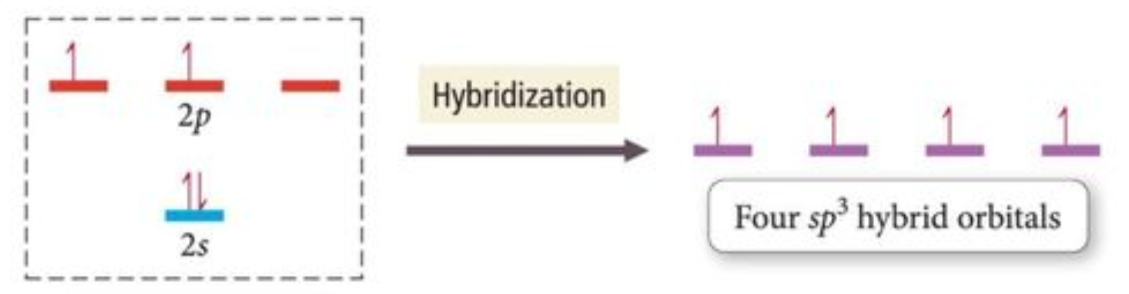
| sp^3 Hybridization | - mixtures of 1 s orbital & 3 p orbitals - 109.5°: tetrahedral |
| sp^3 Hybridization (visual) | Enter text here... |
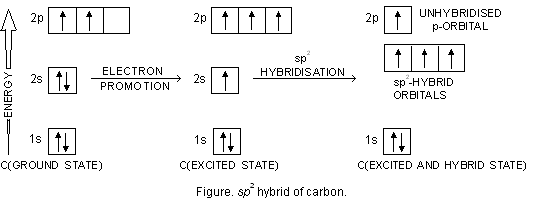
| sp^2 Hybridization | - mixtures of 1 s orbital & 2 p orbitals - 120°: trigonal planar |
| sp^2 Hybridization (visual) | Enter text here... |
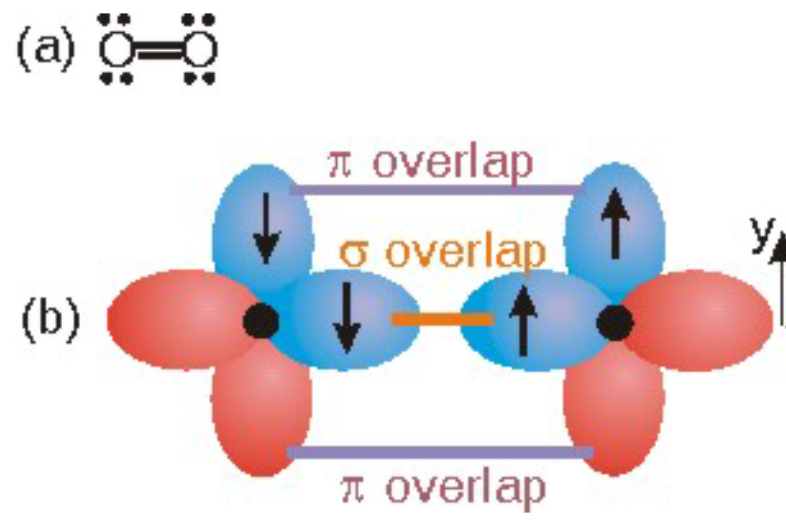
| pi bond (π) | when orbitals overlap side by side |
| sigma bond (σ) | when orbitals overlap end to end |
| sigma & pi visual | Enter text here... |
| 2 atoms can form only _____ sigma bond. | one sigma |
| a single bond is a ____ bond. | sigma |
| a double bond consists of a _____ bond and ____ bond. | sigma pi |
| a triple bond consists of a _____ bond and _____ _____ bonds. | sigma two pi |
| π bonds are _____ than σ bonds because the side-to-side orbital ____ is less _____ than the end-to-end. | weaker overlap efficient |
| _____ bond in a double bond is easier to break than the ______ bond. | π σ |
| rotation about a ____ bond is highly restricted, rotation about a _____ bond is relatively unrestricted. | double single |
| why is a double bond not twice as strong as a single bond | - because a double bond is composed of a π and σ bond; each a different type. - a single bond is composed of a σ bond - thus the bond energy of a double bond is not the energy of 2x a single bond doubled (2 σ) |
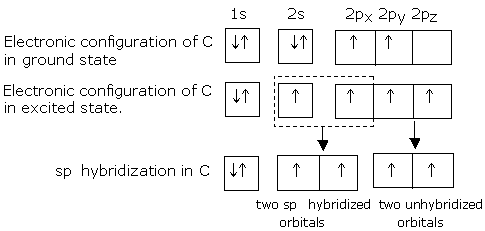
| sp Hybridization | - mixtures of 1 s orbital & 1 p orbitals - 180°: linear |
| sp Hybridization (visual) | Enter text here... |
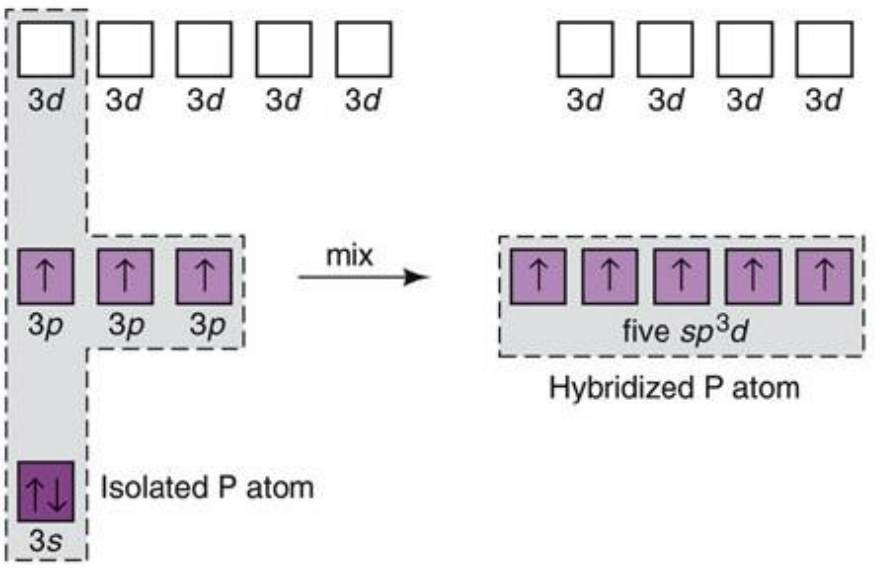
| sp^3d Hybridization | - elements >= third row (expanded octets) - mixtures of 1 s, 3 p and 1 d orbital - trigonal bipyramidal - equatorial: 90° axial: 120° |
| sp^3d Hybridization (visual) | Enter text here... |
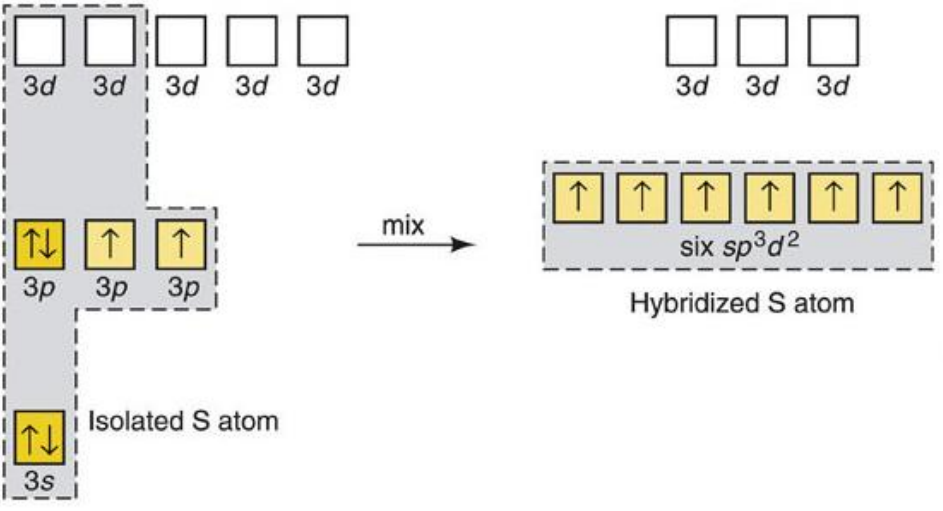
| sp^3d2 Hybridization | - elements >= third row (expanded octets) - mixtures of 1 s, 3 p and 2 d orbital - 90° octahedral |
| sp^3d2 Hybridization (visual) | Enter text here... |
Möchten Sie mit GoConqr kostenlos Ihre eigenen Karteikarten erstellen? Mehr erfahren.