
1737299
Beschreibung

Karteikarten von megan.radcliffe16, aktualisiert more than 1 year ago

|
Erstellt von megan.radcliffe16
vor fast 12 Jahre
|
|
| Frage | Antworten |
| How can Amines be classified? | Primary Secondary Teritary |
| What is the simplest amine? | Ammonia |
| What is a Quaternary ammonium salt? | A quaternary ammonium salt is an ammonium salt, in which all the hydrogens have been replaced by an alkyl group |
| Why are amines bronsted Lowry bases? | Because the lone pair on the N atom can readily accept a proton |
| What does the strength of the base depend upon? | It depends upon the availability of the N lone pair to form a bond with the H+. The higher the electron density of the lone pair on the N, the better it will accept the H+. = stronger the base. |
| Why are carbon chain ( aliphatic) amines stronger bases than ammonia? | Alkyl groups are electron releasing so they push the electron density towards the nitrogen, so therefore increase the availability of the nitrogen lone pair to accept the H+. |
| What is the order of strength of amines? | Tertiary > secondary > primary |
| why are tertiary and secondary amines stronger than primary? | The N lone pair has a greater electron density because of the enhanced inductive effect of more alkyl groups. |
| Why are aromatic amines weaker than ammonia? | The N lone pair interacts with the delocalised π electrons - become partially delocalised into benzene ring. Reduces availability of N lone pair to accept a proton and so reduces strength. |
| What type of reaction occurs with ammonia and haloalkanes to form a primary amine? | Nucleophillic substitution. |
| why does the primary amine formed in nucleophillic substitution act as a nucleophille? | It has a lone pair of electrons on the N atom |
| Why are primary amines able to react to form secondary amines? | Because of the lone pair of electrons on the N atom. |
| How is further substitution possible? what does this lead to? | The secondary amine is able to act as a nucleophile. Leads to the formation of Tertiary and then quaternary ammonium salts. |
| How can the reaction be altered to have primary amines as the main product? | Use a large excess of ammonia |
| How can the reaction be altered to have the quaternary ammonium salt as the main product? | have a large excess of the haloalkane. |
| What is the use of Quaternary ammonium salts? | Fabric softeners |
| How do you prepare aliphatic amines? | 1. Reaction of excess NH3 with Haloalkanes 2. Reduction of nitrile compounds |
| what takes place in the reduction of nitrile compounds. | 1. nitrile is produced by nucleophilic substitution. 2. Reduce the nitrile compound |
| what are the two options for the reduction of nitrile compounds? | 1. Reduction using LiAIH4 in dry ethoxyethane 2. Catalytic hydrogenation using H2 and Ni catalyst |
| What is the process of preparing primary aromatic amines? | 1. Reduction using Sn and conc. HCl, followed by NaOH 2. Catalytic hydrogenation using H2 and Ni catalyst |
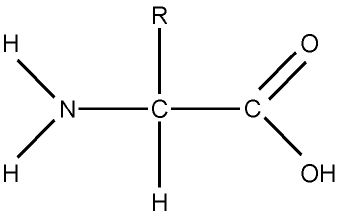
| What is the structure of an amino acid? |
Image:
amino.gif (image/gif)
|
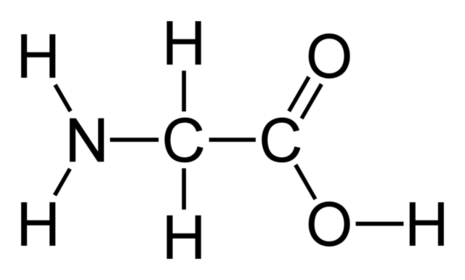
| what is the simplest amino acid? | Glycine (aminoethanoic acid) |
| why are all amino acids optically active? What does this mean? | They all have a Chiral centre. It means that it is able to rotate the plane of polarised light. |
| What property does an amino acid show? | Amphoteric |
| As amino acids are amphoteric, what are they able to do? | Amino acids have a carboxylic acid and an amine group. As acids- able to donate proton to bases. As Bases- able to accept protons. |
| What are the characteristics of pure state amino acids? | 1. White crystalline solid 2. Dissolve in water easily 3. High melting point |
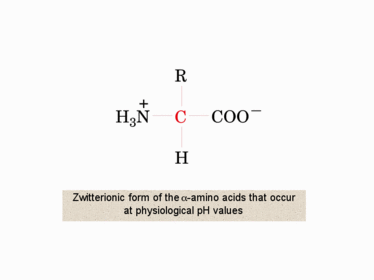
| What is a Zwitterion? |
Image:
img019.gif (image/gif)
|
| Why does the high melting point occur? | There are ionic bonds present between the zwitterions. |
| what happens as the pH increases to the zwitterion? | The NH3 group loses a proton and acts as an acid. |
| what happens to the zwitterion as the pH decreases? | The COO- group gains a proton and acts as a base |
| what do Zwitterions behave as? | Buffers |
| What is the link between amino acids? | Peptide link |
| why type of reaction occurs between two amino acids? | Condensation reaction |
| what do: 1. two amino acids 2. three amino acids 3. Many amino acids form? | 1. dipeptide 2. tripeptide 3. Polypeptide |
| What is the primary structure of an amino acid? | The particular order of the amino acid. |
| How is an amino acid chain in a protein held into shape? | By hydrogen bonding |
| What are the two basic shapes the the proteins due to hydrogen bonding? What are those kind of structures? | 1. α helix 2. β pleated sheet secondary protein structures |
| what is the type of reaction where proteins are broken down to form amino acids? | Hydrolysis |
| How can a mixture amino acids be separated and identified? | by using Paper chromatography or thin layer chromatography |
| How can the peptide link by hydrolysed? | Boil the protein with 6 mol dm-3 for 24 hours |
| What are polymers? | Large molecules built up from many monomers. |
| what kind of mechanism takes place during addition polymerisation? | Free radical mechanism |
| What are the conditions of addition polymerisation? | High pressure presence of an initiator which provides free radicals. |
| how are esters formed? | A reaction between carboxylic acid and an alcohol |
| how are polyesters formed? | When a dicarboxylic acid reacts with diols |
| what is an example of a polyester and how is it formed? | Terylene formed from benzene-1,4- dicarboxylic acid and ethane-1,2-diol |
| How are Amides formed? | the reaction of a carboxylic acid and an amine |
| How are Polyamides formed? | Dicarboxylic acids react with diamines |
| what are an examples of a polyamide? Howare they manufactured? | Nylon-6,6 Reaction between 1,6-diaminohexane and hexane-1,6-dioic acid Kevlar benzene-1,4-diamine and benzene-1,4-dicarboxylic acid |
| why are addition polymers non biodegradable? | They are saturated and chemically unreactive. They have strong, non polar C-C and C-H bonds. |
| How are polyesters and polyamides hydrolysed? | By being in the presence of strong acid or a specific enzyme |
| What bond is broken in polyesters during hydrolysis? | Polar ester linkage |
| What bond is broken during the hydrolysis of polyamides? | Polar amide linkage |
| What is produced during the inceneration of polymers? | Greenhouse gases (CO2, methane) nitrogen dioxide cyanide |
| What are the advantages of recycling? | Conserves supplies Saves energy |
| what are the disadvantages of recycling? | Plastics need to be collected, transported and sorted uses energy uses man power Expensive |
Möchten Sie mit GoConqr kostenlos Ihre eigenen Karteikarten erstellen? Mehr erfahren.