
Karteikarten
Chapter 18: Aggregate demand and the circular flow of income
Karten in diesem Stapel (178)
- 1Define aggregate demandThe total planned expenditure on real output (goods and services) within the economy
- 2What is national expenditure ?Measures realised or actual spending which has already taken place
- 3What are the different sectors of the economy ?Households
Firms
Government sector
overseas sector - 4What is the aggregate demand equation?AD= C + I + G + (X-M)
Consumption spending by households + Investment spending by firms + Government spending + Net export demand - 5If any of the components of AD change, what happens to aggregate demand ?Either increases or decreases
- 6Define consumptionTotal planned spending by households on real output produced within the economy
- 7Aggregate consumption does not include what ?Spending by households on imports because they part of the goods and services produced in other countries
- 8What is saving ?Income which is not spent on consumption
- 9What is investment ?Spending by firms on capital goods such as machines and office equipment. Also includes spending on raw materials and energy
- 10Who makes saving decisions and who makes investment decisions ? (usually)Households make saving decisions
Firms make investment decisions - 11Give an exception to the idea that firms only make investment decisions.A firm makes the decision to plough back retained profits and spend them on capital goods, rather than distribute them as income to the owners of the business.
The firm is saving and investing. - 12If a business were simply to stores profits as a cash reserve, what would they be doing ?Only be saving and not investing
- 13Whenever members of households make decisions about whether or not to spend on consumer goods, they are simultaneously deciding what ?Whether or not to save
- 14A determinant of consumption is also a determinant of what ?Household saving
- 15What are the main factors influencing consumption and saving ? (7 marks)1) Interest rates
2) Income levels
3) Expected future income
4) Wealth
5) Consumer confidence
6) Availability of credit
7) Relative income - 16Define interest rateThe reward for lending savings to someone else (a bank) and the cost of borrowing.
- 17The rate of interest rewards savers for what ?Sacrificing current consumption
- 18The higher the interest rate, the greater the what ?Reward of saving
- 19At any particular income level, the amount saved will increased while what rises and what falls ?Real rate of interest rises
Amount consumed falls - 20Keynes believed what about the relationship between rising aggregate planned consumption and rising income ?Aggregate planned consumption rises at a slower rate than income, so that at high levels of income planned consumption is less than income and planned saving is positive
- 21In the 1930s, Keynes argued what about interest rates and aggregate saving and consumption decisions ?Had little effect on aggregate saving and aggregate consumption levels
HOWEVER
they do affect how people move their savings: between banks and a building society - 22Keynes lack of enthusiasm for the effectiveness of interest rates led him to focus on what as the main determinant of consumption and saving decisions ?Income
- 23Keynes argued for what as the most important single determinant of consumption ? He believed that consumption is also largely a function of it/The level of income (Y)
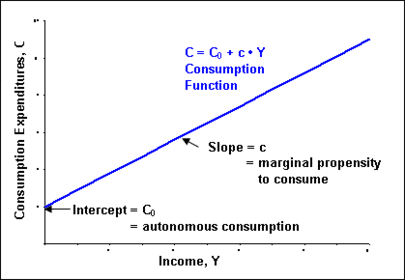
- 24What is the the Keynesian consumption function equation ?C= a + cY
Aggregate consumption = Autonomous consumption + Income-induced spending - 25Draw a graph showing Keyne's theory of consumption
- 26Explain what autonomous consumption is What is the value of autonomous consumption determined by ?represented as a
Part of the total consumption which is unaffected by the level of income. It is constant at all levels of income.
Determined by the influences on income other than the level of income. e.g. rate of interest etc - 27Explain what Income-Induced consumption is - What rises at a faster rate than income ?Measured by (cY) being the slope of the consumption function
- Part of consumption that varies with the level of income
- If consumption increases as incomes rise, but at a slower rate, it follows that household saving also increases as income rise, but at a FASTER RATE than income - 28Explain how saving can be positive or negativeNegative saving= People on very low incomes tend to borrow or dissave to spend more than their incomes
Positive saving= rich people tend to spend less than their incomes even though their total spending is greater than the poor. - 29The current level of income in a particular year may have much less influence on what ?A person's PLANNED CONSUMPTION
- 30What may have more influence on a person's planned consumption ?'Expected income' over a much longer time period, perhaps extending over the individual's remaining lifetime or life cycle
- 31What is 'non-contractual' saving ?takes place when a person sets income aside. More short-term such as saving for a summer holiday
- 32What is contractual saving ?Occurs when an individual makes a contract to save regularly with a financial institution such as a pension fund.
Usually undertaken with a long-term motive in mind.
Saving takes place at regular intervals over a number of years to be followed in later years by dissaving when say a house is bought or on retirement. - 33Give some examples of contractual savingA person signs saving contracts early in their working lives to finance a house purchase and then continue to save to finance retirement or to protect dependants against financial problems that would result from the saver's early death.
- 34How do people plan their contractual saving ?On the basis of a long-term view of their expected lifetime or permanent income, and of likely spending plans over the remaining length of an expected life cycle.
- 35What generally has little effect on the contractual savings that are regularly contributed to pension schemes and to purchase life insurance policies ?Temporary fluctuations in yearly income
- 36Define WealthThe stock of assets or things that have value which people own
- 37Which is a stock and which is a flow in terms of wealth and incomeIncome is a flow
Wealth is a stock - 38What are the 2 main forms of wealth asset that people own in the UK and the USA ?Houses and Shares
- 39What generally happens if conumers' wealth increases ?Spending may be higher
- 40An increase in house prices usually causes home-owners to do what ? Why ?Consume more and to save less from their current flow of income because the wealth increase is a form of saving.
- 41What is the main household wealth asset in the UK ?Houses
- 42How do rising house prices influence economic behaviour among owner-occupiers of houses ?Induces a feel-good factor, leading to a consumer spending spree in the shops.
- 43How do falling house prices influence the economic behaviour of house owners ?Increases uncertainty and precautionary saving via a 'feel-bad' factor occurs.
- 44What was the impact of the stock market crash in 2000 centred on the collapse of the share prices of dot.com and high-tech companies ?Reduced the wealth of shareholders
Reduced consumption of shareholders - 45In the summer of 2007, what event caused share prices to fall at the time of the financial crisis in the USA ?US banks lending unwisely to poorer American families to finance house purchases, known as sub-prime loans.
- 46In 2008, what 2 main factors ushered in a recession in the USA and is other countries such as the UK ?1) Falling house and share prices
2) Collapse in consumer and business confidence - 47What was the impact of borrowers not being able to repay their loans/ interest on banks ?Banks were left with bad debts as were other financial institutions that bought 'packages' of bad debt from the banks
- This infected the financial system and meant that banks stopped lending to each-other - 48What was the result of banks haulting lending to each-other ?The credit-crunch
- 49What were the main impacts of a lack of mortgages in the housing market ?- The market began to stagnate and properties were bought for less than previously.
-This increased the amount of NEGATIVE EQUITY in the economy - 50What is a state of consumer confidence closely linked to ?People's views on expected income and changes in personal wealth
- 51When consumer optimism increases, households generally do what ?Spend more and save less
- 52What is the likely impact of a fall in consumer optimism ?Households generally save more and spend less
- 53Why do Governments try to boost consumer and business optimism ? How do they do it ?Ward off the fear of a collapse in confidence
- by 'talking the economy up' and by trying to enhance the credibility of government economic policy. - 54If the government is optimistic about the future and people believe there are good grounds for this optimism, how are the general public likely to be ?Optimistic and confident about the future
- 55How much consumer confidence dissipate ? (2 marks)1) Believe the government is pursing the wrong policies
2) An adverse economic shock hits the economy in a way the government cannot control - 56What other aspects of monetary policy affect consumption ?1) Controls on bank lending
2) Hire-purchase controls. - 57If credit is available easily and cheaply, then what is likely to happen to consumption ? Why ?Consumption increases as people supplement current income by borrowing on credit credited by the banking system.
- 58What is the likely impact of tight monetary policy ?Reduces consumption.
- 59Explain the link between the financial crisis in 2007 and 2008 and tight monetary policy reducing consumption.In the credit crunch, interest rates rose and the supply of credit dried up, with banks refuisng to supply applicants with new credit cards of mortgages.
- 60Explain how the distribution of income influences consumption and saving.Higher income groups tend to have a higher marginal propensity to save.
Redistribution of income from rich to poor increases consumption and reduces saving - 61Uncertainty caused by fears of rising inflation has what affect on saving and consumption ?Increases precautionary saving and reduces consumption
- 62What is the opposite effect of expectations of rising future inflation ?Households may bring forward consumption decisions by spending NOW on consumer durables (TVs, Cars etc)
This way they avoid expected future price increases which make goods unaffordable without a rise in real wages. - 63If people expect property prices to appreciate at a rate faster than general inflation, people may make what decision ?Decide to borrow to finance the purchase of houses.
- 64If the real rate of interest is low or negative, people will often decide to buy what things in preference to saving through the purchase of financial assets?Land, property and other physical assets such as fine art and antiques as a 'hedge' against inflation.
- 65Why does speculative demand for housing occur ?House prices are rising faster than general inflation
- 66Define the personal savings ratioMeasures the actual or realised saving of the personal sector as a ratio of total personal sector disposable income
- 67What is the equation for the personal savings ratio ?Personal saving ratio= realised or actual personal saving (divided by) personal disposable income
- 68What is a household saving ratio ?Measures households' realised savings as a ratio of their disposable income.
- 69What does the personal sector consist of ?Households, unicorporated businesses (partnerships, charitable organisations such as independent schools)
- 70Why are economists interested in how much of their incomes people plan to save and to consume in the near future ?Provides important information about what lies ahead for the state of aggregate demand
- 71What is generally used as an indicator of what people wish to do in the future in terms of consumption and saving ?The personal saving ratio calculated for the most recent past period
- 72Why is the personal saving ratio used as an indicator of future plans ?It is difficult to measure people's plans accurately
- 73Between the end of 1996 and early 2008, what happened to the UK household savings ratio ?Fell rapidly with some volatility
- 74The household savings ratio bottomed out at what % before the beginning of the recession ?around 0%
- 75When does negative saving occur ? What is this called?If people borrow more than they save
DISSAVING - 76After early 2008, the household savings ratio recovered to around what % in 2009 and 2012 ?8%
- 77What is one of the factors affecting household savings ? What is the effect ?Peoples uncertainty about the future
1) job losses
2) Fall in future income
likely to save more for essentially precautious reasons - 78What usually happens to savings ratios in recessions ?They generally rise
- 79What factors may override an increase in the savings ratio ?The need to borrow more to maintain spending levels and current standards of living and lifestyles
- 80What is the equation for total savings ?Disposable income - household consumption
- 81What was the UK savings ratio in Q3 2014 ?Decreased to 7% from 7.5% in Q2
- 82Why do savings ratios tend to rise in recessions ?1) Worries about unemployment
2) Harder to get a loan in a recession, Banks try to balance the sheets
3) People save more despite low interest rates - 83What is the paradox of thrift ?If everyone saves at once, it causes macroeconomic problems such as recessions because it will cause a fall in AD
- 84In a recession, a sharp rise in the savings ratio means what happens consumer spending ?Decreases significantly
- 85In Keynesian economics, a rise in the savings ratio gives reason for what governmental actions ?A rise in the budget deficit
- 86If the savings ratio rises, what is the effect on government spending and borrowing ?-Government spending rises to take the place of the private sector spending and investment. If not, the recession will be deeper
- Private sector have more available funds to purchase government bonds - 87What are the main benefits of a high savings ratio ? (2 marks)1) Long-term, helps promote more sustainable economic growth
2) Enables more private sector investment, key to determining the long-term economic growth rate. - 88What are the main problems with a high savings ratio ?Cause a fall in aggregate demand and a recession (SHORT-TERM)
- 89What are the main problems with a low personal savings ratio1) Unbalanced economy with over reliance on consumer spending
2) Current account deficit, imports greater than exports.
3) Build up of personal debt. - 90What is investment ?Planned demand for capital goods.
- 91How can firms and the government invest in human capital ?- Providing or improving education
- Providing or improving training - 92Is capital or investment a stock concept or a flow concept ?Capital = stock
Investment= flow - 93What is the national capital stockrepresents the total of all the nation's capital goods, of all types, which are still in existence and capable of production.
- 94How do we measure the flow of investment ?Over a period, usually a year
- 95What are the 2 parts of a country's gross investment ?1) Replacement investment
2) net investment - 96Explain what replacement investment is- Maintains the size of the existing capital stock by replacing worn-out capital
- 97Explain what net investment isNet investment adds to the capital stock, thereby increasing productive potential.
- 98Along with technical progress, net investment is one of the engines of what ?economic growth
- 99Investment in physical capital goods can be two types:1) Investment in fixed capital (new factories or plants, social capital such as roads and socially owned hospitals)
2) Inventory investment (in stocks of raw materials or variable capital) - 100What are the 2 main determinants of investment in fixed capital ?1) Entrepreneur's expectations of an investment's FUTURE YIELD or RATE OF RETURN
2) cost of borrowing funds to finance the purchase of caputal goods - 101If a firm is expected an investment to yield a return of 8% on average for each year of the investment's expected future life, and the cost of borrowing the funds to finance the investment is 6%, is the investment worthwhile ? Why ?yes, because it is expected to be profitable.
- 102Draw a typical marginal efficiency of capital curve
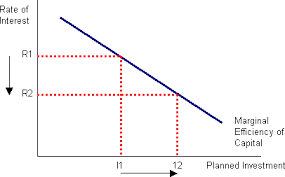
- 103What does the marginal efficiency of capital curve ?Shows the rate of return on each additional unit of capital.
- 104Define planned investmentLevel of investment which firms intend to undertake at the beginning of the period.
- 105Define actual investmentLevel of investment which has occurred at the end of the period.
- 106What happens if firms fail to sell as much as they want to ?Left with stocks which they had not planned for
Actual investment will be greater than planned investment - 107Define autonomous investmentUnrelated to the level of national income
- 108Define induced investmentInvestment which is related to changes in the level of national income
- 109On a marginal efficiency of capital curve, the equilibrium level of aggregate investment is determined on the graph at what point ?Where the marginal efficiency of capital equals the cost of borrowing
I = R - 110Explain how worthwhile the investment is at the equilibrium levelOnly just worthwhile
The value of future returns = cost of borrowing the funds to finance invesmtent - 111All investments to the left of the equilibrium level of aggregate investment are said to be what ?Supra-marginal, worthwhile
Marginal efficiency of capital is more than the cost of borrowing. - 112Investments to the right of the equilibrium level are what ?Sub-marginal
SHOULD NOT BE UNDERTAKEN
future returns are expected to be less than the interest payments needed to finance the investments - 113How is a collapse in investment shown by an MEC curve ? What is the effect ?MEC shifts inwards
Aggregate demand falls and a recession ensues - 114Other than expected future rates of return and the rate of interest, what are some other determinants of investment ? (5 marks)1) relative prices of capital and labour
2) Nature of technical progress
3) adequacy of financial institutions in the supply of investment funds
4) impact of government policies
5) Activities on investment by the private sector - 115When the price of capital rises, (prices of capital goods or rates on interest rise) what do firms do in the long-term ?Firms adopt more labour-intensive methods of production, substituting labour for capital.
- 116If the price of capital goods or the interest rates fall, firms switch to what methods of production ? What is the impact on investment ?Capital-intensive
Investment increases - 117Define technical progressImprovements in methods of production resulting from invention, innovation and R&D. It often leads to the production of new types of goods and better-quality goods.
- 118What is the impact of technical progress of a machine's business life ?Becomes shorter than the the machines technical life
- 119What is a machine's technical life ?the number of years before the machine wears out.
- 120A sudden burst of technical progress may cause firms to do what long before the equipment's technical life is over ?Firms may replace capital goods too early
- 121Many investments in fixed capital are what type of time period ?Long-term investments
yield most of their expected income several years into the future. - 122Why may long-term investments in fixed capital goods be difficult to finance ?The inadequacy of the financial institutions that provide the investment funds. Banks tend to favour short-term investments and are reluctant to provide the finance for long-term investments.
- 123The growth of what has emerged to provide an important source of medium to longer term finance ?private equity finance
- 124How can governments finance investment projects ?Provide funds for firms to borrow
- 125In the past, the UK governments have provided investment funds to rescue jobs in what type of industries ? Why is this viewed as poor choice on governments behalf ?Loss-making and uncompetitive industries
Many people feel that they ought to be allowed to continue their decline. - 126Why might government ministers and their civil servants make bad investment decisions ?Unlike entrepreneurs, they don't face the risk of being bankrupted as a result of poor decision making.
- 127What is the accelerator ?- Shows the relationship between net investment and the rate of change of national output.
- When an increase in national income results in a proportionately larger rise in investment
- A change in the level of investment in new capital goods induced by a change in national income or output. - 128The size of the accelerator depends on what ?The economy's capital-output ratio
- 129The accelerator theory stems from what assumption about firms production and investment ?Firms wish to keep a relatively fixed ratio, known as the capital-output ratio, between the output they are producing and their existing stock of fixed capital assets.
- 130If output grows by a constant amount each year, why will firms invest in exactly the same amount each year ?To enlarge their capital stock so as to maintain the desired capital-output ratio. The level of investment is constant from year to year.
- 131When the rate of growth of output accelerates, what happens to investment and why ?Investment also increases because firms take action to enlarge their capital to a level sufficient to maintain the desired capital-output ratio.
- 132When the rate of growth of output decreases, what happens to investment ?Investment declines
- 133What does a capital-output ratio of 4:1 mean ?4 units of capital are required to produce 1 unit of output.
- 134The accelerator, or the accelerator coefficient is also known as what ?The capital-output ratio
- 135State the equation showing the accelerator principleI= v(Yt - Yt-1)
Net investment = Current national income - last year's income - 136With a capital-output ratio of 4:1, holding the assumption that current net investment in fixed capital depends on the change in income or output in the previous year. 1) In year 2013, Net investment is £40 billion, current income is 4x(£100bn) and last year's income is £90bn. - In 2014, current income increases by £10bn. - What will happen to net investment in 2014 ?Remains at £40 billion
- 137If income grows by the same amount each year, what happens to net investment ?Constant
- 138If income growth speeds up or ACCELERATES, what happens to net investment ?Net investment increases
- 139If income growth slows down or decelerates, net investment will ?Decrease
- 140As firms adjust stock of capital to the desired level, relatively slight changes in the rate of growth of income or output cause what ?Large absolute rises and falls in investment
- 141You can use the accelerator to explain what ?Why investment in capital goods is more volatile or unstable component of aggregate demand than consumption.
- 142Draw a circular flow of income model-
- 143Households supply what in exchange for goods and services produced by firms ?Labour
- 144These real flows generate what ?money flows of income and expenditure
- 145What is the AD formula ?AD = C + G + I + (X-M)
- 146Saving in the circular flow of income is an example of what ?A leakage or withdrawal
- 147What are investment in the circular flow of income ?An injection of demand
- 148What does the circular flow of income show ?Shows connections between different sectors. Revolves around flows of goods and services and factors of production between firms and households
- 149What are the 3 main withdrawals from the circular flow of income ?1) Saving
2) Taxation
3) Imports - 150What do withdrawals lead to ?multiplied contraction of output
- 151What are the main injections into the circular flow of income ?1) Investment expenditure
2) Government spending
3) Exports - 152Define equilibrium national incomeThe level of national income at which withdrawals from the circular flow of income equal injections into the flow.
- 153When equilibrium national income occurs, national income is tending neither to ?Rise nor to fall
- 154If the withdrawal exceeds injection, the resulting net leakage of spending from the circular flow causes what to occur ?Output and income to fall
- 155Savings can be either hoarder or the funds being saved can be ?the funds being saved can be lent to others to spend.
- 156When may planned saving end up equaling planned investment ?When all savings are lent, via international intermediaries (banks) for firms and consumers to spend.
- 157Where planned saving ends up equaling planned investment, what is the outcome of national income and the level of income?Remains in equilibrium
No reason for a fall in the level of income - 158If planned savings is greater than planned investment, the national income or output circulating around the economy is in what ?Disequilibrium
- 159Explain what a disequilibrium in national income is where planned saving is greater than planned investmentLeakages out of the system exceed injections of spending into the flow of income
- 160If planned saving by households exceeds planned investment by firms, there is a danger of what occurring to cause the economy to shrink into recession ?Deficient aggregate demand
- 161John Maynard argued what about household savings and the level of income or output circulating in the economyArgued that if household savings are not lent to finance spending by others, (investment by firms) the level of income circulating falls.
- 162How does the economy end up in a recession if savings are not lent to finance spending ?It reduces saving until planned saving equals planned investment, equilibrium is restored at a significantly lower level of national income.
- 163What was the belief of many of Keynes's opponents on deficient aggregate demand?Only exists as a temporary and self-correcting phenomenon
When deficient AD occurs, the rate of interest, rather than level of income, falls, quickly restoring equality between saving and investment intentions. - 164Why do low interest rates cause people to save less and for firms to invest more in new capital goods ?Saving is less attractive
Cost of borrowing has fallen - 165Keynes believed what about the process of interest rates bringing about equality between saving and investment ?The process is slow
- 166Keynes believed that the level of income does what when planned leakages of demand from the circular flow of income exceed planned injections of demand into the flow ?Level of income or output falls to restore equilibrium
- 167According to Keynes, what is the major cause of recessions ?Deficient AD
- 168Define a Closed EconomyAn economy with no international trade
- 169Define open economyan economy with exports and imports
- 170In an extended circular flow model, national income equilibrium, tending neither to rise nor to fall, is shown by what equation ?Saving + taxation + imports = investment + government spending + exports
S+T+M=I+G+X - 171S+ T + M > I + G + X What does this equation show ?A net leakage of demand
- 172In keynesian analysis, a net leakage causes what to happen to the equilibrium level of national income ?falls
- 173S + T + M < I + G + X what does the equation show ?A net injection of demand
- 174In keynesian analysis, what happens to the equilibrium level of national income ?Rises
- 175Explain how changes in the rate of interest affect consumption and saving (12 marks)-
- 176Explain the meaning of the circular flow of income (12 marks)-
- 177Do you agree that recessions are always caused by a collapse in aggregate demand ? justify your answer (25 marks)-
- 178'Lending your savings to a bank is always good; hoarding your savings by keeping them in a safe is always bad.' Discuss the extent to which you agree or disagree with this view. (25 marks)-
Informationen
- Beschreibung
- Explain the meaning of AD Introduce the AD equation and the components of AD Explain the determinants of the aggregate levels of consumption and saving in the UK economy Briefly explain personal saving ration and household saving ratio Explain determinants of aggregate level of investment in the economy Link investment to the concept of the accelerator Relate aggregate demand to the circular flow of income in the economy Explain the equilibrium level of national income - circular flow
- Erstellt von
- callum_j.smith
- Aufrufe
- 105
- Bewertung