
Karteikarten
Biology Topic 5 Flashcards

Karten in diesem Stapel (62)
- 1Define: BiosphereThe part of the earth + its atm that is inhabited by living organisms
- 2Define: PopulationA group of organisms of the same species, living and breeding together in a habitat.
- 3Define: HabitatThe place where an organism lives.
- 4Define: CommunityAll the pops. of different species or orgs. living in a habitat at one time.
- 5What piece of equipment could you use for random sampling of plants?A quadrat
- 6How many measurements should you take during an investigation?Enough to become statistically significant or until the running mean stabilises.
- 7List 2 systematic sampling methodsLine transect & Interrupted belt transect.
- 8What type of information do you get from a line transect? And are quadrats involved?What species are present, and no.
- 9What can light intensity be a measure of?Primary productivity
- 10List the 6 biotic factorsCompetition
Predation
Parasitism + Disease
Mutualism
Pollinators
Anthropogenic factors - 11List the 8 abiotic factorsSolar energy input
Climate (rain, wind, temp.)
Topography (altitude, slope)
Oxygen availability
Pollution
Edaphic (pH, texture, mineral availability)
Catastrophes
Water currents and wave action - 12Define a nicheThe role of an organism in a community.
- 13Define: SuccessionA process by which communities of animals and plants colonise an area and then over time replace each other, usually by more varied communities.
- 14What is a sere?A name for all the stages of succession.
- 15What are seral stages?Each different community in a process of succession.
- 16What can cause secondary succession to occur?Fires, floods, or human disturbances.
- 17What is the climatic climax community in Britain?Deciduous broad-leaved woodland
- 18Define: Deflected successionA community remaining stable only due to human action preventing succession from running its course.
- 19Define: Global warming potentialA measure of the greenhouse effect caused by a certain gas compared to the same amount of \(CO_2\) over a given time.
- 20List 4 sources of methaneAnaerobic decay of organic materials in waterlogged conditions.
Digestion of ruminant herbivores.
Decay of domestic waste in landfills.
Decomposition of animal waste.
Rice fields. - 21List 5 areas used as evidence of global warmingTemperature records
Frozen Isotopes
Peat bogs
Dendrochronology
\(CO_2\) levels - 22What is peat?An accumulation of partially decayed organic matter - mainly dead plants.
- 23What can be retrieved from peat bogs as evidence for global warming and what can you do with them?Pollen grains, construct pollen diagram showing each species' abundance in the layer the samples were taken from.
- 24Why are pollen grains from peat bogs still intact?They have a tough outer layer resistant to decay.
- 25Why are peat bogs, specifically, so useful?When plant material dies it would normally decay but the anaerobic, acidic conditions inside peat bogs slows the decay rate.
- 26Define: DendrochronologyThe dating of past events using tree ring growth.
- 27Why are tree rings produced?During spring when there is plenty of moisture trees grow more quickly and new xylem vessels are wider. During summer growth is slower and vessels are narrower. This produces a contrast of widths of vessels produced at the end of each year which gives the appearance of rings which can be counted.
- 28Why do you have to be wary of climate predictions?Political/Economic viewpoints and funding cause bias of conclusions from data.
Extrapolation of data assumes current trends continue which isn't always the case.
They don't always include all the factors which could affect climate. - 29List 3 effects of global warmingRising temperature
Changing rainfall patterns
Seasonal cycle changes - 30What is the equation for PS?
- 31Give the equation for photophosphorylationADP + Pi --> ATP
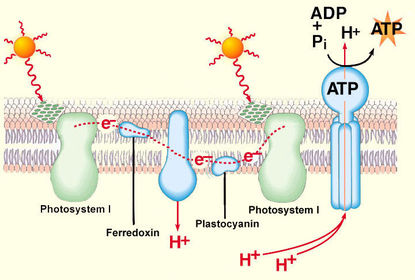
- 32What are the products of the light-dependent PS reactions?Waste oxygen, ATP and NADPH.
- 33Which photosystem is involved in cyclic L-D PS?PSI
- 34Which enzyme catalyses the break down of ATP?ATPase
- 35Where do the L-D reactions of PS take place?Thylakoids
- 36Where do the light in-dep reacts of PS take place?In the stroma
- 37Where does the energy for photo phosphorylation come from?Chemiosmosis - \(H^+\) ions moving through ATPsynthase proton pore having been pumped in using energy from ETC.
- 38What are the products of the L-in dep. reacts of PS?GALP - glyceraldehyde 3 phosphate
Which is converted into glucose. - 39List the 6 components of a chloroplastStroma
Thylakoid (membrane & space)
Starch grain
Granum (stack of thylakoid)
Smooth inner and outer membrane
DNA loop - 40NPP=_________+__________GPP - Respiration
- 41What is GPP?Rate at which energy is incorporated and organic matter synthesised in producers.
- 42What is NPP?Rate organic matter is stored by plants / used for biomass production.
- 43What are autotrophs?Producers
- 44What are heterotrophs?Consumers
- 45What are primary consumers also known as?Herbivores
- 46Define: Trophic levelAn org's position in the food chain.
- 47What are detrivores?Primary consumers that feed on dead organic matter called detritus.
- 48What are decomposers?Species of bacteria and fungi that feed on dead remains of organisms and animal faeces.
- 49What is the PS efficiency formula?GPP/Amount of light energy striking the plant x100
- 50In what ways is energy lost between trophic levels?Not all of the food being eaten.
Faeces and urine.
Respiration. - 51% energy transfer = .....Energy passed on to next level
--------------------------------------------
Energy of prior level - 52Define: Carbon sinkReservoir of carbon locked up in organic or inorganic compounds.
- 53List 4 sources of \(CO_2\)Burning fossil fuels.
Loss of a carbon sink.
Melting ice.
Volcanic activity. - 54What are 2 suggested ways of reducing \(CO_2\)?Biofuels & Reforestation
- 55Define: evolutionA change on allele frequency coming about through gene mutation and natural selection.
- 56What are the 2 types of speciation?Pre-zygotic & Post zygotic
- 57List the 5 types of pre-zygotic speciationHabitat Isolation
Temporal Isolation
Mechanical
Behavioural
Gametic Isolation - 58What are the 3 types of post zygotic isolation?Low hybrid zygote rigour
Low hybrid adult viability
Hybrid infertility - 59Define: Allele frequencyThe proportion of one allele with in a gene pool or population.
- 60Define: gene poolAll the alleles from all the genes found in a particular population
- 614 ways new alleles can be cretedRandom mutation
Radiation
Change in base sequence
(during) Cell division or replication - 62Define: genetic diversityThe variety of different alleles of a particular gene present in a gene pool
Informationen
- Beschreibung
- A2 level Biology Karteikarten am Biology Topic 5 Flashcards, erstellt von J000D97 am 12/01/2015.
- Erstellt von
- J000D97
- Aufrufe
- 177
- Tags
- Bewertung