
Karteikarten
Edexcel GCSE Science P1 Flashcards
Karten in diesem Stapel (22)
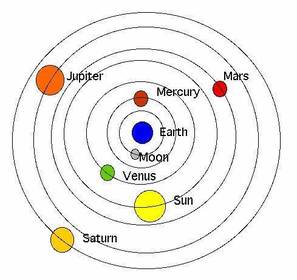
- 1Geocentric ModelEverything orbits around the Earth
- 2Heliocentric ModelSun is the centre of the Solar System and the Earth and other planets orbit around it
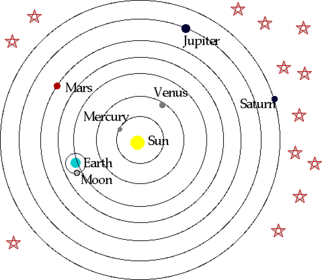
- 3What led Galileo to support the heliocentric model and reject the geocentric model of the Solar System?Galileo used a telescope and discovered 4 of Jupiter's moons. By plotting their movements he saw that they orbited Jupiter and not the Earth.
*In a 6 marker, explain what heliocentric and geocentric mean. - 4Properties of transverse waves-Particles vibrate at right angles in the direction of the wave
-Do not need a medium (can travel through space)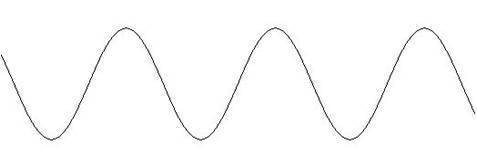
- 5Example of transverse wavesElectromagnetic waves (e.g. radio waves)
- 6Properties of longitudinal waves-Particles vibrate back and forth in parallel with the direction of the waves (forming areas where air particles are spread out and areas where they are pushed together)
-Need a medium in which to travel (cannot travel in space)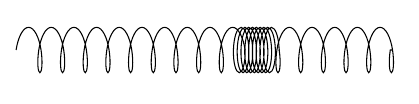
- 7Properties of seismic waves-Can be either transverse or longitudinal
*Longitudinal- rock material is pushed and pulled
*Transverse- rock material is moved up and down - 8Example of longitudinal wavesSound waves
- 9Properties of waves
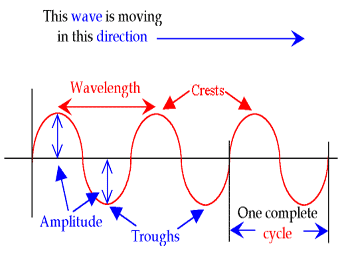
- 10Frequency-Number of waves passing a point each second
-Measured in Hertz (Hz)
*1 Hz means 1 wave passing per second - 11Wavelength-Distance from a point on one wave to the same point on the next wave
-Measured in metres (m) - 12Amplitude-Maximum distance of a point on the wave from its rest position
-Measured in metres (m) - 13Crest & ThroughCrest- top of the wave
Through- bottom of the wave - 14Wave speed-How fast the energy in a wave travels
-Measured is meters per second (m/s)
*Wave speed(m/s)=distance/time*
*Wave speed=frequency x wavelength - 15Types of telescopes-Refracting telescopes
-Reflecting telescopes - 16What does the data collected help scientists do?-Make conclusions about the universe
- 17What has photography allowed astronomers to do?-It has allowed astronomers to make more detailed observations than they could with drawings
- 18How was infra red discovered?Hershel shone a light ray through a prism which split the visible light into the colours of the spectrum. He measured the different temperatures and found that the highest temperature was beyond the red end of the spectrum.
- 19How was ultraviolet (UV) discovered?*Silver chloride is a solution that turns black under light.
Ritter used silver chloride that here were invisible light rays which existed beyond visible violet.
Under red light it turned black slowly.
Under violet light it tuned black faster.
It turned black the fastest under UV light. - 20Electromagnetic Spectrum
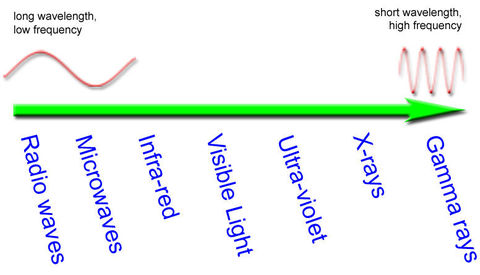
- 21Uses of RadiowavesCommunication
- 22Uses of microwavesCooking & communication
Informationen
- Beschreibung
- GCSE Edexcel GCSE Science (Physics) Karteikarten am Edexcel GCSE Science P1 Flashcards, erstellt von RainGC am 30/03/2015.
- Erstellt von
- RainGC
- Aufrufe
- 58
- Bewertung