
2530482


| Frage | Antworten |
| Psychophysics | The relationship between physical stimuli and their subjective or psychological correlates |
| Transduction | Converting physical stimuli to nerve impulses |
| Chemical senses | Gustation Olfaction |
| Body Senses | Somatosensation Equilibrioception |
| Somatosensation | Taction/Haptics Proprioception |
| How much of the cortex is involved in visual processing? | 50% of the cortex |
| Failure in recognition due to failure in perception | Apperceptive agnosia |
| Failure in recognition despite successful perception | Associative agnosia |
| Hierarchical Processing | Neural impulses travel "up" the system to the cortex |
| Top down processing | Prior knowledge influences what is perceived |
| Bottom-up or Top-down processing? | Forward, backward and lateral connections in the visual pathway demonstrate information can flow in all directions |
| Selectivity | Cells respond most to stimuli with certain properties |
| Tuning | A cell is "tuned" to the dimension of a stimulus that generates the strongest response |
| Organisation | Within sensory brain regions there's often an orderly progression of stimulus preferences |
| Cortical magnification | Larger amounts of cortex are devoted to processing more important stimulus values |
| Doctrine of specific nerve energies | => Each sense projects onto a specific cortical area => The nature of sensation depends on which sensory fibres are stimulated (Müller, 1838) |
| Noise | Neural firing is stochastic (random) -Noise interferes with measurement of responses to stimuli |
| Spontaneous Activity | Cells fire a little even with no stimulus |
| Detectability | How easy a stimulus is to detect. More intense stimuli are easier to detect |
| Detection Threshold | The minimum intensity required for detection |
| Absolute Threshold | The minimum intensity required for detection |
| Sensitivity | Opposite of threshold (1/threshold) |
| Method of Adjustment (MoA) Detection | Adjust a stimulus until subject can just see it =>Not reliable, people cheat |
| Method of Constant Stimuli (MoCS) Yes-No Paradigm | -Vary stimulus intensity -Subjects respond if they can detect it -Plot the psychometric function (curved due to noise) =>Threshold is the point where detectability is 50% |
| Method of Constant Stimuli (MoCS) 2AFC Paradigm | Subjects respond if stimuli was detected in one of two fields =Threshold at 75, as there is 50% chance of correct guesses |
| Measuring Magnitude: Estimation Technique | "Modulus" stimuli presented, acts as a reference for sensory magnitude -Following stimuli rated by subject compared to modulus which is rated "10" |
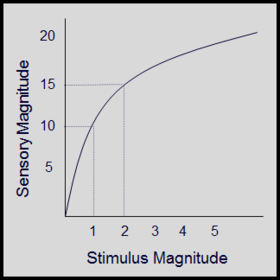
| Compressive non-linear functions | If intensity is increased 2x, sensory magnitude increases <2x (Except for electric shock) |
| Discrimination | Perceiving the difference between two stimuli |
| Discrimination threshold | The minimum difference between two stimuli for discrimination =>Just noticable difference |
| Precision | Degree to which repeated measurements show the same result =>Relates to discrimination threshold |
| Accuracy | Degree to which measurements match the true value of a stimulus =Relates to Bias |
| Bias | Something external to stimulus which changes the way it is perceived =>Sometimes called the "point of subjective equality" (PSE) |
| Method of adjustment (MOA) Matching | Measuring discrimination -Adjust a probe stimulus until it matches the test stimulus -Slightly different settings each time (noise) |
| Method of adjustment (MOA) Matching => Accuracy | Represented by the mean of several settings -Good result if mean probe settings are close to true test setting -Poor results are said to be biased |
| Method of Adjustment (MoA) Matching -Precision | Represented by the 'spread' of probe settings (eg. standard deviation) -Low spread = good discrimination ability |
| Adaptation (4 consequences) | Prolonged stimulation decreases rate of firing => Increases detection threshold for similar stimuli =>Reduces perceived intensity =>Rate at which magnitude rises with stimulus intensity is increased =>Perceived properties of similar stimuli can appear biased |
| Anatomical Research Methods | Examining dead brains |
| Anatomical research methods: staining dead brains (3 features) | => Reveals axons/connections => Reveals cell body density & size => Reveals activity (cytochrome oxidase) |
| Recording techniques: Single cell recording | Electrode attached to single brain cell -Invasive -Anaesthetised or awake (microstimulation) -High spatial and temporal resolution -limited information (only one cell) |
| Recording techniques: Optical imaging | Filming a working brain with a colour sensitive camera -Blood flow increases to active areas => Active areas become more red -Invasive -Only a small area visible -Slow response to stimulus |
| Visually evoked potential | Presenting a visual stimulus and measuring the brain's response |
| Magnetoencephalography (MEG) | Superconducting quantum interference device (SQUID) -Non Invasive -Measures magnetic fields in the brain -High temporal resolution -Moderate spatial resolution |
| Electroencephalography (EEG) | Electrodes on the scalp detect changes to electric fields in the brain -Non invasive -High interference from skull -Low spatial resolution -High temporal resolution |
| Positron Emission Tomography (PET) | Injecting radioactive dye and tracking it through the brain -More radioactive blood goes to active areas so is detectable -Non invasive -Moderate spatial resolution -Low temporal resolution |
| Functional Magnetic Resonance imaging (fMRI) | Use powerful magnet to detect differences between oxygenated & deoxygenated blood in brain -Moderate spatial resolution -Low temporal resolution -Non-Invasive |
| Anatomical Research Methods: Lesions | Destroying (ablating) parts of the brain with neurotoxins (for specific pathways) or surgery (for specific areas) and studying what happens -Invasive |
| Anatomical Research Methods: Human Brain Lesions (Neuropsychology) | Studying living humans with damaged brains. -Damage is usually diffuse -Damage to fibres can affect areas far from lesion -Brains recover from damage (plasticity) -Correct tests are neccessary |
| Transcranial Magnetic Stimulation (TMS) (3 properties) | Temporary magnetic field "knocks out" cells over a broad area of the brain -Temporary -Temporally precise -Spatially imprecise |
| Axon | Also known as Nerve Fibre -Long slender projection of a nerve cell (or neuron) -Conducts nerve impulses away from the cell body -In some sensory neurons, electrical impulses travel UP the axon to the cell body |
| Action Potential | A nerve impulse -Electrical membrane potential rapidly rises and falls back to resting potential -ion channels on the axon open, allowing sodium ions to gush inside, causing a rise in the electrochemical gradient -The polarity of the plasma membrane then reverses, closing the ion channels -Sodium ions actively transported out -Potassium channels open and potassium ions are released (Repolarisation) |
| Grey Matter | Neuronal cell bodies, with relatively few myelinated axons |
| White matter | Mostly glial cells and myelinated axons that transmit signals from one region of the cerebrum to another and further on |
| Neurotransmitters | Endogenous chemicals that transmit signals across a synapse from one neuron (nerve cell) to another "target" neuron |
| Psychometric Function | Describes the relationship between a parameter of a physical stimulus and the subjective responses of the subject (eg. visual acuity) |
| Suprathreshold | Stimulus of sufficient intensity to generate a response |
| Thalamus | Symmetrical structure between the cerebral cortex and midbrain -Relays sensory and motor signals to the cortex -Regulates consciousness/sleep/alertness |
Möchten Sie mit GoConqr kostenlos Ihre eigenen Karteikarten erstellen? Mehr erfahren.