
Karteikarten
Edexcel Core GCSE Science P1

Karten in diesem Stapel (11)
- 1Describe the main features of the geocentric model.That the Earth was at the centre of the solar system and the Sun, Moon, planets and stars orbited it.
- 2Explain how Galileo's observations of Jupiter proved the geocentric model wrong.He saw three 'stars' in line near Jupiter. The next evening they had moved in the wrong direction. After a week a fourth star appeared. Galileo realised that they were moons that orbited Jupiter, not stars. This proved not everything orbited the Earth.
- 3How are we able to see stars and planets?Using the naked eye, telescopes and photographs.
- 4What are the two formulas for the speed of a wave?Speed = Frequency * Wavelength
Wave speed = Distance / Time - 5Give an example of a transverse wave.All Electromagnetic (EM) waves.
- 6Give an example of a longitudinal wave.Sound waves.
- 7Describe what happens to a light ray as it travels from air into water at an angle.The part of the wave which hits the water first slows down while the other part carries on faster in the air until it hits the water. This causes the wave to bend.
- 8Light is reflected off a mirror, as shown in the diagram. If angle i is a 50 degree angle what is angle r?50 degrees.
(Angles of reflection and incidence are always the same)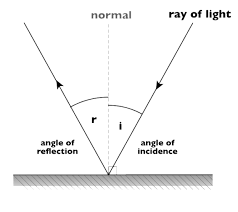
- 9Draw a rough diagram of how a converging lens works. (Not a ray diagram)
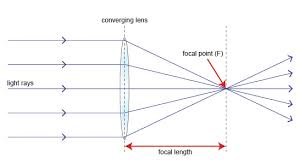
- 10Describe what is meant by the focal point of a lens.The focal point is where rays hitting the lens parallel to the axis all meet.
- 11How can you work out the focal length of a lens.Clamp the lens at one end of a track then clamp a piece of white card further down the track. Set this up at near a window with the lens directed at a distant object. Move the card along the track until the image is focused and clamp it in place. Use a ruler to measure the distance between the centre of the lens and the card. This is the focal length.
Informationen
- Beschreibung
- GCSE Physics Karteikarten am Edexcel Core GCSE Science P1, erstellt von Daniel I am 27/04/2015.
- Erstellt von
- Daniel I
- Aufrufe
- 98
- Tags
- Bewertung