
Karteikarten
Fsss microbiology - herts dietetics
Karten in diesem Stapel (62)
- 1Give an example of a microbiological agent of food borne diseases.Toxic Algae-can go down food chain to shellfish
Protozoa- Group of single celled microscopic animals
Parasites- an organism which lives in or on another organism and benefits by deriving nutrients at thier expense. - 2What is a mycotoxin?Any substance produced by a fungus.
- 3What components are in a bacteria cell?.Cell wall=peptidoglycan
.Cytoplasm
.Nucleoid (DNA)
.Ribosomes
.Cytoplasmic membrane - 4Bacteria come in 2 different shapes. What are these 2 different shapes?.COCCI-spherical bacteria- in chains, grape like clusters, pairs,in cubes of cells
.RODS-short or long- singly- in filaments of attached cells
Bacteria also come in different sizes - 5Names tell you about the bacteria. What does staphylococcus aureus and streptococcus pneumoniae tell you?Aureus-Gold
Pneumoniae=lungs - 6How are Chromosomes present in a bacteria cell?Chromosomes are wrapped up but not in histone protiens
E.coli chromosome length=1.3mm
E.coli cell length=1.7um
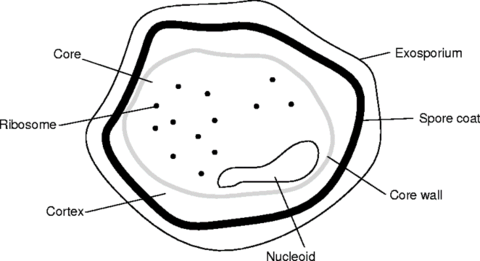
DNA density in cell=10mg/ml - 7What is an endospore?.some bacteria produce this reproductive structure
.spore has lots of layers around the genetic material=very resistant - 8What are endospores resistant to?.Heat
.UV radiation
.Chemical disinfectants
.Drying - 9How can endospores be killed?sterilization removes the layers but takes a very long itme
Treatment at 121 degrees for 15 minutes - 10what are the components of an endospore ?
- 11Label a bacteria cell
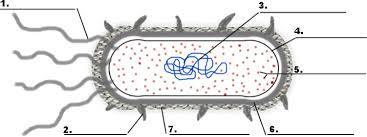
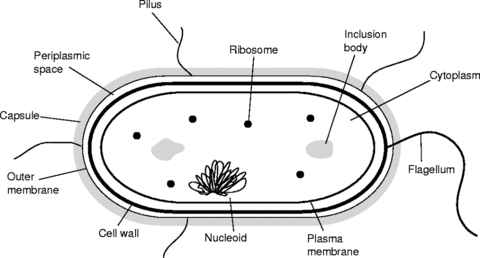
- 12What are the functions of these components? .Flagellum .Pillus .Cell wallFlagellum---> movement
Pillus----> attaching
Cell wall ----> stops the cell from bursting due to osmosis - 13What is the difference between gram negative and gram positive?Gram postive=Purple
Gram Negative= pink
Due to differences in cell structure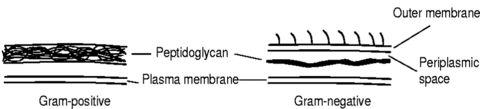
- 14what extra layers does gram negative have than gram positive?gram negative=has an additional outer membrane containing lipopolysacchardies
another layer of polysaccharide or protien making up a capsule or slime layer
layers external to the outer membrane referred to as the cell envelope. - 15what do endotoxins cause?Endotoxins cause a septic shock when introduced into the bloodstream.
- 16How do bacteria grow and divide?Binary Fission
1. Synthesizes new cell consituents
2. Grows in size
3.Replicates its genetic material
4. A new cell wall is formed
5.The cell divides into 2-septum forms - 17What is the name of bacteria that grow in liquid?Planktonic
- 18What is the name of bacteria that grow on surfaces?Sessile
- 19What is the name of bacteria growing on surfaces as an organised community?Biofilms
- 20What do each of the line of the graph represent? What type of growth does this show?1. lag phase
2. exponential phase
3. stationary phase
Type of growth=exponential growth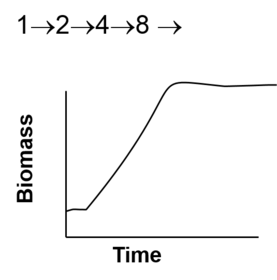
- 21Define 'Doubling time'The time taken for the number of cells in a population to double.
- 22Define 'Chemoorganotroph'.Bacteria that use organic chemicals such as glucose and acetate.
- 23Define 'Chemolithotrophs'.Bacteria that use inorganic chemicals e.g H2,H2S.
- 24Define 'Phototrophs'.Organisms that use sunlight as a source of energy.
- 25Define 'Heterotrophs'.Bacteria/fungi that use organic products such as glucose,amino acids etc.
- 26Define 'Autotrophs'Microbes capable of fixing carbon e.g CO2 and then using it to make cellular components.
- 27What agar should be used for fastidious pathogenic organisms?Blood agar
- 28What temperatures do each listed prefer? 1.Psychrophiles 2.Psychrotolerant 3.Mesophiles 4.Thermophiles 5.Hyperthermophiles1.low temperatures 0-25
2. 25-30
3.Body temperature 15-45
4.30-75
5. very high temperatures >100 - 29Define Aerobes.Capable of growing in the presence of oxygen.
- 30Define anaerobes.Bacteria that do not require oxygen for growth.
- 31Define Facultative Anerobesprefer oxygen but can grow anaerobically.
- 32Define Obligate Anaerobes.Die in the presence of oxygen.
- 33Define AerotolerantAnaerobes that ignore the presence of oxygen and grow equally well in its presence or absence.
- 34Define Microaerophillic.Damage by normal atmospheric concentractions of 20% and only survive at much lower concentrations.
- 35What pH range does an acidophile live in?0-5.5
- 36What pH range does an alkaliphile live in?8.5-11.5
- 37Water availablity is important, what conditions do this live in? 1.Halophile 2.Halotolerant 3.Osmophiles 3.Xerophile1.Grow at high salt concentration
2.Capable of growing in 3M nacl
4.Likes high osmolarity
3.Able to grow in dry environments - 38How can we stop microbes from growing?Control temperature
Remove water
Use extreme pH's
Control oxygen availabilty
Add substances to prevent growth - 39Define 'Sterilisation'.Total destruction of all microbes.
- 40Define 'Disinfection'.Removal of microbes using physical or chemical means-does not necessarily involve all microbes.
- 41Define 'Antiseptic'.Use of chemical agents on skin or living tissue.
- 42Define 'Bactericidal'.Kills bacteria
- 43Define 'Bacteriastatic'.Inhibits growth
- 44Define 'sporocide'.Kills endospores
- 45Give some examples of foods you can food bourne dieases from.Chicken=Camplylobacter Jejuni
Eggs=salmonella
Strawberries= Hepatitis A virus
Ready to eat meats= Listeria - 46Which disinfectants and antiseptics kill evrything but endospores and some virses?Alcohol 70%
Phenoilics - 47Which disinfectants and antiseptics kill everything though some spores may survive?Hydrogen peroxide and chlorine
- 48Which disinfectant and antiseptics kills everything?Formaldehyde
- 49What factors influence effectiveness of disinfectants?.Number of microbes
.Type and concentration of disinfectant
.Duration of exposure
.Temperature of exposure - 50Name a potential target site.Peptidoglycan
.Ribosomes
.Nucleic acid synthesis - 51What does MRSA stand for?Methicillin-resistant staphylococcus aureus
- 52Who is at risk of infections?.Very Young
.Old
.People that are already ill
.Malnourished
.Those in poor housing - 53To cause infection bacteria must beable to:.Spread between hosts
.Reach their prefered site in the body
.Grow and multiply
.Avoid the host immune response
.Leave the host - 54How can a host prevent against infection?1. Prevent access- skin,mucus
2.Prevent replivation
Prevent nutrient acqusition
neutralise microbe or its products
3. Get rid of it - 55How can Bacteria reach different places?The epithial surface
Invasion though th mucosal surfaces
Direct injection into blood stream
Though wounds
Canulas - 56What are the defense mechanisms on mucosal surfaces?.Mechanical barriers-skin,Mucosal membranes-prevents microbial penetration
.Flushing-Tears,Urine,Saliva,Coughing
.pH-Stomach acidity,fatty acids on skin
.Lysozyme=Breaks down peptidoglycan in bacteria - 57What is the role of Commensals? Natural Flora.Metabolism of food products
.Production of essential growth factors
.protects against infection
.Stimulate the immune response - 58Define 'Virulence factors'.Features of the bacterium that help it infect and cause disease. Virulence factors help the bacteria get to the prefered site and survive on the way there. evade host defense mechanisms-cell surface feactures,stay there and multiply,cause damage-toxins and enzymes etc
- 59Name some virulence factors..Flagella-movement
.Mucinases and proteases-enzyme that breaks down protiens and peptides- hydrolyses Mucins (a component in Saliva)
.Ciliostatic protiens-inhibition of cilial movement - 60Name the virulence factors in cholera.Flagella-motility and chemotaxis-penetrate mucus
pili and haemagglutinins-adherence to gut
mucinase and protease-degrade mucus
Enterotoxin-stimulates adenyl cyclase resulting in the secreation of fluid into the gut. - 61How does typhoid get in?.Penetrate gut mucosa
.reach lymph nodes
.survive and multiply in macrophages
.Transported in macrophages to bloodsteam
.Reach spleen,liver,bone marrow,Peyers Patches - 62What are some symptoms of gut infections?.Diarrhoea leading to dehydration
.Bloody diarrhoea
.weight loss
.Sudden onset of nausa,vomiting,diarrhoea
.Fever
Informationen
- Beschreibung
- Karteikarten am Fsss microbiology - herts dietetics, erstellt von Fern Chipperfield am 06/05/2015.
- Erstellt von
- Fern Chipperfield
- Aufrufe
- 59
- Bewertung