
Karteikarten
The Changing Natural Environment Part 2
Karten in diesem Stapel (163)
- 1List the four external forces that may affect the climate systemNatural Causes:
Changes in plate tectonics
Changes in Earth's orbit
Changes in sun's strengths
Anthropogenic Causes:
Combustion of fossil fuels
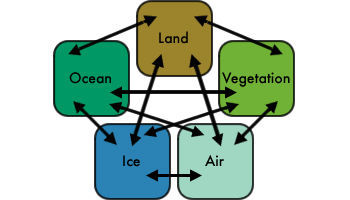
Land use changes - 2Draw a rough diagram illustrating the internal interactions in our Climate system
- 3List the internal repsonses that may occur due to external forcesChanges in atmosphere
Changes in ice
Changes in vegetation
Changes in ocean
Changes in land surface - 4What is meant by the sun's coronaThe corona is the sun's "atmosphere"
It is much hotter than the sun's surface but due to its low density it radiates much less energy into space - 5What is meant by a magnetic storm?a magnetic storm is another word for a solar flare
These emit large quantities of UV radiation and energised charged particles - 6List facts about the sun~150 million km away from Earth
15 million °C at the core
6000K at the surface (photsphere/chromosphere) - 7List three facts about sunspotsSunspots are cooler regions
The average area of a sunspot is five times the size of Earth
The 11-year sunspot cycle has a measurable but small impact on solar energy output - 8Define radiationradiation is energy that travels
- 9What untis do we use to quanitfy energyJoules
Joule per second = Watt
Watt per square unit of area = Energy flux density - 10What is meant by a black body in the physical sciences?A "black body" is a term for an idealised object that absorbs and transmits EM radiation over all wavelengths
At room temperature such a body looks black
Both the sun and the Earth are approximately like black bodies - 11What is Planck's law?Planck's Law describes the amount of energy emitted at a given wavelength at a given temperature
In theory it describes the spectral distribution of emitted EM radiation of a black body at a given temperature - 12What is meant by radiant exitance?Radiant energy that is emitted, transmitted, received or reflected (radiant flux) by a surface per unit of area
- 13What does the Stefan-Boltzmann Law describe?This law describes the power radiated from a black body in terms of its temperature
Specifically, the radiant exitance of a black body is directly proportional to the fourth power to the black body's absolute temperature - 14What does the Wien's displacement law describe?It states that the black body radiation cruve for different temperatures peaks at a wavelength inversely proportional to the temperature (i.e. the hotter the temperature, the shorter the wavelength)
- 15Explain differences we'd see if there were no atmosphereNo air to breathe
No lakes or oceans
Extreme temperature rnages without atmosphere (like on the moon)
No sound without air
No protection from meteorites
No protection from UV radiation - 16Describe Earth's second atmosphereformed 4.0-3.3 billion years ago
Earth cooled and developed a solid crust
convective magma activity contributed to the formation of magnetic field capable of deflecting solar wind and cosmic rays
high volcanic activity
atmosphere contained (co2, h2o and n2)
very high atmospheric temperatures (>100°C) due to volcanic & tectonic activity, frictional heating from meteorites and strong greenhouse gas effect - 17How did the oceans form?Once temperatures cooled down below 100°C condensation of water vapour and precipitation became possible (3.8-3.9 billion years ago)
expanding oceans served as a CO2 sink
anaerobic bacteria began to develop near volcanic hydrothermal vents - 18Describe what is meant by the 'Oxygen Catastrophe'3.8-3.5 billion years ago prokaryote cyanobacteria appeared as first O2 producing organisms
Stromatolites must have lived deep enough (>5m) to be protected from harmful radiation but still within the rnage of sunlight
1.3 billion years ago eukaryotic cells were more efficient at producing oxygen
1 billion years ago the oceans were saturated with oxygen and O2 could subsequently build up in the atmoosphere forming an ozone layer
dissolved oxygen was toxic to anerobic organisms - 19Describe the formation of Earth's "Third Atmosphere"with development of more sophisticated forms of plant life oxygen levels iun the atmosphere continued to increase
the present day atmosphere (oxygen-nitrogen) formed approximately 400 million years ago
formation of ozone layer and the protection from harmful solar radiation were key to the formation of plant life on land - 20What are the four layers of the atmosphereFrom Earth to space:
Troposphere
Stratosphere
Mesophere
Thermosphere - 21Describe the atomspheric vertical profile in relation to pressurethe global average atmospheric pressure decreases near-exponentially in vertical direction
99.9% of the atmospheric mass is below 50km
90% is below 10km - 22What does the atmospheric vertical profile look like in relation to temperatureTroposhere: decreasing with height
Stratosphere: increasing with height
Mesosphere: decreasing with height
Thermosphere: increasing with height - 23Why does temperature decrease with height in the troposphere?An air parcel cools and expands when rising vertically
Conversely, an air parcel warms and is compressed when descending - 24Name the three main gases that make up the airs compositionNitrogen : 78.08%
Oxygen: 20.95%
Argon: 0.93% - 25What are three effects aerosols may have on us?Reduction in visibility through a haze effect
They can scatter incoming light
They can absorb outgoing thermal radiation (like GHGs) - 26Outline the processes involved in the hydrological cycleEvaporation: solar energy transforms liquid water into water vapour
Transpiration: Moisture given up by plants (in form of water vapour)
Condensation: Water vapour reverts back to liquid phase (formation of droplets)
Precipitation: liquid or solid forms of water falling from clouds - 27Where is most of the water held?97% Oceanic system
2.999% in the land system
0.0001% in atmospheric system - 28Describe the evaporation processStage 1: -evaporation can occur at any temperature
-at the surface, water molecules with sufficient kinetic energy will break away from the surface and evaporate into the air
-with time the amount of water vapour in the air increases
-condensation also will occur, however the condensaiton rate is slower than the evaporation rate - 29What is meant by the dynamic equlibrium in the evaporation processStage 2: - the rate of condensation depends on the amount of water vapour in the air
-once the air above the water is saturated, for every molecule that evaporates, one condenses
-the amount of water vapour therefore stays the same
-wind enhances evaporations as water vapour molecules are carriued away by it thus never reaching saturation - 30Why is cold are dryer and warm air more humid?At higher tempreatures the water molecules will have more kinetic energy and therfroe the rate of evaporation will be higher
The dynamic equilibrium will therefore be reached at higher concentrations of water vapour - 31Deifne relative humidityRelative humidity is the ratio of the amount of water vaoupr in the air to the maximum amount of water vapour required for saturation at that particular point
- 32What is meant by the dew point temperatureThe Dew point temperature represents the temperature to which air would have to be cooled foor saturation to occur
Warm dew points indicated high relative humidity and cold low - 33Explain trends of relative humidity variationDiurnal: -water vapour amounts can remain unchanged with changing RH
-RH changes mainly due to diurnal temperature variations which affect the water vapour capacity
Meridional:
-high RH values at tropics and cold 60° and above
-low RH values at the tropics of cancer and capricorn - 34Define cloudA cloud is a visible aggregate of tiny water droplets or ice crystals supsended in the air
- 35What are the different types of clouds?High clouds:
Cirrus (Ci), Cirrostratus (Cs), Cirrocumulus (Cc)
Middle clouds:
Altostratus (As), Altocumulus (Ac)
Low clouds:
Stratus (St), Stratocumulus (Sc), Nimbostratus (Ns)
Clouds with vertical development:
Cumulus (Cu), Cumulonimbus (Cb) - 36How does latitude variation in solar irradiance affect the flow of air (winds)?-winds are involved with the transfer of heat, as there is a surplus of heat at the equator which has to be distributed around the globe
-these vary in intensity with the Earth's tilt and its seasons - 37How does the pressure gradient force (PGF) affect the flow of air (winds)?the pressure gradient force is directed from higher toward lower pressure at right angles to the isobars
closely spaces isobars on a map indicate steep pressure gradients and a alrge PGF - 38How does the coriolis force affect the flow of air (winds)?the coriolis force describes an apparent force due to the rotation of the Earth
in the northern hemisphere wind deflects to the rihgt of its intended path and to the left on the southern hemisphere
the higher the wind speed the stronger the deflection
the force increases with latitude with zero at the equator - 39What is meant by geostrophic wind?Geostrophic wind is where PGF and CF are in balance
As a consequence the wind will flow parallel to the isobars and will not further accelerate - 40What is meant by the centripetal force?The combination of PGF and CF results in a Centripetal force component which forces the wind in a circular motion
Consequently wind motion is anticlockwise around a low-pressure system (cyclone) and clockwise around a high-pressure system (anticyclone) in the Northern hemisphere --> the opposite for the Southern hemisphere - 41How does firction in the planetary boundary layer affet the flow of air (winds)?the planetary boundary layer refers to a layer of the troposphere in which winds are affected by friction with the ground
This friction reduces the wind speed which in turn reduces the CF leading to winds being able to blow across isobars
At stable stratification and smooth terrain the layer is quite thin whereas when the air is unstable and the terrain rough the effect extends far further upwards due to vertical mixing - 42What is the intertropical convergence zone?The zone at which the trade winds meet
The problem with this is that heat is desperately trying to be redistributed therefore most of the heat at the equators is distributed via ocean surface currents - 43What are the westerlies?The westerlies are the winds which go towards the poles at 30° north and south
- 44What is meant by thermal cicrulations?Local circulations brought on by changes in air temperature
- 45What factors result in the heat island effect?The interaction of the follwoing factors:
-release and reflection of heat from buildings
-absoprtion of heat by concret, brick and tarmac by day and the release of it at night
-enhanced cloud formation as pollution traps heat
-relative absence of water means that less energy is used for avapotranspiration and more for heating of the lower atmosphere
-absence of strong winds to disperse heat and bring in cool rural air - 46How does the mountain and valley breeze form?-During the day sloped valley walls will receive more insolation and so the air above the valley warms
-this air rises and cuases a gentle valley breeze
-at night the cooler denser air descends the slope which is known as the mountain breeze - 47What is a possible impact of a subsidence inversion?Increased pollution:
-during a strong anti-cyclone (high pressure) warm air is compressed and warmed, pushing toward the land
-below, the colder denser air collects and creates a thick layer which traps the pollution - 48What is the adiabatic process?Wehn an air parcel cools and warms or expands and compreesses without exchange of matter and energy of the surrounding air
- 49What is the environmental lapse rate (ELR)?The rate at which the temperature of an air parcel decreases with altitude
the rate depends on the temperature of the surface air and whether the atmosphere is stable or not because unstable atmospheres allow vertical development
It is crucial is determining the extent of vertical motion in the atmosphere - 50What is the dry adiabatic lapse rate (DALR)?10°C for 1km of change in elevation
This only counts for unsaturated air (RH below 100%) - 51What is the moist adiabatic lapse rate (MALR)?6°C for 1km
This only counts for saturated air
As moist air rises temperature cools more slowly for the water vapour condenses giving off latent heat countering the temperature loss caused by the expanding air parcel - 52What are the two processes respoinsible for carbon uptake on land?Photosynthesis
Weathering - 53What are the two broad processes carried out by the oceans in the carbon balance?Biological pump (through phytoplankton into food chain)
Physical pump (deep water formation and ventilation/upwelling) (the warmer the oceans the less able they are to dissolve CO2) - 54What is a consequence of increased CO2 uptake in oceans?Uptake of increased CO2 reduces surface ocean pH value --> increasing the ocean's acidity
this affects:
-coral reefs (decling calcification/weaker)
-cold water corals
-ecosystems where aragonite is essential (aragonite)
-temperature increase (coral bleaching) - 55What is meant by Insolation?Incoming Solar Radiation
mostly at an oblique angle and not vertical
average insolation equals to a quarter of the solar constant
342 W m^-2 - 56What is the solar constant?the rate at which energy from the Sun reaches the Earth
1370 W m^-2 - 57What are the four different atmospheric solar radiation pathways?Absorption 19%:
radiative energy turned into other forms by gases or particles in the atmosphere
Reflection 30%:
radiative energy is reflected back into space when hitting a surface
Scattering:
Radiative energy is (at least partly) redirected by air molecules and particles
Transmission:
radiative energy passes through the atmosphere - 58What is the distinguishing factor between geometric scattering, Mie scatering and Rayleigh scattering?The size of the object on which he sunlight falls on
- 59Which type of particle induces which type of scattering?Air particles --> Rayleigh scattering --> blue sky, red sunsets
Aerosols (pollutants) --> Mie scattering --> Brownish smog
Cloud droplets --> geometric scattering -> white clouds
Darker clouds have larger water droplets which absorb some of the incoming light - 60Explain the effects by Rayleigh scatteringAir molecules (N2) scatter shorter (blue) wavelengths more efficiently than longer ones (red)
The longer the path length of light through the air, the more blue light is scatter, which results in remaining red light turning the sky red
Equally the sky appears blue because of this too - 61What is Albedo?the ratio of reflected radiation to incoming radiation
The albedo of Earth and its atmosphere is roughly 30% - 62What are the three types of thermal energy transfer?Conduction: through contact
Convection: gases & fluids
Radiation: also works in a vacuum - 63What are greenhouses gases?Greenhouse gases are atmospheric gases which absorb thermal radiation emitted by the Earth's surface
this blanketing effect leads to increased temperatures
H2O is responsible for most of the greenhouse warming, but its atmospheric proportion is not changing directly as a consequence of humans - 64Which are the important GHGs which are influenced by humans?Carbon dioxide, methane, nitrous oxide, chloro-fluorocarbons and ozone
Carbon dioxide is the most important because after water it has the largest greenhouse effect - 65Outline the global pressure distributionThe average surface wind and pressure distribution is largely determined by semi-permanent highs and lows
E.g. the pressure difference between the icelandic low and the bermuda high determines the severity of European winters (the bermuda high drives the golf stream)
interseasonal variability in the inter-tropical convergence zone which affects monsoon seasons - 66What are monsoons?Monsoons seasons are experienced by those countries that lie where the inter-tropical convergence zone (ITCZ) shifts
India, for example, receives warm moist air from the indian ocean in july and colder dry wind from the north during winter - 67What factors determine climate?Latitude: determines how much solar radiation a location receives
Land and water: determines continentality
Ocean currents: can provide additional heat
prevailing winds: moisture and thus precipitation
Pressure cells: cloud coverage
mountain barriers: rain shadow
altitude - 68Outline the NAO (North Atlantic Oscillation)determined by the pressure difference between the bermuda high and the icelandic low
Positive phase: strong pressure difference resulting in warm wet winters for Europe and mild and wet winters in the US
Negative phase: weak pressure difference resulting in more cold air invasions
phase changes take decades - 69What factors influence the natural variability in the Earth's global average surface temperatures?Changes in insolation
Continental drift
Changes in Earth's albedo
Changes in outgoing terrestrial radiation (GHG effect) - 70Outline the Milankovitch cyclesChanges in the Earth orbit's eccentricity vary with a period of about 100,000 years
Variations in the obliquity (angle of tilt) of the Earth's axis have a period of about 41,000 years
Changes in precession (direction of tilt) and point of perihelion (proximity to the sun) change with a period of about 23,000 years - 71What are the four natural influences on the energy imbalance?Plate tectonics: millions of years; regional scale
Volcanic Activity: years, but longer for 'mega-eruptions'; regional/global
Changes in solar irradiance: 11 years, but also much longer; global
Long-term outgassing from oceans volcanoes: millenia; global - 72What are the four anthropogenic influences on the energy imbalance?Land-use change: instantaneous; regional/continental
Aerosol emissions: instantaneous/constant; regional
Ozone depletion: decades; mostly at poles but small effect globally
Fossil fuel emissions: decades/centuries; global - 73What is radiative forcing?-one of the most commonly used climate metrics
"Radiative forcing is a measure of how the energy balance of the Earth-atmosphere system is influenced when factors that affect climate are altered"
it allows for the comparison of different climate mechanisms - 74What are two ways to describe the absolute quantity of a gas?Density - microgram per cubic metre
Concentration - molecules per cubic centimetre (cm-3) - 75Name 2 sources and sink of methaneNatural:
-Wetlands
-Termites
Anthropogenic:
-mining (petroleum)
-enteric fermentation (rumenants)
Sinks:
-Atmoshpheric removal
-removal by soils - 76Where can the ozone layer be found?at an altitude of 20km to 30km
it contains about 90% of atmospheric ozone, which is produced via photolysis of molecular oxygen - 77What is tropospheric ozone?it's an air pollutant
produced from oxidisation of hydrocarbons in presence of nitrogen oxide (photolysis of nitrogen dioxide) - 78Outline how tropospheric ozone formsozone is formed in the presence of sunlight (never at night)
Carbon monoxide (CO) or volatile organic compounds, water vapour, nitrogen oxides (NOx) and sunlight is needed
pollutants must be available in the right concentration, especially NOx
urban environment usually contains pollutants in the right concentration
ozone production requires a reaction chain - 79Outline how stratospheric ozone formsozone forms at 20km to 50km of altitude through the photodissociation of oxygen molecules
it requires shortwave solar radiation (<240nm); shortwave UV-radiation (<280nm) is completely filtered out during the process - 80What are two instruments used to measure ozone?Total Ozone Mapping Spectrometer (TOMS)
Ozone Monitoring Instrument (OMI)
total ozone in the atmosphere is measured in Dobson units (DU) - 81What are the conditions for efficient ozone depletion at the poles?Low temperatures (formation of PSCs (polar stratospheric clouds))
Isolated conditions (for chemical processes)
PSCs (reaction on surface of cloud crystals increases destruction efficiency by 100x) - 82When and where is ozone depletion strongest?Ozone Depletion is storngest in polar regions during the onset of spring when sunlight reaches the polar regions again (halogen gases are made reactive)
Ozone depletion occurs globally but most efficient in polar regions as meteorological conditions there enhance the depletion process - 83What are some of the environmental impacts of ozone depletion?decrease in stratospheric ozone layer has small cooling effect (minimal compared to proportion lost due to GHGs inefficiency)
Significant increase in UV radiation leading to increase skin cancer and plant damage especially in Southern Hemisphere - 84What are the indirect effects from aerosols?impact on cloud droplet size which affects both the cloud's albedo and the amount of precipitation
other effects include impacts on heterogeneous chemistry, cloud condensation processes, etc. - 85What are atmospheric brown clouds (ABCs)?Indoor and outdoor pollution consisting of paerticles and gases (Nox, CO, SO2, NH3 and many other VOCs and acids)
- 86Where are the regional hotspots for ABCs?East Asia
Indo-Gangetic Plain in South Asia
Southeast Asia
Southern Africa
the Amazon Basin
Also in the Hindu Kush-Himalayan-Tibetan glacier region
can also occur in East USA and Europe but dissipate quickly due to washout processes such as precipitation - 87What are the impacts of ABCs?-dimming of solar irradiance at the surface (sulphate aerosols)
-increase in atmoshperic solar heating (black carbon, soot)
-Dimming effect about 6% in China and India
-black carbon is responsible for a 15% increase in average annual mean of solar absoprtion in troposphere
-change in rainfall patterns
-increased receding and thinning of glaciers
-rainfall in northern half opf india has decreased, shift in patterns in china
albedo changes and temperature increase affects glaciers and snowpacks in the Hindu Kush - Himalayan - Tibetan region - 88What are the consequences of ABCs?-changes in monsoon rainfall and glacier extent will affect water levels required for irrigation of crops
-ground level ozone increases will affect crop yields
-1985-1998 rice production decreased by 6.2 million tonnes in 9 South and East Asian countries
-health effects from indoor and outdoor pollution (affecting pulmonary and cardiovascular systems leading to chronic respiratory problems) - 89Distinguish between Climate Change and Global WarmingGW refers to an increase in globally and annually averaged air temperature near the surface (also observed in oceans and soils)
GW is a good proxy for CC but it does not describe the complexity of the individual changes nor the regional differences
CC refers to a significant and persistent change to the mean state of the climate or its variability. - 90What is the hydrological cycle?the continuous movement of all phases of water
driven by solar radiation and gravity
generates landscapes
connects biosphere, lithosphere and oceans - 91Name the stores and fluxes of the hydrological cycleStores:
-atmosphere
-canopy
-surface water and snow
-soil
-ground
Fluxes:
Precipitation
Evapotranspiration
Runoff
Throughflow - 92How does the atmosphere act as storage in the hydrological cycle?total of 11mm of rainfall across the globe
highly spatio-temporally variable
involved in the latitudinal and meridional transfer of energy (as latent heat)
reflects solar radiation back into space - 93Outline the relationship between cloud cover and foreststhere is a strong relationship between cloud cover and forest cover
clouds are important because they reduce the solar loads and bring rainfall. - 94Outline the canopy water interception process and its properties as a storage-captures rainfall
-redistributes in space -> concentration
-redistributes in time -> reduced intensity
-interception loss= 10-20% rainfall
-remaining 880-90% is efficient rainfall
-leads to efficient ET and thus rainfall recycling (20% in Amazon) - 95Outline facts about damsvary in size and geographical distribution
much more common in the developed world
capacity growing rapidly in the less developed world - 96Outline the properties of snow and ice as a water storage68% of global freshwater in snow and ice
huge seasonal changes
important input during the dry season (India form Himalaya)
susceptible to long term change (CC and GW) - 97What are the important characteristics of precipitation?Seasonality -> within the year
Variability - in inter-annual totals
Reliability -> consistency in timing and duration
Amount -> total volume (depth) of rainfall
Duration -> how long it lasts
frequency
Intensity -> amount per unit time - 98Outline properties of evapotranspirationupward flux from land to atmosphere
potential ET controlled by solar radiation, temperature, humidity and wind speed
Actual ET controlled by availability of water
varies with climate and land surface properties
-used by plants and animals for colling
- - 99Outline properties of Runoff-the lateral flux of water balance (precipitation minus actual ET)
-depends on rate of rainfall vs. rate of infiltration
-overland flow on land
-streamflow/runoff in rivers
-responsible for global river network
-connects landscapers upstream and downstream - 100Outline properties of throughflow-slow through matrix
-fast through macropores
-important for redistribution in time and space
-ensures rivers are perennial - 101Describe the problems faced in the 'world water crisis'humans have less than 0.08% of water available
use is estimated to increase by 40% in the next decade
one in five people lacks access to safe drinking water - 102Name the World's water suppliesGroundwater
Rivers
Lakes (aquaculture)
Wetlands (filtration)
Dammed reservoirs (downstream problems, earthquakes, local climate) - 103Distinguish between physical and economic water scarcityPhysical - climatically not enough water
Economic - water quality and/or water infrastructure is poor - 104Outline the water problem in NW Indiaintensive agriculture (wheat belt)
semi-arid climate
heavenly dependent on (fossil) groundwater
water tables falling
population and agriculture further increasing - 105Outline the water problem in Perularge mines are important tot he economy (Yanacocha - gold)
release effluent into rivers containing cyanide used in processing
many people downstream are unhappy (civil unrest) - 106Outline some of the anthropogenic impacts on waterhuman water footprint is dominated by the human agricultural footprint on a global scale
National scale - influence of roads and protected areas become more obvious
Local scale - supply to urban areas is influenced by water diversions, aqueducts, etc. - 107Why is there a change in demand for water?-getting through the demographic transition
- increasingly urbanised populations
increasing per capita withdrawals - 108How does climatre variability and CC affect waterwarmer world = more ET
more ET= more cloud cover= more rainfall
spatial distribution will change
temporal distribution will change
some stores (snow and ice) will be lost
change to intensity - 109Outline facts about the 1950 population boomoccurred mostly in developing countries since 1920s
projected to last until the 2050s
we are committed to a population of 9.5 billion - 110Distinguish the classic and the anthrome paradigmClassic paradigm: biosphere shaped primarily by biophysical systems
Anthrome: Most of the biosphere reshaped by human systems - 111What are some of the factors causing malnourishment on a global scale?1 billion people remain chronically malnourished
stemming from continued poverty and increasing food prices
food production is industrialised and energy-dependent - 112What factors could impact food prices?market speculation
bioenergy expansion
climatic disturbance - 113What are some of the factors affecting recent growth in crop productionincrease in yield
multiple cropping techniques
fewer crop failures
less fallow
improvement in: irrigation, fertilisers, new varieties and pesticides
Land expansion and intensification have contributed less as we have moved to less productive land
GROWTH HAS BEEN PRODUCTIVE BUT ENV UNSUSTAINABLE - 114List the environmental impacts of growth in food productionImpacts of land expansion:
loss of grasslands, savanna, temperate forest and tropical rainforest
80% of new croplands are replacing tropical rainforests
But it has done little to improve food security
Impacts of intensification:
irrigated cropland has doubled in past 50 years
80-90% of global consumptive water use is irrigation
global fertiliser use increased by 500%
increased energy use
widespread pollution of water and disruption of nutrient cycles
impacts on aquatic and marine fisheries - 115List a usually overseen impact of crop intensificationLand degradation:
declines in land productivity
associated soil erosion and nutrient exhaustion
production becomes unsustainable - 116How does urbanisation affect the sustainability of food productionUrbanisation is increasing particularly in developing world
majority of population not self-sufficient for food/water and thus dependent on infrastructure and technololgy
greater supply chain complexity ->(consumer ignorance)
farm prices/profits driven down
more transportation of food
virtual water imports/exports - 117Outline facts on food waste-there are significant losses at all stages
-greatest for fresh food + veg
-30-50% of food produced is never consumed
-higher post-harvest losses for developing countries (pests, storage)
-highest losses at retailer/consumer level for developed countries - 118What are the dangers in exploiting water for food?limited amount of rainfall available globally at a time
Natural cleansing and renewing functions become disrupted
'Renewal' of water takes time through the hydrological cycle
rate of consumption exceeds rate of renewal - 119Distinguish between withdrawal, consumption and degradationWithdrawal - total amount of water taken from a source
Consumption- fraction of water withdrawn made unavailable for other purposes
Degradation- change in water quality due to contamination making it unsuitable for desired use - 120What are the 8 drivers for chronic food insecurity?1. increasing population
2. changing and converging consumption patterns
3. increasing per capita income linked to resource consumption
4. growing demand for livestock products
5. growing demand for biofuels
6. increasing water and land scarcity
7. Adverse impacts of CC
8. Slowing of increases in agricultural productivity - 121What is meant by the 'land grab' pertinaing to food security?Industrial countries buying up large leases of land in developing countries
Used for crop/biofuels/meat production
serious ethical concerns - 122What are some of the solutions to food security?-increase area of croplands
-increase yields
-eco-efficient agriculture
-price regulation of commodities
-removal of perverse subsidies
-reduce use of cereals and fish in animal feed - 123What are some of the solutions to water security?=increase price of water
-increase supply of water (waste-water as resource, better management, desalination)
-increase efficiency of water use
-reform water governance - 124List the ways in which water governance can be reformedEvidence based policy
Institutional Reform
Water rights and sharing
Better valuation and pricing of water
Improved management systems - 125List the five steps to double food production and reduce environmental change by 20501. more maize - because yield can be readily improved
2. less meat - because meat calories are inefficient and environmentally expensive
3. close the diet gap - crops for food only and less waste
4. Stop burning rainforests - it is not contributing much
5. Use fertiliser more effectively because it is highly damaging - 126What are the downsides of biofuels?e.g. maize, palm oil, sugar cane, soy bean
NOT carbon neutral
rapid growth often on agriculturally fertile land
sometimes very high water consumption
sometimes leading to deforestation - 127What are the solutions to the problems facing hydropower?many small scale instead of many large scale storages
rainwater harvesting instead of irrigation from groundwater
fish ladder maintain flow/connectivity
international cooperation across borders - 128What are the solutions to the problems facing biofuels?NEVER on new cropland
NEVER with food crops (eg. maize)
consider full carbon costs
regulation of markets to reverse perverse subsidies - 129Outline the different types of droughtMeteorological drought - reduced rainfall for the norm at the same time and place
Hydrological drought - occur after meteorological droughts, effcts seen on water table
Agricultural drought - not enough water available for a particular crop at a particular time, not only rainfall but water use
Socio-economic drought - when the demand for an economic good exceeds the supply as a result of a weather-related shortfall in water supply - 130What are the natural causes of droughts?Changes in circulation patterns due to normal seasonality, interannual/decadal variability, sunspots sea-surface temp change, periodic events (eg ENSO, more heat less rain)
Significant change in land surface (albedo, ET and cloud generation)
CC brings less rain and/or temepratures either seasonally or annually - 131What are the human causes of drought?Overpopulation (too much demand)
Overcultivation (unsustainable)
Overextraction
Inefficient use (pollution/wastage)
Degradation of soil and ladnscape reducing the capacity for the ecosystem to provide water for urban systems or agriculture - 132What are the consequences of drought?Ecological/Environmental - impacts on terrestrial and aquatic habitats
Agricultural - crop declines/failures
Water supply - reduced storage for dry seaosns
Humanitarian - loss of livelihood, migration, malnutrition
Off-site (fire, dust, etc.) - 133Outline the 2006 drought in Ethiopia-Sahel region drought conditions since 1985
-drought of 1984/85 1 million deaths
-Causes = low precipitation, desertification, overpopulation, over-cultivation
-GDP 110$ and life expectancy of 43yrs
-2006 event affected 2.7 million people
-UNICEF donated $50million to water aid projects
-consequences = famine, chronic poverty, migration, disease, 46% of cattle died, debt - 134Outline the 2006 drought in Australia-extremely low rainfall season in South
- River Murray dried up in places (most important basin with agriculture and vast irrigation)
-triggered by 'El Nino'
-Human causes= poor use of water resources
-consequences= 6 million sheep died in 2 years, temporary migration, improvements to water resource use
-floods in 2010/11 - 135What is FEWS?Famine Early Warning System
It works using:
-Early Warning Variables
-Vulnerability Analysis
-Networking
-Capacity Building
-Response Planning - 136What measures can be taken to adapt agriculture to drought?Water efficiency
Choice of crops
Drought-tolerant varieties
Rainwater harvesting, water transfer and local storage - 137How can be water use be adapted?Reducing use - low flush, low flow, reuse grey water, rainwater harvesting
Desalinisation - (costly in terms of energy, water only useful for some purposes)
Indsutrial and agricultural wastewater filtration/recycling for grey water uses - 138Define desert and desertificationDesert - vegetation cover is spare or absent, land surface is exposed to atmosphere, rainfall is small and infrequent/irregular in occurrence
Desertification - conversion from non-desert top desert, where desert is characterised by low or null biological production - 139What are the consequences of desertification?diminution or destruction of a land's biological potential
effectively irreversible changes in the nature of the landscape (irreversible due to restoration costs)
Harsh agricultural, health, socio-economic and aesthetic consequences - 140List the physical and human drivers of desertificationhuman reaction to a drought (more crops and let livestock live) -> overcultivation/overgrazing
frequent climatic variability and change in semi-arid areas
response of vegetation to climate - 141Name the exclusively human causes of desertificationDeforestattion for fuel/firewood
Agirculture:
-destruction of soil crumb structure
-humus removal (dung for fuel)
-soil erosion
-difficulty in vegetation re-establishment
-over-grazing
Over-exploitation of water resources
Pollution - 142What are problems of global desertification assessments?1. lack of data
2. simplicity of causal factors
3. complexity of feedbacks unaccounted for
4. vested interest - hype and alarmist
5. not particularly useful in mitigation
6. no account for cultural and economic context
7. very little info of causes and change over time - 143What are the processes involved in desrtification?1. aridification (positive feedback)
2. soil erosion ad degradation (+)
3. Changes in infiltration and runoff
4. Salinisation of soil and groundwater
5. loss of soil fertility
6. declining productivity and veg. cover - 144Name some of the hydrospheric components of the Mediterraneanhigh water deficit
low water storage capacity
low surface water infiltration rates
high deep percolation rates
salt affect soils and groundwaters - 145What are the four main categories of Ecosystem Services (ES)?Supporting (nutrient cycling, primary roduction, etc.)
Provisioning (food, water, wood. etc.)
Regulating (climate, flood, disease, etc.)
Cultural (aesthetic, spiritual, educational, etc.) - 146What is the value of ES?17 ES values for 16 biomes
US$16-54 trillion dollars a year - 147What are the three key hydrological ES?Water quantity (although more can be provided by agriculture through ET)
Water regulation
- protected ecosystems do not protect against the most destructive floods
-encourage more seasonally regular flow regimes during normal periods
Water quality
-protected ecosystems encourage infiltration leading to lower erosion and sedimentation
-unprotected tends to have more peesticides, etc. - 148What are the local impacts of Land Use and Cover Change (LUCC)?regional climate change
hydrology, water resources
soil erosion and sedimentation, landsliding
biodiversity loss - 149What is the water balance equation for a given catchment?P= ET+Q+D+#S
precipitation= ET+streamflow+groundwater recharge+change in soil water storage - 150How can ET and Q be obtained?ET= I+T+E
ET=interception loss+transpiration+soil evaporation
Q=OF+BF
Streamflow= Overland flow + Baseflow - 151What factors do infiltration and runoff depend on?Essentially on the rate of rainfall relative to the rate of hydraulic conductivity
- 152How is the runoff ratio determined?Discharge or runoff (Q) per unit rainfall (P)
runoff ratio=Q/P
observed short-term changes are the filling and draining of stores
long-term changes reflect losses (canopy interception, deep percolation) - 153What are the 5 types of floods and their causes?Coastal flooding - high river flows combined with high tides, low pressure systems, sea surges
River flooding - water tops its banks as a result of prolonged and extensive rain, snow melt, blockage with debris
Flash flooding - very rapid flooding as a result of high intensity rainfall, failure of dam or flood defence or insufficient drainage
Groundwater flooding - water table rises as a result of prolonged rainfall or change in abstraction
Sewer flooding - when sewers fail or cannot cope with rainfall - 154Which factors increase flood risk?-urbanisation
-deteriorating urban wastewater systems/blocked drains
-agriculture-/practices
-CC (wetter winters, increased high rainfall events)
-loss of wetlands and floodplains
-sea level rise - 155Which factors increase flood exposure and/or flood vulnerability?Exposure:
-more infrastructure, housing, people
-increased building in high risk areas
-greater population densities especially at the coast
Vulnerability:
-poverty
- urbanisation & higher dependence on infrastructure - 156What are the consequences of flooding?1. Fertilisation of soils
2. Destruction of infrastructure
3. Loss of life
4. Disruption of economic activity
5. Depends on exposure - 157What are some mitigation techniques for flooding?-Embankments, sluices, pumps, barriers (green vs. grey)
-SUDS (sustainable urban drainage)
-Natural defences (ES, green infrastructure) cheaper than engineered ones (grey infrastructure) - 158What are some methods to aid flood adaptation?Forecasting
Planned Regulations
Preparedness
Emergency Response
Cleanup
Insurance - 159Outline three problems the ocean facesAcidification:
increased uptake of CO2 forms weak carbonic acid which is corrosive to crustaceans and coral reefs
Fisheries:
nearly 70% full overfished; trawling harms the sea bed
Plastics:
five large gyres around the world, micro and macro plastics affecting toxicity, affecting whole food chain - 160What are the four major pieces of evidence on which CC science and policy is based upon?1. Emissions of CO2 and other GHGs are increasing
2. Atmospheric concentration of CO2 and GHGs are increasing
3. Global temperature is increasing
4. Atmospheric theory and General Circulation Models (GCMs) indicate if CO2 continues to increase so will average global temperatures. This will affect other climatic variables in complex ways - 161What are the components which are theorised to have slowed atmospheric warming?1. oceans taking up heat
2. volcanic activity (offset)
3. tropospheric aerosols from the same pollution - 162What factors does the IPCC consider to generate scenarios relevant to CC modelling?1. Understand changes in the economy
2. Understand impacts of GHG concentrations
3. Model climate
4. Look into impacts - 163What are the four major trends that act as proof for the 'Great Acceleration'?1. Loss of biodiversity
2. Land degradation
3. Atmospheric change
4. Hydrological change
Informationen
- Beschreibung
- Karteikarten am The Changing Natural Environment Part 2, erstellt von R S am 06/04/2016.
- Erstellt von
- R S
- Aufrufe
- 183
- Bewertung