
5163786
Beschreibung

Karteikarten von Amy Warrell, aktualisiert more than 1 year ago

|
Erstellt von Amy Warrell
vor mehr als 10 Jahre
|
|
| Frage | Antworten |
| Atoms consist of _____, _____ and _____ | Protons, neutrons, electrons |
| Protons are _____ charged | Positively |
| Neutrons are _____ | Neutral - no charge |
| Electrons are _____ charged | Negatively |
| All of the elements in a _____ have the same number of _____ in their _____ | Group Electrons Outer shell |
| Group 1 elements react with _____ to form an _____ and _____ | Water Alkaline solution Hydrogen gas |
| Group 1 elements react with _____ to form _____ | Oxygen Oxides |
| Group 0 elements are the _____ and all have _____ electrons in their outer shell, excluding _____ | Noble gases Eight Helium |
| Noble gases are _____ and _____ | Stable Unreactive |
| The top number is the _____ The bottom number is the _____ | Mass number Atomic number/proton number |
| The mass number tells you the number of _____ and _____ | Protons Neutrons |
| The atomic number tells you the number of _____ | Protons |
| Electrons always occupy _____ | Shells |
| Atoms are more stable when then have a _____ of electrons | Full outer shell |
| However, in most atoms the outer shell is not full so it wants to _____ to fill it | React |
| Compound | Different elements react Atoms form chemical bonds |
| Making these bonds includes _____, _____ or _____ electrons | Gaining Donating Sharing |
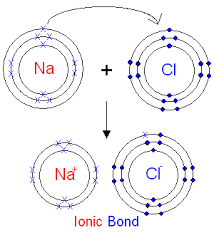
| Ionic bonding | Metal and non-metal |
| Metal atoms _____ electrons to form _____ ions | Lose Positive |
| Non-metal atoms _____ electrons to form _____ ions | Gain Negative |
| Describe ionic bonding to form sodium chloride | |
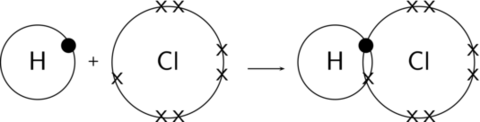
| Covalent bonding | Two non-metals |
| Each atom _____ electrons with the other to create a _____ of electrons | Shares Full outer shell |
| Describe covalent bonding to form hydrogen chloride | |
| A chemical formula shows what _____ are in a _____ | Elements Compound |
| Limestone is mainly _____ | Calcium carbonate (CaCO3) |
| When heated it _____ to form _____ and _____ | Thermally decomposes Calcium oxide Carbon dioxide |
| Chemical equation for the thermal decomposition of calcium carbonate | |
| Thermal decomposition | A substance chemically changes Forms at least two new substances when heated |
| Calcium carbonate also reacts with _____ to make a _____, _____ and _____ | Acid Calcium salt Carbon dioxide Water |
| Chemical equation for the reaction between calcium carbonate and sulfuric acid | |
| The type of salt depends on the type of _____ | Acid |
| Other carbonates that react with acids | Magnesium Copper Zinc Sodium |
| Calcium oxide reacts with _____ to form _____ | Water Calcium hydroxide |
| Chemical equation for the reaction between calcium oxide and water | |
| Calcium hydroxide is an _____ which can be used to neutralize _____ in fields, and works much _____ than powdered limestone | Alkali Acidic soil Faster |
| Calcium hydroxide can also be used to test for _____ by making a solution called _____ | Carbon dioxide Limewater |
| If carbon dioxide is present, the limewater will turn _____, caused by the formation of _____ | Cloudy Calcium carbonate |
| Chemical equation for the reaction between calcium hydroxide and carbon dioxide | |
| Limestone can be _____ and _____ in a kiln with _____ to make _____ | Powdered Heated Powdered clay Cement |
| Cement can be mixed with _____ and _____ to make _____ | Sand Water |
| Or cement can be mixed with _____ and _____ (water and gravel) to make _____ | Sand Aggregate Concrete |
| 5 environmental issues caused by quarrying limestone | Huge holes in landscape Noise and dust in quiet scenic areas Destroys natural habitats Noise and pollution from transportation Waste materials make unsightly tips |
| 2 environmental issues caused by using limestone production | Cement factories make dust which can cause breathing problems Energy used most likely from fossil fuels |
| 5 uses of limestone | Houses and roads Chemicals in paints and dyes Medicines Neutralising acidity in soils, rivers and lakes Neutralising sulphur dioxide in power station chimneys |
| 2 good things about quarrying limestone | Creates jobs which improves local economy = local infrastructural improvements Restoration and landscaping is normally required in planning permission |
| Advantages of limestone | Widely available and cheaper than granite/marble Fairly easy to cut Can be more hard wearing than marble More attractive Fire resistant |
| Advantages of concrete | Can be poured into moulds to make blocks or panels Very quick and cheap for constructing Doesn't corrode Fire resistant |
| Disadvantages of limestone/concrete | Concrete is very unattractive Fairly low tensile strength |
| Some _____ metals such as _____ are found in the earth as the metal itself | Unreactive Gold |
| A metal _____ is a rock that contains _____ to make it _____ extracting the metal from it | Ore Enough metal Economical/worthwhile |
| In many cases the ore is an _____ of the metal | Oxide |
| The main aluminium ore is called _____ | Bauxite |
| The _____ of metal extraction can _____ over time and affect how _____ it would be to extract certain metals | Economics Change Worthwhile |
| A metal can be extracted from its ore by _____ or _____ | Reduction Electrolysis |
| Some ores may need to be _____ before extraction | Concentrated |
| Electrolysis can also be used to _____ the extracted metal | Purify |
| A metal can be extracted from its ore by reduction using _____ | Carbon |
| When an ore is reduced _____ is _____ from it | Oxygen Removed |
| The position of the metal in the _____ determines whether it can be extracted by ______ with _____ | Reactivity Reduction Carbon |
| Metals higher than _____ have to be extracted by _____ which is _____ | Carbon Electrolysis Expensive |
| Metals below _____ can be extracted by _____ using _____, for example _____ | Carbon Reduction Carbon Iron (oxide) |
| Metals that are more reactive than carbon have to be extracted using _____ of _____, such as _____ | Electrolysis Molten compounds Aluminium (oxide) |
| This is very expensive because it uses a lot of _____ | Energy |
| While copper can be extracted using _____, it is very _____ and cannot _____ very well | Reduction Impure Conduct electricity |
| So electrolysis is used to _____ it | Purify |
| Electrolysis is the _____ of a substance using _____ | Breaking down Electricity |
| It needs a _____ to conduct the electricity, called the _____, often a _____ solution, such as _____, or a _____ | Liquid Electrolyte Metal salt Copper sulfate Molten metal oxide |
| The electrolyte has _____ which conduct the electricity | Free ions |
| Electrons are _____ copper atoms at the _____, causing them to go into _____ as _____ ions | Pulled off Anode Solution Cu2+ |
| _____ ions near the _____ gain electrons and turn back into _____ | Cu2+ Cathode Copper atoms |
| The _____ are dropped at the _____ as a sludge, whilst _____ bond to the _____ | Impurities Anode Pure copper atoms Cathode |
| Copper can also be extracted from _____ using a _____ reaction | Solution Displacement |
| More reactive metals react _____ than _____ metals | More vigorously Less reactive |
| Placing a _____ metal into a solution of a _____ will mean that the _____ metal will _____ the _____ metal in the _____ | Reactive Dissolved metal compound More reactive Replace Less reactive Compound |
| The _____ metal bonds _____ to the _____ part of the compound and _____ the _____ metal | More reactive More strongly Non-metal Pushes out Less reactive |
| For example, _____ can be used to displace _____ from _____ solution | Iron Copper Copper sulfate |
| The supply of _____ ores is _____ so it is important to _____ as much as possible | Copper-rich Limited Recycle |




Möchten Sie mit GoConqr kostenlos Ihre eigenen Karteikarten erstellen? Mehr erfahren.