
Karteikarten
Chemistry Regents Vocabulary
Karten in diesem Stapel (49)
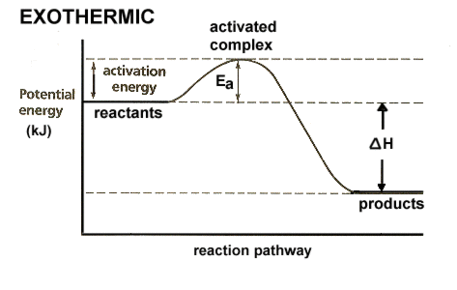
- 1Potential Energy Diagram
- 2Activation EnergyEnergy needed for a reaction to take place
- 3Activated ComplexState of molecules during which reactants are changed to products
- 4EnthaplyEnergy of heat changing at the same pressure
- 5Heat of ReactionDifference between the potential energy of the products and reactants of the reaction
- 6CatalystSubstance used to lower activation energy needed for a reaction to take place
- 7SpontaneousOccurring almost immediately
- 8Reversible ReactionReaction in which the product has the ability to change back into reactants
- 9EntropyRandomness of a reaction
- 10CollisionsCollision of atoms or molecules that affects the speed or effect of a reaction
- 11Surface AreaArea available for collisions to take place
- 12SpeciesAtoms or molecules that are involved in a reaction
- 13ConcentrationAmount of molecules in one area
- 14SufficientRelating to amount of energy required for a reaction to take place
- 15SoluteWhat is being soluted, the minor component of the solution
- 16SolventWhat is dissolving the solute, the major part of the solution
- 17Colligative PropertiesRatio of solutes and solvents
- 18Non-VolatileNon-reactive
- 19Homogeneous MixtureMixture in which the components are evenly distributed
- 20SolutionMixture in which a solvent dissolves and distributes the solute
- 21Heterogeneous MixtureMixture in which components are not evenly distributed
- 22SuspensionMixture of undissolved particles in a heterogenous solution
- 23MiscibleSomething that forms a homogenous mixture is formed
- 24Unsaturated SolutionSolution where there is not enough solute added
- 25Saturated SolutionSolution at which the saturation point and an equilibrium are reached
- 26Supersaturated SolutionSolution with too much solute
- 27SolubilityThe point at which the solution is saturated
- 28DiluteA solution in which there is more solute than solute
- 29MolarityNumber of moles of a solute per a liter of that solution
- 30PrecipitateSomething deposited out of a solution as a result of the solution being saturated already
- 31SolubleCapable of being solved, distributed evenly in a saturated solution
- 32InsolubleIncapable of being solved or reaching a saturation point
- 33LeChatelier's PrinciplePrinciple that dictates that when a reaction in an equilibrium is put stress upon, it makes changes to restore the needed equilibrium
- 34EquilibriumState of balance in a reaction or between opposing forces
- 35Dynamic EquilibriumState of equality between the forward and the reverse reaction
- 36Arrhenius AcidA substance that increases the amount of H+ ions present
- 37Arrhenius BaseSubstance that increases the substance of OH- ions present
- 38IonizedRemoval or addition of an electron to make the atom an ion
- 39ElectrolyteSubstance that ionizes in certain solvents, such as water. It is either a base or an acid
- 40AmphiproticA substance that can be both an acid and a base
- 41Alternative Theory AcidAccording to Alternative Theory, acids give up a proton to the base
- 42Alternative Theory BaseAccording to Alternative Theory, bases receive the donated protons from acids
- 43pHState of acidity or basicity of a substance
- 44pH ScaleScale that rates the substance neutral, basic or acidic
- 45TitrationTechnique of determining the unknown molarity of a base or an acid with its opposite’s known molarity, using the equation MaVa=MbVb
- 46EndpointStage of the titration at which the indicator signals a balance between acids and bases
- 47Equivalence PointPoint at which the substance during a Titration is neutralized
- 48NeutralizationThe balance between an acid and a base resulting in salt forming
- 49IndicatorCompound that changes color when reaching a specific pH
Informationen
- Beschreibung
- Chemistry vocabulary you need to know for the chemistry regents!
- Erstellt von
- jlyn
- Aufrufe
- 342
- Tags
- Bewertung