
Karteikarten
respiratory system que cards
Karten in diesem Stapel (29)
- 1where does air travel?1. nose
2.larynx
3.trachea
4.bronchi
5.bronchioles
6.alveoli - 2what is the process where there is an exchange of gases between lungs and blood and who are responsible for this?- Alveoli are responsible
-called diffusion
-Movement of gas molecules from high partial pressure to low partial pressure - 3what is gaseous exchange?the movement of oxygen from the air into the blood, and co2 from the blood into air
- 4what makes alveoli so good at gaseous exchange-walls very thin(short diffusion pathway)
-extensive capillary network surronds alveoli so have excellent blood supply
-huge surface area (greater uptake of oxygen) - 5what muscles are used during inspirationrest: diaphragm and external intercostals
Exercise: diaphragm, external intercostals, sternocleidomastoid, scalenes and pectorals major
ribcage moves up and out, diaphragm contracts and flattens - 6what muscles are used during expirationrest: diaphragm and external intercostals relax
Exercise: internal intercostals and abdominals
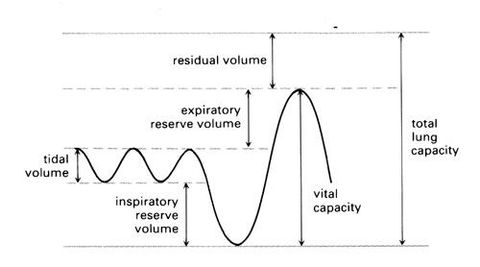
ribcage falls, diaphragm relaxes and rises to dome-shaped position - 7what is tidal volumethe volume of air breathed in or out per breath
increases during exercise - 8what is minute ventilationis air breathed in and out per minute
number of breaths(per min)x tidal volume=minute ventilation
large increase during exercise - 9what is inspiratory reserve volumevolume of air that can be forcibly inspired after a normal breath
(breasting in more than tidal volume)
decreases in exercise - 10what is expiratory reserve volumevolume of air that can be forcibly expired after a normal breath
(expelling more air than tidal volume)
slight decrease during exercise - 11what is residual volumethe amount of air that remains in the lungs after maximal expiration
remains the same during exercise - 12what is a spirometer trace
- 13gaseous exchangeaims:
-getting oxygen in air into lungs so it can diffuse into blood and transported to the cells of body
-removal of co2 from blood - 14what is concentration/diffusion gradientdifference in partial pressure
- 15gaseous exchange at alveoli-partial pressure of oxygen in alveoli is higher than that in the capillary blood vessels
-oxygen will diffuse from alveoli into blood until pressure is equal on both - 16gaseous exchange at the muscles-partial pressure of oxygen lower at tissues than in blood so diffuses in
-also partial pressure of co2 is higher in muscles than in blood so diffuses out - 17neural and chemical regulation of pulmonary ventilation-neural control involves the brain and nervous system
-chemical control involved blood acidity
-they work together to regulate breathing
-when blood acidity is high brain is informed and sends impulses through nervous system to increase breathing - 18what two systems are used to control pulmonary ventilation (breathing) though the the nervous systemparasympathetic and sympathetic
- 19what does the sympathetic nervous system do?-prepares body for exercise
-increase breathing rate - 20what does the parasympathetic nervous system do?-comes down from exercise
-slows down breathing - 21what is the respiratory centre-located in medulla oblongata
-controls the rate and depth of breathing - 22what happens when the respiratory centre detects and increase in carbon dioxidethe increased concentration of co2 in blood stimulates the respiratory centre to increase respiratory rate
- 23what are the two main areas in the respiratory centre?1. inspiratory centre is responsible for inspiration and expiration
2. expiatory centre stimulates the expiratory muscles doing exercise - 24inspiratory centre-sends out nerve impulses via phrenic nerve to inspiratory muscles (diaphragm and external intercostals) causing them to contract , after two seconds passive expiration occurs
- 25what do chemoreceptors do?-detects blood acidity (increases due to plasma concentration of co2 and latic
acid production)
-they send impulses to inspiratory centre to increase ventilation (by recruiting the extra muscles) until blood acidity has returned to normal - 26what do proprioceptors do?-they are sensory receptors located in joints and muscles
-provide feedback to respiratory centre to increase breathing during exercise
(detect movement) - 27what do baroreceptors do?-detect blood pressure
-decrease means feedback to respiratory centre results in an increase in breathing rate - 28what affects does smoking have-causes irritation of trachea and bronchi
- reduces lung function
-damages cells lining trachea, bronchi and bronchioles
-damages alveoli walls break down and join together forming large air spaces, reduces efficiency of gaseous exchange (increase risk of COPD) - 29What does smoking do to blood?-affects oxygen transport as carbon monoxide from cigarettes combines with haemoglobin.
-reduces oxygen-carrying capacity of the blood
-increasing breathlessness
Informationen
- Beschreibung
- A level Physical Education (PE) (NWY) Karteikarten am respiratory system que cards, erstellt von Lucinda Adams am 08/04/2017.
- Erstellt von
- Lucinda Adams
- Aufrufe
- 25
- Bewertung