
11766066
Description

Flashcards by Delvin Hayfron, updated more than 1 year ago

|
Created by Delvin Hayfron
almost 9 years ago
|
|
| Question | Answer |
| Conductors | Have free-moving electrons capable of carrying a charge |
| Main form of conductive material | Metals- Eg Copper and silver |
| Insulators | Materials with fixed (unmoving) electrons that cannot conduct |
| Why are metals good conductors? | The sea of delocalised electrons that hold them together, can flow freely and easily as current |
| Examples of insulative materials | Many non-metals, such as: Rubber Plastic Wood |
| Current | The flow of electrons/electric charge. Measured in Amperes (Amps) Unit symbol: A Equation symbol: I |
| Direction of flow of electrons | Negative terminal of cell/battery to positive terminal |
| Potential difference (Voltage) | Work done (energy transferred) between two points per unit charge: AKA Joules/Coulomb Unit/equation symbol: V |
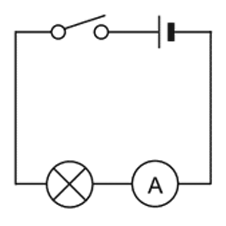
| Series Circuit |
A circuit with only ONE route for current flow.
All components are either ON or OFF at once
Image:
Series (binary/octet-stream)
|
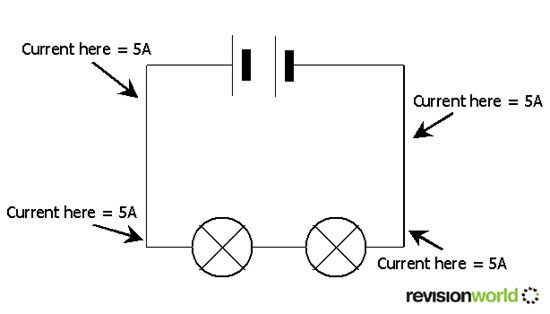
| Current in a series circuit | The same everywhere |
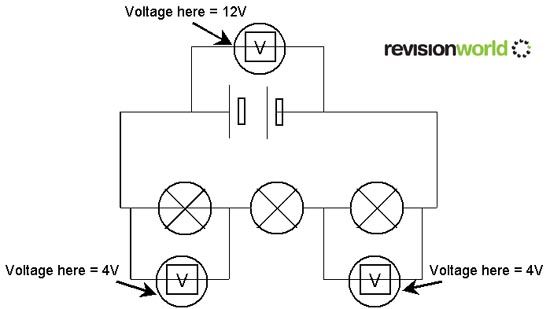
| Voltage in a series circuit | Is SPLIT AMONG COMPONENTS (Total = sum of all voltages) |
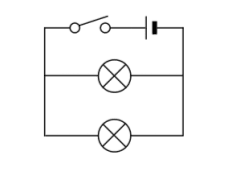
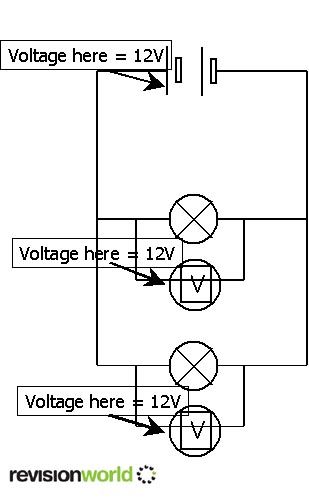
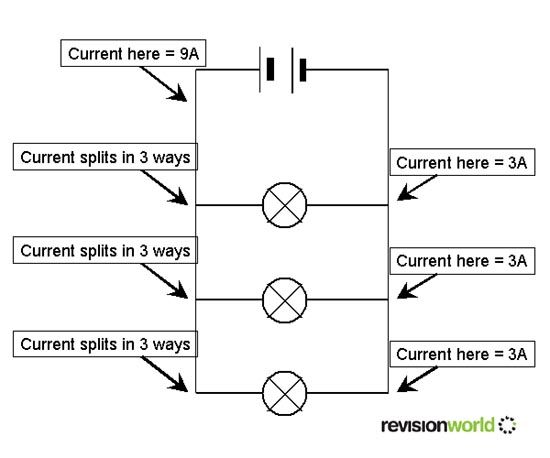
| Parallel circuit | A circuit with MULTIPLE paths for current to flow |
| Voltage in parallel | The same throughout the circuit |
| Current in parallel | Total current = sum of individual branch currents |
Want to create your own Flashcards for free with GoConqr? Learn more.