
11826433
Description

Flashcards by Jake Lewis, updated more than 1 year ago

|
Created by Jake Lewis
almost 9 years ago
|
|
| Question | Answer |
| what arer the two types of synapse | electrical and chemcia |
| another name for electrical synapses | gap synapses |
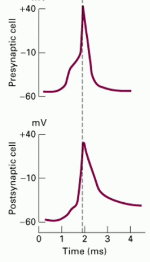
| outline electrical sysnapses | signals pass directly from one cell to another |
| the tructural component that is required for electrical synapse functionality | gap junctions |
| at a gap junction what occurs | the cytoplasm of the two cells involved come together very closely |
| which is faster electrical or chemical synapses | electrical |
| t or f: no tranmitter molecule is required at a electrical synapse | t |
| where are electircal synapses common | places where fast suignals are needed like 1. reflexs, 2. cardiac muscles 3. epithelial cells |
| t or f: like chemical synapses electrical synapse have signals only flow one way | f: can flow both ways |
| at gap junctions there are special structures called? | connexon (channel or pore) |
| for a molecule to be able to transfer between the cells at a gap junction it needs to be within what size range | less than 1000 daltons |
| connexons are made up of how many subunits? | 6 |
| the subunit of a connexon is a | connexin (i instead of o) |
| distance between membranes of cells at an electrical synapse | 3.5nm |
| distance between cell membranes at a chemical synapse | 20-40nm |
| is there a transmission delay in electrical synapses (i.e. a delay at the end of the presynaptic cell) if so how long? | no |
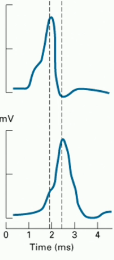
| is there a transmission delay in chemical synapses (i.e. a delay at the end of the presynaptic cell) if so how long? | yes 1-5 msec |
| is transmission in a chemical synapse bi or mon directional | monodirection |
| is transmission in a electrical synapse bi or mon directional | bidirectional |
| the first demonstration of a chemical synapse occured when by who ? | 1921 otto loewi |
| criteria to be clased as a neurotransmitter | 1. when applied to postsynaptic membrane has to mimic the normal neurotransmission 2. has to be manufactured and storred in the presynaptic cell 3. the presynaptic cell mut release it when excited 4. drugs that are known to affect the functionallity fo the synapse should have an effect on the functionality of the chemcial if its a neurotransmitter 5. should be an inherint mechanism to clear the chemical from the synaptic cleft |
| outline otto loewi's experiment that showed chemical synapse function | - ‘experimental demonstration of chemical transmission by Otto Loewi’ - He took a frog heart and isolated it. It was innovated by the vagus nerve - Stimulation of vagus leads to slowed heart beat He put that heart in a jar with a chemical solution - He counted the heartbeat of said heart - He had another jar linked onto this jar with another second (non-innovated by vagus nerve) heart in it - He counted heart beats of this one two - If he stimulated the vagus nerve of heart one the heart beats slowed down (after a while normal rhythm came back) - Stimulation of heart 1 vagus nerve, heart 2 also showed a slowed heart beat - The explanation: a chemical must have been released from the vagus nerve in container 1, that diffused into container 2 and thus had effect on heart 2 9this chemical is now known to be acetate choline) |
| 10 examples of neurotransmitter | 1. Acetylchholine 2. Norepinephrine 3. Dopamine 4. Seratonin 5. GABA 6. Glyceine 7. Glutamate 8. Aspartate 9. Substance P 10. met-enkephalin |
| the main CNS excitatory neurotransmitter is | glutamate |
| the main inhibitory CNS neurotransmitter is | GABA |
| name for receptors that are directly linked to the channel that opens | inotropic |
| name for the receptor that links to channel via secondary molecule (two names) | metabotropic G protein linked |
| in presynaptic neurons in chemical synapses the vesicles containing the neuortransmitter tend to gather together. the site they gather at is called? | the active zone |
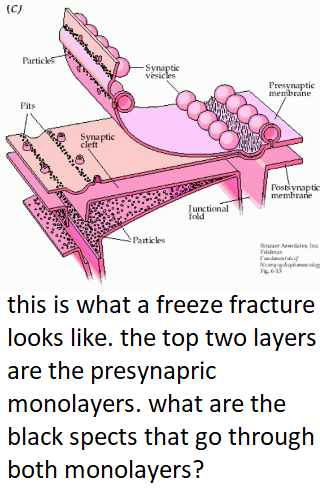
| name a method of separating the two layers of a phospholipid bilayer? outline | freeze fracture: snap freezing it allows the two to be snaped apart |
|
type of synapse?
Image:
Llllll (binary/octet-stream)
|
electrical |
|
type of synapse?
Image:
M (binary/octet-stream)
|
chemical |
|
Image:
Mmm (binary/octet-stream)
|
protiens that span the bilayer like receptors and channels |
| example of proteins that span the presynaptic neuron membrane (2) | 1. neurotransmitter reuptake proteins 2. calcium channels |
| SNARE proteins are involved in? | calcium sensing and vessicle docking |
| SNARE stands for? | somehow: soluble N-ethylmaleimide sensitive fusion protein receptor |
| SNARE proteins are found where? | siome on the terminal membrane of the presynaptic membrane and some on vessicles containing neurotransmitters |
| snare proteins can be one of two types which are? what diserns them? | V-SNARes : on vessicle membrane T-SNAREs: on the neuronal membrane |
| what potein is important for SNARE protein function but isnt part of the SNARE family | calcium channel |
| name 2 V-SNARe proteins | synaptobrevin synaptotagmin |
| name 2 T-snare proteins | syntaxin SNAP-25 |
| which of the SNARE proteins is the calcium sensitive one | synaptotagmin |
| which protein initiates the start of the SNARE protein complex formation in response to calcium | synaptotagmin |
| Formation of the SNARE protein complex causes? | vessicle fusion |
| which protein is important for vesicle recycling? | dynamin |
| vessicles are coated in what protein? | clathrin |
| where are most the electrical readings of a neuron taken? why? issue caused by this? | cell body dendrites too thin it means theres a delay in the elctrical signal detection as delay getting to cell body |
| if excitation occurs but not enough for a AP whats it called | excitatory post synaptic potential |
| how long do action potentials last roughly | 2-3 msec |
| how long do post synaptic excitatory potentials last roughly | 15-20 msec |
| are excitatory post synaptic potentials decrimental | yes |
| whats the oposite of an EPSP | i hibitory post synaptic potential |
| two ways that inhibitory neurotransmitters can work to reduce the neurons membrane potential | 1. open cloride channels so chloride moves in 2. open K+ chanels so K+ moves out |
| two types of sumation? outline | 1. temporal: combination of EPSPs hiting same location over tiem period 2. spacial: combination of EPSPs hiting separat locations at the same time |
| forction of IPSPs | ait in filtering information allows the inhibition of one muscle whilst its counterpart is active allows fine tuning of purkinji cells |
Want to create your own Flashcards for free with GoConqr? Learn more.