
14118457
Description

Flashcards by Alinta Kalns, updated more than 1 year ago

|
Created by Alinta Kalns
over 7 years ago
|
|
| Question | Answer |
| Aim of prostaglandin-type protocols | Synchronise P4 decline Cause luteolysis of any present CL Initiate follicular phase May be repeated if cows in early dioestrous or in follicular phase already |
| Advantages of PG-type protocols | Easy IM admin Variety of protocols Fertility normal Economical |
| Disadvantages of PG protocols | Only works if CL present May cause abortion if pregnant May cause abortion/respiratory difficulties in humans Doesn't synchronise follicular development |
| Why should cows be treated in days 5-19 (heifers) or days 7-18 (cows) with PG protocols? | Ensure enough PG receptors available to bind |
| Aims of progestin-based protocols | Get anoestrous cows cycling Provide artificial CL to prevent ovulation Combined with GnRH and PGs to synchronise new wave + luteolyse any present CLs Can be combined with ovulation synchronisation (GnRH, oestrogen, eCG |
| How do Progestin protocols work in anoestrous cows? | Anoestrous = high negative feedback sensitivity of oestrogen on hypothalamus Progesterone reduces hypothalamic sensitivity --> allows production of LH and FSH in response to oestrogen (positive feedback) Deep anoestrous cows take longer to return. |
| How to disinfect intravaginal P4 devices | Autoclave Soak + rinse in pressured water + soak in Virkon/bleach + rinse, dry, and store away from light Can be reused once effectively |
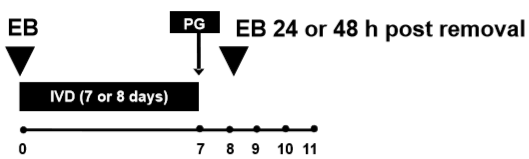
| Variations of progestin protocols | Oestrogen or GnRH admin Place intravaginal P4 device for 5-7 days Admin PG 1-2 times (8 hours apart) when removing P4 devise Admin oestrogen 1-2 days or GnRH 54-72 hours after PG admin AI immediately with ovulation protocol (Co-synch - GnRH) or 12-16 hours after |
| Describe what the admin of the below does | EB/GnRH - synch new wave emergence IVD - prevents ovulation PG - removes endogenous P4 EB - stimulates ovulation |
| Advantages of GnRH based protocols | Simple Some efficacy in anoestrous cows Useful if poor heat detection |
| Disadvantages of GnRH protocols | Reduces pregnancy rates in heifers Reduced conception rates (but increases if IVD and PG also used) Reduces oestrous behaviour Cost Requires pre-synchronisation treatments |
| What are examples of pre-synchronisation treatments and why are they used? | Increases % of follicles that respond to GnRH May increase fertility BUT increased cost + handling 2 PG injections 14 days apart, 14 days prior to starting OvSynch PG injection + heat detection and AI for 3 days, then starting GnRH Double OvSynch |
| Indications of OvSynch | Poor heat detection Reluctance to practice continuous heat detection Simplicity May help anoestrous cows Combined with progestin protocols |
| Aim of resynchronisation protocols | Produce synchronised return to oestrous after 1st/2nd AI in cows that aren't pregnant +/- pregnancy testing |
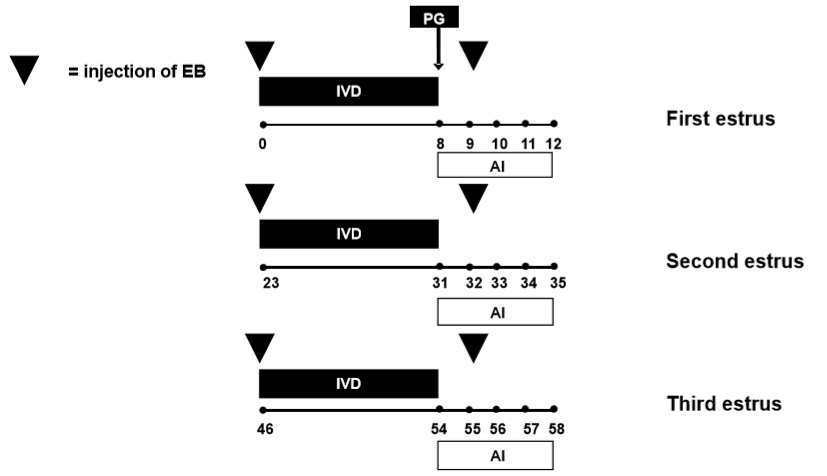
| Describe a resynch protocol without pregnancy testing | Leave 11 days between programs Day 0 --> oestradiol + IVD implant for 8 days Day 8-12 - PG injection, oestradiol injection day 9, and AI Day 23 --> oestradiol + IVD for 8 days Day 31-35 - remove IVD, oestradiol day 32, AI Day 46 --> oestradiol + IVD for 8 days Day 54-58 - remove IVD, oestradiol D55, AI |
| Re-synch protocol | |
| In dairy cows, should you use Oestradiol, GnRH or can you use both? | GnRH. Oestradiol is banned in dairy cows |
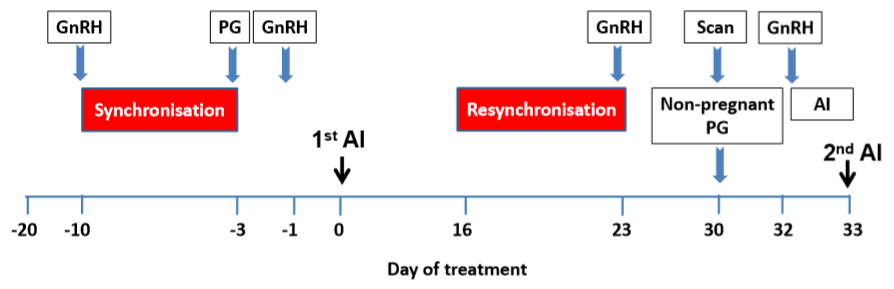
| In a resynch protocol that uses pregnancy testing, describe the protocol | Pregnancy test on day 30 after 1st round If non-pregnant: PG + GnRH and fixed time AI Second oestrous doesn't require GnRH before inserting the CIDR Only admin PG after P4 removal if non-pregnant |
| Pregnancy testing + resynch protocol |
Want to create your own Flashcards for free with GoConqr? Learn more.