
15423923
Description

Flashcards by Eve Crutchfield, updated more than 1 year ago

|
Created by Eve Crutchfield
about 8 years ago
|
|
| Question | Answer |
| Evapouration (C1) | Turning from a liquid to a gas |
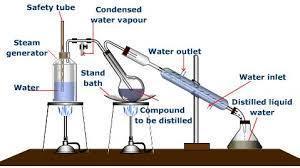
| distillation (C1) | evaporation followed by condensation |
| condensation (C1) | turning from a gas to a liquid |
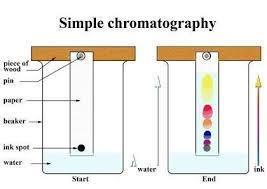
| chromatography (C1) | a way to separate soluble substances |
| chromatography (C1) | the resulting evidence on paper |
| separation (C1) | when one substance can move more than another in a liquid , this results in separation between them |
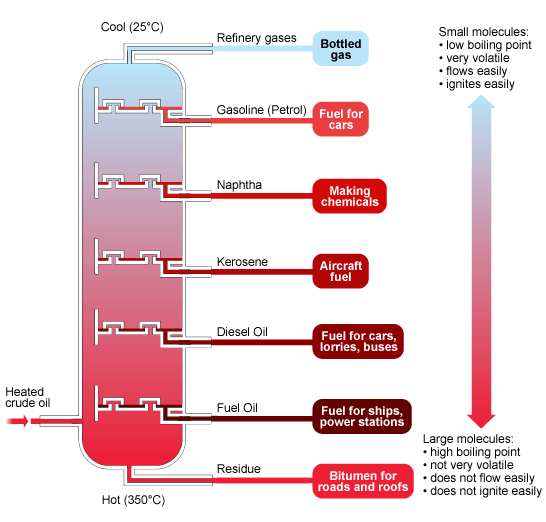
| fractional (C1) | a type of distillation used to separate crude oil |
| boiling point (C1) | a temperature at which a substance turns from a liquid into a gas |
| fraction (C1) | molecules with similar boiling points |
| heavy (C1) | substances with a high boiling point |
| light (C1) | substances with a low boiling point |
| hydrocarbons (C1) | long chain molecules found in crude oil |
| pure (C1) | a substance consisting of only one kind of particle |
| impure (C1) | a substance where another kind of particle has contaminated the main substance |
| atom (C1) | the smallest unit of matter |
| element (C1) | a substance make up of one kind of atom |
| molecule (C1) | two or more atoms held together by chemical bonds |
| compound (C1) | two or more substances not chemically joined |
| mixture (C1) | two or more substances chemically joined |
| solute (C1) | a liquid with a solid dissolved in it |
| solution (C1) | a liquid that lets solids dissolve in it |
| solvent (C1) | a solid that dissolves |
| dissolve (C1) | breaking up of a solid when added to a liquid |
| soluble (C1) | something that dissolves in a liquid |
| insoluble (C1) | something that cant dissolve in a liquid |
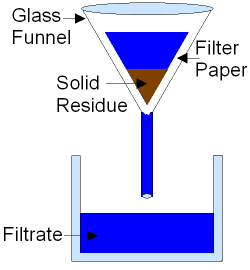
| filtration (C1) | separating an insoluble substance from a liquid |
| residue (C1) | the solid left in the filter |
| filtrate (C1) | the liquid that has passed through the filter |
| melting and boiling points (C1) | they increase as you go down the group due to their density and there is more shielding for the electrons . |
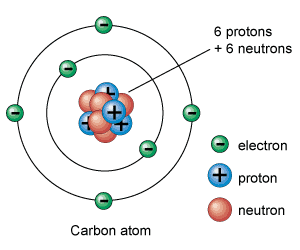
| Atom (C1) | the smallest particle of a chemical that that can exist |
| Proton (C1) | symbol: P location:nucleus relative mass:"+1" relative charge: positive +1 |
| neutron (C1) | symbol: n location: nucleus relative mass: "1" relative charge:neutral (no charge) |
| electron (C1) | symbol: e location: in the shell (outside the nucleus) relative mass: "1" relative charge: negative 1- |
| atomic number (C1) | the number of protons in an atom |
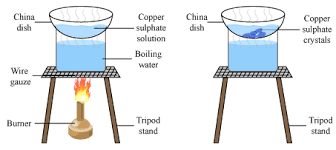
| crystallisation (C1) | crystallisation separates solids that have dissolved (solutes) in a liquid (solvent) |
| atom (C1) | the smallest particle of a chemical that can exist |
| compound (C1) | two or more elements bonded together |
| balancing symbol equations (C1) | whatever is on one side of the equation must be on the other side as well. 1. count up the atoms on each side 2. add "big" numbers in front to balance things out. |
| groups (C1) | columns in the periodic table (we only need to know 3 of them--1,7,8(0)) |
| group number (C1) | tells you the amount of electrons you need on the outer shell |
| periods (C1) | rows in the periodic table |
| the period (C1) | tells you how many shells are being filled with electrons |
| group 1 (C1) | alkali metals |
| group 7 (C1) | halogens |
| group 8 (C1) | noble gases |
| group number (C1) | number of electrons on the outer shell |
| period (C1) | how many shells |
| metals (C1) | on the left of the periodic table |
| non-metals (C1) | on the right of the periodic table |
| transition metals (C1) | below the main part of the periodic table |
| 1:identify 2:explain | 1:mane something 2:why |
| properties of metals (C1) | properties of metals |
| shiny (C1) | not very reactive |
| malleable (C1) | bend into shape |
| ductile (C1) | can be made into a wire |
| high melting points (C1) | melts at a high temperature |
| good electricity conductors (C1) | conducts electricity |
| strong (C1) | strong |
| melting point (C1) | the temperature at which a solid becomes a liquid |
| density (C1) | the mass per unit volume of a substance |
| electrical sensitivity (C1) | how strongly a substance resists electric current flowing through it. the lower the number , then the better the electrical conductor |
| tensile strength (C1) | the resistance of a material to a force tending to pull it apart |
| corrosion resistance (C1) | how well the material resists the gradual destruction from external factors (eg: rainwater or other acids) |
| crystallisation (C1) | separates solids that have dissolved (solutes) in a liquid (solvent) |
| distillation (C1) | separates two liquids from each other |
| boiling points (C1) | the temperature that turns gas to liquid |
| filtration (C1) | separates a solid from a liquid (this only works if the solid cannot dissolve in the liquid) |
| chromatography (C1) | used to separate mixtures of different colours |
| fractional distillation (C1) | separates mixtures into many different parts. |
| filtration (image) (C1) | |
| crystallisation (image) (C1) | |
| distillation (image) (C1) | |
| atom (image) (C1) | |
| periodic tale (image) (C1) | |
| chromatography (image) (C1) | |
| fractional distillation (image) (C1) | |
| atomic number (C1) | the number of protons in an atom |
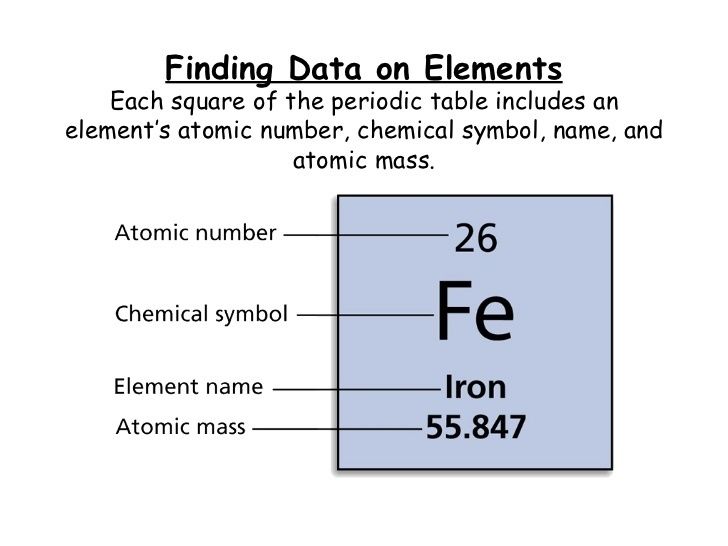
| using periodic table (image) (C1) | |
| isotopes (C1) | an element with a different number of neutrons |
| electronic structure (C1) | rules: 1. start filling up from the inner shell 2.first shell=2 MAX second shell=8 MAX third shell=8 MAX |
| mass number (C1) | the total number of protons and neutrons in a nucleus. |
| atomic number (C1) | the number of protons in the nucleus of an atom |
| chemical symbol (C1) | a notation of one or two letters representing a chemical element. |
| position of elements in the periodic table (C1) | The periodic table is also called the periodic table of elements, is a tabular display of the chemical elements are arranged by atomic number, electron configuration, and recurring chemical properties. |
| The periodic table (C1) | The periodic table, also known as the periodic table of elements, is a tabular display of the chemical elements, which are arranged by atomic number, electron configuration, and recurring chemical properties. |
| separation techniques (C1) | are techniques that can be used to separate two different states of matter such as liquid and solid these separation techniques include filtration or evaporation. |
| chlorine (C1) | kills bacteria |
| aluminium (C1) | has a low density |
| The forces between iodine molecules (C1) | are stronger |
| ionic bonding values (C2) | -hard -crystalline -soluble in water -high melting point -conducts electricity |
| structure (C2) | The arrangement of chemical bonds between atoms in a molecule |
| three main types of bonds: | ionic, covalent and metallic |
| structure and bonding. (C2) | Elements are held together in different ways and the properties of chemical compounds are the bonding between atoms and the attractive inter-molecular forces between molecules. |
| double bond | a chemical bond between two chemical elements |
| carbon atom can form (which bonds) (C2) | Four single bonds. One double and two single bonds. |
| what are ionic bonds formed between? (C2) | metals and non-metals |
| what are ionic bond's properties? (C2) | -dissolve -strong bonds -high melting and boiling point -conduct electricity -form giant ionic lattices(visible to the naked eye) |
| what are the reasons for ionic bonding? (C2) | -movement of electrons between two atoms -one atom wants to giveaway its outer shell electron(metals) -the other will readily accept electrons(non-metals) -all atoms want a full outer shell to be like a noble gas |
| metals (C2) | always give away |
| non-metals (C2) | always accept |
| ionic rules (C2) | ions have a charge.this charge is written as: +, 2+, 3+,- ,2-, 3- metals always form positive ions non-metals always form negative ions |
| simple molecules (C2) | have low melting and boiling points because they have weak forces of attraction between their molecules they are gases |
| The - (C2) | means one pair of shared electrons |
| balancing equations-state symbols (C2) | (S) means solid (L) means liquids (not aqueous) |
Want to create your own Flashcards for free with GoConqr? Learn more.