
1778580
Description

Flashcards by Brian Hedspeth, updated more than 1 year ago

|
Created by Brian Hedspeth
almost 12 years ago
|
|
| Question | Answer |
| A fault is ____. | a fracture in the Earth where movement has occurred |
| the place on the surface directly above the focus of an Earthquake | epicenter |
| When an earthquake occurs, energy radiates in all directions from its source, which is called the ____. | Focus |
| Force that causes earthquakes | elastic rebound |
| Which seismic waves travel most rapidly? | P waves |
| P-waves can travel only through | solids |
| Which seismic waves compress and expand rocks in the direction the waves travel? | P-waves |
| which seismic waves are the most destructive? | surface waves |
| A travel-time graph can be used to find the ____. | distance to the epicenter of an earthquake |
| The distance between a seismic station and the earthquake epicenter is determined from the ____. | arrival times of P and S waves |
| The scale most widely used by scientists for measuring earthquakes is the ____. | moment magnitude scale |
| What instrument records earthquake waves? | seismograph |
| The trace that records an earthquake from seismic instruments is called a ____. | seismogram |
| what are the three types of rock? | igneous sedimentary metamorphic |
| rocks are classified by ____. | how they formed |
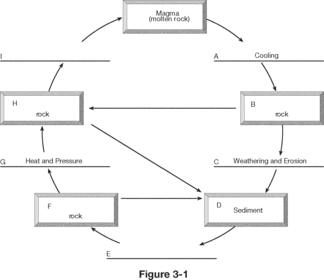
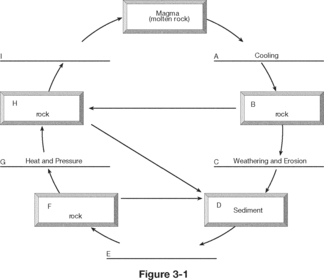
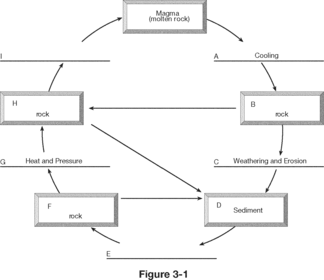
| what type of rock should occur in the part of the rock cycle labeled B? | igneous |
| what process or processes would be occurring in the part of the rock cycle labeled E? | compaction and cementation |
| In Figure 3-1, what type of rock should occur in the part of the rock cycle labeled F? | sedimentary |
| A rock that forms when magma hardens beneath Earth’s surface is called an ____. | intrusive igneous rock |
| A rock that forms from cooling lava is classified as an ____. | extrusive igneous rock |
| As the rate of cooling of igneous rocks increases, the size of the crystals that form ____. | decreases |
| What is the correct order of the processes involved in sedimentary rock formation? | weathering, erosion, deposition, compaction, cementation |
| What type of sedimentary rock is formed from weathered particles of rocks and minerals? | clastic sedimentary rock |
| Most of the heat for contact metamorphism is supplied by ____. | magma |
| Which are the three agents of metamorphism? | heat pressure hydro-thermal solutions |
| A foliated metamorphic rock forms when crystals ____. | combine and form visible bands |
| A fault is ____. | a fracture in the Earth where movement has occurred |
| the place on the surface directly above the focus of an earthquake | epicenter |
| the actual source of an earthquake | focus |
| Which seismic waves travel most rapidly? | P waves |
| Which seismic waves compress and expand rocks in the direction the waves travel? | P waves |
| Overall, which seismic waves are the most destructive? | surface waves |
| What is the minimum number of seismic stations that is needed to determine the location of an earthquake’s epicenter? | three |
| The amount of shaking produced by an earthquake at a given location is called the ____. | intensity |
| The Richter magnitude of an earthquake is determined from the ____. | measurement of the amplitude of the largest seismic waves |
| A succession of ocean waves set in motion by a submarine earthquake is called a(n) ____. | tsunami |
| What layers of Earth make up the lithosphere? | the crust and upper mantle |
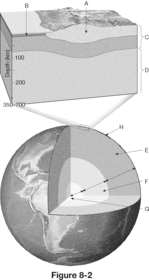
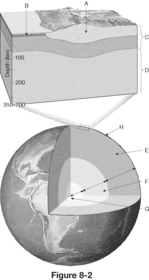
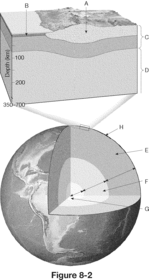
| What layer of Earth is labeled C in Figure 8-2? | the lithosphere |
| What layer of Earth is labeled E in Figure 8-2? | the mantle |
| What layer of Earth is labeled B in Figure 8-2? | the oceanic crust |
| Earth’s thin, rocky outer layer is its ____. | crust |
| boundary between the crust and the mantle | The Moho |
| Through which Earth layer are S waves NOT transmitted? | outer core |
| Wegener’s continental drift hypothesis stated that all the continents once joined together to form!____. | one major supercontinent |
| The supercontinent in the continental drift hypothesis was called ____. | Pangaea |
| According to the theory of plate tectonics, ____. | the lithosphere is divided into plates |
| In the plate tectonics theory, the lithosphere is divided into ____. | 7 major plates and many smaller plates |
| What kind of plate boundary occurs where two plates grind past each other without destroying or producing lithosphere? | transform fault boundary |
| Which of the following results when divergence occurs between two oceanic plates? | seafloor spreading |
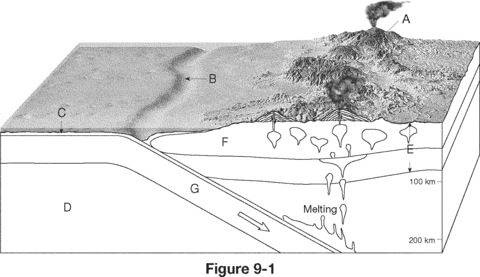
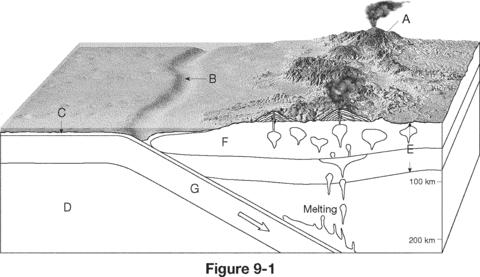
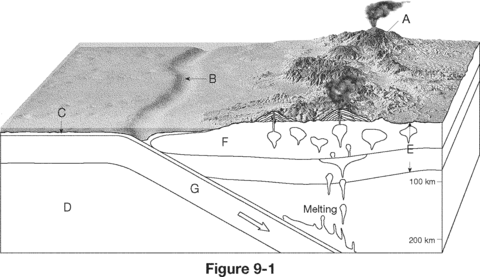
| What feature is labeled B in Figure 9-1? | trench |
| What layer of Earth is labeled C in Figure 9-1? | oceanic crust |
| What process is illustrated by the area labeled G in Figure 9-1? | subduction |
| The Hawaiian Islands were formed when the Pacific Plate moved over ____. | a hot spot |
| The thermal convection that drives plate motion is caused by ____. | an unequal distribution of heat |
| A magma’s viscosity is directly related to its ____. | silica content |
| What factors helps determine whether a volcanic eruption will be violent or relatively quiet? | amount of dissolved gases in the magma temperature of the magma composition of the magma |
| As the temperature of lava increases,its viscosity ____. | decreases |
| Highly explosive volcanoes tend to have what type of magma? | magma with high silica, high viscosity, and higher gas content |
| A volcanic bomb is a ____. | piece of semi-molten rock ejected as glowing lava |
| The particles produced in volcanic eruptions are called ____. | pyroclastic material |
| Large particles of hardened lava ejected from a volcano are called ____. | blocks |
| What is the most abundant gas associated with volcanic activity? | water vapor |
| What type of volcano is built almost entirely from ejected lava fragments? | cinder cone |
| The broad, slightly dome-shaped volcanoes of Hawaii are ____. | shield volcanoes |
| A volcano that is fairly symmetrical and has both layers of lava and pyroclastic deposits is a ____. | composite cone volcano |
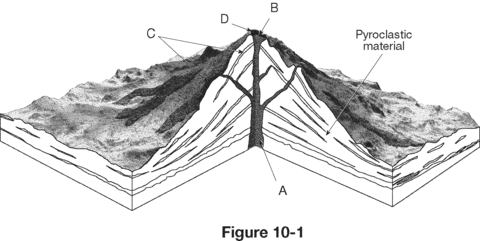
| What feature is labeled D in Figure 10-1? | crater |
| What feature is labeled A in Figure 10-1? | pipe or conduit |
| What type of volcano is illustrated in Figure 10-1? | composite cone |
| The most violent volcanic eruptions are associated with what type of volcano? | composite cones |
| A caldera is a ____. | large depression in a volcano |
| The volcanic landform that is formed when the more resistant volcanic pipe remains after most of the cone has been eroded is called a ____. | volcanic neck |
| Structures that form from the cooling and hardening of magma beneath Earth’s surface are ____. | plutons |
| The largest intrusive igneous body is called a ____. | batholith |
| Which type of intrusive feature forms when magma is injected into fractures cutting across preexisting rock layers? | dike |
| A lens-shaped intrusive igneous mass close to Earth’s surface is called a ____. | laccolith |
| What commonly horizontal intrusive igneous body is formed when magma is injected parallel to sedimentary bedding planes? | sill |
| Magma forms when solid rock in the crust and upper mantle ____. | melts |
| Magma tends to rise towards Earth’s surface primarily because ____. | rocks become less dense when they melt |
| Most of the active volcanoes on Earth are located in a belt known as the ____. | Ring of Fire |
Want to create your own Flashcards for free with GoConqr? Learn more.