
267846


| Question | Answer |
| Phenocopy Effect | environmental aid to change phenotype, no effect on genotype |
| karyotyping | use chromosomes from somatic cells in mitosis |
| Null/Amorphic Alleles | non-functional (error in encoding region) or no protein (error in regulatory region) produced |
| hypomorphic allele | poorly functioning (encoding) or reduced amount (regulatory) of functioning proteins produced |
|
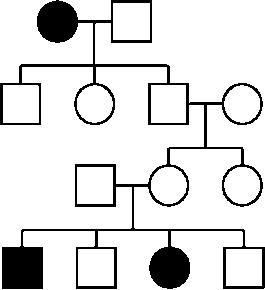
Image:
pedigr4.gif (image/gif)
|
recessive pedigree |
| dominant hypomorphic alleles | over production (regulatory) of normal protein OR protein with increased activity (encoding) |
| Neomorphic allele | negative consequence due to altered protein function/interference with wildtype protein (encoding) |
| Karyotype | # of appearance of chromosomes from somatic cell (only visualized when highly compacted) |
| Light bands (karyotyping) | structural genes (eurochromatin) - less condensed, at chromosome arms |
| Dark Bands (karyotyping) | heterochromatin - highly condensed, at centromeres or telomeres |
| Heterogametic vs. Homoegametic | sperm with Y OR X chromosome vs. eggs with ONLY X chromosome |
| X-Linked recessive trait trends (2) | 50% of sons of carrier women will be affected, male must be affected for daughter to be affected |
| X-Linked Dominant trait trends (2) | affected females most likely heterozygous, affected male = all daughters will be affected |
| Barr Body | darkly stained structure in nucleus, inactivated X chromosome (entirely heterochromatin) |
| Independent assortment | different chromosomes or 50+ map units apart |
| tightly linked | on same chromosome - no crossing over |
| map units | distance between genes, gives frequency of crossing over #recombinants/#offspring x 100 |
| Incomplete/Semi/Partial Dominance | phenotype of heterozygote can be distinguished from both homozygotes |
| Codominance | both alleles fully expressed in heterozygote (2 distinct proteins being made) |
| Variable expressivity | range of phenotypes can be expressed by a genotype |
| Allelic Heterogeneity | different alleles cause same phenotype |
| Incomplete Penetrance | allele not expressed even though present in individual |
| Pleiotropy | single gene responsible for many distinct and seemingly unrelated phenotypic traits |
| Locus Heterogeneity | 2 or more genes can individually produce a phenotype (if on same gene, all albino, if on different genes, all wild type) |
| Gene Interaction | different combinations of alleles from different genes result in different phenotypes due to interactions between products at cellular and biochemical level |
| Epistasis | one gene prevents phenotype expression of another (overriding effect) |
| Sex-Influenced Traits | both male and female have genes but expression varies |
| sex-limited traits | males and females have genes but only one sex expresses the trait |
| Genetic Anticipation | worsening/earlier onset of symptoms with each generation - due to expanding/accordion genes |
| Repeated gene in encoding region | long tract of single repeated amino acid (polyglutamine tract) - misfolding or new function |
| repeated gene in regulatory region | null alleles, absence of functional protein |
| repeated gene in regulatory region | null alleles, absence of functional protein |
| Epigenetic Effects | chromosomal modification that does not change DNA sequence but alters gene expression |
| Epigenetic modifications (3) | change to chromatin structure (compaction), de-acetylation of histones, chemical modification of DNA (methylation) |
| Genomic Imprinting | parent specific epigenetic effects - mammals need imprinted genes from mother and father |
| uniparental disomy | two sets from one parent - do not survive |
| Transposable Elements | short sequences of DNA that change position within a gene ("jumping genes") |
|
Image:
Slide20403.gif (image/gif)
|
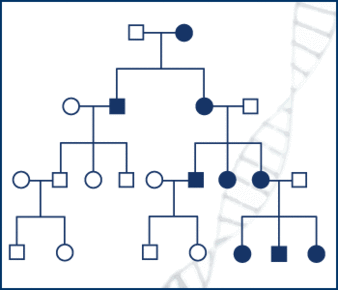
maternal inheritance |
| Heteroplasmic cells | different mitochondrial DNA within cell |
| Aneuploidy | 2N but more or less chromosomes (trisomies and monosomies) |
| Polyploidy | more than 2 sets of chromosomes |
| Autoploids | chromosome sets are identical |
| Allopolyploids | result of crosses between 2 or more species |
| purpose of doubling | individual gametes from each parent can not pair (do not recognize as homologous pairs) |
| result of doubling | doubled by malfunction of spindle fibres, known as amphiploid (act as diploid) |
| Back-Crossing | cross with suspected ancestor or hybrid parent - if parent, will see bivalents and univalents |
| Endomitosis | sister chromatids separate but no cytokinesis (seen in liver and kidney) |
| Trisomy on Chromosome 21 | Down Syndrome |
| Patau Syndrome | Trisomy of chromosome 13 |
| Edward Syndrome | Trisomy of chromosome 18 |
| XO, XXY, XXX, XXY | Turner Syndrome, Klinefelter Syndrome, Triple X Females, XXY Males |
| chromosome identification characteristics (3) | size, centromere position, banding patterns |
| chromosome painting | fluorophores bind to specific DNA sequences |
| 4 centromere locations | metacentric (middle), submetacentric (off-middle), acrocentric (towards end), telocentric (at end) |
| Intragenic deletion | two breaks in chromosome resulting in small piece lost (typically inactive gene) |
| Paracentric inversion | inverted region doesn't include centromere, results in dicentric bridge and acentric fragment |
| pericentric inversion | inverted region includes centromere |
| types of translocations (3) | reciprocal, robertsonian, unidirectional |
| chromosomes involved in Robertsonian translocation | 21, 14 or 13 |
| characteristic of robertsonian translocation carrier | offspring with down syndrome common, also miscarriages |
| Explain tissue specific polyploidy | endomitosis (no cytokinesis) resulting in tetraploid cells - increased transcription (liver and kidney) |
| Factors affected expression of mt disorders (4) | # of mitochondrion/cell, severity of mutation, effect on energy production, energy requirements of cell |
Want to create your own Flashcards for free with GoConqr? Learn more.