
10660878
Description

Mind Map by Isobel Temple, updated more than 1 year ago
|
|
Created by Isobel Temple
about 8 years ago
|
|
Physics (P.5. Waves)
- Basics
- A wave is an ossilation that transferes
energy from one point to another
- Mechanical waves: are
vibrations which travel
through a medium
- Meduim: refers to a
material of a stubstance (it
travels through matter)
- Electromagnetic waves:
waves capable of
transmitting energy
through a vaccume (no
medium/matter)
- A wave can be mechanical/
electromagnetic and
transverse/ longitudinal
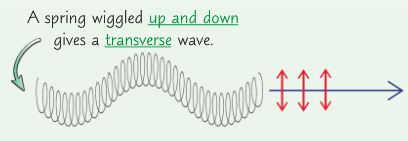
- Transverse waves: the
vibrations are perpendicular
(90 degrees) to the way the
waves travel (e.g. all
electromagnetic waves,
ripples in water)
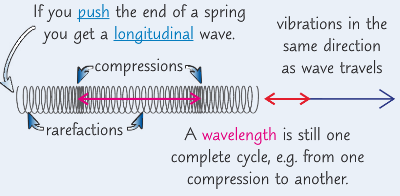
- Longitudinal waves: the
vibrations are parallel to the
direction the wave travels
(squashed up then stretched
out)
- You can model it with water
drop something in it transvers
waves happen, the wave
moves but the water does not
- Wave properties
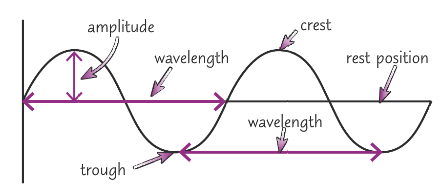
- Amplitude: distance from the
middle to the top (crest) or
bottom (trough) of a wave
- Symbol: A
- Unit: Meters or Volts
- Wave length: distance from one
point on a wave to the same point
on the next wave
- Symbol: Upside
down 'y' (lambda)
- Unit: Meters(m)
- Frequency: Number of
waves/ ossilations per
second
- Symbol: F
- Unit: Herts (Hz)
- Time period: The time from
one wave to pass a given
point
- Symbol: T
- Unit: Seconds, s
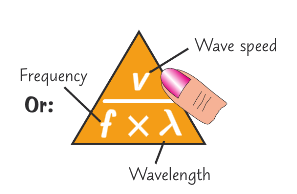
- Wave speed (m/s) = frequency (Hz) x wavelength (m)
- Symbol: T
- Symbol: F
- Symbol: Upside
down 'y' (lambda)
- Symbol: A
- Amplitude: distance from the
middle to the top (crest) or
bottom (trough) of a wave
- Wave properties
- You can model it with water
drop something in it transvers
waves happen, the wave
moves but the water does not
- Longitudinal waves: the
vibrations are parallel to the
direction the wave travels
(squashed up then stretched
out)
- Transverse waves: the
vibrations are perpendicular
(90 degrees) to the way the
waves travel (e.g. all
electromagnetic waves,
ripples in water)
- A wave can be mechanical/
electromagnetic and
transverse/ longitudinal
- Electromagnetic waves:
waves capable of
transmitting energy
through a vaccume (no
medium/matter)
- Meduim: refers to a
material of a stubstance (it
travels through matter)
- Mechanical waves: are
vibrations which travel
through a medium
- A wave is an ossilation that transferes
energy from one point to another
- Wave velocity
- Wave speed
- Wave velocity (m/s) = frequency (Hz) x wave length (m)
- 1kHz = 1000Hz
- 1MHz = 1,000,000Hz
- 1MHz = 1,000,000Hz
- Wave velocity (m/s) = frequency (Hz) x wave length (m)
- Velocity of sound
- To work it out record how long it
takes you to hear an echo
- Or use microphones and a computer
(diagram not acccurate, sound is
longitudinal)
- Velocity of
sound varies
with pressure
and
temperature
- Velocity of
sound varies
with pressure
and
temperature
- Or use microphones and a computer
(diagram not acccurate, sound is
longitudinal)
- To work it out record how long it
takes you to hear an echo
- Wave speed
- Wave properties
and uses
- When a wave hits a boundary
between two media (material
interface) 3 things can happen (it
depends on the densities), it can
be: reflected (an echo), transmitted
(and possible refracted), absorbed
- When the wave is
absorbed it
transferes energy to
that materials energy
store
- If the densities are
different then more of
the sound will be
absorbed
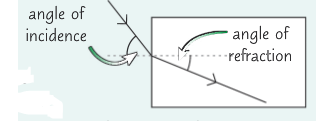
- When a wave travels from one
mediun to another it may carry
on moving (be transmitted) but
it's velocity may change and it's
direction may change - moves
away from norm line, (a line at 90
to the surface) (refraction)
- It may be reflected, this is
where it isn't absorbed
or transmitted so it is
'sent back' from the
other material
- Sound is genrally faster in
solids than liquids and faster
in liquids than gasses
- Reflection
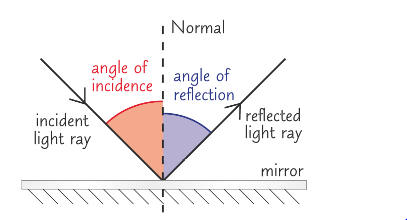
- Angle of incidence =
angle of reflection
- The "angle" if measured
from the norm. The
norm is an imagenry
line drawn by a dotted
line that is at 90
degrees to the surface
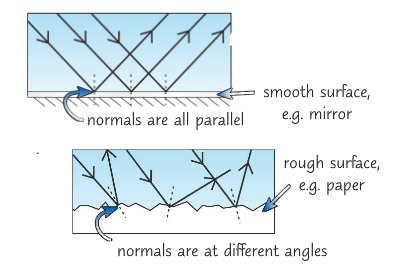
- Reflection of visible light is what lets
us see things, light rays reflect of
smooth surface (e.g.mirror) in the
same direction giving a clear image
This reflection is called specular (all
reflected in the same direction)
- Light reflected of rough surface (e.g.paper) goes
in all directions, each ray hits the surface at a
differnt angle (angle of incidenc still = angle of
reflection). This reflection is called scattered. It
happens becuase the norm is different for each
ray of light. The surface will therefore look matt
- White light is made
up of lots of different
colurs of light, this
don't split up when
reflected
- You need to be able to draw ray diagrams.
Draw the normaland then the angle of
incidence and reflection- make sure they are
the same size. Always add arrows to the rays
- Reflection investigation...
- Draw the surface line on apiece of paper,
draw a dotted line at 90 degrees to it
(normal line). Place a mirror on the
surface line. Get a ray box and shine at
norror, so it intersects at the surface line
and the norm line. Trace the incidence
line and the relected line. measure the
angle. Repeat for diferent angles and
colours of light. The angle should always
be the same no matter what
- Draw the surface line on apiece of paper,
draw a dotted line at 90 degrees to it
(normal line). Place a mirror on the
surface line. Get a ray box and shine at
norror, so it intersects at the surface line
and the norm line. Trace the incidence
line and the relected line. measure the
angle. Repeat for diferent angles and
colours of light. The angle should always
be the same no matter what
- Reflection investigation...
- You need to be able to draw ray diagrams.
Draw the normaland then the angle of
incidence and reflection- make sure they are
the same size. Always add arrows to the rays
- White light is made
up of lots of different
colurs of light, this
don't split up when
reflected
- Light reflected of rough surface (e.g.paper) goes
in all directions, each ray hits the surface at a
differnt angle (angle of incidenc still = angle of
reflection). This reflection is called scattered. It
happens becuase the norm is different for each
ray of light. The surface will therefore look matt
- Reflection of visible light is what lets
us see things, light rays reflect of
smooth surface (e.g.mirror) in the
same direction giving a clear image
This reflection is called specular (all
reflected in the same direction)
- The "angle" if measured
from the norm. The
norm is an imagenry
line drawn by a dotted
line that is at 90
degrees to the surface
- Angle of incidence =
angle of reflection
- Refraction
- Refraction is
when waves
bend
- Waves travel at diferent speeds in
materials with different densities,
so when it crosses a boundary it
changes speed
- The frequency of the
wave stays the same, it
means the wavelength
changes. (wavelenght
decreases if wave slows
down, wavelenght
increases if it speeds up
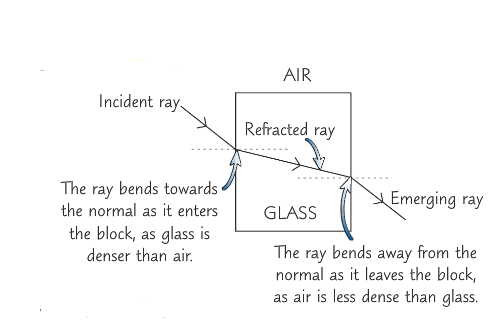
- If it hits it at an angle to the
norm the change in speed (and
wavelength) makes it bend-
refraction. Greater change in
speed= greater bend
- If the wave slows down= bends to normal
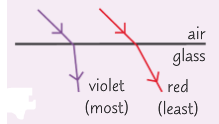
- Colours have slightly
different wavelengths so
when they enter a denser
substance the shorter wave
lenght slows down more and
refracts more.
- Light ray travelling through
more dense material= slows
down= towards the normal
- Less dense material= speeds
up= away from material
- When white light travels
through a triangular prism
you get a rainbow
- You can investigate this
using a blue and red light box
and a prism
- You can investigate this
using a blue and red light box
and a prism
- When white light travels
through a triangular prism
you get a rainbow
- Less dense material= speeds
up= away from material
- Light ray travelling through
more dense material= slows
down= towards the normal
- Colours have slightly
different wavelengths so
when they enter a denser
substance the shorter wave
lenght slows down more and
refracts more.
- If the wave slows down= bends to normal
- If it hits it at an angle to the
norm the change in speed (and
wavelength) makes it bend-
refraction. Greater change in
speed= greater bend
- The frequency of the
wave stays the same, it
means the wavelength
changes. (wavelenght
decreases if wave slows
down, wavelenght
increases if it speeds up
- Waves travel at diferent speeds in
materials with different densities,
so when it crosses a boundary it
changes speed
- Refraction is
when waves
bend
- Reflection
- Sound is genrally faster in
solids than liquids and faster
in liquids than gasses
- It may be reflected, this is
where it isn't absorbed
or transmitted so it is
'sent back' from the
other material
- When a wave travels from one
mediun to another it may carry
on moving (be transmitted) but
it's velocity may change and it's
direction may change - moves
away from norm line, (a line at 90
to the surface) (refraction)
- If the densities are
different then more of
the sound will be
absorbed
- When the wave is
absorbed it
transferes energy to
that materials energy
store
- When a wave hits a boundary
between two media (material
interface) 3 things can happen (it
depends on the densities), it can
be: reflected (an echo), transmitted
(and possible refracted), absorbed
- Sound in solids
and the ear
- Sound waves are caused by vibrating
objects, which are passes around the
surrondings as longitudinal waves
- As it travels
through a
solid it causes
vibration of
particle
- Sound
waves can
reflect or
refract
- Sound
waves can
reflect or
refract
- As it travels
through a
solid it causes
vibration of
particle
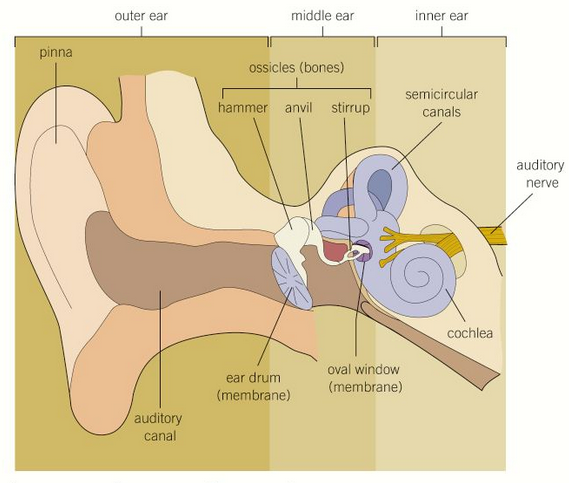
- The outer ear (pinna and
auditory canal) gather
the sound wave and
direct it to the ear drum
- The ear drum then vibrates, these vibrations
are passed onto tiny bones called your
ossicles (through the semiciruclar cannal) to
the cochlea
- The cochlea turns the
vibrations into electrical
signal which are sent to the
brain, the brian interprets
them as sound
- As you get older the upper limit
of what you can hear decrease
(you can hear less high pitched
sounds), due to the wear and
tare of the cochlea and the hairs
inside it. The hairs inside the
cochlea all have different lengths
and resonate (vibrate) at diferent
frequencies. As you get older the
shorter hairs (which pick up
higher sounds) are lost.
- As you get older the upper limit
of what you can hear decrease
(you can hear less high pitched
sounds), due to the wear and
tare of the cochlea and the hairs
inside it. The hairs inside the
cochlea all have different lengths
and resonate (vibrate) at diferent
frequencies. As you get older the
shorter hairs (which pick up
higher sounds) are lost.
- The cochlea turns the
vibrations into electrical
signal which are sent to the
brain, the brian interprets
them as sound
- The ear drum then vibrates, these vibrations
are passed onto tiny bones called your
ossicles (through the semiciruclar cannal) to
the cochlea
- Bell in a jar
- If a bell was put in a jar and the all the air was pumped
out (a vacuum), then the bell were then to ring you
would not hear the sound as sound waves need a
medium to travel through (e.g. air)
- If a bell was put in a jar and the all the air was pumped
out (a vacuum), then the bell were then to ring you
would not hear the sound as sound waves need a
medium to travel through (e.g. air)
- Sound travels at different
speeds through differen
tmediums e.g. sound
travels slower through air
than it does through steel
- This happens due to different
densities (how much matter) .
Sound transferes energy by
vibrations of the medium. The
closer togetehr the particles,
the more efficient (quicker)
the transfer of energy (the
faster the sound)
- This happens due to different
densities (how much matter) .
Sound transferes energy by
vibrations of the medium. The
closer togetehr the particles,
the more efficient (quicker)
the transfer of energy (the
faster the sound)
- Sound can sound
different due to
these things
- Pitch: how
high or low a
tone is
(change
frequency)
- Voulme: how
loud or quite it is
(change
amplitude)
- Amplitude: how
high the wave is
- Amplitude: how
high the wave is
- Frequency:
how often
- Voulme: how
loud or quite it is
(change
amplitude)
- Pitch: how
high or low a
tone is
(change
frequency)
- Sound waves are caused by vibrating
objects, which are passes around the
surrondings as longitudinal waves
- Electromagnetic
spectrum
- There are different waves
(bands of frequencies) in the
electromagnetic spectrum
- The electromagnetic
spectrum is a
continuous
spectrum
- Our eyes are only sensitive to a narrow
range of this, called visible light,
different colours have different wave
lengths
- EM waves are transverse
waves and they travel at
the same speed through
air or space (a vacuum),
they travel at different
speeds through different
materials
- The waves with a shorter wave length
have a higher frequency. And the
higher the frequency the more energy
transfered
- All EM waves
transfer energy
from a source
to an absorber
- All EM waves
transfer energy
from a source
to an absorber
- The waves with a shorter wave length
have a higher frequency. And the
higher the frequency the more energy
transfered
- EM waves are transverse
waves and they travel at
the same speed through
air or space (a vacuum),
they travel at different
speeds through different
materials
- Our eyes are only sensitive to a narrow
range of this, called visible light,
different colours have different wave
lengths
- The electromagnetic
spectrum is a
continuous
spectrum
- There are different waves
(bands of frequencies) in the
electromagnetic spectrum
- Use and dangers of EM
radiation
- Raidio waves
- They are refracted by
some layers of the
atmosphere
- They are transmitted
through the body without
being absorbed
- They are used for
communication, they
are used to transmit
imformation like
television and radio
shows
- TV and FM radio use
very short wave length
radio waves, other
radio transmissions use
medium and long wave.
- Penetration: They can go
through soilds and
gasses
- Hazards: There are no hazards
that we know of at
the moment
- Hazards: There are no hazards
that we know of at
the moment
- Penetration: They can go
through soilds and
gasses
- TV and FM radio use
very short wave length
radio waves, other
radio transmissions use
medium and long wave.
- They are used for
communication, they
are used to transmit
imformation like
television and radio
shows
- They are transmitted
through the body without
being absorbed
- They are refracted by
some layers of the
atmosphere
- Micro waves
- Aren't refracted by layers of the
atmosphere, making it good for
satellite communication
- Some wavelengths can
be absorbed, it can
cause heating of cells,
which can be
dangerous
- Bluetooth uses microwaves as
well as satellites (can pass easily
through the earths very watery
atmosphere) and wi-fi
- They are used for
cooking and
communications
- Used to cook food- the waves can
penetrate a few cm then they are
absorbed and the energy is
transfered to water molecules,
causing the water to heat up. Water
molecules transfer thsi energy to
the rest of the food- cooks food
quickly
- Penetration: can't
go through solids
- Hazards: can
damage tissue
- Hazards: can
damage tissue
- Penetration: can't
go through solids
- Used to cook food- the waves can
penetrate a few cm then they are
absorbed and the energy is
transfered to water molecules,
causing the water to heat up. Water
molecules transfer thsi energy to
the rest of the food- cooks food
quickly
- They are used for
cooking and
communications
- Bluetooth uses microwaves as
well as satellites (can pass easily
through the earths very watery
atmosphere) and wi-fi
- Some wavelengths can
be absorbed, it can
cause heating of cells,
which can be
dangerous
- Aren't refracted by layers of the
atmosphere, making it good for
satellite communication
- Infra-red (IR)
- Reflected and absorbed by the skin,
may cause burns if the skin gets too
hot
- Pulses of infra-red can be
used to communicate
with TV (e.g. in remotes)
- It can also be used to send
imformation at high speeds
using optical fibres
- IR radiation is given of by all objects,
the hotter the object = the more IR
radiation. Infra-red cameras can detect
it and turn it into an electrical signal
which is displayed on screen
- It can be sued for
night- vision cameras
(CCTV)
- Can be used in medicine to detect
an increase in temperature
around a wound. Use a thermal
imaging camera to produce a
thermogram
- Absorbing IR radiaion
cause it to get hotter-
so it can be sued to
cook food
- Penetration: can't
go through solids
- Hazards: too much can
burn skin
- Hazards: too much can
burn skin
- Penetration: can't
go through solids
- Absorbing IR radiaion
cause it to get hotter-
so it can be sued to
cook food
- Can be used in medicine to detect
an increase in temperature
around a wound. Use a thermal
imaging camera to produce a
thermogram
- It can be sued for
night- vision cameras
(CCTV)
- IR radiation is given of by all objects,
the hotter the object = the more IR
radiation. Infra-red cameras can detect
it and turn it into an electrical signal
which is displayed on screen
- It can also be used to send
imformation at high speeds
using optical fibres
- Pulses of infra-red can be
used to communicate
with TV (e.g. in remotes)
- Reflected and absorbed by the skin,
may cause burns if the skin gets too
hot
- Visible light
- Reflected and
absorbed by the
skin
- Ships can use it to communicate
e.g. morse code
- It can be sued for
cameras and is used
in eyesight
- Light is used in optical
fibres, which are used
for telephones, internet
cables and medical
procedures
- Hazards: none
- Lasers, CD's, DVD's and Blu-ray discs use visible light
- Lasers, CD's, DVD's and Blu-ray discs use visible light
- Hazards: none
- Light is used in optical
fibres, which are used
for telephones, internet
cables and medical
procedures
- It can be sued for
cameras and is used
in eyesight
- Ships can use it to communicate
e.g. morse code
- Reflected and
absorbed by the
skin
- Ultra-violet (UV)
- It is absorbed by the skin. But it has a
higher frequency so transfers more
energy and therfore cause more
damage. When it enters cells it
collides with atoms in molecules, it
may knock and electron off and
cause ionisation (it is ionising
radiation)- damages cells = genetic
mutation, cancer, tissue damage,
radiation sickness
- If your eye is exposed to UV
light it can cause catztacts,
where your cornea goes
blury
- It helps to produce
vitamin D which you
need for strong bones
- Also forensic scientists use the facts
that bodily fluids glow in UV light
- Can be used to detect
fake bank notes
- Kills bacteria in
water (sterilises it)
- It is fluresant (radiation is
absorbed and then visible light
is emmited)- it is an energy
efficient way of producing light
for long periods fo time
- Security pens can
be used to mark
propery so if it is
stolen it can be
easily identified
- Penetration: it can't go
through soilds
(e.g.suncream), it can go
through air but not the
Ozone layer
- Penetration: it can't go
through soilds
(e.g.suncream), it can go
through air but not the
Ozone layer
- Security pens can
be used to mark
propery so if it is
stolen it can be
easily identified
- It is fluresant (radiation is
absorbed and then visible light
is emmited)- it is an energy
efficient way of producing light
for long periods fo time
- Kills bacteria in
water (sterilises it)
- Can be used to detect
fake bank notes
- Also forensic scientists use the facts
that bodily fluids glow in UV light
- It helps to produce
vitamin D which you
need for strong bones
- If your eye is exposed to UV
light it can cause catztacts,
where your cornea goes
blury
- It is absorbed by the skin. But it has a
higher frequency so transfers more
energy and therfore cause more
damage. When it enters cells it
collides with atoms in molecules, it
may knock and electron off and
cause ionisation (it is ionising
radiation)- damages cells = genetic
mutation, cancer, tissue damage,
radiation sickness
- X-rays
- It is ionising (lead to
cancer) x-rays have an even
higher frequency than UV so
can cause more damage and
may get into deeper tissue
- X-rays can kill
cancer or other
cells
- Bones absorb many x-rays, but soft
tissue (e.g. skin, mussle) does not.
Photographic film darkens when
x-ray hits it. A person can ly on
photographyic film and have x-ray
sent at them this will produce and
image of the bone, to see if it is
broken
- To protect people
from radiaton they
can stand behind
leed walls
- A computer can also be used to do this,
it produces an image that looks liek a slic
ethrough your body- computerised
tomography (CT scan)
- Can also be used to
look into peoples bags
at the airport
- Penetration: pass through air,
low density solds, partially
pass through bones
- Penetration: pass through air,
low density solds, partially
pass through bones
- Can also be used to
look into peoples bags
at the airport
- A computer can also be used to do this,
it produces an image that looks liek a slic
ethrough your body- computerised
tomography (CT scan)
- To protect people
from radiaton they
can stand behind
leed walls
- Bones absorb many x-rays, but soft
tissue (e.g. skin, mussle) does not.
Photographic film darkens when
x-ray hits it. A person can ly on
photographyic film and have x-ray
sent at them this will produce and
image of the bone, to see if it is
broken
- X-rays can kill
cancer or other
cells
- It is ionising (lead to
cancer) x-rays have an even
higher frequency than UV so
can cause more damage and
may get into deeper tissue
- Gamma rays
- It is ionisong (lead to
cancer) gamma rays have
an even higher frequency
than x-rays so can cause
more damage and be
absorbed by even deeper
tissue
- It can damage/ kill the
cell in your body
- Gamma rays can kill
cancer cells and bacteria
on food
- Can be used to
sterlise medical
instruments (kill
microbes)
- Food can be sterilised in the
same wa (killing microbes) -
kepps food fresher for longer
- Used for cancer treatments (to kill
cells/ tumor). To minimise damage to
healthy cells the cancer is pinpointed
then the radiation is moved around
the body, this means healthy cells get
less radiation
- Used for medical imaging. They
are transmitted by skin, soft
tissue and bone, so if they are
produced inside a patient they
can be detected outside
- Radiotracers (radioactive isotpes in the
patients body) move around the body and
emit gamma rays. Those gamma rays are
detected by a gamma camera outside a
patient to form an image. It can be used to see
the inner workings of the body e.g. a
cencerous tumor will take up more energy=
bright spots or leaks in pipes like the intestine
- Penetration: high, it can pass
through thehuman body
- Penetration: high, it can pass
through thehuman body
- Radiotracers (radioactive isotpes in the
patients body) move around the body and
emit gamma rays. Those gamma rays are
detected by a gamma camera outside a
patient to form an image. It can be used to see
the inner workings of the body e.g. a
cencerous tumor will take up more energy=
bright spots or leaks in pipes like the intestine
- Used for medical imaging. They
are transmitted by skin, soft
tissue and bone, so if they are
produced inside a patient they
can be detected outside
- Used for cancer treatments (to kill
cells/ tumor). To minimise damage to
healthy cells the cancer is pinpointed
then the radiation is moved around
the body, this means healthy cells get
less radiation
- Food can be sterilised in the
same wa (killing microbes) -
kepps food fresher for longer
- Can be used to
sterlise medical
instruments (kill
microbes)
- Gamma rays can kill
cancer cells and bacteria
on food
- It can damage/ kill the
cell in your body
- It is ionisong (lead to
cancer) gamma rays have
an even higher frequency
than x-rays so can cause
more damage and be
absorbed by even deeper
tissue
- Raidio waves
- Imaging with
electromagnetic
waves
- Electromagnetic
waves and matter
- Lenses
- Light and colour
- Wave experiments
- There are many
different experiments
you can carry out to
demonstrate waves.
- One way is to
use an
oscilloscop (to
measure the
speed of sound)
- You have an oscilloscope with two
microphones attatched, have a
speaker making a sound. Then
slowly move one microphone away
from the other untill the wave
patteren shows up the same on the
oscilloscope, the distance between
the mirophone is the wave length
- You have an oscilloscope with two
microphones attatched, have a
speaker making a sound. Then
slowly move one microphone away
from the other untill the wave
patteren shows up the same on the
oscilloscope, the distance between
the mirophone is the wave length
- You can also use a ripple tank
- One way is to
use an
oscilloscop (to
measure the
speed of sound)
- There are many
different experiments
you can carry out to
demonstrate waves.
- Ultrasounds
- It is a frequency greater
than 20,000 Hz (human
hearing)
- It is useful as it has sall
wave length so you can
focus the beam
- Uses of ultrasound: to attract the attention
of specific animals, to scan a baby, cat
alarms, anti-teenager alarms, dolphins and
whales, bats (echo-location), sonar,,
cleaning delicate
instruments/jewellery,finding & treating
kidney stones, purification of water
- How ultrasound is used
to do baby scans:
- 1. Transmitter beams
ultrasound waves into
mother
- 2.The waves reflect from the
different boundaries
- 3. The machine calculates the
distances using time and
velocity, and uses those
distances to produce an
image
- Sonar
- It is the vibration of particles
- You can use the same
technique for sonar
- Sonar is used by submarines and
fishermen
- They use echos which are reflected waves
- They use echos which are reflected waves
- Sonar is used by submarines and
fishermen
- You can use the same
technique for sonar
- It is the vibration of particles
- Sonar
- 3. The machine calculates the
distances using time and
velocity, and uses those
distances to produce an
image
- 2.The waves reflect from the
different boundaries
- 1. Transmitter beams
ultrasound waves into
mother
- How ultrasound is used
to do baby scans:
- Uses of ultrasound: to attract the attention
of specific animals, to scan a baby, cat
alarms, anti-teenager alarms, dolphins and
whales, bats (echo-location), sonar,,
cleaning delicate
instruments/jewellery,finding & treating
kidney stones, purification of water
- There is also infresound
which is a frequency lower
than human hearing
- It is useful as it has sall
wave length so you can
focus the beam
- It is a frequency greater
than 20,000 Hz (human
hearing)
- Medical imaging (e.g.
x-rays)
- Human hearing:
20-20,000 Hertz
(hz)
- e.g. 20Hz is
when it
vibrates 20
times a secon
- Infersound: vibrations at a lower
frequency than the human ear can
hear
- Infersound: vibrations at a lower
frequency than the human ear can
hear
- e.g. 20Hz is
when it
vibrates 20
times a secon
- Do p5.3
Media attachments
Want to create your own Mind Maps for free with GoConqr? Learn more.