
1540146
Description

Mind Map by Luciano Longo, updated more than 1 year ago

|
Created by Luciano Longo
almost 12 years ago
|
|
Characteristics of the
Absurdist Theatre
- Cited as one of the chief examples of American absurdism.
It strips the illusion and identifies the meaninglessness of
life.
- As an Absurdist, Albee believed that a life of illusion
was wrong because it created a false content of life,
just as George and Martha's marriage evolves
arounds an imagenary son. In Albee's view, reality
lacks any deeper meaning and George and Martha
must come to face that by abandoning illusion.
- Creates a specular effect with
a lack of linear plot according
to their capacity to act
- The fragmentation of the play shifts
between scenes (there is "no character",
"no scene", "no fact", "no language"
- Contributes to Social-Political moments that shapes the
characters with puns, ironic twists and comic reliefs
- This genre was popular in the 1950s and '60s, when religion lost
prominence and the threat of nuclear annihilation was new.
- Edward Albee
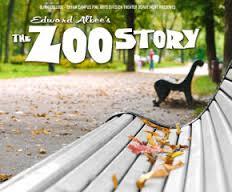
- The Zoo Story - it sounds so normal and
innocent from the title, right? Maybe it's
about a family's trip to their local zoo. Maybe
they see some monkeys or tigers. Maybe
they have popcorn. Alas, no. The Zoo Story is
an absurdist one-act play written by Edward
Albee. And there are no monkeys or
popcorn. The Zoo Story premiered in 1959,
making it Albee's first performed play.
- Unlike non-absurd plays, these plays usually lack things like plot and
character development. They highlight humanity's pointlessness and isolation.
There's a lot of standing around, doing very little, often in bizarre situations. If
things happen, they happen for no reason. The message is basically that life
has no purpose or meaning. We're just here for a while, we try to
communicate, often failing, but we're mostly alone. Then we die.
- Theater of the Absurd applies to a group of
plays with a certain set of characteristics. These
characteristics convey a sense of bewilderment,
anxiety, and wonder in the face of an
unexplainable feeling. These plays all have
unusual actions and are missing a key element
that would clearly define other pieces of
literature. Language and actions differ from the
usual and sometimes cannot be explained in
the Theater of the Absurd. In the works of Albee
and Ionesco language, behavior, and structure
are abnormal if compared to other plays.
Language is a key factor that is presented as a
weak form of communication
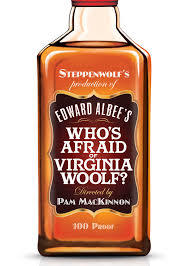
- Even though Albee's Who's Afraid of' Virginia
Woolf would not be strictly classified as
belonging to the movement known as "The
Theater of the Absurd," there are, however, a
great many elements of this play which are
closely aligned with or which grew out of the
dramas which are classified as being a part of
"The Theater of the Absurd." Furthermore,
the movement emerged on the literary scene
just prior to and during the beginning of
Albee's formative, creative years.
- Who's Afraid of Virginia Woolf? also utilizes
many of the techniques and ideas of his
earlier plays, for example, the lost or
non-existent child is a constant factor in many
of Albee's plays of all periods.
- Who's Afraid of Virginia Woolf? also utilizes
many of the techniques and ideas of his
earlier plays, for example, the lost or
non-existent child is a constant factor in many
of Albee's plays of all periods.
- To begin, even though the movement known as the Theater of the
Absurd was not a consciously conceived movement, and it has never
had any clear cut philosophical doctrines, no organized attempt to
win converts, and no meetings, it has characteristics which set it
apart from other experiments in drama. Each of the main
playwrights of the movement seemed to have developed
independently of the other. The playwrights most often connected
with the movement are Samuel Beckett, Eugene Ionesco, Jean
Genet, and Arthur Adamov. The early plays of Edward Albee and
Harold Pinter fit into this classification, but they have also written
plays that move far away from the Theater of the Absurd.
Media attachments
Want to create your own Mind Maps for free with GoConqr? Learn more.