
22007530
Description

Mind Map by Jenyffer Estupiñan Benitez, updated more than 1 year ago

|
Created by Jenyffer Estupiñan Benitez
over 6 years ago
|
|
Bilingual Education Programmes
- Bilingual education approaches (Garcia 2009)
- Monoglossic
- learners to develop proficiency in two languages from a monolingual perspective.
- Languages are taught
separately.
- Languages are taught
separately.
- Subtractive
- Transitional
- They are addressed to migrants
- They are usually temporary and bring about permanent monolingualism.
- L1 Tends to disapear
- They are addressed to migrants
- Submersion
- set up subtractive language learning
environments
- Baker (1996) explained that ‘submersion contains the idea of a student thrown into the deep end and
expected to learn to swim as quickly as possible without the help of floats or special swimming lessons’ (p.
195).
- set up subtractive language learning
environments
- Transitional
- Additive
- Maintenance
- - The primary goal is try and preserve the minority language.
- -Delivering subjects in two languages as well as including the cultural component.
- For instance Catalonia, the Basque Country or Galicia in Spain.
- For instance Catalonia, the Basque Country or Galicia in Spain.
- -Delivering subjects in two languages as well as including the cultural component.
- - The primary goal is try and preserve the minority language.
- immersion
- children with a high-status mother tongue voluntarily choose to be instructed through the medium of a
foreign (minority) language.
- Variations:
- Early immersion programmes.
- Delayed immersion (Elementary or Primary school)
- Early immersion programmes.
- Variations:
- children with a high-status mother tongue voluntarily choose to be instructed through the medium of a
foreign (minority) language.
- Prestigious or elitist
- Students learn through two prestigious
languages.
- It has been associated with the idea of language as cultural or symbolic capital to be used on the market of
social interaction (De Mejia, 2002, p.36)
- It has been associated with the idea of language as cultural or symbolic capital to be used on the market of
social interaction (De Mejia, 2002, p.36)
- Students learn through two prestigious
languages.
- Maintenance
- learners to develop proficiency in two languages from a monolingual perspective.
- Heteroglossic
- Are related to plurilingualism and
translanguaging.
- Recursive
- Developmental
- The majority language is included in the curriculum and is taught as a foreign language.
- Participating students typically come from the same linguistic community.
- Heritage Language Education values the teaching of the majority language
- The majority language is included in the curriculum and is taught as a foreign language.
- Immersion revitalization
- The aim is to protect a minority
language.
- Support in minority language L1
- The aim is to protect a minority
language.
- Preserve minority
language
- Linguistic goal: Bilingualism
- Developmental
- Dynamic
- Poly-directional or two way immersion.
- Dual language programmes where students learn majority and minority language.
- In European Schools students of different languages become at least trilingual.
- Content taught in different
languages
- Dual language programmes where students learn majority and minority language.
- CLIL
- Teaching and learning curricular content through the use of an additional language (Coyle, 2007; San Isidro,
2010)
- In CLIL programmes the knowledge of the language becomes the means of learning content.
- CLIL is based on language acquisition rather than on language learning.
- Based on curricular integration
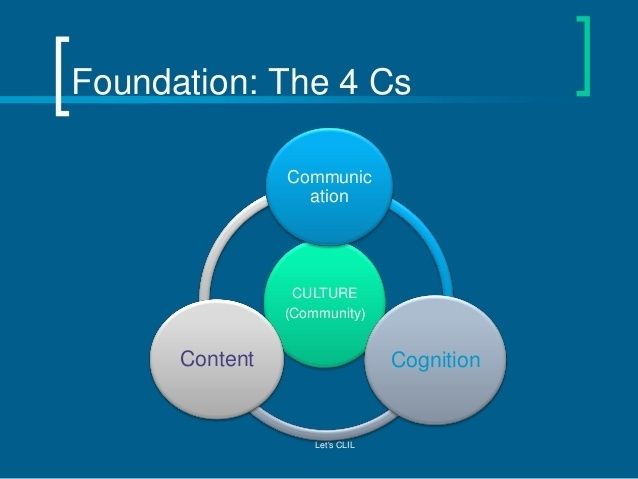
- Content and language become intregrated within a context:
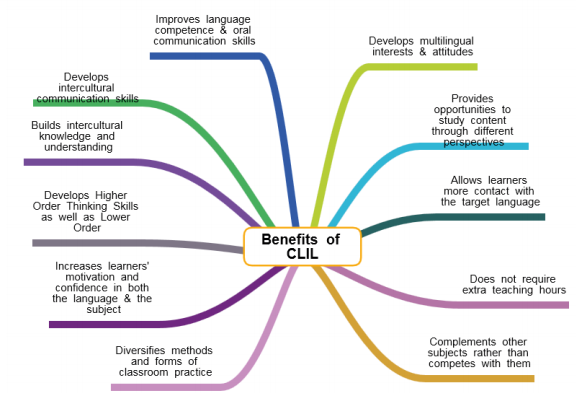
- Benefits of CLIL
- Teaching and learning curricular content through the use of an additional language (Coyle, 2007; San Isidro,
2010)
- Poly-directional or two way immersion.
- Are related to plurilingualism and
translanguaging.
- Monoglossic
Media attachments
Want to create your own Mind Maps for free with GoConqr? Learn more.