
3807890
Description

Mind Map by shannon.kelly4, updated more than 1 year ago

|
Created by shannon.kelly4
about 11 years ago
|
|
RESPONDING TO THE
ENVIRONMENT (behaviour and
muscle contraction)
- Muscle contraction
- NEUROMUSCULAR
JUNCTIONS
- this is where motor neurones
terminate and info is transmitted
from motor neurone to effector. this
happens similarly to a synapse
- what happens:
- 1) action potential arrives at neuromuscular
junction which causes vesicles with
neurotransmitter inside, to fuse with
presynaptic membrane and release
acetylcholine into gap
- 2) acetyle choline binds to (nicotinic
cholinergic) receptors on muscle
membrane causing inflow of na+ ions
which depolarises the sarcolemma
(muscle fibre membrane)
- 3) if threshold is reached, action potential is
transmitted along the sarcolemme and down
thet-tubules (t-system). these membranes
have the same channel proteins and pumps
as neurons.
- 4) t system depolarisation leads to
Ca2+ ions release from
sarcoplasmic reticulum into
sarcoplasm. Ca2+ ions act as
second messengers to stimulate
movement of muscle myofibrils.
- 5) Ca2+ ions bind to protein actin in
muscle, which leads to muscle
contraction
- 6) acetylcholinesterase in the gap
rapidly breaks down acetylcholine so
contraction only occurs when action
potential arrives continuously
- 6) acetylcholinesterase in the gap
rapidly breaks down acetylcholine so
contraction only occurs when action
potential arrives continuously
- 5) Ca2+ ions bind to protein actin in
muscle, which leads to muscle
contraction
- 4) t system depolarisation leads to
Ca2+ ions release from
sarcoplasmic reticulum into
sarcoplasm. Ca2+ ions act as
second messengers to stimulate
movement of muscle myofibrils.
- 3) if threshold is reached, action potential is
transmitted along the sarcolemme and down
thet-tubules (t-system). these membranes
have the same channel proteins and pumps
as neurons.
- 2) acetyle choline binds to (nicotinic
cholinergic) receptors on muscle
membrane causing inflow of na+ ions
which depolarises the sarcolemma
(muscle fibre membrane)
- 1) action potential arrives at neuromuscular
junction which causes vesicles with
neurotransmitter inside, to fuse with
presynaptic membrane and release
acetylcholine into gap
- synapses vs neuromusclular junction
- BOTH
- neurotransmitter
acetylcholine located in
vesicle is pre synaptic
cytoplasm
- vesicles release
acetylcholine into cleft
on stimulation (arrival
of ap)
- acetylcholine diffuses
across gap and binds to
post synaptic
membrane receptor
- binding of
neurotransmitter results
in opening of channels
and depolarisation of post
synaptic membrane
- enzyme
acetylcholinesterase
present to break down
acetylcholine into ethanoic
acid and choline to avoid
continual stimulation of
post synaptic membrane
- neurotransmitter
acetylcholine located in
vesicle is pre synaptic
cytoplasm
- SYNAPSE is neurone to
neurone, NMJ is
neurone to sarcomemre
(muscle cell)
- SYNAPSE post synaptic
stimulation leads to ap in
postsynatic neurone, NMJ
postsynpatic stimulation leads
to depolarisation of
sarcolemma and muscle
contraction
- SYNAPSE have
synaptic knob which is
smooth and round,
NMJ end plate has
appearance of
microvillia/ brush
border and is flattened
up to muscle cell
- SYNAPSE ca2+ ions
diffuse into synaptic
knob, NMJ ca2+ ions
released from
sarcoplasmic
reticulum
- BOTH
- this is where motor neurones
terminate and info is transmitted
from motor neurone to effector. this
happens similarly to a synapse
- elbow joint
- when arm goes down bicep
relaxes an tricept contracts. when
arm goes up bicep contracts and
tricep relaxes.
- shoulder blade at the top, tendon joins
muscles to bone. bicep on top/right of
humerus and tricep on bottom/left.
radius on palm side lower arm, ulna on
top
- ELBOW
- in middle is synovial fluid
which lubricates the joint
- next layer is synovial
membrane which
produces synovial fluid
- ligament surrounds the
rest which holds bones
together and prevents
dislocation
- ligament surrounds the
rest which holds bones
together and prevents
dislocation
- next layer is synovial
membrane which
produces synovial fluid
- at end of bones is cartilage
which pads wheres bones
meet, reduces friction
during movement and
eases movement
- in middle is synovial fluid
which lubricates the joint
- when arm goes down bicep
relaxes an tricept contracts. when
arm goes up bicep contracts and
tricep relaxes.
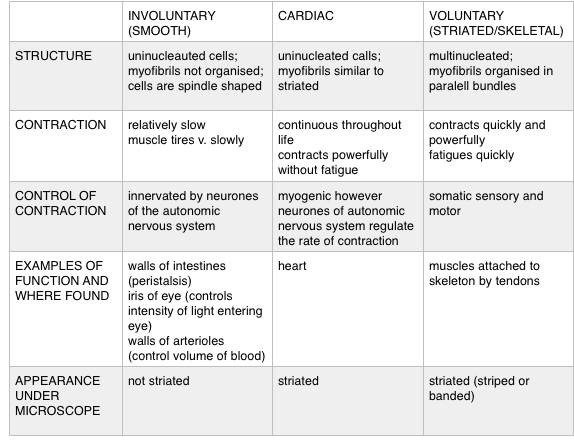
- types of muscle
- GENERAL
- Length of sarcomere when
muscle is relaxed=2.5um and
contracted=2um
- THIN FILAMENTS
- made up of G/F actin
which is a globular
protein
- long chains of actin
molecules: 2 chains
of actin lie side by
side and twist around
one another
- actin chains are firmly
anchored in Z lines
- actin chains are firmly
anchored in Z lines
- TROPOMYOSIN
- rod shaped proteins
hich forms long, thin
molecules that lie in
groove between 2 F/G
actin chains
- rod shaped proteins
hich forms long, thin
molecules that lie in
groove between 2 F/G
actin chains
- TROPONIN
- globular protein
that binds to actin
chains at regular
intervals
- composed of 3
polypeptides: 1 binds to
actin, 1 to tropomyosin
and 1 to ca2+ ions
- globular protein
that binds to actin
chains at regular
intervals
- made up of G/F actin
which is a globular
protein
- THICK FILAMENTS
- made up of bundles of
myosin which is a fibrous
protein
- many myosin molecules
lie side by side
- each myosin molecules has a
head and bundles are arranged
so that half molecules heads
are one end and half the other
end
- where the tails meet forms the M line
- where the tails meet forms the M line
- made up of bundles of
myosin which is a fibrous
protein
- Z LINES: border of sarcomeres
- M LINES: middle of sarcomeres
- H ZONE: distance between ends of
thin filaments, shortens during
contraction as actin and myosin
overlap increases
- I BAND: distance between thick
filaments of one sarcomere and
thick filaments of the
subsequent sarcomere, shotens
during contraction as actin
slides over myosin
- A BAND: total length of thick
filaments, stays the same on
contraction as myosin length
is unchanged
- overall sarcomere reduces in length on
contraction as overlap increases and
actin slides towards myosin, when
relaxed sarcomere is longer
- striated muscles look
stripey because I band
has only actin
microfilaments so
appears light and A
band has actin and
myosin microfilaments
so appears dark.
filaments are arranged
regularly giving stripey
look.
- Length of sarcomere when
muscle is relaxed=2.5um and
contracted=2um
- SLIDING FILAMENT THEORY
- in presence of ATP, thin actin
filaments slide towards the M line
along the thick myosin filaments.
This is the sliding filament model
and explains why H ZONE and I
BANDS shorten by A band does
not during contraction
- the filaments dont change size, they just overlap
- energy is provided by splitting of ATP
caused by ATPase in the myosin cross
bridge head. The cross bridges can also
attach to actin
- energy is provided by splitting of ATP
caused by ATPase in the myosin cross
bridge head. The cross bridges can also
attach to actin
- the filaments dont change size, they just overlap
- Binding sites in resting muscles:
- for myosin and actin to slide past
eachother, the myosin head must
bind to the actin-myosin binding site
on the actin filament
- in a resting muscle, the
actin-myosin binding site is
bloacked by tropomyosin which
means myofilaments cant slide
past eachother because myosin
head cant bind to actin filaments
- in a resting muscle, the
actin-myosin binding site is
bloacked by tropomyosin which
means myofilaments cant slide
past eachother because myosin
head cant bind to actin filaments
- 1) Arrival of action potential
- when ap from motor neurone
stimulates muscle cell, sarcolemma is
depolarised. depolarisation spreads
down t tubules to sarcoplamsic
reticulum where ca2+ ions are released
from into sarcoplasm. influx of ca2+
ions stimulate muscle contraction
- ca2+ ions bind to troponin causing it
to change shpe. this pulls attached
tropomyosin out of the actin-myosin
binding site on the actin filament
- this exposes binding site so allows
myosin head to bind. the bond
formed when myosin head binds to
actin filament is called an
actin-myosin cross bridge
- this exposes binding site so allows
myosin head to bind. the bond
formed when myosin head binds to
actin filament is called an
actin-myosin cross bridge
- ca2+ ions bind to troponin causing it
to change shpe. this pulls attached
tropomyosin out of the actin-myosin
binding site on the actin filament
- 2) Movement of actin filament
- ca2+ ions also activate enzyme
ATPase which breaks down ATP into
ADP + Pi to provide energy for
contraction
- energy released from ATP
moves myosin head to the side
which pulls the actin filament
along in a rowing action
- energy released from ATP
moves myosin head to the side
which pulls the actin filament
along in a rowing action
- 3) Breaking of the cross bridge
- ATP provides energy to also break cross bridge so myosin
head detached from actin filament after it moved
- myosin head then returns to starting position and
reattaches to different binding sie further along the actin
filament
- new cross bridge is formed and cycle is repeated. many cross
bridges rapidly form and break pulling actin filament along which
shortens the sarcomere causing muscle to contract
- as long as ca2+ is present and bound to troponin, cycle will continue
- as long as ca2+ is present and bound to troponin, cycle will continue
- new cross bridge is formed and cycle is repeated. many cross
bridges rapidly form and break pulling actin filament along which
shortens the sarcomere causing muscle to contract
- myosin head then returns to starting position and
reattaches to different binding sie further along the actin
filament
- 4) Returning to resting state
- when muscle stops being stimulated, ca2+ ions leave binding
sites on troponin molecules are are moved by active transport
back into sarcoplasmic reticulum (needs ATP)
- the troponin molecules return to their original
shape, pulling attached tropomyosin molecule
with them so tropomyosin now blocks the
actin-myosin binding sites again
- mucle now cant contract as no myosin heads are
attached to actin filaments so there are noa-m cross
bridges
- actin filaments slide back to relaxed position
lengthening sarcomere
- actin filaments slide back to relaxed position
lengthening sarcomere
- mucle now cant contract as no myosin heads are
attached to actin filaments so there are noa-m cross
bridges
- the troponin molecules return to their original
shape, pulling attached tropomyosin molecule
with them so tropomyosin now blocks the
actin-myosin binding sites again
- when muscle stops being stimulated, ca2+ ions leave binding
sites on troponin molecules are are moved by active transport
back into sarcoplasmic reticulum (needs ATP)
- ATP provides energy to also break cross bridge so myosin
head detached from actin filament after it moved
- ca2+ ions also activate enzyme
ATPase which breaks down ATP into
ADP + Pi to provide energy for
contraction
- when ap from motor neurone
stimulates muscle cell, sarcolemma is
depolarised. depolarisation spreads
down t tubules to sarcoplamsic
reticulum where ca2+ ions are released
from into sarcoplasm. influx of ca2+
ions stimulate muscle contraction
- for myosin and actin to slide past
eachother, the myosin head must
bind to the actin-myosin binding site
on the actin filament
- in presence of ATP, thin actin
filaments slide towards the M line
along the thick myosin filaments.
This is the sliding filament model
and explains why H ZONE and I
BANDS shorten by A band does
not during contraction
- NEUROMUSCULAR
JUNCTIONS
- Behaviour
- = an organisms
response to changes in
its external
environment, these
responses help
organisms survive and
reproduce. Behaviour is
influenced by genes and
environment.
- INNATE BEHAVIOUR
- behaviour organisms do instinctively
- genetically determined
- requires no thought or learning, respond straight away
- eg new born babies
instinctively suckle from their
mothers
- eg new born babies
instinctively suckle from their
mothers
- not influenced by environment
- inherited from parents
- it is stereotyped= always carried out in
the same way and by all indiciduals in a
species
- Escape Reflexes
- the organism moves away
from potential danger
- eg cockroaches run away
when threat of being
squashed
- the organism moves away
from potential danger
- Tactic Responses (TAXIS)
- directional movement in
response to a stimulus
- direction of stimulus
affects response
- eg woodlice move away from light
source, keep safe from predators
- directional movement in
response to a stimulus
- Kinetic Responses (KINESIS)
- non-directional (random)
movement in response to a stimulus
- intensity of stimulus
affects the response
- eg woodlice under low humidity move from dry air to
more humid air and stay put as this reduces water loss
so improves chances of survival
- non-directional (random)
movement in response to a stimulus
- complex example: bee waggle dance
- a display used by worker honey bees to
communicate the direction and distance of a food
source to other worker bees this helps bees find
food source
- a display used by worker honey bees to
communicate the direction and distance of a food
source to other worker bees this helps bees find
food source
- behaviour organisms do instinctively
- LEARNED BEHAVIOUR
- Habituation
- = a reduced response to an
unimportant stimulus after repeated
exposure over time
- an unimportant stimulus is a
change that isnt threatening or
rewarding
- an animal quickly
learns to reduce or
stop response to
unimportant stimulus
so it doesnt waste time
and energy responding
to unimportant things
- however animals remain
alert to unfamiliar stimuli
- eg living near busy road,
noise of traffic wont keep
u awake at night as you
stop responding to noise
so sleep through it but an
unfamiliar noise lik ea car
crash will wake you up
- = a reduced response to an
unimportant stimulus after repeated
exposure over time
- Classical Conditioning
- = learning to respond naturally to a
stimulus that doesnt normally cause
that response (association)
- before conditioning a natural
stimulus (unconditioned stimulus)
can cause natural response
(uncondtioned response)
- if neutral stimulus coincides with
unconditioned stimulus enough times,
eventually neutral stimulus (now
conditioned stimulus) will on its own
cause the same response as the
uncondtioned stimulus (condtioned
response)
- eg in dogs: uncondtioned
stimulus= food,
unconditioned response=
salivation; if a bell is rung
immediately before dogs
given food, dog will salivate to
sound of bell. neutral
stimulus= bell, is associated
with unconditoned stimulus =
food, triggers salivation
(unconditoned), bell by itself=
conditioned stimulus trigger
conditioned response=
salivation
- = learning to respond naturally to a
stimulus that doesnt normally cause
that response (association)
- Operant Conditioning
- =learning to associate
particular response with a
reward or punishment
(reinforcement)
- when in same sitaution several
times, animal will work out which
response gets reward or
punishment
- the response must be rewarded
or punished stright away, this
reinforces behaviour so animal is
more likely to repeat behaviour if
it is rewarded
- eg rat put in a cage with
choice of leves, pressing one
lever rewarded rat with food
and the rat was repeatedly put
in same cge so learned which
level to press to get the reward
- =learning to associate
particular response with a
reward or punishment
(reinforcement)
- Latent Learning
- =hidden learning
- an animal doesnt
immediately show
its learned
something
- it involves repetedly doing the same task
- animal only shows it's learned
something when its rewarded or
punished
- eg three groups of rats put in
same maze repeatedly
- group 1 were
reinforced with reward
each time they reached
the end, they quickly
learned their way
around the maze
- group 2 were not reinforced (no
reward) and continued to plod
around maze and took ages to
reach the end
- group 3 were only rewarded from 11th
time they did the maze, after this they
vert qickly reached the end with hardly
any errors. the rats had been learning
the maze all along without any
reinforcement but they didnt show their
learning until there was a reward
- group 1 were
reinforced with reward
each time they reached
the end, they quickly
learned their way
around the maze
- =hidden learning
- Insight Learning
- =solving a problem by working out a
solution using previous experience
- solving problems by insight is quicker
than by trial and error as actions are
planned and worked out
- eg chimpanzees put in play area with sticks,
clubs and boxes. bunches of bananas were
hung out of reach. chimps used previous
experience of playing with objects to work out
a soltuion: they piled up boxes to reach
banaanas and used the sticks and clubs to
knock them down
- =solving a problem by working out a
solution using previous experience
- =behaviour influenced by environment and
is modified as a result of experience
- it is not sterotyped, it varies in
different individuals in the same
species
- allows animals to respond to changin conditions
- Habituation
- IMPRINTING
- =combination of learned behaviour
and innate behaviour
- eg animal learns to recognise its parents
and instinctively follows them
- eg animal learns to recognise its parents
and instinctively follows them
- a newly born animal has an innate instinct to
follow the first moving object it sees (usually
mother or father) who provide warmth, shelter
and food (helping suvivl)
- but the animal has no innate instinct of
what its parents look like- need to learn
this.
- once learned imprinting
is fixed and irreversible,
use later in life to
identify mates from
same species
- once learned imprinting
is fixed and irreversible,
use later in life to
identify mates from
same species
- but the animal has no innate instinct of
what its parents look like- need to learn
this.
- only happens during critical
period (soon after birth)
- Lorenz-
ducklings
followed
mother and
him (2
gorups, first
moving
object)
- =combination of learned behaviour
and innate behaviour
- UNDERSTANDING HUMAN BEHAVIOUR
- animals behaviour depends of
structure of brain (neurotransmitters,
synapses, receptors etc)
- dopamine receptor D4
- dopamine= neurotransmitter
- can affect mood
and behaviour
- 5 different receptors
for dopamine (d1-d5)
- effects of dopamine vary
depending on which receptor it
binds to
- each receptor is coded
for by a different gene
- effects of dopamine vary
depending on which receptor it
binds to
- can affect mood
and behaviour
- D4 receptor protein is coded
for by the DRD4 gene
- too many d4 receptors linked to
abnormal behaviour eg
schizophrenia -disorder effects
thinking, perception, memory and
emotions
- evidence for this link: -drugs
that stimualte dopamine
receptors are given to healthy
people, causes abnormal
behaviour -drugs that block D4
receptors reduce symptoms in
schizophrenics -people with
schizophrenia have higher
density of D4 receptors in
brain -one drug used to treat
schiz binds to D4 receptors
better than it binds to other
dopamine receptors
- link between D4 receptor and
abnormal behvaiour helps us
understand roel of D4 in normal
behaviour as it is involed in
thinking , perception, memory
and emotions
- link between D4 receptor and
abnormal behvaiour helps us
understand roel of D4 in normal
behaviour as it is involed in
thinking , perception, memory
and emotions
- evidence for this link: -drugs
that stimualte dopamine
receptors are given to healthy
people, causes abnormal
behaviour -drugs that block D4
receptors reduce symptoms in
schizophrenics -people with
schizophrenia have higher
density of D4 receptors in
brain -one drug used to treat
schiz binds to D4 receptors
better than it binds to other
dopamine receptors
- too many d4 receptors linked to
abnormal behaviour eg
schizophrenia -disorder effects
thinking, perception, memory and
emotions
- dopamine= neurotransmitter
- animals behaviour depends of
structure of brain (neurotransmitters,
synapses, receptors etc)
- SOCIAL BEHAVIOUR IN PRIMATES
- SB= behaviour involving members of large
groups nteracting with eachother
- primates=baboons, apes, humans
- social behaviours have advantages
- Baboons live in groups of around 50, + large
group is more efficeient at hunting for food,
communicate good food sources
- Hireachy of adult males, +
prevents fighting as males
know rank in order
- Groom eachother, +hygeinic
and reinforce bonds between
members of group
- Baboons live in groups of around 50, + large
group is more efficeient at hunting for food,
communicate good food sources
- SB= behaviour involving members of large
groups nteracting with eachother
- = an organisms
response to changes in
its external
environment, these
responses help
organisms survive and
reproduce. Behaviour is
influenced by genes and
environment.
Media attachments
Want to create your own Mind Maps for free with GoConqr? Learn more.