
458909


Chemistry Unit 2.1 - Structure
and Bonding
- Compounds = Substances in which atoms of 2+
elements are chemically combined
- Group 7 Elements - The Halogens
- All react with metals
(alkali) to form ionic
compounds
- The ions have a single negative charge
- E.g. Chlorine forms
Chlorine ions Cl-
- E.g. Chlorine forms
Chlorine ions Cl-
- The ions have a single negative charge
- All react with metals
(alkali) to form ionic
compounds
- Chemical Bonding = Transferring or sharing
electrons in the outer shells of atoms (Ionic or covalent)
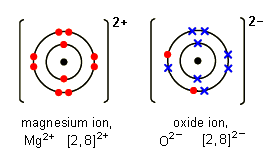
- Ionic Bonding = When metals react with
non-metals, electrons are transferred from the
metal atoms to the non-metal atoms, forming ions
- The metal atoms give electrons to the non-metal atoms.
Metal atoms = positive, Non-metal atoms = negative
- Magnesium Oxide (MgO)
- The metal atoms give electrons to the non-metal atoms.
Metal atoms = positive, Non-metal atoms = negative
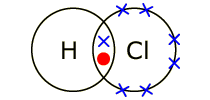
- Covalent Bonding = Strong bond between 2
non-metal atoms, which consists of a shared pair of electrons
- Dot and Cross Diagrams
- Hydrogen Chloride (HCl)
- Some covalently bonded structures
contain simple molecules (HCl, H20,
H2, Cl2) but others have giant
covalent structures (Diamond and
Silicon Dioxide)
- Dot and Cross Diagrams
- Ionic Bonding = When metals react with
non-metals, electrons are transferred from the
metal atoms to the non-metal atoms, forming ions
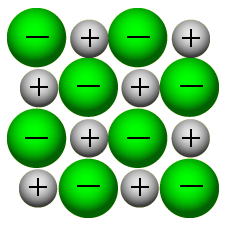
- Ionic substances form GIANT ionic
lattices which contain oppositely charged
ions
- Have high boiling and
melting points, and
conduct electricity when
dissolved in water or
melted
- Held together by strong electrostatic forces of
attraction between positive and negative ions
- Formed when a
metal reacts with a
non-metal
- Example of an
ionic lattice
- NaCl (Na+, Cl-)
- NaCl (Na+, Cl-)
- Formed when a
metal reacts with a
non-metal
- Have high boiling and
melting points, and
conduct electricity when
dissolved in water or
melted
- Group 1 Elements - Alkali Metals
- All react with non-metal elements
to form ionic compounds
- The metal ion has a single
positive charge
- E.g. Sodium
forms Sodium ion
Na+
- E.g. Sodium
forms Sodium ion
Na+
- The metal ion has a single
positive charge
- All react with non-metal elements
to form ionic compounds
- Electrons in the outer
shell of atoms are
DELOCALISED
- They are free to move through the whole structure
- They are free to move through the whole structure
Media attachments
Want to create your own Mind Maps for free with GoConqr? Learn more.