
Notes
Group 7 - Halogens
Content of the notes (1)
Page 1
Group 7 elements are known as 'Halogens'
Group 7 is made up of fluorine, chlorine, bromine, iodine and astatine
All Group 7 elements have 7 electrons in their outer shell so they all react by gaining one electron to form a negative ion.
This means they all have similar properties.
As you go down group 7 the melting points and boiling points of the halogens increase.
This means at room temperature:
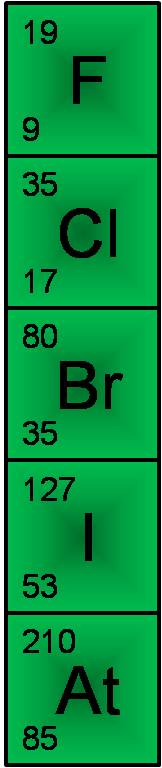

As you go down group 7, the halogens become less reactive - there's less inclination to gain the extra electron to fill the outer shell when it's further out from the nucleus (there's a larger atomic radius).
Chlorine (Cl2) is a fairly reactive, poisonous, dense green gas (low boiling point)
Bromine (Br2) is a dense, poisonous, orange liquid
Iodine (I2) is a dark grey crystalline solid (high boiling point)
Reduction is the gain of electrons:-
Halogens are keen to gain an electron to form 1- ion with a stable electronice structure.
The more reactive the halogen the happier it is to gain an electron.
Gain of electrons is called reduction
The Halogens react vigorously with alkali metals (group 1 elements) to form salts called 'metal halides'.
sodium + chlorine → sodium chloride
2Na(s) + Cl2(g) → 2NaCl(s)
More reactive halogens will displace less reactive ones:-
Chlorine can displace bromine and iodine from a solution of bromide or iodide. Bromine will also displace iodine. You could be asked to predict the results of displacement reactions using other halogens - just remember, more reactive halogens displace less reactive ones.
New Page
Information
- Description
- GCSE Science (Chemistry) Note on Group 7 - Halogens, created by eibhlinjones200 on 01/06/2013.
- Created by
- eibhlinjones200 · Jun 2013
- Updated
- Nov 12, 2016
- Views
- 948
- Tags
- Rating