
Test
Bones Basics :)
Este test tiene tipos de pregunta que se abren en el reproductor de siempre.
Preguntas del test (59)
1There are different types of bone shape. Bone shape is primarily dependent upon bone [blank_start]function[blank_end]. There are 5 main types.
1. The patella is an example of a [blank_start]sesamoid[blank_end] bone (as are most of the knobbly bits in the body.)
2. The pelvic bones are examples of [blank_start]irregular[blank_end] bones.
3. The femur and humerus are both [blank_start]long[blank_end] bones.
4. Bones in the skull are [blank_start]flat[blank_end] bones.
5. The carpals are examples of [blank_start]short[blank_end] bones.- Afunction
- Bshort
- Cflat
- Dlong
- Esesamoid
- Firregular
2Which of these influence bone shape?
- Arange of movement
- Bprotective role in comparison to the viscera
- Csites for muscle attachment
- Dthe shape of the joint
- Esites of increased cartilagious activity
3Which is NOT true regarding the axial skeleton?
- Abones of the trunk: ex) skull bones
- Bfrom sclerotomes of the somites
- Csome of the bones of the axial skeleton formed via intramembranous ossification
- DAll bones of the axial skeleton formed via intramembranous ossifucation
4Differentiation of the sclerotome begins with the activation of [blank_start]HOX[blank_end] [blank_start]genes[blank_end]. These genes also played a role, of course, in fetal development.
- AHOX
- Bgenes
5The embryological origin of the [blank_start]appendicular[blank_end] skeleton (for example, the bones of the arms and legs) is the [blank_start]lateral[blank_end] [blank_start]plate[blank_end] of the [blank_start]mesoderm[blank_end].
- Aappendicular
- Blateral
- Cplate
- Dmesoderm
6In embryological development, the [blank_start]trilaminar[blank_end] [blank_start]disk[blank_end] has three layers: ectoderm (outer), endoderm (inner), and mesoderm (middle).
The ectoderm gives rise to the forces interacting with the exterior, such as the skin, nail, hair and [blank_start]autonomic[blank_end] [blank_start]nervous[blank_end] system.
The endoderm gives rise to the GI tract, [blank_start]epithelial[blank_end] [blank_start]lining[blank_end], liver, and pancreas.
The mesoderm gets more special. There are 4 main types:
-[blank_start]chordamesoderm[blank_end] (which leads to the formation of the notochord)
-the [blank_start]paraxial[blank_end] mesoderm (AKA the somite.)
-[blank_start]lateral[blank_end] [blank_start]plate[blank_end] mesoderm (most posterior part--> appendicular skeleton)
-the [blank_start]intermediate[blank_end] mesoderm (urogenital system)- Atrilaminar
- Bdisk
- Cautonomic
- Dnervous
- Eepithelial
- Flining
- Gchordamesoderm
- Hparaxial
- Ilateral
- Jplate
- Kintermediate
7Cartilage is actually part of the myotome, not the sclerotome.
- AVerdadero
- BFalso
8What else does the lateral plate mesoderm give rise to?
- AHeart
- BBlood vessels
- CGeneral body cavity lining
- DBlood cells
- ELung tissue
- FBrainstem
- GExterior of GI tract
- HGonads
9Somite's 3 parts: (alphabetical order)
1. [blank_start]Dermatome[blank_end]
2. [blank_start]Myotome[blank_end]
3. [blank_start]Sclerotome[blank_end]- ADermatome
- BMyotome
- CSclerotome
10Embryologically speaking, [blank_start]neural[blank_end] [blank_start]crest[blank_end] cells become [blank_start]schwann[blank_end] cells, which produce myelin sheath and are the surrounding coat on nerves.
- Aneural
- Bcrest
- Cschwann
11Ossification is a embryological process.
- AVerdadero
- BFalso
12Intramembranous ossification involves hyaline cartilage.
- AVerdadero
- BFalso
13Which of these are characteristics of cartilage?
- Asmooth
- Bsemi-rigid
- Cprevents bone-bone friction
- Dprevents muscle-bone friction
- Ehigh friction
14The primary purpose of the hyaline cartilage is to provide stability for the osteoblasts as the bone develops further.
- AVerdadero
- BFalso
15There are two primary components of the periosteal bud: the [blank_start]periosteal[blank_end] [blank_start]capillaries[blank_end] (which are important for nutrients/waste exchange) and [blank_start]osteoblasts[blank_end].
- Aperiosteal
- Bcapillaries
- Costeoblasts
16What leads to the breakdown of the hyaline cartilage skeleton?
- Aincreased osteoclast activity
- Bcalcification and vascularization of bone leads to lateral expansion which leads to...
- Cinhibition of osteoblastic activity
- Dbody produces specific antibodies to induce apoptosis of chondroblasts
17Noncalcified bone matrix is referred to as the [blank_start]osteoid[blank_end].
Osteocytes specifically can be found in the bone [blank_start]lacunae[blank_end].- Alacunae
- Bosteoid
18Where can you find red bone marrow?
- AEpiphysial growth plates of the major long bones
- BMedullary cavity of the diaphysis
- CPerichondrium
- DOsteon
- EPeriosteum
19How does the medullary cavity come about?
- AApoptosis of some of the trabecular bone
- BNecrosis of some of the trabecular bone
- CIncreased osteoclast activity
- DRANK and RANK-L interactions
20What is true regarding trabecular bone?
- AAKA spongy bone
- BAKA periosteum
- Cis the initial deposition by osteoblasts
- Dis the later deposition following osteocyte's control
- Econtains osteocytes and vasculature
- Fcontains osteoblasts, osteoclasts, and vasculature
21The most functional unit of bone is called a(n) [blank_start]osteon[blank_end].
- Aosteon
22A bundle of tightly packed osteocytes is known as an osteon.
- AVerdadero
- BFalso
23Compact bone borderlines the rim of [blank_start]trabecular[blank_end] bone. It is created through bone [blank_start]remodelling[blank_end].
- Atrabecular
- Bremodelling
24Bone remodeling eliminates spongy bone only partially.
- AVerdadero
- BFalso
25Yellow Marrow is within [blank_start]long[blank_end] bones and is rich of [blank_start]lipids[blank_end].
- Alipids
- Blong
26What is true regarding red bone marrow?
- Aproduces leukocytes
- Bproduces erythrocytes
- Cproduces platelets
- Dmainly in flat bones
- Emore prominent in children's bones
- Fproduces chondroblasts
- Gmainly in long bones
- Hmore prominent in different time periods of adult life (dependent on when bone remodelling occurs)
27The defining characteristic of flat bones is their appearance:
[blank_start]compact[blank_end] bone--[blank_start]spongy[blank_end] bone--[blank_start]compact[blank_end] bone- Acompact
- Bspongy
- Ccompact
28What is true regarding periosteum?
- Aoutermost superficial layer of bone
- Blayer of bone between compact and spongy
- Chas the ability to lay down more bone matrix if needed
- Dhas the ability to send over osteoclasts if needed
29What is longitudinal growth in bones referred to as?
- Aapositional
- Binterstitial
- Cdiaphysistic
- Dlengthening
30Bones grow in terms of length, width, and thickness.
- AVerdadero
- BFalso
31What feature of the periosteum enables it to produce more bone matrix if needed.
- Athe innermost layer of it is mesenchymal fibros tissue
- Bdue its to close relation to the perichondrium
- Cdue to its multitude of osteons
- Ddue to its higher contact time with vasculature
32Like the periosteum, the perichondrium can lay down more cartilage if needed.
- AVerdadero
- BFalso
33What is the blood supply for the joint?
- Aepiphysial artery
- Bmetaphysial artery
- Cperiosteal artery
- Dnutrient artery
- Enutrient vein
34The [blank_start]periosteal[blank_end] artery, [blank_start]nutrient[blank_end] artery, and [blank_start]nutrient[blank_end] vein all go through the nutrient foramina of bones.
- Aperiosteal
- Bnutrient
- Cnutrient
35The [blank_start]periosteal[blank_end] nerve is the general nerve supply of bones. It contains sensory nerve fibers, and is especially useful to carry [blank_start]pain[blank_end] messages up to the brain.
- Aperiosteal
- Bpain
36Non-remodelled bone is brittle and easy to break
- AVerdadero
- BFalso
37What can lead to resorption? (best answer)
- Adisuse of bones
- Boverexertion of bones
- Cdecreased osteoclast activity
- Dold age
38Blood clots form in the surrounding cleft of the fracture to avoid total blockage of blood, considering vasculaturre is necessary for healing.
- AVerdadero
- BFalso
39What is of clinical relevance regarding greenstick fractures?
- Amore common in children
- Bmore common in elderly and adults
- Cpartial/incomplete fracture
- Dmultiple segments of bone
- Eprotrudes out of skin
40A [blank_start]comminuted[blank_end] fracture is when the bone shatters into more than 2 pieces.
- Acomminuted
41An open fracture (also called a [blank_start]compound[blank_end] fracture) is when bone is poking out of skin or soft tissue. It is very common in [blank_start]wrist[blank_end] injuries, such as falling on an outstretched hand.
- Acompound
- Bwrist
42What is of clinical relevance regarding compression fractures?
- AAKA spinal fracture
- BAKA vertebral fracture
- CAKA wedge fracture
- DAKA osteoporotic fracture
- Efrom external extensive force application
- Fcharacteristic slight decrease in height
- Gdue to increased internal pressure on bones from inflammation viscera
- Hbulging in lower extremities
- IAKA pressure induced fracture
43What types are these hmmm? (all lower case questions)
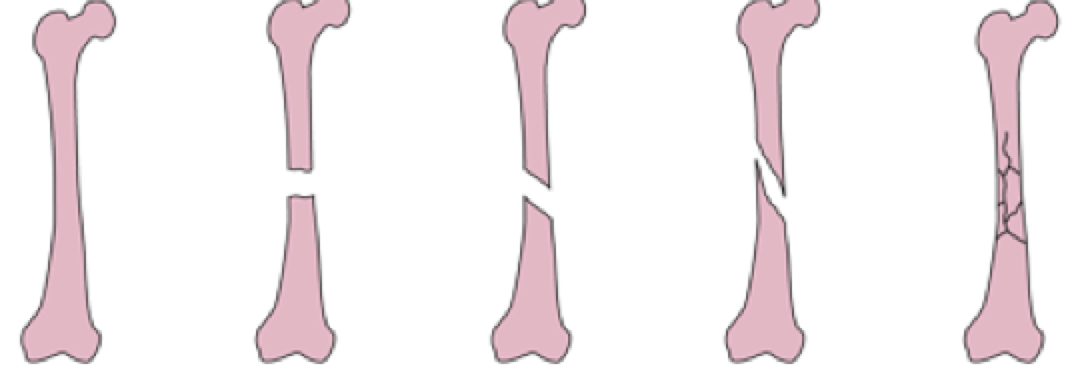
- Atransverse
- Boblique
- Cspiral
- Dcomminuted
44What types are these??? (all lower case; first one is a bonus!)
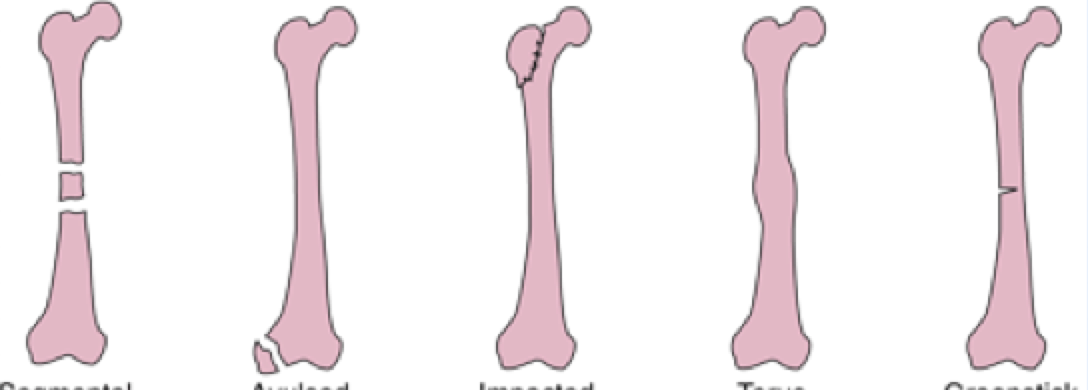
- Asegmental
- Bavulsed
- Cimpacted
- Dtorus
- Egreenstick
45What type of fracture is particularly common in sports injuries
- Atorque
- Bcomminuted
- Ccompression
- Dgreenstick
46An [blank_start]impacted[blank_end] fracture is when the bone kind of bends inwards, bucking and snapping upon itself.
- Aimpacted
47What is of clinical relevance regarding epiphyseal plate fractures?
- Acan affect growth in children still growing
- Bcan be from trauma
- Ccan be from repeated stress upon bones
- Dquite common in older people
- Equite common in children
48Which of these are typical symptoms of fractures?
- Apain
- Bloss of function
- Cbruising
- Ddeformity
- Eswelling
- Fparesthesia
- Gscarring of skin (even if the fracture may be within the skin)
49What is a possible complication of fractures due the break in bone's circulation?
- Anecrosis of bone tissue
- Bloss of sensation in skin overlying/around fracture
- Cavascularization
- Danti-angiogenesis antibodies developed
50Standard for treating open fractures:
1. [blank_start]Analgesia[blank_end] (pain relief)
2. [blank_start]Immobilization[blank_end]
3. [blank_start]Antibiotics[blank_end] (usually Flucloxacillin because mainly gram [blank_start]positive[blank_end] bacteria reside on skin)
4. [blank_start]Tetanus[blank_end] [blank_start]Prophalaxis[blank_end] (vaccination)
5. Clean wound (with sterile [blank_start]saline[blank_end] [blank_start]isotonic[blank_end] solution at low [blank_start]pressure[blank_end])- AAnalgesia
- BImmobilization
- CAntibiotics
- Dpositive
- ETetanus
- FProphalaxis
- Gsaline
- Hisotonic
- Ipressure
51We give the tetanus prophalaxis vaccination as a precaution aginst [blank_start]tetanus[blank_end] because tetanus is a [blank_start]bacterial[blank_end] infection and can happen if the open fracture comes in contact with [blank_start]rust[blank_end], dirt, saliva, or [blank_start]manure[blank_end].
- Abacterial
- Btetanus
- Crust
- Dmanure
52Why is tetanus referred to as "Lockjaw?"
- Amuscle spasms/rigidness begin at the jaw and spread down eventually to other parts of the body
- Bmuscle spasms/rigidness spread up to the jaw at last from the lower extremities
- Cparalysis of the jaw is most emphasized
- DInability to control/use tongue as it is "locked in the jaw"
53Splints are favored over casts by patients due to easy usage.
- AVerdadero
- BFalso
54How does a cast work?
- Acircumferential pressure by bandage and fiber glass
- Bcircumferential pressure by bandage and sponge cushioning
- Ccircumferential pressure by bandage and fluid/gel-like cushioning
- Dcircumferential pressure by bandage causes temporary suppression of sensory nerves (hence why patient feels no pain)
55casts have a higher chance of complications than splints do
- AVerdadero
- BFalso
56One potential complication of a cast is [blank_start]compartment[blank_end] [blank_start]syndrome[blank_end]. This is when fluid accumulates in the [blank_start]muscle[blank_end] compartments, causing increased pressure. This may lead to the tissue to starve for [blank_start]oxygen[blank_end] and [blank_start]nutrients[blank_end].
Presentation:
Due to the change in pressure, it is very [blank_start]painful[blank_end]. The compartment is also very [blank_start]tense[blank_end] at touch. It will seem to have [blank_start]less[blank_end] color than usual, be [blank_start]pulseless[blank_end], and have a tingly feeling ([blank_start]paresthesia[blank_end].)- Acompartment
- Bsyndrome
- Cmuscle
- Doxygen
- Enutrients
- Fpainful
- Gtense
- Hless
- Ipulseless
- Jparesthesia
57What are possible complications of wearing a cast?
- Askin rash
- Bskin infection
- Cpressure sores
- Djoint stiffness
- Efriction burn
58 What is FALSE about buddy taping?
- Auseful for toe fractures
- Bone way to avoid complications of casts
- Cone way to avoid complications of splints
- Duseful for finger fractures
59Clinical relevance of K-wires?
- Aused for small and short bones
- Bused for longer bones
- Ctemporary fixation
- Dlong term fixation
- Ea bit left out of the skin so that they can be pulled out later
- Fmust be surgically removed
- Gnormally removed after about 4-6 weeks of insertion
- Hnormally removed after child stops growing as bones have stabilized
- Ik-wires covered with plasters and padding so that patient doesn't see them
- Jk-wires covered with plasters and padding to prevent infection
Información
- Descripción
- El usuario ha eliminado su información de asignaturas Test sobre Bones Basics :) , creado por Usuario eliminado el 18/01/2018.
- Autor
- Usuario eliminado
- Idioma
- English
- Visitas
- 11
- Historial
- Creado el 18 ene 2018 · actualizado el 23 ene 2018
- Etiquetas