
Test
Windows Server 2016 70-741 - Simulado IV
Este test tiene tiempo límite, así que se abre en el reproductor de siempre.
Preguntas del test (57)
1Question #01
HOTSPOT -
You have a network policy server (NPS) server named NPS1. One network policy is enabled on NPS1. The policy is configured as shown in the following exhibit.
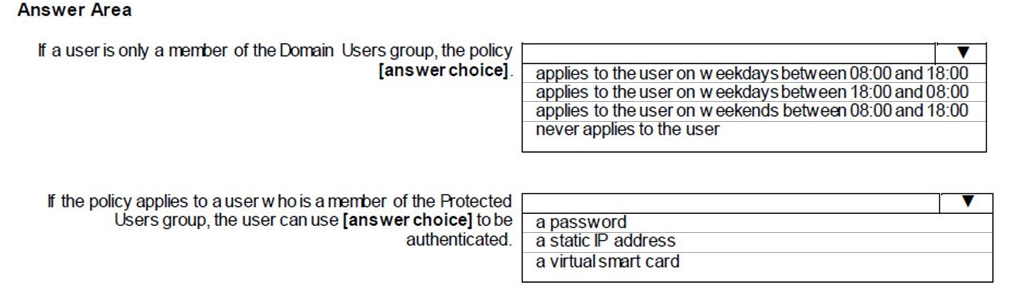
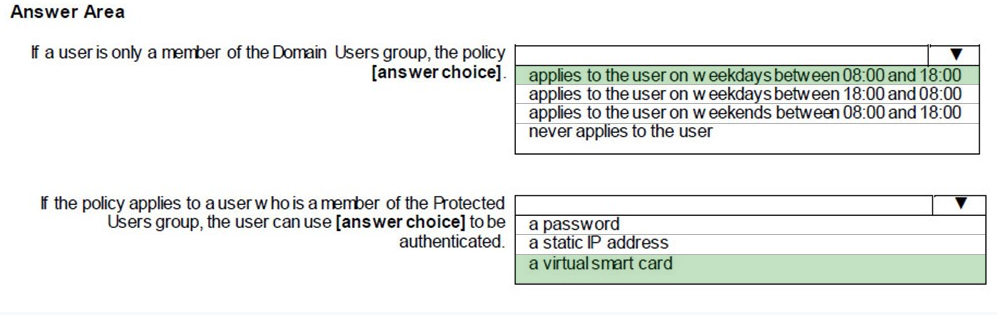
Use the drop-down menus to select the answer choice that completes each statement based on the information in the graphic.
Hot Area: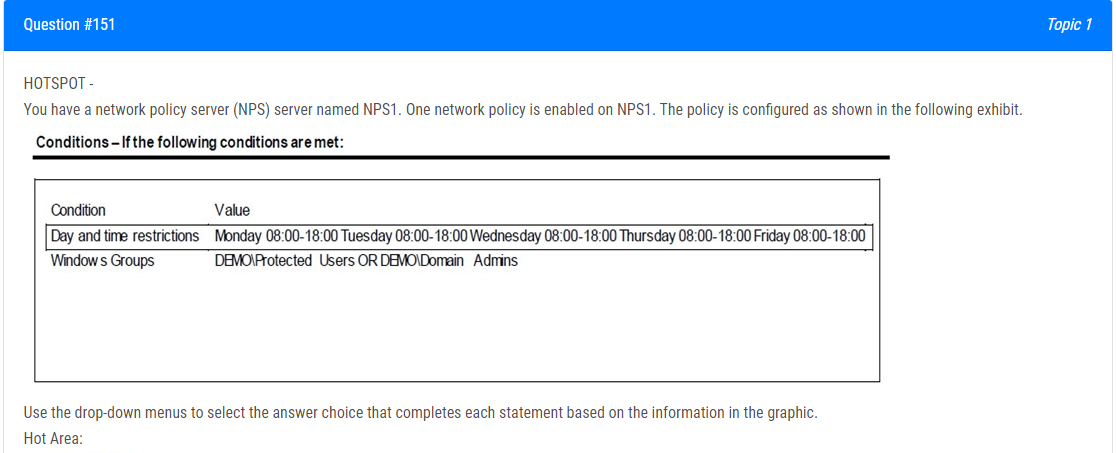
- A
- B
- A
2Question #02
HOTSPOT -
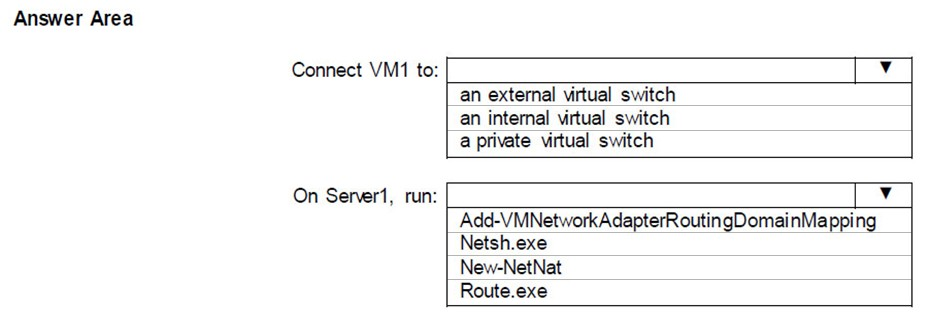
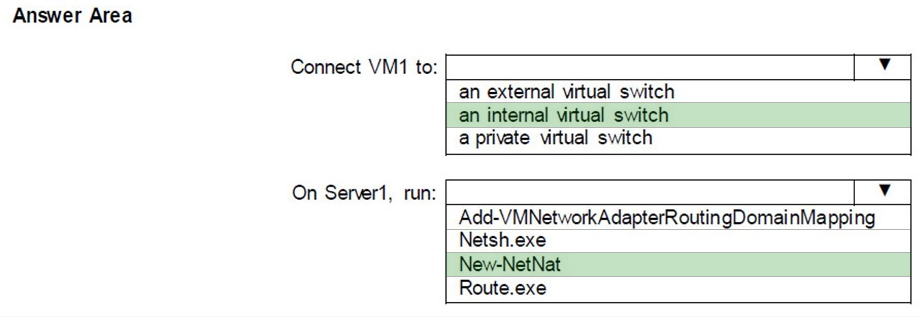
You have a Hyper-V host named Server1 that runs Windows Server 2016. Server1 connects to your corporate network. The Corporate network uses the
10.10.0.0/16 address space.
Server1 hosts a virtual machine named VM1, VM1 is configured to have an IP addresses of 172.16.1.54/16.
You need to ensure that VM1 can access the resources on the corporate network.
What should you do? To answer, select the appropriate options in the answer area.
Hot Area:- A
- B
- A
3Question #153Topic 1
HOTSPOT -
You install the DHCP Server role on a server named server1. You create a new scope on Server1. The scope properties are configured as shown in the following exhibit.
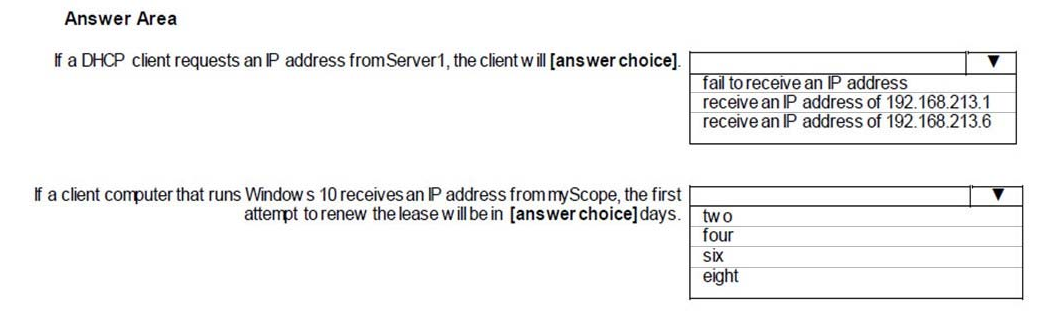
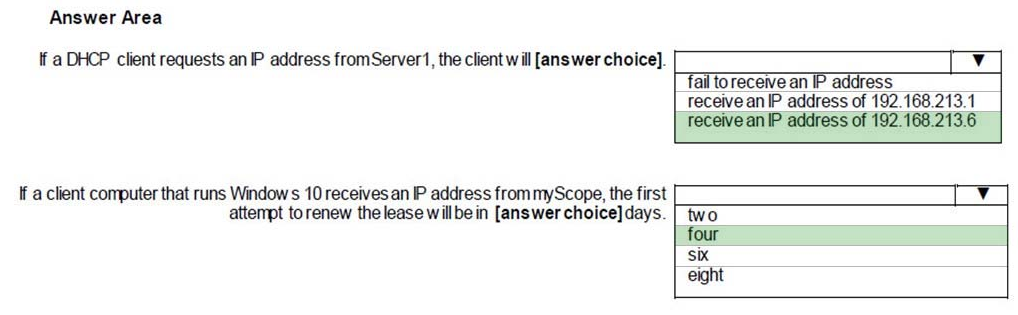
Use the drop down menus to select the answer choice that completes each statement based on the information presented in the graphics.
Hot Area: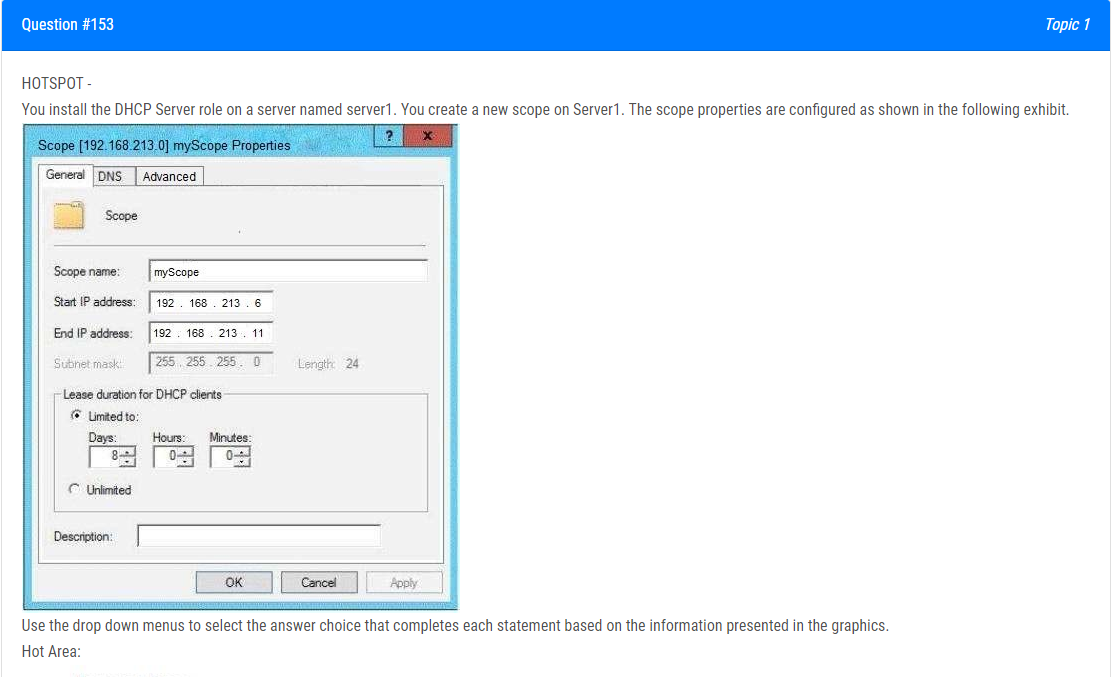
- A
- B
- A
4Question #04
HOTSPOT -
You have a DNS server named Server1.
The forwarders are configured as shown in the Forwarders exhibit. (Click the Exhibit button.)
The Advanced Settings are configured as shown in the Advanced exhibit. (Click the Exhibit button.)
The Root Hints are configured as shown in the Root Hints exhibit. (Click the Exhibit button.)
Server1 does not contain any DNS zones.
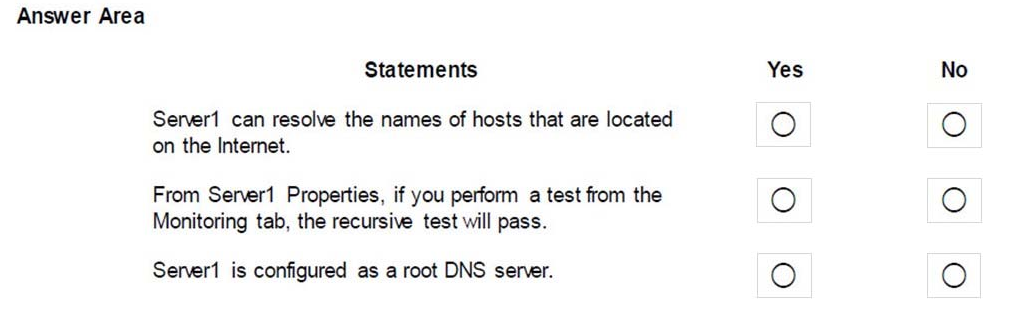
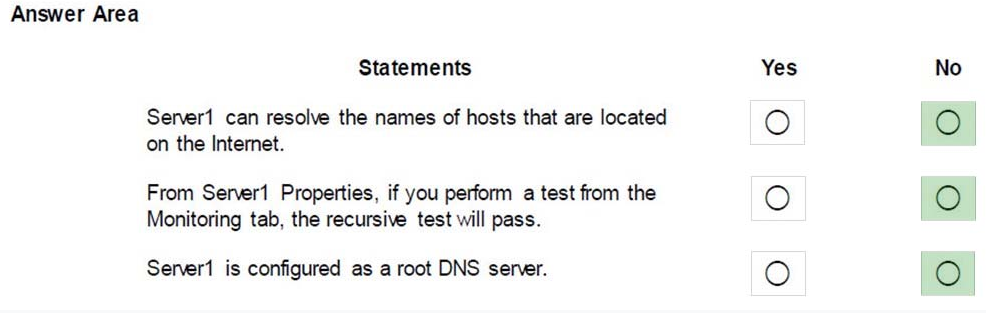
For each of the following statements, select Yes if the statement is true. Otherwise, select No.
Hot Area:- A
- B
- A
5Question #05
You are a network administrator for a company named Contoso, Ltd. The network is configured as shown in the exhibit.
You install the Remote Access server role on Server2. Server2 has the following configured:
✑ Network address translation (NAT)
✑ The DHCP Server server role
The Security Policy of Contoso states that only TCP ports 80 and 443 are allowed from the internet to Server2.
You identify the following requirements:
✑ Add 28 devices to subnet2 for a temporary project.
✑ Configure Server2 to accept VPN connections from the internet.
✑ Ensure that devices on Subnet2 obtain TCP/IP settings from DHCP on Server2.
You add a computer to subnet1. The computer has an IP address of 10.10.0.129. Web1 receives a request from the new computer and sends a response.
You need to determine which address Web1 sends the response to.
Which IP address should you choose?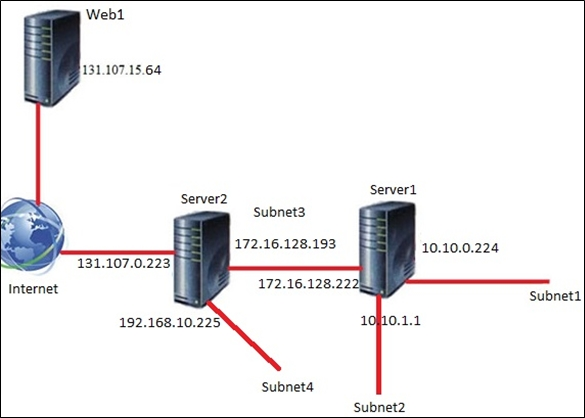
- A10.10.0.129
- B10.10.0.224
- C131.107.0.223
- D172.16.128.222
6Question #06
HOTSPOT -
You are a network administrator for a company named Contoso, Ltd. The network is configured as shown in the exhibit.
You install the Remote Access server role on Server2. Server2 has the following configured:
✑ Network address translation (NAT)
✑ The DHCP Server server role
The Security Policy of Contoso states that only TCP ports 80 and 443 are allowed from the internet to Server2.
You identify the following requirements:
✑ Add 28 devices to subnet2 for a temporary project.
✑ Configure Server2 to accept VPN connections from the internet.
✑ Ensure that devices on Subnet2 obtain TCP/IP settings from DHCP on Server2.
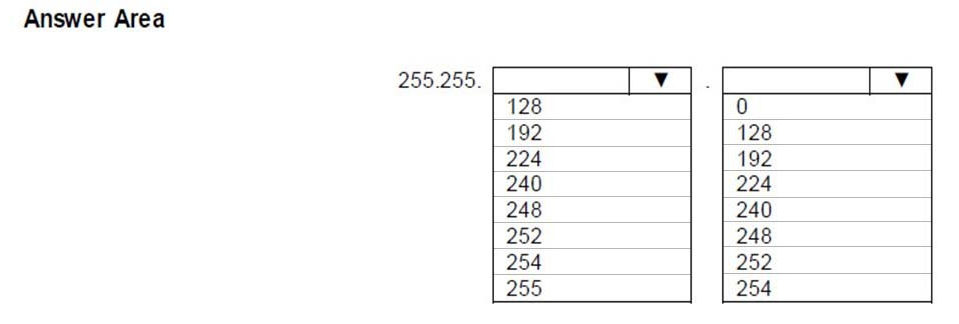
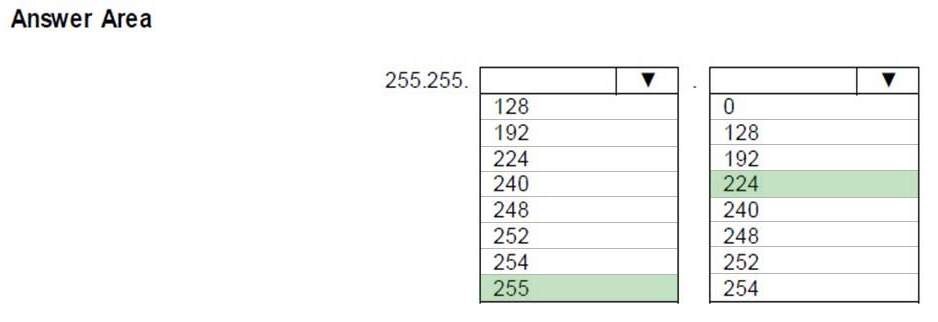
You need to identify which subnet mask you must use for subnet2. The solution must minimize the number of available IP addresses on Subnet2.
What subnet mask should you identify? To answer, select the appropriate options in the answer area.
Hot Area:- A
- B
- A
7Question #07
You are a network administrator for a company named Contoso, Ltd. The network is configured as shown in the exhibit.
You install the Remote Access server role on Server2. Server2 has the following configured:
✑ Network address translation (NAT)
✑ The DHCP Server server role
The Security Policy of Contoso states that only TCP ports 80 and 443 are allowed from the internet to Server2.
You identify the following requirements:
✑ Add 28 devices to subnet2 for a temporary project.
✑ Configure Server2 to accept VPN connections from the internet.
✑ Ensure that devices on Subnet2 obtain TCP/IP settings from DHCP on Server2.
What should you do to meet the DHCP connectivity requirement for Subnet2?- AInstall the Routing role service on Server2.
- BInstall the IP address Management (IPAM) Server feature on Server2.
- CInstall the Routing role service on Server1.
- DInstall the DHCP Server server role on Server1.
8Question #08
HOTSPOT -
You are a network administrator for a company named Contoso, Ltd. The network is configured as shown in the exhibit.
You install the Remote Access server role on Server2. Server2 has the following configured:
✑ Network address translation (NAT)
✑ The DHCP Server server role
The Security Policy of Contoso states that only TCP ports 80 and 443 are allowed from the internet to Server2.
You identify the following requirements:
✑ Add 28 devices to subnet2 for a temporary project.
✑ Configure Server2 to accept VPN connections from the internet.
✑ Ensure that devices on Subnet2 obtain TCP/IP settings from DHCP on Server2.
You deploy a computer named Computer8 to subnet4. Computer8 has an IP address of 192.168.10.230 and a subnet mask of 255.255.255.240.
What is the broadcast address for Subnet4? To answer, select the appropriate options in the answer area.
Hot Area: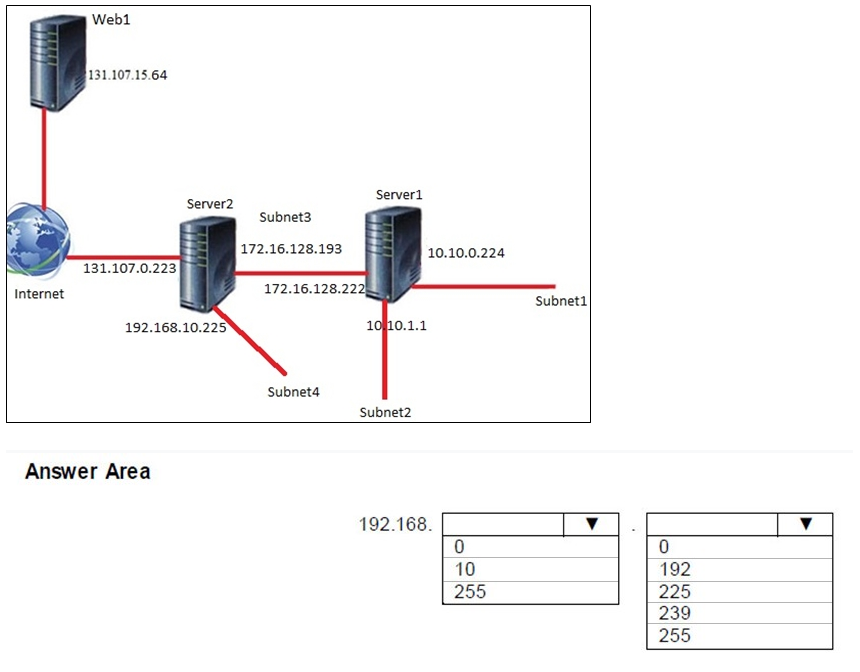
- A10
- B239
9Question #09
You plan to deploy several Hyper-V hosts that run Windows Server 2016. The deployment will use Software defined Networking (SDN) and VXLAN.
Which server role should you install on the network to support the planned deployment?- ANetwork Controller
- BNetwork Policy and Access Services
- CRemote Access
- DHost Guardian Service
10Question #10
Your network contains three subnets, a production subnet that contains production servers, a development network that contains development servers, and a client network that contains client computers.
The development network is used to test applications and reproduces servers that are located on the production network. The development network and the production network use the same IP address range.
A developer has a client computer on the client network. The developer reports that when he attempts to connect to the IP address 10.10.1.6 from his computer, he connects to a server on the production network.
You need to ensure that when the developer connects to 10.10.1.6, he connects to a sever on the development network.
Which cmdlet should you use?- ANew-NetNeighbor
- BNew-NetRoute
- CSet-NetTcpSetting
- DSet-NetNeighbor
11Question #11
Your network contains an Active Directory domain named contoso.com. The domain contains a domain-based Distributed File System (DFS) namespace named
Namespace1 that has access-based enumeration enabled. Namespace1 has a folder named folder1. Folder1 has a target of \\Server1\Folder1.
The Permission for folder1 are configured as shown in the following table.
Access-based enumeration is disabled for the share of Folder1.
You need to ensure that both User1 and User2 can see Folder1 when they access \\Contoso.com\NameSpace1.
What should you do?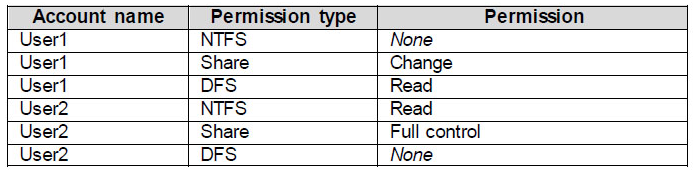
- AEnable access-based enumeration for Folder1.
- BDisable access-based enumeration for Namespace1.
- CAssign User1 the read NTFS permission to Folder1
- DDeny User1 the read DFS permission to Folder1.
12Question #12
You have a server named Server1 that runs Windows Server 2016 and is configured as a domain controller.
You install the DNS Server server role on Server1.
You plan to store a DNS zone in a custom Active Directory partition.
You need to create a new Active Directory partition for the zone.
What should you use?- ASet-DnsServer
- BActive Directory Sites and Services
- CDns.exe
- DDnscmd.exe
- ENew-ADObject
- FActive Directory Administrative Center
- GDNS Manager
13Question #13
You have an Active Directory forest that contains 30 servers and 6,000 client computers.
You deploy a new DHCP server that runs Windows Server 2016.
You need to retrieve the list of the authorized DHCP servers.
Which command should you run?- AGet-DCHPServerDatabase
- BNetstat-p IP ""s ""a
- CGet-DHCPServerInDc
- DShow-ADAuthenticationPolicyExpression-AllowedToAuthenticateTo
- ENetsh DHCP server initiate auth
- FGet-DHCPServerSetting
14Question #14
You have a server named Server1 that runs Windows Server 2016. Server1 is an IP Address Management (IPAM) server that collects DHCP and DNS logs and events for your entire network.
You need to get the IP addresses that were assigned to a client computer named Computer1 during the last week.
What should you do on Server1?- AFrom the IPAM node in Server Manager, click IP Address Space, and then review the IP Address Inventory.
- BOpen Event Viewer and click Windows Logs. Filter the Security log for Computer1.
- CRun the Get-IpamDhcpConfigurationEvent cmdlet.
- DRun the Get-IpamIpAddressAuditEvent cmdlet.
- EOpen Event Viewer and click Windows Logs. Filter the Forwarded Events log for Computer1.
- FRun the Get-IpamAddress cmdlet.
15Question #15
You are deploying a small network that has 30 client computers. The network uses the 192.168.1.0/24 address space. All computers obtain IP configurations from a DHCP server named Server1.
You install a server named Server2 that runs Windows Server 2016. Server2 has two network adapters named Internal and Internet. Internet connects to an
Internet Service Provider (ISP) and obtains the 131.107.0.10 IP address. Internal connects to the internal network and is configured to use the 192.168.1.250 IP address.
You need to provide Internet connectivity for the client computers.
What should you do?- AOn Server2, select the Internet and Internal network adapters and bridge the connections. From the DHCP console on Server1, authorize Server2.
- BOn Server1, stop the DHCP server. On the Internal network adapter on Server2, enable Internet Connection Sharing (ICS).
- COn Server2 run the New-NetNat ""Name NAT1 -InternalIPInterfaceAddressPrefix 192.168.1.0/24 cmdlet. Configure Server1 to provide the 003 Router option of 131.107.0.10.
- DInstall the Routing role service on Server2 and configure the NAT routing protocol. Configure Server1 to provide the 003 Router option of 192.168.1.250.
- EInstall the Routing role service on Server2 and configure the NAT routing protocol. Configure Server1 to provide the 003 Router option of 131.107.0.10.
- FRecreate the DHCP scope on Server1 to lease addresses from the 131.107.0.0/24 address space. On Server2, change the IP address of the internal network adapter to 131.107.0.1. Configure Server1 to provide the 003 Router option of 131.107.0.1.
16Question #16
You have a server named Server1 that runs Windows Server 2016. Server1 will be used as a VPN server. You need to configure Server1 to support VPN
Reconnect.
Which VPN protocol should you use?- ASSTP
- BIKEv2
- CPPTP
- DL2TP
17Question #17
You have Hyper-V host named Server1.
Server1 has a network adapter that has virtual machine queue (VMQ) enabled. The network adapter connects at 10 Gbps and has an IPV4 address.
Server1 hosts a virtual machine named VM1. VM1 has a single network adapter and four processors.
You need to distribute the network processing load across the VM1 processors.
What should you do?- AFrom Device Manager on Server1, configure TCP Checksum Offload (IPv4).
- BFrom Windows PowerShell on VM1, run the Enable-NetAdapterRSS cmdlet.
- CFrom Windows PowerShell on Server1, run the Enable-NetAdapterPacketDirect cmdlet.
- DFrom Windows PowerShell on VM1, run the Enable-NetAdapterPacketDirect cmdlet.
18Question #18
Your network contains an Active Directory domain named contoso.com. The domain contains a Hyper-V host.
You are deploying Software Defined Network (SDN) by using Windows Server 2016.
You deploy a virtual machine that runs Windows Server 2016, and you install the Network Controller server role.
You need to configure the virtual machine as the network controller.
What should you do?- ARun the Install-NetworkControllerCluster cmdlet and set ClientAuthentication to X509.
- BRun the Install-NetworkController cmdlet and set ClientAuthentication to None.
- CRun the Install-NetworkControllerCluster cmdlet and set ClientAuthentication to None.
- DRun the Install-NetworkController cmdlet and set ClientAuthentication to Kerberos.
19Question #19
Note: This question is part of a series of questions that use the same or similar answer choices. An answer choice may be correct for more than one question in the series. Each question is independent of the other questions in this series. Information and details provided in a question apply only to that question.
Your company has five departments, including a web research department.
You have a DHCP server named Server1 and two DNS servers named DNS1 and DNS2.
Server1 has an Ipv4 scope named Scope1. All client computers are configured to use DNS1 for name resolution.
You need to ensure that users in the web research department use DNS2 for name resolution.
What should you do on Server1?- AFrom the properties of Scope1, modify the Conflict detection attempts setting.
- BFrom the properties of Scope1, configure Name Protection.
- CFrom the properties of IPv4, configure the bindings.
- DFrom IPv4, create a new filter.
- EFrom the properties of Scope1, create an exclusion range.
- FFrom IPv4, run the DHCP Policy Configuration Wizard.
- GFrom Control Panel, modify the properties of Ethernet.
- HFrom Scope1, create a reservation.
20Question #20
You have an IP Address Management (IPAM) server named Server1 that runs Windows Server 2016. You have five DHCP servers. Server1 manages all of the
DHCP servers.
On Server1, an administrator uses Purge Event Catalog Data to remove all of the events from the last 30 days.
You need to view all of these lease requests that were denied during the last two days.
What should you do?- AOn each DHCP server, run the \Microsoft\Windows\Server Manager\CleanUpOldPerfLogs scheduled task, and then review the event catalog on Server1.
- BOn Server1, run the Purge Event Catalog Data action and then open Event Viewer on Server1.
- CReview the log data in C:\Windows\System32\ipam\Database on Server1.
- DOn each DHCP server, review the DHCP Server operational event log.
21Question #21
You have Hyper-V host named Server1.
Server1 has a network adapter that has virtual machine queue (VMQ) enabled. The network adapter connects at 10 Gbps and has an IPV4 address.
Server1 hosts a virtual machine named VM1. VM1 has a single network adapter and four processors.
You need to distribute the network processing load across the VM1 processors.
What should you do?- AFrom Windows PowerShell on Server1, run the Enable-NetAdapterPacketDirect cmdlet.
- BFrom Windows PowerShell on VM1, run the Enable-NetAdapterPacketDirect cmdlet.
- CFrom Device Manager on VM1, configure Receive Side Scaling.
- DFrom Windows PowerShell on Server1, run the Enable-NetAdapterRSS cmdlet.
22Question #22
You have a server named Server1 that runs Windows Server 2016. Server1 is an IP Address Management (IPAM) server that collects DHCP and DNS logs and events for your entire network.
You need to get the IP addresses that were assigned to a client computer named Computer1 during the last week.
What should you do on Server1?- AFrom the IPAM node in Server Manager, click Event Catalog, and then review the IP Address Tracking.
- BOpen Event Viewer and click Windows Logs. Filter the Security log for Computer1.
- CRun the Export-IpamAddress cmdlet.
- DFrom the IPAM node in Server Manager, click IP Address Space, and then review the IP Address Inventory.
- ERun the Get-IpamDhcpConfigurationEvent cmdlet.
- FRun the Get-IpamAddress cmdlet.
23Question #23
Note: This question is part of a series of questions that present the same scenario. Each question in the series contains a unique solution that might meet the stated goals. Some question sets might have more than one correct solution, while others might not have a correct solution.
After you answer a question in this section, you will NOT be able to return to it. As a result, these questions will not appear in the review screen.
You have an IP Address Management (IPAM) server named IPAM1 that runs Windows Server 2016. IPAM1 manages all of the DHCP servers on your network.
You are troubleshooting an issue for a client that fails to receive an IP address from DHCP.
You need to ensure that from IPAM1, you can view all of the event data for the DHCP leases from the last 24 hours.
Solution: From Task Scheduler, you run the Microsoft\Windows\IPAM\Audit task.
Does this meet the goal?- AVerdadero
- BFalso
24Question #24
Note: This question is part of a series of questions that present the same scenario. Each question in the series contains a unique solution that might meet the stated goals. Some question sets might have more than one correct solution, while others might not have a correct solution.
After you answer a question in this section, you will NOT be able to return to it. As a result, these questions will not appear in the review screen.
You have an IP Address Management (IPAM) server named IPAM1 that runs Windows Server 2016. IPAM1 manages all of the DHCP servers on your network.
You are troubleshooting an issue for a client that fails to receive an IP address from DHCP.
You need to ensure that from IPAM1, you can view all of the event data for the DHCP leases from the last 24 hours.
Solution: From Windows PowerShell, you run the Invoke-IpamServerProvisioning cmdlet.
Does this meet the goal??- AVerdadero
- BFalso
25Question #25
Note: This question is part of a series of questions that present the same scenario. Each question in the series contains a unique solution that might meet the stated goals. Some question sets might have more than one correct solution, while others might not have a correct solution.
After you answer a question in this section, you will NOT be able to return to it. As a result, these questions will not appear in the review screen.
You have an IP Address Management (IPAM) server named IPAM1 that runs Windows Server 2016. IPAM1 manages all of the DHCP servers on your network.
You are troubleshooting an issue for a client that fails to receive an IP address from DHCP.
You need to ensure that from IPAM1, you can view all of the event data for the DHCP leases from the last 24 hours.
Solution: From Windows PowerShell, you run the Set-IpamDHCPServer cmdlet.
Does this meet the goal?- AVerdadero
- BFalso
26Question #26
Note: This question is part of a series of questions that present the same scenario. Each question in the series contains a unique solution that might meet the stated goals. Some question sets might have more than one correct solution, while others might not have a correct solution.
After you answer a question in this section, you will NOT be able to return to it. As a result, these questions will not appear in the review screen.
You are implementing a secure network. The network contains a DHCP server named Server1 that runs Windows Server 2016.
You create a DHCP allow filter that contains all of the computers on the network that are authorized to receive IP addresses.
You discover that unauthorized computers can obtain an IP address from Server1.
You need to ensure that only authorized computers can receive an IP address from Server1.
Solution: You run the following command: Set-DhcpServerv4FilterList ""ComputerName Server1 ""Allow False ""Deny True
Does this meet the goal?- AVerdadero
- BFalso
27Question #27
Note: This question is part of a series of questions that present the same scenario. Each question in the series contains a unique solution that might meet the stated goals. Some question sets might have more than one correct solution, while others might not have a correct solution.
After you answer a question in this section, you will NOT be able to return to it. As a result, these questions will not appear in the review screen.
You are implementing a secure network. The network contains a DHCP server named Server1 that runs Windows Server 2016.
You create a DHCP allow filter that contains all of the computers on the network that are authorized to receive IP addresses.
You discover that unauthorized computers can obtain an IP address from Server1.
You need to ensure that only authorized computers can receive an IP address from Server1.
Solution: You run the following command: Add-DHCPServerv4Filter ""ComputerName Server1 ""MacAddress * -List Deny
Does this meet the goal?- AVerdadero
- BFalso
28Question #28
Note: This question is part of a series of questions that present the same scenario. Each question in the series contains a unique solution that might meet the stated goals. Some question sets might have more than one correct solution, while others might not have a correct solution.
After you answer a question in this section, you will NOT be able to return to it. As a result, these questions will not appear in the review screen.
You are implementing a secure network. The network contains a DHCP server named Server1 that runs Windows Server 2016.
You create a DHCP allow filter that contains all of the computers on the network that are authorized to receive IP addresses.
You discover that unauthorized computers can obtain an IP address from Server1.
You need to ensure that only authorized computers can receive an IP address from Server1.
Solution: You run the following command: Add-DHCPServerv4Filter ""ComputerName Server1 ""MacAddress * -List Allow
Does this meet the goal?- AVerdadero
- BFalso
29Question #29
You have a virtual machine named Server1 that runs Windows Server 2016.
You plan to use Server1 as part of a Software Defined Networking (SDN) solution.
You need to implement the Border Gateway Protocol (BGP) on Server1.
What should you install?- Athe Peer Name Resolution Protocol (PNRP) feature
- Bthe Routing role service
- Cthe Network Device Enrollment Service role service
- Dthe Network Policy and Access Services server role
30Question #30
You are deploying Software Defined Networking (SDN) by using Windows Server 2016.
You plan to deploy a three-node Network Controller cluster. You plan to use virtual machines for the network controller and the management client. The virtual machines will NOT be domain-joined.
You need to configure authentication for the cluster.
Which command should you run?- AInstall-NetworkController ""Node @{Node1, Node2, Node3} ""ClientAuthentication X509
- BInstall-NetworkControllerCluster ""Node @{Node1, Node1, Node3} ""ClientAuthentication Kerberos
- CInstall-NetworkControllerCluster ""Node @{Node1, Node1, Node3} ""ClientAuthentication X509
- DInstall-NetworkControllerCluster ""Node @{Node1, Node1, Node3} ""ClientAuthentication None
- EInstall-NetworkController ""Node @{Node1, Node2, Node3} ""ClientAuthentication Kerberos
31Question #31
Note: This question is part of a series of questions that present the same scenario. Each question in the series contains a unique solution that might meet the stated goals. Some question sets might have more than one correct solution, while others might not have a correct solution.
After you answer a question in this section, you will NOT be able to return to it. As a result, these questions will not appear in the review screen.
You have an IP Address Management (IPAM) server named IPAM1 that runs Windows Server 2016. IPAM1 manages all of the DHCP servers on your network.
You are troubleshooting an issue for a client that fails to receive an IP address from DHCP.
You need to ensure that from IPAM1, you can view all of the event data for the DHCP leases from the last 24 hours.
Solution: From Server Manager, you run Retrieve Event Catalog Data.
Does this meet the goal?- AVerdadero
- BFalso
32Question #32
You implement Software Defined Networking (SDN) by using the Network Controller server role.
You have a virtual network named VNET1 that contains servers used by developers.
You need to ensure that only devices from the 192.168.0.0/24 subnet can access the virtual machine in VNET1.
What should you configure?- Aa network security group (NSG)
- Brole-based access control
- Ca universal security group
- DDynamic Access Control
33Question #33
You have a DNS server named Server1 that runs Windows Server 2016. Server1 has two Active Directory-integrated zones named contoso.com and adatum.com.
All client computers run Windows 10.
Server1 recently experienced millions of erroneous DNS queries causing a denial of service.
You need to reduce the likelihood that a similar attack will cause a denial of service. The solution must ensure that Server1 continues to resolve names for clients.
What should you do?- AImplement DNS-based Authentication of Named Entities (DANE)
- BEnable Response Rate Limiting (RRL) on Server1
- CConfigure DNS policies on Server1
- DSign both adatum.com and contoso.com zones
34Question #34
Your network contains an Active Directory forest named contoso.com.
The forest contains five domains. You manage DNS for the contoso.com domain only.
You are not responsible for managing DNS for the child domains.
The DNS servers in a child domain named research.contoso.com are reconfigured often.
You need to ensure that clients in contoso.com can resolve addresses in research.contoso.com. The solution must minimize zone replication traffic.
What should you do?- ACreate a primary zone for research.contoso.com on the DNS servers of contoso.com
- BCreate a secondary zone for research.contoso.com on the DNS servers of contoso.com
- CCreate a stub zone for research.contoso.com on the DNS servers of contoso.com
- DCreate a delegation for research.contoso.com
35Question #35
You have a server named Server1 that runs Windows Server 2016.
Server1 is in a workgroup and has the DNS Server role installed.
You need to enable DNS analytical diagnostic logging on Server1.
What should you do?- AFrom Local Group Policy Editor, configure Audit Policy.
- BFrom DNS Manager, configure Monitoring.
- CFrom Windows PowerShell, run the Enable-DnsServerPolicy cmdlet.
- DFrom DNS Manager, configure Event Logging.
- EFrom Event Viewer, configure DNS-Server Applications and Services Logs.
36Question #36
Your network contains an Active Directory domain named contoso.com. The domain contains a server named Server1 that runs Windows Server 2016.
Server1 has IP Address Management (IPAM) installed. IPAM is configured to use the Group Policy based provisioning method. The prefix for the IPAM Group
Policy objects (GPOs) is IP.
From Group Policy Management, you manually rename the IPAM GPOs to have a prefix of IPAM.
You need to modify the GPO prefix used by IPAM.
What should you do?- AClick Configure server discovery in Server Manager.
- BRun the Set-IpamConfiguration cmdlet.
- CClick Provision the IPAM server in Server Manager.
- DRun the Invoke-IpamGpoProvisioning cmdlet.
37Question #37
Note: This question is part of a series of questions that present the same scenario. Each question in the series contains a unique solution that might meet the stated goals. Some question sets might have more than one correct solution, while others might not have a correct solution.
After you answer a question in this section, you will NOT be able to return to it. As a result, these questions will not appear in the review screen.
You have a Hyper-V host named Server 1. The network adapters on Server1 have single root I/O virtualization (SR-IOV) enabled.
Server1 hosts a virtual machine named VM1 that runs Windows Server 2016.
You need to identify whether SR-IOV is used by VM1.
Solution: You sign in to VM1. You run the Get-NetAdapterSriov cmdlet.
Does this meet the goal?- AVerdadero
- BFalso
38Question #38
Note: This question is part of a series of questions that present the same scenario. Each question in the series contains a unique solution that might meet the stated goals. Some question sets might have more than one correct solution, while others might not have a correct solution.
After you answer a question in this section, you will NOT be able to return to it. As a result, these questions will not appear in the review screen.
You have a Hyper-V host named Server 1. The network adapters on Server1 have single root I/O virtualization (SR-IOV) enabled.
Server1 hosts a virtual machine named VM1 that runs Windows Server 2016.
You need to identify whether SR-IOV is used by VM1.
Solution: You sign in to VM1. You view the properties of the network connections.
Does this meet the goal?- AVerdadero
- BFalso
39Question #39
Note: This question is part of a series of questions that present the same scenario. Each question in the series contains a unique solution that might meet the stated goals. Some question sets might have more than one correct solution, while others might not have a correct solution.
After you answer a question in this section, you will NOT be able to return to it. As a result, these questions will not appear in the review screen.
You have a Hyper-V host named Server1. The network adapters on Server1 have single root I/O virtualization (SR-IOV) enabled.
Server1 hosts a virtual machine named VM1 that runs Windows Server 2016.
You need to identify whether SR-IOV is used by VM1.
Solution: On Server1, you open Hyper-V Manager and view the Integration Services settings of VM1.
Does this meet the goal?- AVerdadero
- BFalso
40Question #40
Note: This question is part of a series of questions that present the same scenario. Each question in the series contains a unique solution that might meet the stated goals. Some question sets might have more than one correct solution, while others might not have a correct solution.
After you answer a question in this section, you will NOT be able to return to it. As a result, these questions will not appear in the review screen.
You have a Hyper-V host named Server 1. The network adapters on Server1 have single root I/O virtualization (SR-IOV) enabled.
Server1 hosts a virtual machine named VM1 that runs Windows Server 2016.
You need to identify whether SR-IOV is used by VM1.
Solution: You sign in to VM1. You open Device Manager and view the properties of the network adapters.
Does this meet the goal?- AVerdadero
- BFalso
41Question #41
You are deploying a small network that has 30 client computers. The network uses the 192.168.1.0/24 address space. All computers obtain IP configurations from a DHCP server named Server1.
You install a server named Server2 that runs Windows Server 2016. Server2 has two network adapters named Internal and Internet. Internet connects to an
Internet Service Provider (ISP) and obtains the 131.107.0.10 IP address. Internal connects to the internal network and is configured to use the 192.168.1.250 IP address.
You need to provide Internet connectivity for the client computers.
What should you do?- AOn Server1, stop the DHCP server. On the Internal network adapter on Server2, enable Internet Connection Sharing (ICS).
- BOn Server2 run the New-NetNat ""Name NAT1 -InternalIPInterfaceAddressPrefix 192.168.1.0/24 cmdlet. Configure Server1 to provide the 003 Router option of 192.168.1.250.
- COn Server1, stop the DHCP server. On the Internet adapter on Server2, enable internet Connection Sharing (ICS).
- DRecreate the DHCP scope on Server1 to lease addresses from the 131.107.0.0/24 address space. On Server2, change the IP address of the internal network adapter to 131.107.0.1. Configure Server1 to provide the 003 Router option of 131.107.0.1.
- EInstall the Routing role service on Server2 and configure the NAT routing protocol. Configure Server1 to provide the 003 Router option of 192.168.1.250.
42Question #42
Note: This question is part of a series of questions that use the same or similar answer choices. An answer choice may be correct for more than one question in the series. Each question is independent of the other questions in this series. Information and details provided in a question apply only to that question.
Your network contains an Active Directory domain named contoso.com. The domain contains a server named Server2 that runs Windows Server 2016.
The DHCP Server server role is installed on Server2. The DNS server role is installed on a server named Server3.
The network contains 500 non-Windows devices that are registered in the DNS zone of contoso.com.
You configure Server2 to lease IP addresses to the non-Windows devices.
You need to prevent Server2 from overwriting the host (A) records for the non-Windows devices.
What should you run?- Adism.exe
- Bdns.exe
- Cdnscmd.exe
- Dnetsh.exe
- ESet-DhcpServerDatabase
- FSet-DhcpServerv4DnsSetting
- GSet-DhcpServerv6DnsSetting
- HSet-DNSServerSetting
43Question #43
You have a server named Server1 that runs Windows Server 2016.
Server1 is an IP Address Management (IPAM) server that collects DHCP and DNS logs and events for your entire network.
You need to enable a user named TECH1 to create pointer (PTR), host (A) and service location (SRV) records on all of the DNS servers on the network.
What should you do on Server1?- ARun the Set-IpamRange cmdlet, and then run the Set-IpamAddressSpace cmdlet.
- BRun the Set-IpamCustomField cmdlet, and then run the Set-IpamAccessScope cmdlet.
- CFrom the IPAM node in Server Manager, assign the IPAM DNS Administrator Role to TECH1 and create a new access policy.
- DFrom the IPAM node in Server Manager, assign the IPAM DNS Administrator Role to TECH1 and create a new access scope.
44Question #44
You have a server named Server1 that has a Server Core installation of Windows Server 2016. Server1 is configured to obtain an IP address automatically.
You need to configure the IPv4 address, netmask, and default gateway manually for a network interface named Ethernet on Server1.
What should you run?- Aipconfig.exe
- BNew-NetIPAddress
- CSet-NetAdapter
- DSet-NetIPv4Protocol
45Question #45
You have a server named Server1 that connects directly to multiple networks.
You need to configure Server1 as a BGP router.
What should you install on Server1?- Athe MultiPoint Services server role
- Bthe Network Policy and Access Services server role
- Cthe Network Controller server role
- Dthe Routing role service
46Question #46
You have an Active Directory forest that contains 30 servers and 6,000 client computers.
You deploy a new DHCP server that runs Windows Server 2016.
You need to retrieve the list of the authorized DHCP servers.
Which command should you run?- AGet-ADResourceProperty ""Filter DHCP
- BNetsh DHCP show server
- CNetsh DHCP server initiate auth
- DGet-DHCPServerSetting
- ENetstat ""p IP ""s -a
47Question #47
You have a server named Server1 that runs Windows Server 2016.
Server1 is an IP Address Management (IPAM) server that collects DHCP and DNS logs and events for your entire network.
You need to enable a user named TECH1 to create pointer (PTR), host (A) and service location (SRV) records on all of the DNS servers on the network.
What should you do on Server1?- ARun the Set-IpamCustomField cmdlet, and then run the Set-IpamAddressSpace cmdlet.
- BRun the Set-IpamCustomField cmdlet, and then run the Set-IpamAccessScope cmdlet.
- CFrom the IPAM node in Server Manager, assign the IPAM DNS Administrator Role to TECH1 and create a new access policy.
- DRun the Set-IpamRange cmdlet, and then run the Set-IpamAccessScope cmdlet.
48Question #48
HOTSPOT -
You have a Remote Access infrastructure.
You plan to implement DirectAccess.
Which type of certificate should you install on each DirectAccess server? To answer, select the appropriate options in the answer area.
NOTE: Each correct selection is worth one point.
Hot Area:
The options aret:
Remote Access Server:
Client Authentication
IP Security IKE intermediate
Server Authentication
Network location server:
Client Authentication
IP Security IKE intermediate
Server Authentication- AServer Authentication / Server Authentication.
- BClient Authentication / Server Authentication.
- CIP Security IKE intermediate / Server Authentication.
- DServer Authentication / Client Authentication
- EServer Authentication / IP Security IKE intermediate
- FClient Authentication / IP Security IKE intermediate
- GIP Security IKE intermediate / Client Authentication
- HIP Security IKE intermediate / IP Security IKE intermediate
- IClient Authentication / Client Authentication
49Question #49
You plan to deploy a Software Defined Networking (SDN) infrastructure.
Which service provides name resolution for the virtual machines on a tenant network?- Aa smart host
- BNetwork Controller
- CiDNS
- DiSNS
50Question #50
You have a data center. The data center contains Hyper-V hosts that run Windows Server 2016.
You plan to host virtual machines for several customers. The virtual machines will run across any Hyper-V host. The network traffic of each customer will be isolated from the traffic of other customers.
You plan to use Software Defined Networking (SDN).
You need to recommend how to deploy Network Controller to support the planned deployment.
What should you include in the recommendation?- AOn the Hyper-V hosts, deploy the Network Controller server role to a virtual machine. Run the Set-NetworkControllerNode cmdlet on the hosts.
- BOn the Hyper-V hosts, deploy the Network Controller server role. Add every virtual machine by running the New-NetworkControllerServer cmdlet.
- COn the Hyper-V hosts, deploy the Network Controller server role. Run the cmdlet on every virtual machine. Set-NetworkControllerNode
- DOn the Hyper-V hosts, deploy the Network Controller server role to a virtual machine. Add the hosts by running the New-NetworkControllerServer cmdlet.
51Question #51
You network contains an Active Directory domain. The domain contains two DNS servers named Server1 and Server2.
Server1 has a DNS zone named contoso.com that has the following configurations:
✑ Dynamic updates: Secure only
✑ Scavenge stale resource records: Enabled
✑ Scavenging period: 1 day
✑ No-refresh interval: 3 days
✑ Refresh interval: 7 days
After how many days will a dynamic record become stale if the timestamp is NOT updated?- A1 day
- B3 days
- C7 days
- D10 days
- E11 days
52Question #52
You have two servers named Server1 and Server2.
Server1 contains a folder named D:\Videos that contains large video files.
You configure a replication of D:\Videos to Server2 by using Distributed File System (DFS) Replication.
You need to increase the size of the staging area for the replicated folder.
Which cmdlet should you run?- ASet-DfsrConnection
- BSet-DfsrMembership
- CSet-DfsrReplicatedFolder
- DSet-DfsrServiceConfiguration
53Question #53
You have servers that run Windows Server 2016 and devices that run Windows 10 Enterprise.
You have a certification authority (CA) that issued computer certificates to all the servers and devices.
You plan to allow the Windows 10 devices to connect to the network remotely by using VPN device tunnels.
You install the Remote Access server role on a server. From the Routing and Remote Access console, you configure the server for the VPN role.
You need to ensure that the Windows 10 devices can establish the VPN tunnel before users sign in to the devices.
What should you do on the VPN server?- AFrom Authentication Methods, select Allow machine certificate authentication for IKEv2.
- BModify the ports properties and add additional SSTP ports.
- CFrom Authentication Methods, select Extensible authentication protocol (EAP).
- DModify the ports properties and add additional IKEv2 ports.
54Question #54
Your company has three offices. The offices are located in Seattle, Chicago, and Montreal.
You are configuring a new WAN link between the three offices by using the Remote Access server role in Windows Server 2016. You will use Border Gateway
Protocol (DGP) as a routing protocol between the sites.
You need to configure the server in the Seattle office for BGP routing.
What should you do first?- AFrom Routing and Remote Access, add a new IPv4 routing protocol
- BFrom Windows PowerShell, run the Add-BgpPeer cmdlet and specify the ""LocalASN parameter
- CFrom Routing and Remote Access, add a new IPv6 routing protocol
- DD. From Windows PowerShell, run the Add-BgpRouter cmdlet and specify the ""LocalASN parameter
55Question #55
Note: This question is part of a series of questions that use the same or similar answer choices. An answer choice may be correct for more than one question in the series. Each question is independent of the other questions in this series. Information and details provided in a question apply only to that question.
You have 2000 devices. One hundred of the devices are mobile devices that have physical addresses beginning with 98-5F.
You have a DHCP server named Server1.
You need to ensure that the mobile devices register their host name by using a DNS suffix of mobile.contoso.com.
What should you do on Server1?- AFrom the properties of IPv4, modify the Conflict detection attempts setting.
- BFrom the properties of Scope1, configure Name Protection.
- CFrom the Properties of IPv4, configure the bindings.
- DFrom IPv4, create a new filter.
- EFrom the properties of Scope1, create an exclusion range.
- FFrom IPv4, run the DHCP Policy Configuration Wizard.
- GFrom Control Panel, modify the properties of Ethernet.
- HFrom Scope1, create a reservation
56Question #56
Your network contains an Active Directory domain. The domain contains two domain controllers named DC1 and DC2. DC1 and DC2 host an Active Directory- integrated DNS zone named contoso.com.
You have two DNS Client Subnets named Subnet1 and Subnet2.
You plan to create two DNS records for www.contoso.com. One record will point to 10.1.2.3, and the other record will point to 172.23.6.5.
You need to ensure that www.contoso.com resolves to:
✑ 10.1.2.3 from Subnet1
✑ 172.23.6.5 from Subnet2
What should you create?- AOne DNS recursion policy, two DNS zone delegations, and the DNS records
- BOne DNS zone scope, two DNS query resolution policies, and the DNS records
- COne DNS query resolution policy, two DNS zone delegations, and the DNS records
- DTwo DNS zone scopes, two DNS query resolution policies, and the DNS records
57Question #57
You have a DNS server named DNS1 that hosts several forward lookup zones.
You discover that dynamic records exist for computers that there were removed from your network several months ago.
You need to ensure that the records are removed automatically.
Which two actions should you perform? Each correct answer presents part of the solution.
NOTE: Each correct selection is worth one point.- AFrom the Start of Authority (SOA) settings of each zone, configure the Retry interval setting and the Minimum (default) TTL setting.
- BFor each zone, set Dynamic updates to Secure only.
- CFrom the Start of Authority (SOA) settings of each zone, configure the Refresh interval setting and the Expires after setting.
- DFor each zone, select Scavenge stale resource records.
- EFrom the Advanced settings of the DNS server properties, select Enable automatic scavenging of state records.
Información
- Descripción
- Simulado do exame em ingles para realização da certificação do windows server 2016 MCSA e MCSE.
- Autor
- gabriel ribeiro
- Idioma
- Português
- Visitas
- 66
- Etiquetas
- Valoración
- Aún sin valoraciones Valora este test