
Test
Sin título
Crea una cuenta gratis para terminar este test
Guarda tu progreso y consulta tu resultado final.
¿Ya tienes cuenta? Inicia sesión
Preguntas del test (146)
1An administrator is planning a vSphere infrastructure with the following specific networking requirements:
The ability to shape inbound (RX) traffic
Support for Private VLANs (PVLANs)
Support for LLDP (Link Layer Discovery Protocol)
What is the minimum vSphere Edition that will support these requirements?- AvSphere Essentials Plus
- BvSphere Standard
- CvSphere Enterprise
- DvSphere Enterprise Plus
2What two IT infrastructure components are virtualized by vSphere Essentials? (Choose two.)
- ANetworks
- BApplications
- CStorage
- DManagement
3An administrator attempts to install vCenter Single Sign-On Server. The installer returns an error message indicating that the installation failed. Prior to the installation, all setup prerequisites were met. The administrator has generated a vCenter Server Single Sign-On support bundle.
Which two files should the administrator analyze to determine the cause of the failure? (Choose two.)- AServer\utils\logs\imsTrace.log
- BServer\utils\logs\install.txt
- C%TEMP%\utils\logs\vminst.log
- D%TEMP%\vminst.log
4Which Single Sign-On deployment mode should an administrator use for two 5.x vCenter Servers configured with linked mode?
- ABasic Single Sign-On with vCenter Server Heartbeat
- BMultisite Single Sign-On
- CBasic Single Sign-On
- DSingle Sign-On with Linked Mode
5Which two statements below could explain why the vSphere Client is reporting N/A for hyperthreading? (Choose two.)
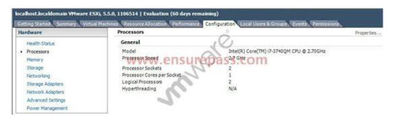
- AThe physical CPUs in the host do not support hyperthreading.
- BHyperthreading is disabled in the host’s BIOS.
- CThe physical CPUs in the host are not multi-core.
- DThe number of CPUs meets or exceeds the maximum without hyperthreading.
6Immediately after installing an ESXi host, an administrator needs to examine the following log files:
/var/log/hostd.log
/var/log/vmkernel.log
/var/log/vpxa.log
Which two connections would allow an administrator to examine these files? (Choose two.)- AConnecting to the Direct Console User Interface.
- BAttaching a vSphere Client directly to the ESXi host.
- CEnable High Availability on the cluster.
- DCreate a new Datacenter, and create the vApp in the new Datacenter.
7An administrator is upgrading a vSphere Distributed Switch. The existing switch is version 5.0 and the administrator wants to upgrade to the latest version possible. The environment contains several ESXi 5.1 hosts. Which two options are available to ensure that the upgraded switch will be compatible with these hosts? (Choose two.)
- AUpgrade the vSphere Distributed Switch to 5.5.
- BUpgrade the ESXi 5.1 hosts to version 5.5, then upgrade the vSphere Distributed Switch to 5.5.
- CUpgrade the vSphere Distributed Switch to 5.1.
- DUpgrade the ESXi host switches to 5.5, then upgrade the vSphere Distributed Switch to 5.5.
8To avoid unnecessary planned downtime, what is the minimum version of VMware Tools that, if installed, will decrease the need for virtual machine reboots following VMware Tools upgrades?
- A5.5
- B5.1
- C5.0
- D4.1
9Which two Identity Sources are available to add for vCenter Single Sign-On authentication? (Choose two.)
- ALocalOS
- BOpenLDAP
- CNIS as an LDAP Server
- DVCMSDS
10Which VLAN configuration requires switch connectivity defined as an access port?
- APrivate VLAN
- BExternal Switch Tagging
- CVirtual Guest Tagging
- DVirtual Switch Tagging
11An administrator needs to deploy several virtual machines. Storage contention between the virtual machines should be managed by the VMkernel. Some of the virtual machines will use MSCS and should be highly available across the ESXi 5.5 hosts. Which two storage options meet these requirements? (Choose two.)
- AiSCSI
- BNFS
- CFibre Channel
- DvSAN
12Which two precautions should a vSphere administrator take before increasing the size of a VMFS datastore? (Choose two.)
- AUnmount the datastore
- BPerform a rescan to ensure that all hosts see the most current storage
- CQuiesce I/O on all disks involved
- DShut down all virtual machines stored in the datastore
13What action should the vSphere administrator take to allow for a new vApp to be created in the cluster?
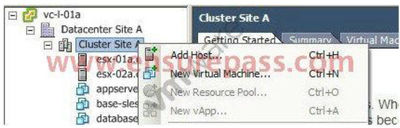
- AEnable Distributed Resource Scheduling on the cluster.
- BCreate a Resource Pool in the cluster, and create the vApp in the Resource Pool.
- CEnable High Availability on the cluster.
- DCreate a new Datacenter, and create the vApp in the new Datacenter.
14A vSphere administrator receives a report of an issue with a vApp. After connecting to the environment with the vSphere Client, the administrator does not see the vApp, but instead sees the inventory shown in the exhibit. What explains this behavior?
- AThe administrator is connected to the ESXi host running the vApp.
- BThe administrator is using the Web Client.
- CThe vApp is in a partially deleted state.
- DThe vApp has been converted to a resource pool.
15A system administrator is unable to clone a windows 2008 server while connected directly to an ESXi host through vSphere Client.
Which two methods can be used to complete the task?
(Choose two.)- AConnect to vCenter Server and retry the operation.
- BUse VMware Converter to perform the operation.
- CConnect to the host using the Web Client and retry the operation.
- DUse VMware Configuration Manager to perform the operation.
16An administrator needs to create and provision new virtual machines from a master image that can not be edited or powered on. Which type of resource is most appropriate for the administrator to perform the task?
- AFull Clone
- BLinked Clone
- CTemplate
- DSnapshot
17A vSphere administrator is unable to vMotion a virtual machine between two hosts. An error message indicates that the USB device is not accessible on the target host. What is causing this issue?
- AThe USB device was not enabled for vMotion when it was added to the virtual machine.
- BESXi does not support vMotion with a USB device attached to the virtual machine.
- CThe VMkernel port for vMotion is not enabled for USB traffic.
- DThe virtual machine has the wrong USB controller installed.
18A vSphere administrator needs to configure a virtual machine to meet a guaranteed CPU performance profile. Which configuration setting could the administrator choose?
- ASet the CPU Limit to High
- BSet the CPU Shares to 500MHz
- CSet the CPU Guarantee to High
- DSet the CPU Reservation to 500MHz
19An organization’s datastores are configured in a fully automated Storage Distributed Resource Scheduler (SDRS) cluster. The vSphere administrator determines that virtual machines are being migrated between datastores even though the datastores look evenly balanced. On further investigation, the administrator determines that the datastore’s utilization percentages differ by 2%. Which Storage DRS setting should the administrator change to prevent the virtual machines from migrating prematurely?
- AEdit the Storage DRS cluster settings to increase the percentage of the Space Utilization Difference threshold.
- BEdit the Storage DRS cluster settings to increase the percentage of the I/O imbalance threshold.
- CEdit the Storage DRS cluster settings to increase the size of the Space Utilization Difference threshold.
- DEdit the Storage DRS cluster settings to increase the size of the I/O imbalance threshold.
20A vSphere administrator enables Fault Tolerance on a powered off virtual machine that has the following configuration:
The virtual machine’s single thin provisioned virtual disk is sized at 100GB.
The datastore that houses the virtual machine has 120GB of free space.
After Fault Tolerance has been configured, another administrator attempts to use Enhanced vMotion to move a 30GB virtual machine file into the same datastore and receives an error. What condition could cause this behavior?- AFault Tolerance inflated the virtual machine’s virtual disk file.
- BFault Tolerance created a temporary logging file on the same datastore.
- CFault Tolerance created a secondary copy of the virtual machine’s virtual disk file.
- DThe Fault Tolerance logging file ran out of disk space.
21While testing a Fault Tolerance setup on a virtual machine, a system administrator notices that the DRS automation level of the virtual machine has been automatically set to Disabled. The administrator needs to enable DRS to migrate the Fault Tolerance virtual machine to balance the cluster’s CPU and memory loads. What should the administrator do?
- AEnable Enhanced vMotion Compatibility (EVC) in the vSphere cluster.
- BMove the virtual machine to a VMFS 5 datastore built on shared storage.
- CManually change the DRS automation level of the virtual machine to Enabled.
- DMove the secondary virtual machine to a host with a Fault Tolerance VMkernel port.
22A vSphere administrator has misconfigured vMotion in such a way that vMotion migrations are failing. Based on the information shown, what is the cause of the problem?
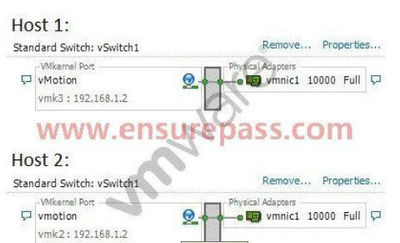
- AThe vMotion VMkernel ports on the hosts are configured with the same IP address.
- BThe labels of the vMotion VMkernel ports are not identical.
- CThe vMotion VMkernel ports are not labeled identically.
- DThe vMotion VMkernel ports are using the same uplink.
23A system administrator detects that a VDP Appliance that has been operational for 6 months has become inconsistent or unstable. Which action should the administrator take to recover the VDP appliance and what will be the impact on the vSphere environment?
- APerform a VDP rollback to the most recent validated checkpoint. All backup and configuration changes made after the checkpoint will be lost.
- BPerform a VDP rollback to the most recent validated checkpoint. Configuration changes after the checkpoint will be lost, but backup data will remain intact.
- CRestore a copy of the latest backup of the VDP appliance. All backup data and configuration changes after the backup was made will be lost.
- DRestore a copy of the latest backup of the VDP appliance. All configuration changes after the backup was made will be lost, but backup data will remain intact.
24Which two features are different between VDP and VDPA? (Choose two.)
- ASupport for guest level backups of SQL and Exchange
- BAbility to perform file level recovery
- CVirtual machines supported per appliance
- DSupport for image level backups
25An administrator must determine which Update Manager procedures can be performed using the vSphere Web Client, and which must be completed using the Windows vSphere client. Which two tasks require the use of the Windows vSphere client? (Choose two.)
- AAttach and detach baselines to inventory objects
- BScan inventory objects for compliance
- CCreate a baseline for an inventory object
- DStage a baseline for remediation
26A vSphere administrator needs to use vSphere Update Manager to perform orchestrated upgrades of virtual machines. Which two options are available for virtual machine remediation? (Choose two.)
- AUpgrade virtual machine hardware
- BUpgrade VMware tools
- CUpgrade virtual machine appliances
- DUpgrade virtual machine guest OS
27Which two are supported object types for Update Manager? (Choose two.)
- Avirtual appliances
- Btemplates
- CvApps
- Dhosts
28A vSphere administrator needs a way of sending noncritical ESXi events to a remote server. Due to budget constraints, no additional costs should be incurred. Which tool will best meet this requirement?
- AvSphere Syslog Collector
- BvSphere ESXi Dump Collector
- CvSphere vCenter Log Insight
- DvSphere Management Appliance
29An administrator determines that traffic shaping does not appear to be working on Production, a virtual machine port group on vSwitch1. Traffic shaping is working on all other port groups on the switch. The administrator examines the Traffic Shaping settings as shown in the exhibit:
What should the administrator do to resolve the problem?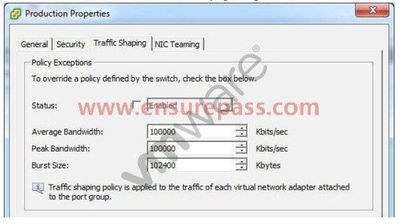
- ASelect the Status checkbox to enable Traffic Shaping on the portgroup.
- BReduce the Average Bandwidth to 50% of the Peak Bandwidth.
- CReduce the Burst Size to 50% of the Peak Bandwidth.
- DClick the Security tab and create the necessary security exception.
30An administrator determines that when a host residing in a High Availability (HA) cluster fails, the virtual machines fail to restart on a remaining host, or will only restart after a long delay. Which two conditions would account for this behavior? (Choose two.)
- AThe virtual machines were not protected by vSphere HA at the time the failure occurred.
- BDistributed Resource Scheduler was not enabled at the time the failure occurred.
- CThere is insufficient spare capacity on hosts with which the virtual machines are compatible.
- DThe virtual machines contain physical Raw Device Mappings.
31The vSphere administrator needs to remove the Production virtual machine port group from an ESXi host. The ESXi host’s Networking Configuration tab is shown in the exhibit.
After disconnecting the Fileserver02 VM, what step does the administrator need to take, assuming that vSwitch1 will still be needed for further configuration?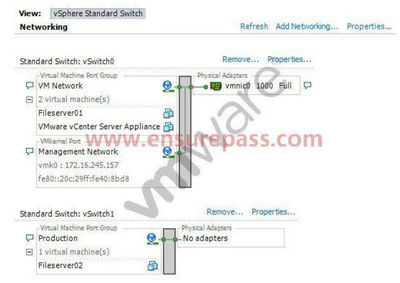
- ARemove the Production port group by accessing the properties for the port group.
- BRemove the Production port group by accessing the properties for vSwitch1.
- CRemove the Production port group by accessing the properties for the Network.
- DRemove the Production port group by removing vSwitch1.
32A vSphere administrator can create an alarm on which two objects? (Choose two.)
- ALUN
- BDatastore
- CTemplate
- DFolder
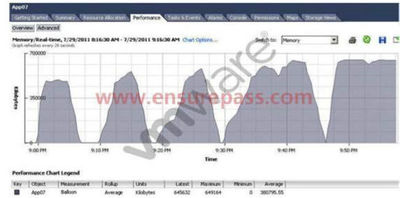
33What is portrayed in the performance chart?
- AThe ESXi host running the VM has Transparent Page Sharing enabled.
- BThe virtual machine’s memory share value is set too high.
- CThe virtual machine is memory constrained.
- DThe ESXi host running the VM is low on memory.
34An administrator needs to modify a virtual machine alert to increase the threshold value of the trigger. Once connected to the vCenter Server, the administrator navigates to the virtual machine to make the change. However, the administrator is unable to edit the alarm. What is the reason that this alarm cannot be edited?
- AThe alarm was not defined on this inventory object.
- BThe administrator is not the owner of this inventory object.
- CThe alarm was not created by the administrator.
- DThe alarm has not been acknowledged.
35An administrator using vCenter Operations Manager is viewing the health of an ESXi host in the environment. There have NOT been any reported outages or issues with the ESXi host, but the administrator needs to determine if the host is behaving normally. Which minor badge should the administrator investigate to determine this information?
- AFaults
- BAnomalies
- CStress
- DHealth
36Which minor badge scores are used to calculate the Health score in vCenter Operations Manager?
- ATime remaining, Capacity remaining, Stress
- BWorkload, Anomalies, Faults
- CStress, Faults, Risk
- DReclaimable Waste, Density
37A small company wants to use VMware products for its production systems. The system administrator needs to recommend a solution that will deliver High Availability to the company’s production applications. What is minimum vSphere offering that will support this requirement?
- AvSphere Essentials
- BvSphere Essentials Plus
- CvSphere Hypervisor
- DvSphere Standard
38A developer needs to create a multi-tier development stack for a home lab. Which vSphere product will support the architecture required for the least software cost?
- AvSphere Hypervisor
- BvSphere Essentials
- CVMware Player
- DVMware Workstation
39An administrator is unable to login to vCenter Server when using the vSphere web client. The administrator successfully accessed vCenter Server using the client earlier the same day. What is the most appropriate first step the administrator should take to resolve this issue?
- AVerify the web browser being used has Adobe Flash plugin version 11.5 or later.
- BVerify the vCenter Single Sign-On service is running on the vCenter Server.
- CVerify the vSphere Web Server service is running on the vCenter Server.
- DVerify the administrator has permissions configured in vCenter Server.
40An administrator is evaluating whether to deploy vCenter Server on a Windows server or on a vCenter Server appliance. The administrator has the following requirements:
A web browser will be utilized to manage the vSphere environment.
16 ESXi hosts will be deployed.
Licenses must be shared with a vCenter Server at another site.
An external Oracle 10g database server will be used to host the vCenter Server database.
Why will the administrator need to deploy vCenter Server on a Windows server?- ALinked Mode is a requirement for the solution.
- BOracle 10g is a requirement for the solution.
- CThe vSphere web client is a requirement for the solution.
- DManagement of more than 5 hosts is a requirement for the solution.
41What is a valid plug-in status for a plug-in that has been added to a vSphere client?
- ADisabled
- BUnknown
- CStopped
- DInstalled
42Immediately after installing ESXi, an administrator observes that the Configure Lockdown Mode option is grayed out in the Direct Console User Interface (DCUI). What is the most likely explanation?
- AThe host has not yet been added to a vCenter Server.
- BThe BIOS on the host does not have NX/XD enabled.
- CThe ESXi host is running in evaluation mode.
- DThe host requires a reboot before this feature is available.
43An administrator is installing ESXi on several hosts attached to iSCSI storage. Why would the administrator detach the host from the IP storage network prior to installation?
- AIt decreases the time the installer needs to search for available disk drives.
- BIt allows the installation of a generic VAAI component for IP storage.
- CIt prevents ESXi from installing vSphere Flash Cache to the IP storage.
- DIt is required when installing ESXi onto a physical server that utilizes IP storage.
44What is the minimum virtual machine compatibility setting required for a virtual machine to run on a vSphere 5.5 host?
- AESXi 5.1 and later
- BESXi 3.0 and later
- CESXi 4.1 and later
- DESXi 3.5 and later
45During the installation of ESXi 5.5, the following error message is reported:
Hardware Virtualization is not a feature of the CPU, or is not enabled in the BIOS.
Which condition would generate this message?- ALAHF/SAHF is not enabled in the BIOS.
- BNX/XD is not enabled in the BIOS.
- CSSE3 is not enabled in the BIOS.
- DHyperthreading is not enabled in the BIOS.
46Which is the simplest baseline group combination an administrator could create to upgrade hosts, VMware tools, and virtual machine hardware to the latest versions using Update Manager?
- AOne baseline group that contains the host upgrade baselines and one baseline group that contains the VM Hardware and VMware Tools upgrade baselines.
- BOne baseline group that contains the host upgrade and vCenter upgrade baselines.
- COne baseline group that contains the host, VMware tools, and VM Hardware upgrade baselines.
- DOne baseline group that contains the Data Center upgrade baseline and one baseline group that contains the VM upgrade baseline.
47During an upgrade, the ESXi 5.x installer finds an existing version of ESXi and a VMFS3 volume. No virtual machines exist on the host or VMFS3 volume. The requirement is to upgrade to VMFS5.
Which option should be chosen to meet this requirement?- AUpgrade ESXi and preserve the VMFS datastore.
- BInstall ESXi and preserve the VMFS datastore.
- CInstall ESXi and overwrite the VMFS datastore.
- DUpgrade ESXi and overwrite the VMFS datastore.
48What happens to the status of users already logged into ESXi Shell when a vSphere administrator enables lockdown mode?
- AUsers remain logged in and can run commands, except to disable lockdown mode.
- BUsers remain logged in and can run commands, including disabling lockdown mode.
- CUsers are immediately logged out of ESXi Shell.
- DUsers are logged out after a timeout specified by the vSphere administrator.
49The vSphere administrator attempts to connect to an ESXi host via an SSH client and receives the following security alert:
The vSphere administrator needs to determine whether the RSA key fingerprint shown in the security alert is the fingerprint of the intended ESXi host. Which tool should the vSphere administrator use?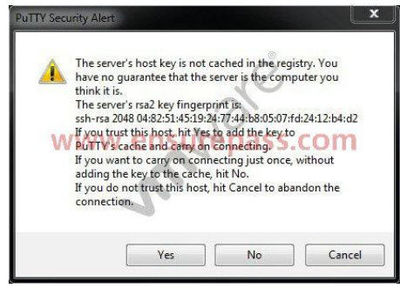
- ADirect Console User Interface
- BvSphere Client
- CvSphere Web Client
- DvSphere Management Assistant
50The vSphere administrator is configuring directory services for an ESXi host:
What should the vSphere administrator do to configure the host to use CAM services?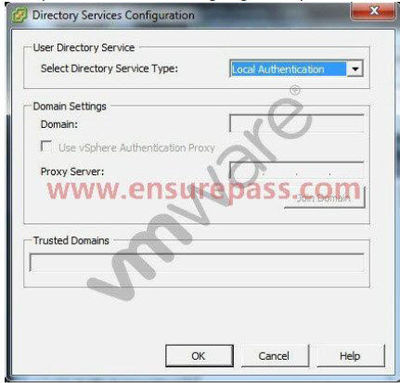
- ACheck the Use vSphere Authentication Proxy checkbox.
- BSet Select Directory Service Type to CAM services.
- CSpecify CAM$ for the Domain.
- DSet Trusted Domains to cam\name.tld where name.tld is the domain that the host is joining.
51A vSphere Standard Switch is configured with two uplinks. When adjusting the failover order of the uplinks, what are two valid states in which an administrator can place the uplinks? (Choose two.)
- AActive
- BUnused
- CPassive
- DDisabled
52An administrator determines that a vSphere Standard Switch is dropping all inbound frames to a specific virtual machine. The behavior appeared in the last two days. Which configuration setting, if changed during this timeframe, would result in this behavior?
- AMAC address changes
- BForged Transmit
- CTraffic Shaping
- DJumbo Frames
53Which two network settings are available on a vSphere Standard Switch? (Choose two.)
- AIngress traffic shaping
- BEgress traffic shaping
- CPrivate Virtual Local Area Networks (PVLAN)
- DVirtual Local Area Networks (VLAN)
54A security team is validating policy settings in a vSphere environment. By default, which security policy is set to reject on a vSphere Standard Switch?
- APromiscuous mode
- BMAC address changes
- CForged transmit
- DUse explicit failover
55A vSphere administrator upgrades a version 5.1.0 vSphere Distributed Switch to version 5.5.0. Another vSphere administrator, unaware of this change, tries to add an ESXi version 5.1.0 host to the switch and fails. What is causing this addition of the ESXi host to fail?
- AThe upgraded switch supports version 5.5 ESXi hosts only.
- BThe upgraded switch must be set up for backwards compatibility.
- CThe switch failed to upgrade properly.
- DA version 5.5 ESXi host must be added to the switch before the 5.1 host.
56A vSphere administrator creates a new vSphere Distributed Switch. The administrator receives notice from the service desk that a cluster of vSphere hosts has disconnected from vCenter Server.
This disconnect occurred immediately after the new switch was created.
This vSphere Distributed Switch is the only distributed switch managed by vCenter.
The virtual machines are still functional and the applications are still accessible by end users.
On the ESXi hosts, which step must the vSphere administrator take to allow vCenter Server to reconnect?- AUse the Direct Console User Interface to reattach the management vmnic to the appropriate switch.
- BUse the Direct Console User Interface to disable lockdown mode on each affected host.
- CUse the ESXi Shell to restart the mgmt-vmware service on each affected host.
- DUse the ESXi Shell to restart the vSphere Web Client service on each affected host.
57A vSphere administrator is administering a vSphere Distributed Switch port group using the vSphere Web Client. The port group was configured using Static binding, but the number of ports must increase as virtual machines are added to the port group. Which port allocation setting should the administrator use to achieve this goal?
- AElastic
- BDynamic
- CFixed
- DManual
58An administrator is deploying vSphere 5.5. The administrator creates a vSphere Distributed Switch, then uses Auto Deploy to deploy several ESXi hosts. After the hosts are deployed, the administrator notices that LACP packets are not being sent between them. Which condition would cause this issue to occur?
- AThe LACP support settings do not exist in the Host Profile.
- BThe LACP installation bundle is not included in the Image Profile.
- CThe LACP setting is not enabled on vCenter Server.
- DLACP has not been configured on the Auto Deploy server.
59A virtual machine is receiving a large number of network packets, which is affecting the performance of other virtual machines connected to the same virtual network. What should the vSphere administrator do to resolve the issue?
- AMigrate the virtual machine to a standard switch that has been configured for ingress traffic shaping.
- BConfigure the distributed switch to which the virtual machine is connected for ingress traffic shaping.
- CMigrate the virtual machine to a different port group on the same distributed switch.
- DEnable Network I/O Control on the standard switch to which the virtual machine is connected.
60A virtual machine is unable to communicate with another virtual machine. Both virtual machines are connected to the Production port group on the same virtual switch and are running on the same host. Which configuration is causing the inability of the virtual machines to communicate?
- ALLDP was enabled instead of CDP for the vSphere Distributed Switch.
- BPromiscuous Mode has been set to Allow on the Production port group.
- CThe Production port group is configured to use a secondary PVLAN.
- DThe speed and duplex settings for the virtual machine vmnics do not match.
61Which two statements are true regarding a new vSphere deployment that is using software FCoE boot from SAN? (Choose two.)
- AMulti-pathing options must be configured by the vmkernel after boot.
- BThe adapter must support iBFT or UEFI.
- CThe adapter must support FBFT or FBPT.
- DMulti-pathing options must be configured in the Boot ROM.
62Which feature requires an administrator to configure an RDM with Virtual Compatibility Mode?
- AvMotion
- BVirtual Machine Snapshots
- CHigh Availability
- DN-port ID Virtualization
63A virtual machine has the following configuration:
Thin provisioned virtual disks
The VMFS datastore on which it resides is on a thin provisioned LUN.
The storage array is VAAI-enabled.
What is the behavior of the virtual machine when it encounters an out-of-space condition?- AIt is suspended.
- BIt is gracefully shut down.
- CIt is powered off.
- DIt is converted to space-efficient sparse.
64What should an administrator do to configure multi-pathing using software iSCSI?
- ABind the VMkernel ports to the software iSCSI initiator.
- BConfigure Zoning between the hosts and SAN switches.
- CConfigure NIC teaming on the associated uplinks.
- DEnsure jumbo frames are enabled end-to-end.
65A vSphere administrator observes a problem with the Virtual SAN Cluster Setting as shown:
Which action should the administrator take on the vmkernel portgroup on all hosts used by Virtual SAN cluster to resolve this problem?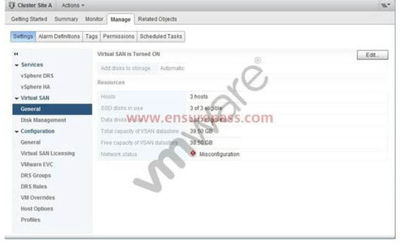
- ASelect the Virtual SAN traffic option
- BIncrease the MTU value
- CChange the DNS server address
- DIncrease the Port Speed
66Which statement is true about the hardware configuration for ESXi hosts participating in a virtual SAN?
- AThe hosts must have identical hardware.
- BEach host must have at least one Solid State Drive (SSD).
- CThe hosts must have network attached storage.
- DEach host must have a RAID Controller.
67An administrator has configured a vSphere 5.5 test environment to evaluate the Virtual SAN feature using Automatic Mode Disk Groups. The administrator needs to disable the Virtual SAN cluster while preserving the virtual machines running on that cluster. The administrator has already installed a vSphere 5.5 Client on a Windows 7 desktop and also has access to the vSphere 5.5 Web Client. What should the administrator do to disable the Virtual SAN?
- AUse Storage vMotion to migrate the virtual machines to another datastore then use the vSphere 5.5 Client to disable the Virtual SAN.
- BUse Storage vMotion to migrate the virtual machines to another datastore then use the vSphere 5.5 Web Client to disable the Virtual SAN.
- CUse the vSphere 5.5 Client to disable the Virtual SAN, which will automatically migrate the virtual machines via the Storage DRS feature.
- DUse the vSphere 5.5 Web Client to disable the Virtual SAN, which will automatically migrate the virtual machines via the Storage DRS feature.
68A vSphere administrator has created a Virtual SAN Cluster with Automatic Mode Disk Groups. The cluster includes three ESXi hosts contributing one SSD and six SAS disks each. The administrator has four new ESXi hosts that boot from a fiber channel array and have no local disks attached.
These four new hosts need additional shared storage but there is insufficient space on the fiber channel array. The hardware budget is limited. What can the administrator do to provide the needed storage for the lowest cost?- AAdd the four new hosts to the Virtual SAN Cluster and use the existing storage in the cluster.
- BAdd an SAS RAID controller to each of the new hosts. Attach one SSD and six SAS disks to each RAID controller and then add the four hosts to the Virtual SAN cluster.
- CAdd the four new hosts to the Virtual SAN Cluster and contribute the fiber channel disks to the Virtual SAN.
- DAdd the four new hosts to the Virtual SAN Cluster and change to Manual Mode Disk Groups.
69A customer needs a datastore to be seen across multiple vSphere clusters with applications inside of the virtual machines that must detect the physical characteristics of the storage device. Which type of virtual disk meets this requirement?
- AA virtual disk on a VMFS datastore.
- BA raw device mapped disk in virtual compatibility mode.
- CA raw device mapped disk in physical compatibility mode.
- DA virtual disk on an NFS datastore.
70The current block size of a datastore in VMFS3 is 4MB. An administrator needs to upgrade the datastore to VMFS5 and wants to change it to 1MB block size. Which action should the administrator take?
- AUpgrade the datastore to VMFS 5. Select the 1MB block size option during the upgrade.
- BCreate a new VMFS5 datastore with a 1MB block size. Migrate all virtual machines from the existing datastore to the new datastore, then delete the VMFS3 datastore.
- CUpgrade the datastore to VMFS5. Use vmkfstools to change the block size on the upgraded datastore
- DCreate a new VMFS5 datastore with a 1MB block size. Migrate all virtual machines from the existing datastore to the new datastore. Upgrade the virtual machine hardware on the migrated VMs, then delete the VMFS3 datastore.
71An administrator needs to use guest OS clustering in a vSphere environment that uses a Fibre Channel SAN. The clustering software does NOT have a SCSI target or a SCSI command pass-through requirement. Which VMware storage type should the administrator use?
- APhysical RDM
- BVMFS
- CVirtual RDM
- DNFS
72Which two CPU features enable the use of 64-bit virtual machines? (Choose two.)
- AIntel VT
- BNX/XD Bit
- CHyper-threading
- DAMD RVI
73An administrator is creating a new VMFS volume and needs to make it available to all hosts within a datacenter using the Web Client. What should the administrator scan for in order to meet this requirement?
- ANew Storage Devices and LUNs
- BNew Storage Devices and VMFS Volumes
- CNew VMFS Volumes and Datastores
- DNew VMFS Volumes and LUNs
74An administrator is deploying a virtual machine from a template. Assuming all of the inventory objects below exist in the implementation, what is the highest level in the vCenter Server hierarchy to which a virtual machine can be deployed?
- ADatacenter
- BCluster
- CResource Pool
- DHost
75Which statement is accurate when choosing the storage controller for a virtual machine using the Create New Virtual Machine wizard in custom mode?
- AThere is a predetermined controller based on the guest OS, which cannot be changed.
- BA controller is recommended based on the guest OS type. The administrator can choose this controller or select any other.
- CThere is a predetermined controller based on the guest OS, which can only be changed after the virtual machine is deployed.
- DThe controller options presented will be based on the guest OS type. The administrator must choose one of these options.
76A VMware administrator needs to simplify the placement of virtual machines. The administrator also needs to balance I/O load and space utilization automatically. Which combination of features should the administrator use to achieve this?
- ACreate a Datastore Cluster and enable Storage DRS on the cluster.
- BCreate a Datastore Cluster and enable Storage I/O Control on each datastore.
- CEnable Storage DRS and Storage I/O Control on each datastore.
- DEnable Storage I/O Control on each datastore and configure Storage vMotion.
77An administrator is creating a vApp for a multi-tiered application and needs to configure custom startup actions for each virtual machine. What should the administrator do to enable this functionality?
- AVerify that VMware Tools is installed on each virtual machine in the vApp.
- BEnsure all virtual machines in the vApp are running hardware version 8 or later.
- CConfigure custom startup actions on the virtual machines, then add them to the vApp.
- DDeploy a vSphere Management Assistant in the cluster and enable the vApp plug-in.
78A vSphere administrator is creating a vApp for a multi-tier application. Every time the vApp is started, the virtual machines perform a file system check. Which action should the administrator take to resolve this issue?
- AChange the shutdown action in the vApp to Guest Shutdown.
- BChange the shutdown action in the vApp to Graceful Shutdown.
- CChange the shutdown action in the vApp to Graceful Power Off.
- DChange the shutdown action in the vApp to Guest Power Off.
79An administrator needs to configure a Linux virtual machine template to support guest customization. The administrator has installed VMware Tools. Which additional component is necessary to enable Linux guest OS customization?
- APerl
- Bbash
- CPython
- DSysprep
80A VMware administrator needs to export a vApp and create a self-contained package that has a single file. Which format should the administrator use?
- AExport as OVF
- BExport as OVA
- CExport as ZIP
- DExport as ISO
81A vSphere administrator needs the ability to adjust the amount of guaranteed physical CPU and Memory resources to a virtual machine without incurring application downtime. Which actions must the administrator perform?
- AEnable CPU hotplug and Memory hotplug on the virtual machine.
- BAdjust the number of CPUs and the Memory Configuration for the virtual machine.
- CAdjust the CPU reservation slider and click the Reserve all Guest Memory checkbox.
- DAdjust the CPU and Memory reservation sliders on the virtual machine.
82A system administrator has an application installed on a physical machine that is licensed to the MAC address of the physical NIC. This system needs to be virtualized. What two methods could an administrator use to ensure the license will function in the virtual machine? (Choose two.)
- AManually set the MAC address for the vNIC in the guest OS.
- BInstall the NIC from the physical server into the ESXi host.
- CManually set the MAC address for the vNIC using the Web Client.
- DConfigure the physical server’s MAC address in the virtual switch.
83An administrator needs to prevent two virtual machines from running on the same host at any time. Which DRS rule should the administrator apply?
- Avm-to-vm affinity
- Bvm-to-host affinity
- Cvm-to-vm anti-affinity
- Dvm-to-host anti-affinity
84A vSphere administrator needs to enable Distributed Resource Scheduling (DRS) in an existing vSphere environment:
The environment contains a High Availability (HA) cluster with eight ESXi hosts.
Six ESXi hosts are not in a cluster.
DRS should be used on as many hosts as possible.
Initial placement of virtual machines should be automatically performed.
Which procedure should the administrator perform to accomplish this task?
Migration recommendations should be provided, but not performed without approval.- ASelect the datacenter and create a DRS cluster. Add the six remaining hosts to this cluster, then enable DRS. Edit the DRS settings and change the automation level to Partial.
- BSelect the existing HA cluster. Add the six remaining hosts to the cluster. Enable DRS, then edit the settings and change the automation level to Manual.
- CSelect the datacenter and create a DRS cluster. Add the six remaining hosts to this cluster, then enable DRS. Edit the DRS settings and change the automation level to Manual.
- DSelect the existing HA cluster. Add the six remaining hosts to the cluster. Enable DRS, then edit the settings and change the automation level to Partial.
85An organization’s wants to ensure that if a host in a High Availability (HA) cluster fails, critical virtual machines resume operation even if there are insufficient resources to continue to run all virtual machines in the cluster.
Which HA setting should be configured to ensure the cluster operates as expected?- AVM restart priority
- BAdmission Control policy
- CVM monitoring sensitivity
- Ddas.checkVmStateDelay
86A vSphere administrator needs to reconfigure the Distributed Power Management (DPM) threshold to be more aggressive. Where should the administrator edit the settings of DPM in the vSphere Web Client?
- ADPM plug-in settings
- BCluster settings
- CESXi host power settings
- DvCenter Service Status
87An administrator has created a Virtual Flash Read Cache and needs to add a total 2TB of capacity to the cache. The administrator has a total of six SSD disks to add, but is unable to add one of the disks. What is a likely cause of the problem?
- AThe SSD device size is less than 256GB
- BThe SSD device size is greater than 4TB.
- CThe SSD device is a local disk.
- DThe SSD device contains existing data.
88A DRS cluster has been created with the following specifications:
All mission critical virtual machines are in the root resource pool.
All other virtual machines are placed into two child pools based on medium or low priority.
The two child pools contain adequate resources needed by the medium and low priority virtual machines.
The two child pools are reserving 35% of the total available resources of the cluster.
What is the advantage of leaving the mission critical virtual machines in the root resource pool?- AThe root resource pool has immediate access to new physical resources added to the cluster.
- BVirtual machines placed in the root resource pool have a higher vMotion priority in DRS.
- CTransparent Memory Page Sharing in the root resource pool has a higher weight than in child pools.
- DVirtual machines placed in the root resource pool have higher default share values.
89A vSphere administrator needs to temporarily disable DRS on a cluster containing a resource pool hierarchy. Which procedure should the administrator follow to preserve the resource pool hierarchy while DRS is disabled?
- AMove the resource pool hierarchy out of the cluster prior to disabling DRS.
- BSave the resource pool hierarchy to the administrator’s local machine prior to disabling DRS.
- CBackup the vCenter Server database and restore the database after re-enabling DRS.
- DCreate a new cluster and move the resource pool hierarchy to the new cluster prior to disabling DRS.
90A vSphere administrator needs to migrate a virtual machine to another datastore and host without disrupting virtual machine users. Which technique should the vSphere administrator use?
- AEnhanced vMotion
- BHigh Priority vMotion
- CLow Priority vMotion
- DStorage vMotion
91A vSphere administrator needs to enable Fault Tolerance on a virtual machine. When performing a Storage vMotion migration, which setting should the vSphere administrator change in the virtual machine’s disk format to ensure it meets Fault Tolerance requirements?
- AThick Provision Eager Zeroed
- BThick Provision Lazy Zeroed
- CThin Provisioned
- DThin Provision Eager Zeroed
92The vSphere administrator needs to migrate a virtual machine from one host to another. The virtual machine .vswp file resides in local storage. Which two techniques can the administrator use to migrate the virtual machine? (Choose two.)
- AvMotion migration
- BCold migration
- CStorage vMotion migration
- DEnhanced vMotion migration
93A customer needs to size a single backup appliance for backing up 3TB of data. There is no requirement for guest level backups of SQL and Exchange. What is the minimum VMware Data Protection solution and sizing that would fulfill the stated requirements?
- AVMware Data Protection Advanced with a 4TB backup appliance.
- BVMware Data Protection with a 4TB backup appliance.
- CVMware Data Protection Advanced with a 3TB backup appliance.
- DVMware Data Protection with a 3TB backup appliance.
94An administrator needs to use vSphere Update Manager to perform orchestrated upgrades of ESXi hosts and virtual machines. The vSphere management components reside in a secure environment that does not have direct access to the Internet. How would Update Manager be configured in this environment while maintaining the organization’s security requirements?
- AInstall Update Manager Download Service on a machine with Internet access and configure an export policy to the Update Manager server.
- BInstall Update Manager Secure Gateway on a machine in the DMZ and configure an IPsec tunnel to the internal Update Manager server.
- CCreate a TFTP server as an HTTP proxy and configure an export policy to the Update Manager erver.
- DEnable gateway services on the Update Manager server and provide Internet access to the gateway address.
95Which tool should an administrator use to modify vSphere Data Protection (VDP) backup jobs?
- AvSphere Web Client
- BvSphere Client using the VDP plugin
- CVAMI on the VDP Appliance
- DvSphere Management Appliance
96An administrator needs to use vSphere Update Manager for the initial deployment of VMware Tools on a group of newly created virtual machines. When the administrator scans the objects for compliance, a compliance state of Incompatible is returned. How should the administrator resolve the issue?
- AInstall VMware Tools manually on the new virtual machines.
- BEnsure the latest version of VMware Tools has been downloaded to the Update Manager repository.
- CEnable the Upgrade VMware Tools on Power Cycle option.
- DCreate a separate baseline object for each guest OS type.
97An administrator is installing ESXi 5.x to a local SAS drive. The installation stops on a purple screen and shows the error:
The system has found a problem on your machine and cannot continue. Could not populate the filesystem: Admission check failed
Which action should the administrator take to resolve this issue?- AUpgrade the ESXi host to meet the minimum hardware requirement for installation.
- BDisable the network interface cards (NICs) to ensure that third-party drivers do not interfere with installation.
- CEnable hardware Virtualization Technology in the ESXi host BIOS.
- DDisable the Host Bus Adapters (HBA) to ensure the installation targets the local disk.
98An administrator notices that a virtual machine fails to start when right-clicking on the VM in the inventory and clicking Power -> Power On. Which log file should the administrator check first to determine why the virtual machine will not start?
- Avmkernel.log
- Bmessages
- Cvpxa.log
- Dfdm.log
99A vSphere administrator is performing maintenance on a group of ESXi 5.5 hosts when an error message displays indicating that the ramdisk is full. The two hosts reporting the problem were deployed with Auto Deploy. What should the administrator do to resolve this issue?
- ARedirect host logs to an NFS store.
- BDisable the System Logs through the host DCUI.
- CDecrease the maximum host log file size to 10240KB.
- DMove the ramdisk to an SSD drive.
100An administrator creates an ESXi cluster using vSphere Auto Deploy. The ESXi hosts are configured to get a management IP address from a DHCP server. The administrator needs to troubleshoot the management network on one of the hosts. Which DCUI option should the administrator use to renew the DHCP lease?
- ARestart Management Network
- BRestore Network Settings
- CTest Management Network
- DConfigure Management Network
101A vSphere administrator assigns VLAN 3389 to the Production port group on the VCP_DCV_Example vSphere Distributed Switch. After the change, users report a loss of connectivity to their applications. Further analysis provides the following data:
The cluster has not had a ESXi host failure.
Application functioned normally prior to the change.
Which condition would cause this loss of connectivity?
The loss of connectivity occurred immediately following the change.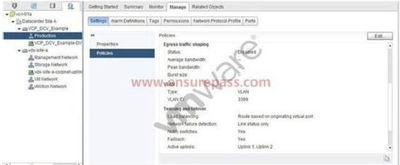
- AThe physical switch ports used by the vmnics have not been configured with 802.1Q.
- BMaintenance Mode was initiated on one of the hosts in the cluster. Connectivity will resume after the virtual machines are migrated.
- CAll uplinks were removed from the VCP_DCV_Example switch and added to another virtual switch.
- DA load balancing setting on the port group conflicts with the load balancing setting of the switch.
102Why would an administrator be unable to locate an IP address for a vSphere vmnic uplink?
- AIP addresses are defined at the virtual nic level, not the vmnic level.
- BESXi host vmnics communicate with physical switches on layer 3.
- CESXi hosts use NAT translation to mask the actual vmnic IP address.
- DThe IP address of the vmnic is not shown in the vSphere Client.
103Which database platform is embedded within the vApp architecture of vCenter Operations Manager?
- AMySQL
- BIBM DB2 Express
- COracle 11g Express
- DvPostgres
104An administrator attempts to delete a Storage Policy and receives an error. Which two object types, if assigned a Storage Policy, would prevent the Storage Policy from being deleted? (Choose two.)
- AA virtual machine.
- BA virtual disk.
- CA datastore.
- DA datastore cluster.
105An administrator has configured hardware acceleration for a Fibre Channel storage array. After a recent maintenance event, the administrator finds that cloning and migration operations are taking excessively long to complete. Which two settings could cause hardware acceleration to become disabled? (Choose two.)
- AVAAI Plugin Name = VMW_VAAIP_SYM
- BVAAI Plugin Name = VMW_VAAIP_NETAPP
- CVMFS3.HardwareAcceleratedLocking = 0
- DDatamover.HardwareAcceleratedInit = 0
106A VMFS5 datastore shows several errors, which suggests file system corruption. Which tool could a vSphere administrator use to check the VMFS file system?
- AvSphere On-disk Metadata Analyzer (VOMA)
- BVMware Infrastructure Management Assistant (VIMA)
- CvSphere Storage APIs for Storage Awareness (VASA)
- DVMware vSphere Health Check Analyzer (VHCA)
107A Windows Server 2008 virtual machine with the following configuration receives an Out of Space condition indicator:
The virtual machine uses thin provisioned virtual disks.
The VMFS5 datastore on which the virtual machine’s files reside is on a thin provisioned LUN.
30% of the VMFS datastore content is no longer needed.
The storage array supports VASA and VAAI.
Which action should the vSphere administrator take to resolve the Out of Space problem without requesting additional space on the storage array?- ADelete unneeded files on the VMFS datastore and then use vmkfstools to reclaim deleted blocks.
- BDelete unneeded files on the VMFS datastore, right-click the datastore in vSphere Web Client, and then select the Reclaim Deleted Blocks option.
- CDelete some files from the guest OS and defrag its file system.
- DDelete some files from the guest OS and use vmkfstools to reclaim the deleted blocks.
108An administrator receives the following error message: Unmanaged I/O workload detected on shared datastore. Which vSphere feature is the likely source of this error?
- ANetwork I/O control
- BStorage I/O control
- CStorage DRS
- DHA datastore heartbeats
109A vSphere administrator is configuring a fully automated DRS cluster and determines that DRS is not balancing virtual machine workloads. What condition could cause this behavior?
- AvMotion is not properly configured on the hosts in the cluster.
- BHA is not properly configured on the hosts in the cluster.
- CThe DRS threshold is configured on the most aggressive setting.
- DSome of the virtual machines have been disabled from DRS.
110An organization has a HA/DRS cluster containing a mixture of ESXi 4.1 and 5.5 hosts in the cluster. An ESXi 5.5 host has failed and HA attempted but failed to restart the virtual machines on another host. HA admission control is disabled. What condition could result in this behavior?
- AA virtual machine has an incompatible hardware version.
- BInsufficient resources exist on the remaining ESXi hosts.
- CvMotion migration is not supported between ESXi 5.5 and 4.1 hosts.
- DHA failover is not supported between ESXi 5.5 and 4.1 hosts.
111Which condition will cause a HA/DRS cluster to display a yellow health indicator?
- AThere are insufficient resources to satisfy the cluster’s requirements.
- BA virtual machine has failed and cannot be restarted in the cluster.
- CVirtual machine I/O activity in the cluster has reached or exceeded a critical level.
- DOne or more hosts in the cluster has entered maintenance mode.
112A vSphere administrator finds a HA/DRS cluster status has turned RED indicating a degraded state. What is the likely reason for the indication?
- AThe cluster enabled for HA has lost resources and is unable to fulfill its failover requirements.
- BThe cluster does not have enough resources to satisfy the reservations of all resource pools and virtual machines.
- CIncompatible CPU generations between hosts are preventing DRS migrations.
- DThe cluster is currently electing a Master host and is unavailable to perform HA functions.
113What is indicated by the performance chart shown?
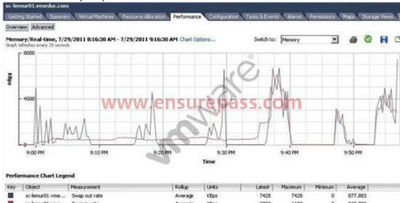
- AGuest memory is overcommitted.
- BHost memory is overcommitted.
- CHost is I/O constrained.
- DGuest is I/O constrained.
114An administrator needs to use performance information from Windows virtual machines to better understand their effect on the vSphere 5.x hosts on which they run. What must the administrator do to collect this information?
- AInstall VMware Tools with the PERFMON counters enabled in the Advanced option of the installer.
- BInstall VMware Tools. Add counters in the PERFMON utility.
- CInstall VMware Tools. Edit the VMware Tools settings to enable the VM-specific counters.
- DInstall VMware Tools. Install the PERFMON plug-in for VMware Tools.
115A vSphere administrator receives a request to capture the state of a virtual machine six times a day. Which procedure will satisfy the requirement with the least amount of administrator intervention?
- AUse the vSphere web client to configure a scheduled task to take a snapshot every four hours.
- BUse the vSphere web client to configure a scheduled workflow to take a snapshot every four hours.
- CUse the vSphere web client to manually initiate a snapshot of the virtual machine every four hours.
- DUse the vSphere web client to schedule an automated snapshot every four hours using Snapshot Manager.
116What action should an administrator take to store ESXi 5.x host system logs centrally?
- AConfigure vCenter Server to automatically export log files to a syslog server at regular intervals.
- BConfigure vCenter Server to send all log information to a syslog server.
- CConfigure each ESXi host to send all log information to a syslog server.
- DConfigure the syslog server to import log files from each ESXi host at regular intervals.
117An administrator needs to configure an alarm that notifies administrators if an application is impacted by overcommitment of memory resources. The environment consists of 100 virtual machines running on 5 ESXi hosts that are configured in a fully automated HA/DRS cluster. The cluster is configured with a parent resource pool and Production and Development child pools. Where should the administrator set the alarm to meet the requirement?
- AOn each virtual machine
- BOn each host
- COn the Production resource pool
- DOn the cluster
118An administrator using vCenter Operations Manager notices an increase in resource consumption by virtual machines over a period of time. The administrator needs to understand how adding more hosts or increasing resources in existing hosts will address the growing resource requirements of the virtual machines. Which vCenter Operations Manager feature can provide this information?
- AHost or Cluster Capacity Optimization Report
- BWhat-if Scenarios
- CDensity and Reclaimable Waste badges
- DVirtual Machine Optimization Report
119An administrator needs to know the estimated time remaining on a virtual machine that is hosting a critical accounting application given current assigned resources such as memory, CPU, and disk. When an administrator selects the virtual machine in the vCenter Operations Manager console, which major badge should the administrator investigate to determine this information?
- ARisk
- BHealth
- CEfficiency
- DTime Remaining
120The virtual machine Fileserver01 shown in the exhibit can not ping anything on the Internet. Why is Fileserver01 unable to connect to the Internet?
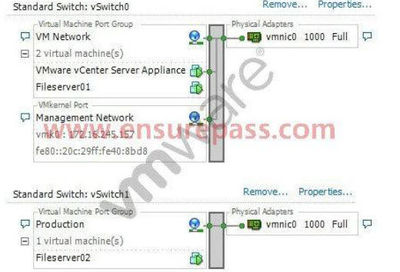
- AFileserver01 does not have a reachable IP address.
- BFileserver01 is not on the Production network.
- CThe virtual nic for Fileserver01 has a speed or duplex mismatch.
- DThe vSwitch1 virtual switch does not have an attached vmnic adapter.
121An application server has been added to an existing multi-tier application contained in a vApp. Shortly after a planned maintenance event, users are unable to access the application. What does the vSphere administrator need to change to ensure the application can be accessed?
- AThe startup order of the vApp.
- BThe shutdown option to power off the virtual machines.
- CThe IP Allocation policy to DHCP.
- DThe Memory Shares to High.
122A vSphere administrator needs to upgrade a single extent VMFS3 datastore to VMFS5 and expand it to 4TB in size. The storage administrator has already expanded the underlying LUN to 4TB. Which steps should the vSphere administrator take?
- AExpand the VMFS3 datastore to 4TB and then upgrade to VMFS5.
- BUpgrade the datastore to VMFS5, manually change the partition scheme to GPT, and then expand the datastore to 4TB.
- CUpgrade the datastore to VMFS5 and then expand it to 4TB.
- DChange the block size of the VMFS3 datastore to 1MB, upgrade the datastore to VMFS5, and expand it to 4TB.
123To comply with security requirements, an administrator with a vCenter Server Appliance needs to force logoff of the vSphere web client after 10 minutes of inactivity. What should the administrator do to meet the requirement?
- AEdit: /var/lib/vmware/vsphere-client/webclient.properties, modify session.timeout=10
- BEdit: /opt/vmware/vsphere-client/webclient.properties, modify session.timeout=600
- CEdit: /var/lib/vmware/vsphere-client/webclient.properties modify session.timeout=600
- DEdit: /opt/vmware/vsphere-client/webclient.properties, modify session.timeout=10
124What are two features provided by VMFS5? (Choose two.)
- ASupport for greater than 2TB storage devices for only VMFS and Physical RDMs.
- BSupport for up to 32 extents.
- CSupport for greater than 2TB storage devices for VMFS, Physical and Virtual RDMs.
- DSupport for up to 64 extents.
125During the installation of ESXi, a vmkernel interface can be configured with what capabilities?
- AManagement traffic.
- BManagement traffic and vMotion.
- CManagement traffic, vMotion and Fault Tolerance logging.
- DManagement traffic, vMotion, Fault Tolerance logging and IP storage.
126As part of a multisite Single Sign-On (SSO) deployment what two steps are required to ensure that a change to one Single Sign-On instance is propagated to the other instances? (Choose two.)
- ASchedule a Replication Task on the primary instance.
- BSelect the first instance during the installation of subsequent instances.
- CDuring the installation of each instance choose Linked-Mode.
- DEnable Synchronize to Active Directory on each instance.
127A network auditing team has observed activity from a virtual machine that may be an organization policy security breach. The vSphere administrator needs to stop network traffic from the virtual machine. Which step should the administrator take?
- AEnable Port Blocking on the vSphere Standard Switches in the organization and block the port on which the virtual machine is connected.
- BEnable Port Blocking on each vSphere Standard Switch portgroup in the organization, then block the port on which the virtual machine is connected.
- CEnable Port Blocking on each vSphere Distributed Switch portgroup in the organization, then block the port on which the virtual machine is connected.
- DEnable Port Blocking on the vSphere Distributed Switches in the organization and block the port on which the virtual machine is connected.
128A server administrator reports that a virtual machine has displayed the following message twice in the past 12 months:
No boot device found
Which virtual machine boot option should the administrator configure to resolve this issue?- AFailed Boot Recovery
- BForce BIOS Setup
- CBoot Delay
- DNetwork Boot Retry
129An administrator is using vSphere Replication to replicate a number of virtual machines to a recovery site. The administrator plans on enabling Storage DRS on the production site, which is running vSphere 5.5. What changes must be made in order to support this configuration?
- AStorage DRS can be added to the existing configuration without any configuration changes.
- BDisable Storage DRS on the virtual machines utilizing vSphere Replication.
- CChange the Recovery Point Objective for the replicated virtual machines to support the additional synchronization time.
- DStorage DRS cannot be used in conjunction with vSphere Replication.
130Which condition would prevent an administrator from unmounting a VMFS datastore?
- AThe datastore is being managed by Storage DRS.
- BThe datastore contains vCenter Server templates.
- CThe datastore is mounted by multiple hosts.
- DThe storage backing the datastore is detached.
131A system administrator needs to control the allocation of memory and CPU resources to an organization’s Finance team. The vSphere environment is built on a single cluster of ESXi hosts. Which feature can be used to accomplish this task?
- AResource Pool Reservations
- BDRS set to Fully Automated
- CVirtual Machine Shares
- DDRS Virtual Machine Groups
132An administrator is planning a new vSphere deployment using shared storage. The solution must support:
vMotion
Storage vMotion
Fault Tolerant virtual machines
VAAI primitives
RDM disks
Which storage type will meet these requirements?- ACIFS
- BiSCSI
- CNFS
- DvSAN
133Which statement is true regarding the licensing of vCenter Server?
- AThe license for vCenter Server must be provided at the time of installation.
- BChanging the license assigned to vCenter Server requires a restart of the vCenter Server service.
- CVirtual machines can still be powered on if the vCenter Server license expires.
- DLicensing for a single vCenter Server installation is determined by the number of managed virtual machines.
134Which information can the administrator use to identify iSCSI nodes?
- AMAC address
- BIQN
- CWWN
- DLUN ID
135A vSphere administrator notices that hosts are not powering off when the total cluster load is low on a cluster configured with Dynamic Power Management. What condition could cause this behavior?
- AThe DRS migration threshold is set to the most conservative setting.
- BThe DRS migration threshold is set to the most aggressive setting.
- CThe DPM migration threshold is set to the most conservative setting
- DThe DPM migration threshold is set to the most aggressive setting.
136A vSphere administrator installs an ESXi host and creates a virtual machine, then installs vCenter Server. Upon connecting to the environment, the administrator notices that several inventory views appear to be missing from the Navigation Bar as shown in the Exhibit. Which condition would result in this behavior?

- AThe vSphere administrator is logged directly into the ESXi host.
- BThe vSphere administrator is logged directly into the vCenter Server.
- CThe vSphere administrator has limited permissions on the ESXi host.
- DThe vSphere administrator has limited permissions on the vCenter Server.
137Which action should an administrator take to increase the size of a VMFS5 datastore from 2TB to 32TB?
- ADynamically expand the original LUN and add a second share for the NFS datastore.
- BDynamically expand the original LUN and increase the size of the VMFS datastore.
- CDynamically expand the original LUN and add extents to the VMFS datastore.
- DDynamically expand the original LUN and add extents to the NFS datastore.
138A user has submitted a trouble ticket complaining that the email server VM has become very sluggish. After looking at the logs, the vSphere administrator suspects the iSCSI network is experiencing congestion. What esxtop statistic should the administrator examine in order to validate that the guest OS is experiencing performance degradation?
- AGAVG/wr
- B%ACTV
- CPATH
- DPKTRXMUL/s
139An administrator needs to configure vFlash Read Cache to improve performance. What would benefit the most from enabling vFlash Read Cache?
- AVirtual machines replicated with vSphere Replication
- BWeb Server virtual machines
- CDatabase virtual machines
- DVirtual machines migrated using Storage vMotion
140Why would a vSphere administrator configure resource shares for a virtual machine?
- ATo prioritize access to a resource during contention.
- BTo guarantee access to a resource during contention.
- CTo prioritize access to a resource at all times.
- DTo guarantee access to a resource at all times.
141A vSphere administrator manages a three host cluster with 20 VMs. The HA cluster is configured with the Host Failures the Cluster Tolerates admission control policy and all other settings are set to default values. The administrator determines that one of the VMs is not able to power on.
After further inspection, it is determined that this VM cannot power on because of a very large CPU reservation. Which cluster advanced HA setting can the administrator modify to enable the virtual machine to power on?- ALower das.vmcpumaxmhz attribute value.
- BHigher das.vmcpuminmhz attribute value.
- CLower das.slotcpuoutmhz attribute value.
- DHigher das.slotcpuinmhz attribute value.
142What two requirements must be met to create a fully automated Distributed Resource Scheduler (DRS) cluster? (Choose two.)
- AShared storage
- BHosts with identical processor features
- CStorage vMotion
- DvMotion
143A vSphere administrator has been using vSphere in evaluation mode and now wants to deploy an environment that provides the same features. Which edition of vSphere provides similar functionality to evaluation mode?
- AEnterprise Plus
- BEnterprise
- CStandard
- DEssentials
144An application administrator reports application slowness when loading the application’s web portal. The virtual machine is currently connected to a vSphere Distributed Switch. The application owner requests information about the virtual machine’s network traffic. Which feature of a vSphere Distributed Switch should the administrator use to gather the needed information?
- ANetFlow
- BPort Mirroring
- CNetwork I/O Control
- DPromiscuous Mode
145An administrator is planning a vSphere Fault Tolerance implementation for 6 virtual machines. Which two virtual disk types are supported with FT? (Choose two.)
- ARaw Device Mapped LUN configured for Virtual Compatibility Mode.
- BRaw Device Mapped LUN configured for Physical Compatibility Mode.
- CVirtual disk thick provisioned, eager zeroed.
- DVirtual disk thick provisioned, lazy zeroed.
146A vSphere administrator created a Virtual SAN and a relevant virtual machine Storage Policy. The administrator is unable to select this virtual machine Storage Policy when creating a new virtual machine. Based on the exhibit, why is the administrator unable to select this virtual machine Storage Policy?
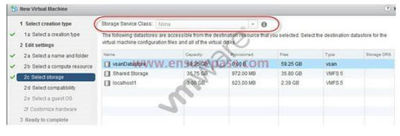
- AThe administrator did not enable the virtual machine Storage Policy per compute resource.
- BThe ESXi Host license does not support virtual machine Storage Policies.
- CThe vCenter Server license does not support virtual machine Storage Policies.
- DThe administrator did not create a storage policy for the datastore selected for the virtual machine.
Información
- Descripción
- Test sobre Sin título, creado por Aledd Gonzales el 29/04/2015.
- Autor
- Aledd Gonzales
- Idioma
- Español
- Visitas
- 18
- Etiquetas
- Valoración
- 2,0 de 5 · 1 valoración Valora este test