
Test
Sin título
Este test tiene tipos de pregunta que se abren en el reproductor de siempre.
Preguntas del test (156)
1A 62 y.o. M has been found unconscious and pulseless outdoors at Cradle Mountain. You commence the Cardiac Arrest algorithm, and upon obtaining a temperature find his temperature to be 29.7C. How would you adjust your management?
- ANo adjustment is required, follow standard cardiac arrest guidelines
- BDouble dosage intervals and relevant cardiac arrest guideline and do not rewarm beyond 33C if ROSC
- CDouble dosage intervals and relevant cardiac arrest guideline and rewarm to 35C if ROSC
- DContinue CPR and rewarm until temp is greater than 30C, provide only 1 defibrillation shock, one dose of adrenaline and one dose of amiodarone
2A 35 y.o. F is in unconscious and pulseless when you arrive on scene. When you apply the pads, you note the patient has pulseless electrical activity (PEA). What are the potential causes of PEA you can treat as outlined in the AT Adult Cardiac Arrest CPG (select all that apply)?
- AExsanguination
- BAsthma
- CAnaphylaxis
- DUpper airway management
- EHypoxia
- FTension pneumothorax
3You have been working on a 52 y.o. M in cardiac arrest and the patient responds with a return of spontaneous circulation (ROSC). Using the Cardiac Arrest and ROSC checklist, which of the following would you aim for (select all that apply):
- ATarget BP <100mmHg
- BActivating the appropriate clinical pathway e.g. CODE STEMI
- CMaintain ventilation 12-20/min - avoiding hypoventilation
- DConsider SGA or ETT (ICP)
4You and your crew mate are called to a 5 y.o. F, unconscious and pulseless. On applying the pads, you discover the pt is in VF. Please select which of the following would be the appropriate course of action to take:
- AImmediately commence CPR 30:2, defibrillate at 72J (rounding up to the nearest 10)
- BImmediately commence CPR 15:2, defibrillate at 100j
- CImmediately commence CPR 15:1, defibrillate at 100j
- DImmediately commence CPR 15:2, defibrillate at 72J (rounding up to the nearest 10)
5With a paramedic scope of practice, you are authorised to provide adrenaline 10mcg/kg IV to at 4 minute intervals in a paediatric unconscious/pulseless VF/VT:
- AVerdadero
- BFalso
6Using a paediatric adapter with an Automated External Defibrillator is suitable for use in children 1 – 5 years of age. Children over 5 years may be treated with adult preset energy levels.
- AVerdadero
- BFalso
7Which of the following are true in relation to a Traumatic Cardiac Arrest? (Select all that apply)
- ADamage control resuscitation including the use of the HOTT management principles have led to improved survival rates.
- BThe initial cardiac rhythm for most patients is pulseless electrical activity (PEA).
- CPEA is often a very low output state, rather than no output at all, as experienced in a medical cardiac arrest.
- DAttempted resuscitation is futile.
8In Traumatic Cardiac Arrest management the HOTT management principles refer to which of the following:
- AHypoxia, Oxygenation, TXA, Transport
- BHelp, Overwhelmed, Totally Perplexed & Can't be Treated
- CHypovolaemia, Oxygenation, Tension Pneumothorax & Cardiac Tamponade
- DHaemorrhage, Origin of injury, Time & Topical
9When managing a Traumatic Cardiac Arrest which of the following is incorrect?
- AThe use of intravenous adrenaline will improve perfusion in the hypovolaemic state
- BPerforming chest compressions should only be commenced after HOTT principles of management have been addressed.
- CDiastolic pressure during chest compressions decreases in a hypovolaemic patient
- DRapid management of external haemorrhage, application of a TPOD, aligning/splinting fractured limbs and needle decompression aim to reduce hypovolaemia.
10What complications may arise from the use of Combat Arterial Tourniquet? Select all that apply.
- AEmbolism
- BIschaemia
- CCompartment syndrome
- DReperfusion injury when released
- EAnalgesia
- FPermanent neurological or muscular damage if used for longer than 2hrs
11Which of the following is a contraindication for use in application of a traction splint CT-7?
- ACompound fractures
- BKnee, ankle or foot trauma
- CMid-shaft femur compound fractures
- DPelvic trauma
12Regarding the T-pod pelvic binder, which of the following is true:
- AThe T-pod cannot be made longer by affixing this to another T-Pod.
- BAll clothing should be removed prior to applying the T-Pod.
- CThe T-Pod can be applied to small children.
- DThe top of edge of the T-Pod should be aligned at the level of the iliac crest.
13What is the correct way to perform a chest thrust?
- APlace your arms around the patient from behind, clasping your hands across their abdomen and pulling sharply towards you.
- BBy performing the Heimlich manoeuvre
- CGive a sharp thrust with the heel of one hand in the same position you would if you were going to perform CPR on the patient’s chest.
- DNone of the above
14When should you not insert an iGel?
- ASuspected epiglottis or upper airway obstruction
- BStrong jaw tone/trismus
- CIntact gag reflex or resistance to insertion
- DSignificant volume of vomit in the airway
15You attend a 7 y.o. M that weighs 22kg that requires the insertion of an iGel. What would be the most likely iGel size for this patient?
- ASize 2
- BSize 3
- CSize 1.5
- DSize 2.5
16Which of the following is true regarding laryngoscopy?
- AIt is recommended that a Miller Size 1 blade be used for small children.
- BThe action in laryngoscopy is to lever the tongue / mandible.
- CThe Miller blade is straight and its design allows the epiglottis to be lifted directly.
- DAmbulance Tasmania uses the Macintosh and Miller disposable blades attached to a laryngoscope.
17You attend a 40 y.o. M who has fallen from a height of 3m from a roof. You note that he is groaning and on pain stimulus is not opening his eyes and that he has decerebrate posturing. What is the GCS of this patient?
- AE1, V1, M2 = GCS 4
- BE1, V2, M1 = GCS 4
- CE1, V4, M2 = GCS 7
- DE1, V2, M2 = GCS 5
18You attend a 3 y.o. F who has fallen from a 2m height in a skatepark onto concrete. You attempt to gather a GCS and find the patient is eye opening to pain, persistently irritable and withdraws from pain. What is the GCS of the patient?
- AE2, V2, V5 = GCS 9
- BE2, V3, V4 = GCS 9
- CE1, V4, V5 = GCS 10
- DE2, V3, V5 = GCS 10
19You attend a normally fit 35 y.o. F complaining of shortness of breath. She has a history of asthma. When you arrive, you find her seated on the couch where she has been sitting for the last 30 minutes. You perform your basic assessment and find the patient has a resp rate of 24 with a prolonged expiratory phase, has an occasional cough with inspiratory & expiratory wheeze, room air oxygen saturations of 95%, and is speaking in short phrases only. How would you categorise this patient’s respiratory status initially?
- AMild
- BNormal
- CSevere (life-threatening)
- DModerate
20You attend a side impact car collision with your partner in an 80km/hr zone. There are 4 patients on scene, 2 adults and 1 child are walking and there is 1 child who is sitting on the ground, crying. You are informed they are 4 years old, were not in a car seat but was wearing a seatbelt in the back RHS passenger seat, and was extricated by an adult on scene prior to your arrival. You go straight to the child and find the following: cold and clammy, RR 40, BP 60mmHg, pulse 150, GCS 14 (E4, V4, M6). They are holding their right side and you find significant bruising to their R) flank. This patient is:
- AEmergent TC
- BActual TC
- CPotential TC
- DNot time critical
21You arrive at a supported accommodation facility to find an 82kg 28-year-old known epileptic, intellectually impaired man exhibiting continual clonic seizure activity (generalised motor). Your goal of management, after protecting the patient from immediate harm, is terminating the seizure activity with midazolam. The presentation of midazolam is 5mg in 1mL, and the dose is 0.1mg per kg.
What is true of midazolam use in this setting?
Dose = [blank_start].[blank_end]
Volume = [blank_start].[blank_end]- A8.2mg
- B1.64mL
22You assess a 48-year-old male's vital signs. Using the information below, choose the vital sign numbers you will record on your ePCR.
PR (13 beats in 15 sec) = [blank_start].[blank_end]
RR (7 in 10 sec) = [blank_start].[blank_end]- A52
- B42
23You attend a motorcyclist who has come off of her motorbike at high speed and you have noted injury to her head. She is resistive to your interventions by removing the SpO2 probe and ECG leads, and not complying with instructions. She is not talking and is often staring around the scene.
What is her GCS breakdown?
Eyes = [blank_start].[blank_end]
Verbal = [blank_start].[blank_end]
Motor = [blank_start].[blank_end]
GCS = [blank_start].[blank_end]- A4
- B1
- C5
- D10
24A 1-year-old child has experienced severe scald burns to anterior chest and abdomen. Using the Lund and Browder burn surface area chart you have estimated the total burn surface area % as 13%, with 10% partial thickness burns, the rest being superficial burn. Please answer the following questions related to this clinical situation.
Weight = [blank_start].[blank_end]
Volume of normal saline in first 8 hours = [blank_start].[blank_end]
If the burn was 6 hours ago what infusion rate would you administer the fluid = [blank_start].[blank_end]
At what drip rate would you set the infusion to run via a giving set with a drip factor of 20 drops per mL = [blank_start].[blank_end]- A10kg
- B200mL
- C1.67mL/min
- D5.6 drops in 10 seconds
25You are attending a 6-year-old boy who has accidentally overdosed on his mother's oxycodone. He has a respiratory rate of 6 per minute, is poorly rousable and has pin-point pupils. You decide to administer naloxone to reverse the effects of the opioid.
The patient weight calculation is 2 x age + 8.
Naloxone is presented as 0.4mg in 1mL, and the dose is 10mcg per kg IMI.
What is true of this case?
Weight = [blank_start].[blank_end]
Dose = [blank_start].[blank_end]
Volume = [blank_start].[blank_end]- A20kg
- B200microg
- C0.5mL
26You are attending a 2-year-old child who has been generalised, motor seizing for at least 15 minutes prior to your arrival. What are your calculations with regard to this patient?
Weight = [blank_start].[blank_end]
Dose of midazolam = [blank_start].[blank_end]
Volume = [blank_start].[blank_end]- A12kg
- B1.8mg
- C0.36mL
27You are attending a 74-year-old woman who has fallen onto a brass crane garden ornament on her verandah and has a penetrating abdominal injury. She weighs about 90kg.
You are considering fentanyl IVI or IO for analgesia given the potential for hypovolaemia.
Fentanyl is presented as 100mcg in 2mL, and the dose is 0.5mcg per kg.
What is true for this patient with regard to that?
Dose = [blank_start].[blank_end]
Volume = [blank_start].[blank_end]- A45microg
- BIf diluted to 10ml - 4.5mL
28A patient is to be administered 500mcg of undiluted Adrenaline IMI. The presentation is 1mg in 1mL.
What volume would be given to the patient?- A0.5mL
- B1mL
- C0.05mL
- D0.1mL
- E0.25mL
- F2.5mL
- G5mL
- H10mL
29A 7-year-old is short of breath with suspected asthma. They are catatonic and not moving adequate tidal volume. You are considering IM adrenaline. What is the undiluted volume of adrenaline required for this patient to be administered IMI?
- A220 microg
- B0.22mL
- C0.22mg
- D2.2mL
- E2.2mg
30You are considering dexamethasone IVI for a very unwell (life-threatened) 10-year-old asthmatic child. Using the AT Paediatric Weight formula, what undiluted volume could you administer?
- A0.198mL
- B19.8mg
- C2.475mL
- D4.95mL
- E2mL
- F2.475mg
31A 9-year-old child has a fractured radius and ulna on a football ground. You are considering morphine IMI as analgesia. Up to how much volume of undiluted morphine could you administer to this child?
- A3mg (rounded from 2.97mg)
- B2.6mL
- C2.6mg
- D0.26mL
- E0.3mL (rounded from 0.297mL)
- F3mL (rounded from 2.97mL)
32A 5-year-old girl has fallen from a trailbike and sustained numerous fractures and bleeding wounds from extremities. After initial management of the fractures and successful haemorrhage control, the patient is still inadequately perfused. How much 0.9% saline solution would you administer?
- A360mL
- BEqual to or less than 360mL
- C400mL
- DUp to 400mL
- E180mL
- FUp to 180mL
- GTitrated to ETAT criteria up to 180mL
- H250mL aliquots titrated to ETAT criteria
33You are attending a 2-year-old child in cardiac arrest. If the weight calculation is 2 x age +8, to what energy will you charge this defibrillator (rounding up)?
Note that ANZCOR advise 4 joules/kg for paediatric defibrillation energy.- A30J
- B28J
- C15J
- D20J
- E14J
- F50J
- G200J
- H7J
- I10J
- J70J
34You are attending a 4-year-old with several days' history of infection, and who now is complaining of a painful neck and has petechial spots on their legs. What dose of ceftriaxone should you administer?
- A200mg
- B2g
- C4mL
- D800mg
- E8mg
- F400mg
35Which of the following is not true of ACS:
- AA goal of management in ACS is to achieve pain control if safe to do so
- BCurrent evidence suggests transport to a PCI-enabled facility improves Pt outcomes in STEMI transport time < 90 mins
- CThe absence of ischaemic signs on the ECG does not exclude AMI.
- DSuspected ACS related pain that has spontaneously resolved can be safely left at home as long as there is a referral to see their GP in the next few days
- EAcute Coronary Syndrome (ACS) is a spectrum of illnesses including Unstable Angina, Non-ST Elevation Myocardial Infarction (NSTEMI) and ST-Elevation Myocardial Infarction (STEMI)
- FNot all Pts with ACS will present with pain, e.g. diabetic Pts, atypical presentations, elderly Pts
- GThe IM route of administration is relatively contraindicated in ACS if Pt is eligible for thrombolysis
36What does the following 12-lead indicate? The patient is male, 85 years old, BP of 82/52 and complaining of chest pain.
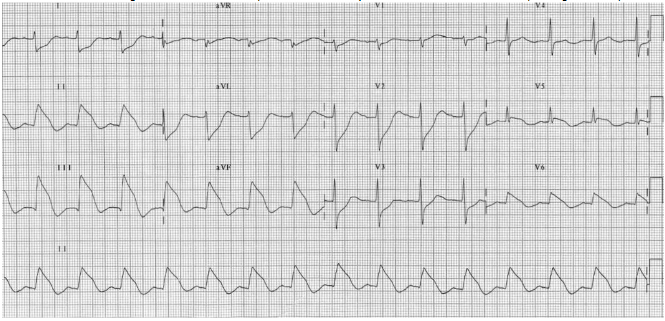
- AIsolated inferior STEMI with “tombstone” morphology
- BSinus rhythm with RBBB
- CExtensive infero-postero-lateral STEMI with “tombstone” morphology
- DVentricular Tachycardia
37You are called to a 70 y.o. M who is sitting on a stool at the kitchen counter, pale and sweaty, BP of 80/50, bradycardic at 40 with a first degree block, inferior STEMI pattern with reciprocal depression in aVL, as well as ST elevation in V4R. He says he feels a bit light-headed and that this has come on all of a sudden. With a paramedic scope of practice, you should:
- AAssist the patient to the floor, request ICP back up, apply pads, perform a full assessment, and obtain IV access
- BAssist the patient to his chair, apply pads and commence pacing, request ICP backup, perform a full assessment and obtain IV access
- CPut pads on, call for ICP back up and provide 400mcg GTN sublingual
- DPerch the patient on a kitchen stool and supply 300mcg adrenaline to the deltoid
38You are called to a 65 y.o. F with ACS symptoms. You look at her ECG and attempt to recall the 12-lead criteria that indicates activation of CODE STEMI. Of the following, which would you activate CODE STEMI for in this patient? (Select all that apply).
- A>1.5mm ST elevation in V2-V3
- B>1mm ST elevation in II, III + aVF with reciprocal depression in aVL
- C<0.5mm ST elevation in V7-V9 (posterior)
- D>1mm ST elevation in V2-V3
39Your patient is having a raging inferior STEMI and you are about to activate CODE STEMI. How do you do this and what information do you need to pass along?
- ASend a carrier pigeon to say you are heading to the hospital with lights and sirens
- BProvide the patients name, DOB and address via radio to Comms to pass along to the cath lab
- CPhone your Operations Supervisor and ask them to prenotify the cath lab for you
- DSend an email to stemi@ambulance.tas.gov.au with:
Subject line: case #
Email contents: Name, DOB, and patient’s address, as well as a single ECG photo attached
40An AT clinician authorised to provide thrombolysis has arrived on scene to give this treatment to your patient. What medications may you see administered to this patient?
Select all that apply.- AEnoxaparin
- BHeparin
- CTranexemic acid (TXA)
- DClopidogrel
- ETenecteplase
41FALLS - Part A:
It is 10pm and you and your crew mate are paged to a 75 y.o. M who has fallen in his home and his wife has called for lift assistance from the ambulance. On arrival, you find the patient is now sitting in his chair, saying he tripped over the cat, landing on his back and hitting his head on the carpet. He denies any LOC, and while he initially had trouble getting up has been able to stand with assistance by his neighbour who came over to help. You decide to run through the falls risk assessment tool and find that:
He does not have a history of fall in the previous 12 months
He takes more than 4 prescribed medications per day
He does not have a diagnosis of stroke or parkinson disease
He does not report any problems with his balance
He needs to use his arms to stand from a chair of knee height.
According to the FRAT scoring, is the patient a low or high falls risk?- ALow falls risk
- BHigh falls risk
42FALLS - Part B:
It is 10pm and you and your crew mate are paged to a 75 y.o. M who has fallen in his home and his wife has called for lift assistance from the ambulance. On arrival, you find the patient is now sitting in his chair, saying he tripped over the cat, landing on his back and hitting his head on the carpet. He denies any LOC, and while he initially had trouble getting up has been able to stand with assistance by his neighbour who came over to help. You decide to run through the falls risk assessment tool and find that:
He does not have a history of fall in the previous 12 months
He takes more than 4 prescribed medications per day
He does not have a diagnosis of stroke or parkinson disease
He does not report any problems with his balance
He needs to use his arms to stand from a chair of knee height.
When you perform a standard assessment on the patient and ask questions of the wife, you find the following:
The patient fell at 8pm and was on the floor until 9:30pm when the neighbour came over to help the patient up.
The patient has a pacemaker.
The patient is currently prescribed aspirin, atorvastatin, esomeprazole, perindopril and coumadin.
The patient has a mild headache but states he otherwise feels fine.
In reference to both the Patient Not Transported Procedure and CWI 216 Falls Risk Assessment Tool, can this patient be left at home?- AYes, this patient can be left at home
- BNo, this patient should be advised to attend hospital for further assessment
43Which of the following is true regarding physical abdominal assessment (select all that apply):
- ACullen’s sign: presents as superficial oedema with bruising in the subcutaneous fatty tissue around the peri-umbilical region
- BRovsing’s sign: presents as right lower abdominal pain upon palpation of the left side of the lower abdomen, suggesting right sided peritoneal irritation
- CIn the instance of ectopic pregnancy, an abdominal assessment may present with rigidity, involuntary guarding and severe tenderness
- DThere are 4 steps to abdominal assessment: inspection, auscultation, percussion and palpation
44Which of the following is true regarding AT’s pain management (select all that apply):
- AOpioids are recommended for those suffering with migraines
- BParacetamol should not be used to treat chest pain in suspected acute coronary syndrome.
- CMorphine IM and fentanyl IM is preferable over IV to reduce the instance of infection.
- DOral paracetamol for children has a presentation of 120mg in 5mL. Based on this, the dose of oral paracetamol for a 4 year old would be 240mg (10mL volume), undiluted
45Which of the following is true regarding the management of nausea and vomiting:
- AParamedics can provide Ondansetron 0.1mg/kg IV or IM to a max of 4mg in severe nausea and vomiting in a 3 year old.
- BProchlorperazine must not be given IM.
- CIn an adult, the max dose of ondansetron is 16mg.
- DMetoclopramide is not be given to patients <16 years.
46If mild-moderate trauma, splinting should be considered part of essential Ambulance management and should not be compromised in order to decrease time at scene. If the patient is in traumatic "cardiac arrest" or has experienced major trauma, limbs should be re-aligned and anatomically splinted only, with consideration for pelvic splinting and spinal motion restriction, before transport.
- AVerdadero
- BFalso
47You are called to a 35 y.o. M patient with a known history of epilepsy, normally compliant with his medication regime. His partner states he has missed a couple of medications recently as he has had gastro for the last 2/7. On your arrival the patient has been seizing for >5 minutes. You estimate the patient weighs 70kg. What dose of midazolam would you provide, in what volume, and via what route?
- A7mg - 1.4mL - IV
- B14mg - 0.7mL - IM
- C7mg - 1.4mL - IM
- D14mg - 7mL - IV
48You are called to a 2 y.o. F patient with clonic seizure activity, eyes are deviated upwards and she is unresponsive. She has been generally unwell for the last week, and has been sent home multiple times from the GP and hospital with nil diagnosis. Alongside your partner, you reposition the patient laterally and apply oxygen. You determine that you need to terminate the seizure activity and that you need to draw up midazolam. What dose of midazolam would you provide, in what volume, and via what route?
- A1.8mg - 0.36mL - IV
- B1.8mg - 1.6mL - IM
- C1.8mg - 0.36mL - IM
- D18mg - 3.6mL - IM
49You are called to a 6 y.o. M, unconscious, pinpoint pupils, respiratory rate of 10 and blood pressure of 70/40. The grandmother on scene states she last saw him 30 minutes ago and he was fine. On exposing the patient, you find a fentanyl patch on his abdomen; the grandmother states she had replaced her patch an hour ago and had placed it in the bin. You suspect the patient is experiencing an opioid overdose and decide to give naloxone while your partner provides assisted ventilations. What initial dose of naloxone would you provide, in what volume, and via what route?
- A200microg - 0.5mL - IM
- B300mg - 0.5mL - IV
- C200microg - 0.5mL - IV
- D20microg - 0.05mL - IM
50It’s 11pm on a Saturday night and you are co dispatched alongside police to Salamanca square for an 18 y.o. M (weight approx. 60kg), generally unwell. Arriving on scene, you find the patient agitated, flushed to the face, and pointing at a blank wall asking you and your partner to “tell the octopus I don't want to go to sea, it can take Ben instead, he loves boats”. Slightly perplexed, you look towards the friend who identifies himself as Ben, who confirms he does indeed love boats, but is a bit worried about his mate. Ben states the patient took “a couple of eccies” about 50 minutes ago, has been shouting nonsensically, been pointing at things that aren’t there for the last 30 minutes and has vomited twice. At this point, the patient vomits a profuse amount of liquid onto his shoes, punches the wall and shouts at Ben to take him to Bunnings. He is non-compliant with your de-escalation attempts. You suspect the patient is experiencing a psychostimulant overdose. You decide to manage as per CPG A0708 Acute Behavioural Disturbance and determine he has a SAT score of +3. With police available to assist, what is the recommend approach:
- AAdminister 10mg droperidol IM.
- BAdminister 6mg midazolam IM.
- CAdminister 5mg droperidol IV
- DAdvise him to take 10mg diazepam orally.
51Which of the following is not a sign of tricyclic antidepressant toxicity:
- ALess than adequate perfusion
- BQTc >500ms
- CPositive R wave >3mm in aVL
- DQT prolongation >1/2 the R-R interval
- EQRS >0.12sec
52In the instance of anaphylaxis, what does RASH stand for:
- ARashes and welts, Abdominal symptoms, Skin/mucosal symtoms, Hypertension
- BRespiratory distress, Altered conscious state, Skin/mucosal symptoms, Hypotension
- CRespiratory distress, Abdominal symptoms, Skin/mucosal symptoms, Hypotension
- DRashes, Airway distress, Swelling, Hypotension
53You attend a 10 y.o. M with a known history of anaphylaxis to peanuts. He took a bite out of his friend's satay kebab at school and within minutes has started experiencing nausea and vomiting, developed a rash and painfully swollen lips. He accidentally left his epipen at home, and the school has already used up their stash of epipens on another student that morning. What dose of adrenaline, in what volume, and via which route would give to this patient?
- A330microg - 0.33mL - IM
- B330mg - 0.33ml - IM
- C300microg - 0.3ml - IM
- D500microg - 0.5ml - IM
54According to AT protocols, which of the following is true regarding sepsis (select all that apply):
- AqSOFA criteria comprises of 2 or more of HAT: Hypotension with a SBP <100mmHg, Altered conscious state and Tachypnoea RR >22
- BSepsis is defined as “life-threatening organ dysfunction caused by a dysregulated host response to infection.”
- CqSOFA stands for Quick Sequential Organ Failure Assessment
- DAntibiotics are only administered if the patient has a provisional diagnosis of sepsis with a positive qSOFA score AND the time to hospital is longer than 30 minutes.
55According to AT protocols, which of the following is true regarding sepsis in a paediatric patient (select all that apply):
- AFor those with signs of shock, administer normal saline 5ml/kg fluid boluses repeated once after 15 minutes titrated to effect (max dose 10mLs/kg)
- BIf signs of shock, consult for ceftriaxone 100mg/kg IV if >60 minutes from hospital.
- CETAT stands for Emergency Triage Assessment and Treatment
- DTo meet ETAT criteria, patients must meet all 4 of the following: cap refill >3 seconds, cold extremities, fast pulse and weak pulse
56Which of the following is true? Select all that apply:
- ABradycardia is unusual in an Inferior AMI.
- BGTN is a potent vasodilator that can decrease venous return.
- CNitrates are contraindicated in bradycardia (HR < 50).
- DUp to 50% of Inferior AMIs have right ventricular involvement.
57Extensive anterior/anterolateral AMI = [blank_start].[blank_end]
Anteroseptal AMI = [blank_start].[blank_end]
Anterior AMI = [blank_start].[blank_end]
Anterolateral AMI = [blank_start].[blank_end]
Septal AMI = [blank_start].[blank_end]- AV1-V6, I + aVL
- BV1-V4
- CV2-V5
- DV3-V6, I + aVL
- EV1-V2
- FV2-V5
- GV3-V6, I + aVL
- HV1-V4
- IV1-V2
- JV1-V6, I + aVL
- KV1-V2
- LV1-V4
- MV3-V6, I + aVL
- NV1-V6, I + aVL
- OV2-V5
- PV3-V6, I + aVL
- QV1-V2
- RV2-V5
- SV1-V4
- TV1-V6, I + aVL
- UV1-V4
- VV1-V2
- WV3-V6, I + aVL
- XV2-V5
- YV1-V6, I + aVL
58When completing a secondary survey of the abdomen, according to AT CWIs, what are you assessing? Select all that apply.
- APalpating for tenderness, rigidity, distension, masses and spasms
- BAuscultating bowel sounds
- CAuscultating chest sounds
- DVisually inspecting the abdomen, looking for bruising, lacerations or penetrating injuries
59You attend a 62 y.o. female who you suspect has a bowel obstruction. She is nauseated and has experienced episodes of vomiting prior to your arrival. What is your antiemetic of choice for this patient?
- AOndansetron
- BProchlorperazine
- CMetoclopramide
60Which of the following are AT CPG contraindications to fentanyl administration? Select all that apply.
- AKnown addiction to narcotics
- BPatients < 2 years old
- CElderly patients
- DActive labour
- EEpistaxis or occluded nasal passages (IN use)
- FKnown hypersensitivity
61You attend a 4-year-old patient with a fractured humerus and decide to administer IN fentanyl. According to AT CPGs using a 25mcg atomiser, what doses will you administer?
- AInitial dose of 50mcg, with subsequent doses of 50mcg, to a total maximum of 3 doses
- BInitial dose of 25mcg, with subsequent doses of 25mcg, to a total maximum of 3 doses
- CInitial dose of 75mcg, with subsequent doses of 50mcg, to a total maximum of 4 doses
- DInitial dose of 25mcg, with subsequent doses of 25mcg, to a total maximum of 4 doses
62According to AT CPGs, what is true with regard to ondansetron?
- AOndansetron can only be given for active nausea and vomiting
- BOndansetron can be given to children <2 yrs
- COndansetron should not be given in conjunction with metoclopramide
- DOndansetron reduces the activity of the vagus nerve, inhibiting the vomiting centre in the medulla oblongata.
63You attend a 60 y.o. female with a PHx of Meniere’s syndrome who is nauseated, vomiting, unsteady on her feet and reporting feeling like the room is moving. She doesn’t have any medication with her as she is currently on holiday. What is your antiemetic of choice and dosing?
- AProchlorperazine 12.5mg IM, followed by metoclopramide 10mg IV if symptoms persist
- BProchlorperazine 12.5mg IV
- CProchlorperazine 12.5mg IM
- DOndansetron 4mg IV, repeated after 10min if required (max 8mg)
- EMetoclopramide 10mg IV, repeated after 10min if symptoms persist (max 20mg)
64Which of the following statements are correct regarding AT’s recommended fracture management? Select all correct answers.
- AGeneral principles of fracture management include control of external haemorrhage, support the injured area, immobilise the joint above and below the fracture site, and evaluate and record neurovascular condition distal to the fracture site
- BIn suspected pelvic fractures there should not be any splinting of the legs
- CFemoral shaft fractures and fractures of the upper 2/3 tibia and fibula should be managed with a traction splint unless there are distal dislocations or fractures
- DPatients who are in traumatic "cardiac arrest" or meet major trauma criteria should not receive routine minor bone or traction splinting if it will delay scene time
- ESplinting can assist in reducing pain and arresting haemorrhage
65The T-POD Pelvic Binder application is indicated in any patient with a suspected fractured pelvis. In the correct order, arrange the steps of applying the T-POD Pelvic Binder:
Trim belt, leaving a 15-20cm gap over the centre of the pelvis = [blank_start].[blank_end]
Apply Velcro-backed Mechanical Advantage Pulley System to each side of the trimmed belt = [blank_start].[blank_end]
Cut off all outer clothing or remove all objects from pockets = [blank_start].[blank_end]
Slowly draw tension on the Pulley Tab, creating simultaneous, circumferential compression. Secure the chord to the hooks and Pull Tab to the belt = [blank_start].[blank_end]
Commence reduction of pelvic fracture by realigning legs in a neutral position = [blank_start].[blank_end]
Record the date and time of application on the space provided = [blank_start].[blank_end]
Align the top edge of the belt at the level of the iliac crest. Alternatively, the belt can be centred at the level of the greater trochanters = [blank_start].[blank_end]- A1
- B2
- C3
- D4
- E5
- F6
- G7
- H1
- I2
- J3
- K4
- L5
- M6
- N7
- O1
- P2
- Q3
- R4
- S5
- T6
- U7
- V1
- W2
- X3
- Y4
- Z5
- AA6
- AB7
- AC1
- AD2
- AE3
- AF4
- AG5
- AH6
- AI7
- AJ1
- AK2
- AL3
- AM4
- AN5
- AO6
- AP7
- AQ1
- AR2
- AS3
- AT4
- AU5
- AV6
- AW7
66Select all that are correct in relation to seizures (according to AT guidelines):
- AParamedics can administer IV midazolam if IV access is already obtained
- BMidazolam does not have any affect on BP, conscious state or airway tone
- CSeizures may not always present as tonic-clonic limb activity
- DIM midazolam dosing can be repeated after 10min if seizure activity continues
- EIf a patient has a phx of seizures, and refuses transport, leave them in the care of a responsible third person.
- FConsideration to a patients own management plan and treatment already given should occur
67You are called to a 80kg, 62 y.o. male who is experiencing a tonic-clonic seizure. His family report he has a history of epilepsy however hasn’t had a seizure in a long time. He has been seizing for approx. 10 minutes now. According to AT CPGs, what is your initial dose and volume of midazolam if stock strength is 5mg/1mL?
- A10mg, 2ml IM, repeated once after 10min
- B2mg, 0.4ml IM, repeated once after 5min
- C8mg, 1.6ml IM, repeated once after 10min
- D4mg, 0.8ml IM, repeated once after 10min
68You attend a 75-year-old male who is unconscious and presents with a respiration rate of 4/min with poor tidal volume. He has a BP of 110/75 and in a sinus bradycardia at 55. He has pinpoint pupils and is newly under the palliative care team.
According to AT CPGs, what is your treatment plan?- AAssist and maintain airway/ventilation, call ICP backup, ask them to intubate the patient and assist with transport to hospital
- BAssist and maintain airway/ventilation, administer 800mcg IM naloxone, call for ICP backup, gain IV access, if inadequate response after 5min administer 800mcg IV, repeating 400mcg IV to a total max of 2mg
- CNil management required, patient is seeing the palliative care team
- DAssist and maintain airway/ventilation, call for ICP backup, gain IV access, administer naloxone 100mcg IV every 60 seconds titrated to response (max total 2mg)
69You attend a 17-year-old female who has been drinking alcohol with her friends. They have been drinking excessively all night and AT has been called because she ‘passed out’. O/A you find her GCS13 – eyes to voice and confused, unsteady gait, smelling strongly of alcohol. She reports she feels nauseated, has been vomiting prior to AT arrival and is never drinking again. All other vital signs and assessment are NAD. There is no evidence of violence or abuse. She states she just wants to go home and sleep. What is your management plan?
- ALeave patient with her friends
- BTransport the patient to hospital for monitoring despite her not wanting to go
- CCall police to look after patient
- DAsk patient if she is happy for you to call her parents, explain the situation, wait with the patient until her parents collect her and take her home
70You attend a 38-year-old female who has been reported to take an overdose of amitriptyline and is now unconscious, with a RR of 10 and poor tidal volume. She is hypotensive at 90/50, tachycardic at 120, with progressively widening QRS >0.12. Her QTc is 600msec.
According to AT CPGs, what are your management priorities? Select all that apply.- ACall ICP backup
- BImmediately administer sodium bicarbonate
- CHyperventilate with 100% O2 titrating EtCO2 to approx. 30mmHg
- DTransport the patient to hospital with no emergency management required
71Regarding anaphylaxis, according to AT CPGs, which of the following are correct? Select all that apply.
- AIrrespective of known allergen exposure, if 2 or more systemic manifestations are observed then anaphylaxis should be accepted.
- BAnaphylaxis can occur with symptoms to an isolated body system.
- CRASH stands for Respiratory distress, Abdominal symptoms, Skin/mucosal symptoms, Hypertension
- DIf a patient responds well to adrenaline, they do not require transport to hospital.
- EIV adrenaline boluses are preferred over IM adrenaline
72You are called to a 55-year-old male beekeeper who has been stung by a swarm of bees. He reports he has a history of allergy to bees, experiencing localised swelling. He didn’t worry initially, however within minutes of being stung, reported feeling very unwell, finding it difficult to walk to the house as he kept falling over.
O/A you find the patient, pale, diaphoretic, nauseated and having experienced multiple vomits prior to your arrival, he reports feeling short of breath and feeling like his tongue is swollen and it is difficult to swallow, however he is speaking in clear sentences. You administer IM adrenaline and reassess to find no improvement in the patient’s condition.
What are your treatment priorities? Place in the correct order.
Repeat 500microg IM adrenaline 5-minutely = [blank_start].[blank_end]
Call for ICP backup = [blank_start].[blank_end]
Gain IV access = [blank_start].[blank_end]
Administer 0.9% normal saline up to 20mL/kg = [blank_start].[blank_end]
Administer nebulised adrenaline 5mg/5ml = [blank_start].[blank_end]
Transport the patient to hospital without delay = [blank_start].[blank_end]- A1
- B2
- C3
- D4
- E5
- F6
- G1
- H2
- I3
- J4
- K5
- L6
- M1
- N2
- O3
- P4
- Q5
- R6
- S1
- T2
- U3
- V4
- W5
- X6
- Y1
- Z2
- AA3
- AB4
- AC5
- AD6
- AE1
- AF2
- AG3
- AH4
- AI5
- AJ6
73Which of the following statements about out of hospital wound care are correct? Select all that apply.
- AWounds should be managed with an aseptic technique
- BWounds should be dressed with moist gauze or combine pad, and secured with a crepe bandage
- CWounds should be left untouched if there is no life threatening haemorrhage
- DWounds should be irrigated with sterile water or normal saline
74Under the Mental Health Act 2013, paramedics may sedate a patient while Detaining for the purposes of Assessment if: (Select all that apply)
- AThe patient is rude and not complying with care the paramedic considers necessary
- BThey have a Sedation Assessment Tool (SAT) score of +2 or +3
- CThey have a Sedation Assessment Tool (SAT) score of 0-+1
- DThey consider it necessary or prudent to do so and have exhausted all other means of getting the patient to hospital in a less restrictive manner
75The AT Acute Behavioural Disturbance (ABD) CPG is complex and has many components. Which of the following statements are correct? Select all that apply.
- ACommon ABD presentations include: panic, agitation, anxiety, delusions, hallucinations, or thought disorders
- BThis CPG can be used to sedate the combative traumatic head injury patient
- CABD can be classified into four general categories: Psychiatric disorders, substance related, organic disorders and situational
- DAll paramedics can take patients into protective custody under the Mental Health Act
- EUnder the Mental Health Act 2013, paramedics must be legally "Detaining for the purposes of Assessment" prior to administration of sedation or restraint
- FAll AT officers are able to use this CPG
76Differentiating between SVT and VT can be difficult.
What is true of the following for SVT?- AAV dissociation/absence of P waves
- BMay be regular or irregular
- CQRS <0.12sec
- DQRS >0.12sec
- EAbsent or abnormal P waves
- FGenerally regular
77Differentiating between SVT and VT can be difficult.
What is true of the following for VT?- AAbsent or abnormal P waves
- BGenerally regular
- CAV dissociation/absence of P waves
- DQRS >0.12sec
- EQRS <0.12sec
- FMay be regular or irregular
78Acute pulmonary oedema (APO) is a clinical syndrome which results from both cardiac and non cardiac causes. AT CPGs are primarily directed at cardiogenic pulmonary oedema secondary to left ventricular failure.
Which of the following statements are correct regarding AT paramedic management of APO? Select all that apply.- AMorphine is indicated to control anxious/combative APO patients
- BParamedic skills include increasing GTN doses incrementally to a maximum of 1.6mg per dose
- CAll patients with a wheeze should be managed as per the Asthma CPG
- DCauses of APO include liver disease, renal disease, nutritional deficiency and fluid overload
- EThe ideal position for an APO patient with basal/midzone crackles is sitting with legs dependent.
- FGTN 400mcg SL/buccal is indicated in APO patients who are experiencing breathing difficulty
79Chronic obstructive pulmonary disease (COPD) should be managed as per AT’s Acute Bronchoconstriction (Asthma, COPD) CPG A0601. With COPD and asthma being managed differently.
Select the correct statements in relation to COPD management. Select all that apply.- AIf possible, all exacerbations of COPD are managed with salbutamol pMDI with spacer (8 doses, 10 minutely), and ipratropium bromide pMDI with spacer (4 doses, 10 minutely)
- BTarget SpO2 for COPD patients is 100%
- CIf COPD patients require ventilation, ventilate at a rate 5-8/min, allowing for a prolonged expiratory phase and gentle lateral chest pressure on expiration as required.
- DIf the patient loses cardiac output during assisted ventilation, immediate intervention is to manage as a medical cardiac arrest.
- EAltered conscious state COPD patients require immediate assisted ventilation.
80You attend a 30-year-old male who has a PHx of severe asthma with ICU admissions. He reports he has been trying to manage his asthma at home with nebs and steroids after the initial symptoms of a viral illness, however he has not been able to find a resolve in symptoms, calling AT for assistance.
He has full field inspiratory/expiratory wheeze, speaking in phrases with increased work-of-breathing and accessory muscle use.
His initial observations are:
> SpO2 92% RA
> RR 26/min
> HR 120 sinus tachy
> Pale and clammy
According to AT guidelines, what is your paramedic management plan? Select all that apply.- ARepeated salbutamol 10mg and ipratropium 500mcg nebulised at 5 min. intervals
- BICP backup
- CDexamethasone 8mg IV/IM/oral
- DMagnesium 2.5g /5mL infusion over 20 min
- ESalbutamol 12 doses every 5-10 min and ipratropium bromide 8 doses every 20 min, via pMDI and spacer
81You attend a 5-year-old female at school who has a diagnosis of asthma. She has forgotten her asthma medications and has become short of breath in PE. She has an expiratory wheeze, increased RR, with slightly increased work of breathing. Her HR is normal, and she is talking in full clear sentences.
What is your management plan according to AT guidelines?- ANo management is required, the patient can return to her class. She has mild asthma which does not need to be managed
- BSalbutamol pMDI 6 puffs every 5-10 min. until resolution of symptoms and ipratropium bromide pMDI 4 puffs once only
- CSalbutamol pMDI 6 doses every 20 min. until resolution of symptoms
82High EtCO2 levels should be anticipated in the asthmatic patient with altered conscious state. EtCO2 levels of 120mmHg in this setting is considered safe and no attempt should be made to reduce this via increased ventilation, except in the setting of severe persistent hypoxia.
- AVerdadero
- BFalso
83If an adult asthma patient loses cardiac output which is not regained after 1 min. of apnoea, the patient should receive a further 1 min. of apnoea.
- AVerdadero
- BFalso
84If an asthmatic paediatric patient loses cardiac output during assisted ventilation, they should receive 1 min. of apnoea and gentle lateral chest pressure as adults do.
- AVerdadero
- BFalso
85According to AT CPGs, which of the following statements regarding suspected stroke or TIA assessment are correct? Select all that apply.
- AIf the patient is ACT-FAST positive with symptom onset <6h ago, and >60 min. from RHH, consider AMR notification
- BIf FAST positive and symptom onset <24h, the paramedic should perform an ACT-FAST stroke assessment
- CAll patients’ neurological signs/symptoms of stroke should receive a FAST stroke assessment
- DIf the patient is ACT-FAST negative but FAST positive, pre-notification of the closest stroke management hospital should occur
86Severe traumatic brain injury patients require supportive care to target vital sign parameters. According to AT CPGs, these principles include:
Select all that are correct.- AManage BGL and correct hypoglycaemia
- BTarget HR <100 and SBP >100mmHg
- CMaintain EtCO2 35-40mmHg
- DMaintain SpO2 >97% and treat causes of hypoxia
- EEnsure adequate ventilation and Vt of 7mL/kg
- FSedate as required
87In the setting of trauma of a mechanism potentially significant enough to cause a spinal injury, patients should be encouraged to undertake self-extrication when they are conscious, and cooperative, not intoxicated, and not prevented from doing so by injury.
A soft cervical collar should be applied prior to the patient undertaking self-extrication, and the patient should be instructed to minimise movement of the head and neck.- AVerdadero
- BFalso
88Clinical signs of dehydration include:
Select all that are correct.- APoor skin turgor, dry mouth and dry tongue
- BFatigue and altered consciousness
- CDecreased sweating and urination
- DEvidence of poor fluid intake compared to fluid output
- EPostural perfusion changes including tachycardia, hypotension and dizziness
89The AT CPG A0801 Inadequate perfusion associated with hypovolaemia can be applied to a range of medical and traumatic conditions.
In relation to paramedic fluid administration to adults in trauma, which of the following statements are correct? Select all that apply.- APenetrating trunk injury, suspected aortic aneurysm or uncontrolled haemorrhage should all be managed with targets of HR <100 and SBP >100mmHg
- BIdentification and management of haemorrhage, fractures, pain, tension pneumothorax and hypoxia should occur before fluid administration
- CHypotensive patients with isolated neurogenic shock can be given up to 500mL normal saline bolus, however no further fluid should be given if spinal cord injury is the sole injury
- DIn hypovolaemic patients with no modifying factors, with either isolated tachycardia >100, or isolated hypotension SBP <100mHg, management is normal saline up to 20mL/kg IV, repeated to total of 40mL/kg if no response
90What are potential signs and symptoms of meningococcal disease? Select all that apply.
- ANeck stiffness + headache
- BSkin mottling
- CChills
- DMyalgia
- EIrritability
- FNon-blanching petechial rash
- GCold extremities
- HNausea + vomiting
- IPoor feeding/refusal of food
- JFever
91You attend a 7-year-old female with an altered conscious state and meningeal irritation symptoms secondary to a 2-day history of fever, myalgia, nausea, and headache. You suspect she has meningococcal disease. You are approx. 30 minutes from hospital. What is your management plan?
- AApply PPE, request ICP backup, gain IV access and administer ceftriaxone 2g IV, P1 transport to hospital, pre-notify and meet ICP on route
- BApply PPE, request ICP backup, gain IV access and administer ceftriaxone 1.1g IV, P1 transport to hospital, pre-notify and meet ICP on route
- CApply PPE, request ICP back up, P1 transport to hospital
- DTransport to hospital with symptomatic management
92You attend a 60-year-old female who has a weeklong history of feeling unwell with flu-like symptoms. You are approx. 90 minutes from hospital.
You find the following VSS on assessment:
HR 123 sinus tachycardia
BP 90/50 – normally hypotensive
RR 26 at rest
Temp 38.9°C
SpO2 92% RA
Using the Quick Sequential Organ Failure Assessment (qSOFA), what is the patient’s score, and your management plan? Select the correct answer.- AqSFOA score <2, O2 to maintain SpO2 >94%, normal saline 500mL IV, repeated if required until SBP >100mmHg (total max 3L), transport to hospital
- BqSOFA score >2, ICP backup, O2 to maintain SpO2 >94%, normal saline 500mL IV repeated until SBP >100mmHg (total max 3L), ceftriaxone 2g IV, prenotification and transport to hospital
- CqSOFA score >2, O2 to maintain SpO2 >94%, normal saline 500mL IV repeated until SBP >100mmHg (total max 3L), ceftriaxone 2g IV, transport to hospital
93You attend a 36-year-old male who has a been found by his wife at 0630 this am when she woke with an altered conscious state, agitated on the ground, rolling around and combative when stimulated. He has a PHx of type I diabetes mellitus and has been well otherwise. The patient’s wife reports he was out drinking with friends last night and she knew he had come home around midnight. She woke this morning, found her husband, and called AT.
You assess the patient and find the following:
GCS 12
Agitated/combative when stimulated
Pale
Diaphoretic
HR 130 sinus tachycardia
RR 24
BP 130/90
BSL 1.1mmol/L
Afebrile
According to AT CPGs, what is your initial management plan?- AHold the patient down with your partner and the patient’s wife’s help, gain IV access and administer glucose 10% 15g (150mL) IV
- BCall the police to deal with the patient, he is likely intoxicated
- CSedate the patient with droperidol under the acute behavioural disturbance guideline
- DAdminister glucagon 1mg (1 IU) IM with least stimulation to patient as possible ensuring he remain safe
94You attend a 10-year-old female who has been unwell for the past few days. Her parents report she has been nauseated, is vomiting, had headaches, muscle aches and been extremely tired. This morning she has been resting in bed. Her parents woke her at lunch time and called AT as she is flushed, confused and appears very dehydrated.
You assess the patient and find the following:
GCS 13 (confusion and eyes open to voice)
Skin flushed and dry
HR 140 sinus tachycardia
BP 75/50
RR 32 with offensive smell
SpO2 99% RA
Afebrile
BSL 22mmol/L
According to AT CPGs, what is your initial management plan?- AICP backup, IV access, administer normal saline 500mL bolus IV, rapid transport to hospital and pre-notify
- BICP backup, IV access, administer normal saline 330mL IV, reassess and administer further fluid if required, transport to hospital and pre-notify
- CTransport to hospital as patient requires definitive medical assessment and treatment
95According to the acute behavioural disturbance (ABD) CPG, what are some strategies for de-escalation? Select all that apply.
- AMatch energy levels – respond appropriately, and use ‘voice for occasion’
- BFocus on the issue at hand – help the patient focus on how to solve their problem
- CNon-aggression – ensure you communicate non-aggressively with your voice and body language
- DApproach the situation with the right attitude and maintain self-control
- EEmpathise and listen actively – empathy can help to defuse a conflict situation
96Burns occur in all ages of patients, with management dependent upon the total burns surface area (TBSA).
Which of the following statements are correct regarding management of an 80kg patient with full thickness burns circumferentially to bilateral arms, chest and head?
Select all that apply.- AIn patients with airway burns, caution should be used when considering fluid administration
- BBurns should be dressed with a wet combine
- CThe total BSA of this patient is 24%
- DFluid for burns >10% is calculated as 2mL/kg x % TBSA over the first 8 hours
- EThe total BSA of this patient is 36%
- FCooling the burns area with running water is recommended for 20 min.
97The modified Valsalva manoeuvre is used for management of haemodynamically stable supraventricular tachycardic patients (SVT per CPG A0403: Tachyarrhythmias).
Place the following steps to perform a modified Valsalva manoeuvre in the correct order.
At the end of the high intrathoracic pressure breath hold, have the patient fully release the breath and immediately position the patient supine with legs raised = [blank_start].[blank_end]
Reassess the patient’s vital signs and cardiac rhythm = [blank_start].[blank_end]
Position the patient in a semi-recumbent position, with an IV cannula = [blank_start].[blank_end]
Reassure the patient and explain the procedure. Apply full cardiac monitoring during the process = [blank_start].[blank_end]
If SVT does not revert, consider repeating the procedure (maximum of 3 attempts) = [blank_start].[blank_end]
Hand the patient a new 10mL syringe with an easily moving plunger. Ask the patient to take a deep breath and hold it = [blank_start].[blank_end]
Raise patient’s intrathoracic pressure: Ask the patient to hold the syringe tip firmly in the lips and guide them to exhale forcefully against the syringe for at least 15 seconds, with the aim to push the plunger outwards (whether the plunger moves or not) = [blank_start].[blank_end]
Reposition the patient in a semi-recumbent position = [blank_start].[blank_end]- A1
- B2
- C3
- D4
- E5
- F6
- G7
- H8
- I1
- J2
- K3
- L4
- M5
- N6
- O7
- P8
- Q1
- R2
- S3
- T4
- U5
- V6
- W7
- X8
- Y1
- Z2
- AA3
- AB4
- AC5
- AD6
- AE7
- AF8
- AG1
- AH2
- AI3
- AJ4
- AK5
- AL6
- AM7
- AN8
- AO1
- AP2
- AQ3
- AR4
- AS5
- AT6
- AU7
- AV8
- AW1
- AX2
- AY3
- AZ4
- BA5
- BB6
- BC7
- BD8
- BE1
- BF2
- BG3
- BH4
- BI5
- BJ6
- BK7
- BL8
98The modified Valsalva manoeuvre aims to increase vagal tone, slow conduction through the AV node, and prolong AV nodal refractory period, leading to a reduction of HR and reversion of SVT.
Place the following BP responses in the correct order.
Upon release of the strain, the drop in intrathoracic pressure causes massive venous return and, therefore, cardiac output. BP suddenly spikes and this overshoot is sensed by baroreceptors in the aortic arch and carotid bodies (amongst others) = [blank_start].[blank_end]
An initial increase in intrathoracic pressure occurs at the onset of straining. The resulting compressive effect on the aorta transiently increases BP and decreases HR = [blank_start].[blank_end]
The Vagus nerve is immediately stimulated to hyperpolarise pacemaker and conduction cells. This affects the timing of refractory periods and can interrupt the timing of the re-entry circuit that is causing the SVT = [blank_start].[blank_end]
The increased intrathoracic pressure reduces venous return and subsequently, preload and, therefore, cardiac output. There is an increase in systemic vascular resistance to compensate for the drop in BP = [blank_start].[blank_end]- A1
- B2
- C3
- D4
- E1
- F2
- G3
- H4
- I1
- J2
- K3
- L4
- M1
- N2
- O3
- P4
99Which of the following statements are correct in relation to medication administration in COPD patients? Select all that apply.
- ASalbutamol is a synthetic β-adrenergic stimulant with primarily β2 effects resulting in bronchodilatation.
- BIpratropium bromide is a non-selective muscarinic antagonist producing bronchodilatation.
- CIpratropium bromide is indicated for use in all cases of respiratory distress associated with bronchospasm, regardless of severity.
- DIpratropium bromide blocks ACh receptors, decreasing intracellular cGMP and decreasing intracellular calcium, resulting in decreased smooth muscle contractility.
100Which of the following statements in relation to asthma pathophysiology are correct? Select all that apply.
- AAirway limitation becomes more progressive and persistent as a result of airway oedema, inflammation, mucus hypersecretion and mucous plug formation.
- BIn acute exacerbations of asthma, bronchoconstriction occurs quickly to narrow the airways in response to exposure to a variety of stimuli, including allergens and irritants.
- CAsthma is a chronic respiratory condition characterised by cough, dyspnoea, and airflow limitation due to chronic abnormalities of the airway and/or alveoli and persistent mucosal hypersecretion or destruction of tissues.
- DBronchial inflammation involves an interaction of many inflammatory cell types and multiple mediators
- EAsthma is a common chronic disorder of the airways, characterised by variable and reoccurring usually reversible symptoms, airflow obstruction, bronchial hyperresponsiveness and underlying inflammation.
101Paediatric asthmatic patients who have an altered conscious state with poor or no ventilation but still have cardiac output require immediate assisted ventilation. Ventilation strategies need to be modified to ensure assisted ventilation does not worsen respiratory pathology.
According to AT CPGs, what principles of assisted ventilation should be used in paediatric asthma patients. Select all that are correct.- AModerately high airway pressures may be required
- BRecommended ventilation rates are:
Infant 15-20/min
Small child 10-15/min
Large child 8-12/min - CAllow for a prolonged exhalation phase, with gentle lateral chest pressure, if required, during expiration
- DAsthmatic paediatric patients who have life threatening asthma should receive adrenaline 10mcg/kg IM
- EVentilation rates remain unchanged from the patients normal/healthy expected ventilation rate based upon age
102ou are working with a paramedic and back up a paramedic crew to an adult severe asthmatic patient. Upon arrival the crew report the patient’s conscious state is decreasing and they are becoming increasingly stiff to bag. While delegating tasks, the patient loses cardiac output.
What immediate actions are required? Select all that apply.- APreparation for cardiac arrest
- BInsertion of iGel if not previously inserted, being aware that higher airway pressure might make it difficult to seal
- CApnoea 1min
- DCommence cardiac arrest algorithm if no response after apnoea 1min
- EGentle lateral chest pressure
- FCheck ICP backup ETA or confirm they are on route
103The FAST tool will not always detect atypically presenting strokes, such as strokes affecting the cerebellum.
Some atypical signs and symptoms for stroke include which of the following?
Select all that are correct.- AUnsteady gait or gait disturbance
- BItchy skin
- CRash
- DDiarrhoea
- EDizziness and vertigo
- FPoor coordination
- GHeadache
- HVisual changes
104Caution should be exercised with the use of nasopharyngeal airway in patients with suspected base of skull fractures.
- AVerdadero
- BFalso
105According to AT CPGs, what are components of spinal motion restriction?
Select all that are correct.- ACareful handling with minimal gross patient movement
- BRestrain the head independently to the stretcher
- CFull body restraint using stretcher restraints and towel rolls
- DNeutral alignment
- ESemi-recumbent position
106You attend a 38-year-old male motorcyclist who has been thrown over the handlebars of his motorbike into the rear tray of a ute when he applied the brakes suddenly when traffic ahead came to a stop. He was wearing a helmet at the time, did not lose consciousness, however, has sustained the following suspected injuries:
Bilateral fractured femurs
Right shoulder dislocation with significant haemorrhage to his R humerus, unable to be controlled with direct pressure
? right pneumothorax
He has the following vital signs:
GCS 14 – confusion
HR 130 sinus tachycardia
BP 95/60
RR 26
SpO2 97% RA
Temperature 37.1°C
BSL 5.2mmol/L
Pain 10/10
What are your management strategies according to AT CPGs?
Select all that apply.- ANormal saline administration 20mL/kg bolus
- BConsider chest decompression for simple pneumothorax
- CIV fentanyl 0.5mcg/kg
- DCombat torniquet application to R upper arm
107You attend an 7-year-old female who has landed on her back after falling 2.5m from a tree. She landed on a bench below has not lost consciousness; family have not moved her, however state she has not been moving her legs since the accident.
You assess the patient and find the following:
GCS 15
HR 45 sinus bradycardia
BP 70/50
SpO2 98% RA
RR 20 shallow
Afebrile
BSL normal
Neurological examination:
Arms – strong push, pull and grasp, normal sensation to palms and back of hands
Legs – nil movement when prompted for plantar flexion, dorsiflexion and leg raise nil sensation to touch
Secondary survey:
Abrasion and back pain lower thoracic/upper lumbar back.
Mild abrasions to elbows, nil other injuries found on secondary survey.
What is your management plan for this patient?
Select all that apply.- ACoach the patient to undertake self-guided spinal motion restriction by moving to the stretcher independently and adopting a position of comfort
- BICP backup
- CPre-notification
- DGain IV access and administer normal saline 110mL bolus to correct hypotension
- ESpinal motion restriction
- FPain relief, IN fentanyl 25mcg, repeated after 5 min. to a total max. of 3 doses
108You are working with a qualified paramedic and attend a suspected meningococcal case, a 28-year-old male who has an altered level of consciousness and meningeal irritation. You are 40 min. from hospital. He meets the criteria for Abx administration; however, you are unable to obtain IV access.
According to AT CPGs, what is your plan regarding Abx administration?- ARapid transport to hospital, do not delay on scene waiting for Abx administration
- BAdminister ceftriaxone 2g IM into the upper lateral thigh
- CCall ICP backup and wait on scene for them to arrive. They can administer IO ceftriaxone
- DGain IO access, administer 2g ceftriaxone IO
109Neisseria meningitidis bacteria is a serious cause of community acquired meningitis and sepsis. Which of the following statements are correct regarding meningococcal disease? Select all that apply.
- AEndotoxin production and activation of inflammatory mediators cause microvascular damage, disordered coagulation, capillary leak and microthrombi formation.
- BMeningococcal can affect people of any age, however the most at risk group are the elderly
- CThe disease colonises the gut and is spread through body fluids
- DPatients who meet the antibiotic criteria should be administered ceftriaxone as early as possible, regardless of distance to hospital
- EMeningococcal progresses rapidly, with septic shock and/or meningitis usually occurring within hours to 24h of symptom onset
110The World Health Organisation (WHO) Paediatric Shock Criteria for Emergency Triage Assessment and Treatment (ETAT) are criteria designed to assist in the recognition of critically unwell children requiring escalation of care, fluid therapy and consultation for antibiotics.
Which of the following are ETAT criteria? Select all that apply.- AAltered conscious state
- BDecreased SpO2
- CCold extremities
- DFast pulse
- EHypotension
- FWeak pulse
- GCapillary refill >3 sec
- HTachypnoea
111You are working with a qualified paramedic and are called to an 8-year-old female who has reportedly been unwell for the past few days. She has been complaining of being tired, has been off her food, nauseated and vomiting intermittently. Her parents thought she had a mild case of gastro but checked on her at 0700 and have found her unresponsive, calling AT for assistance. She is a known diabetic and has a history of labile BGL readings, however, is usually managed at home by her parents.
You find her to be unresponsive with a BGL of 1.1mmol/L. According to AT CPGs, what is your management plan for this patient?- AManage patient laterally and ensure airway patent, call ICP backup, gain IV access, administer glucose 10% 120mL IV, reassess and transport to hospital
- BManage patient laterally and ensure airway patent, call ICP backup, administer glucagon 0.5IU IM, reassess and transport to hospital.
- CManage patient laterally and ensure airway patent, call ICP backup, gain IV access, administer glucose 10% 120mL IV, reassess and leave patient in the care of her parents
- DManage patient laterally and ensure airway patent, call ICP backup, administer glucagon 0.5IU IM, reassess and leave the patient in the care of her parents
112Hyperglycaemia occurs due to a range of mechanisms where patients can present very unwell with dysregulated bloods and severe dehydration.
Which of the following statements regarding pathophysiology of hyperglycaemia are correct? Select all that apply.- ADiabetic ketoacidosis occurs a result of insulin deficiency, increasing circulating blood glucose levels which is unable to be taken up by cells. This prompts the body to breakdown fat stores for energy, which results in ketone byproducts
- BEuglycemic ketoacidosis occurs where blood glucose levels are near normal, however ketones are elevated.
- CHyperosmolar hyperglycaemic state (HHS) most commonly occurs in pregnancy.
- DHyperglycaemia occurs due to a lack of available insulin, or if the body is unable to efficiently use insulin
113You are working with a paramedic and are called at 1900 to an agitated 28-year-old male who is a resident at a group home. Staff report he has a history of agitation and assaulting staff members, however his behaviour has been well managed with medications. Staff report he has been increasingly unsettled with increasing agitation over the past week. They report he has assaulted a staff member tonight, throwing a sharp knife at her before stabbing the door she was hiding behind.
They report the patient is more settled now, and they are happy to keep him there for the night, however you and your partner determine he is not able to remain at the group home safely without assessment, more resources and additional care plans/medications.
In the past, infection has been a trigger for his agitation/violence. He has a history of fear and violence with police and ambulance staff (uniforms).
From the call history, police were dispatched also and arrive on scene while you get a handover from care staff.
You and your partner determine the patient requires assessment at the hospital after discussion with staff. Staff report the patient will become agitated and aggressive as soon as he sees AT and TasPol staff.
With this history, you anticipate the patient will require sedation and restraint to facilitate assessment, management, and transport to hospital. You decide to prepare the equipment, and brief staff and TasPol of this prior to seeing the patient.
You enter the group home, with the patient immediately yelling, screaming, and running upstairs and locking himself in the bathroom away from staff. The patient appears scared, screaming, intermittently opening the bathroom door and throwing things out the door towards staff with force.
According to AT CPGs, what is your immediate plan for this patient?- AMaintain scene, paramedic, Tas Pol, care staff and patient safety. Attempt verbal de-escalation and assess patient capacity if able to do so. Consider/assess and manage clinical causes if possible. Call ICP backup. With the help of TasPol, safely restrain and sedate the patient. This patient is agitated ++, administer droperidol 10mg IM and if unresponsive to this initial dose, administer IM ketamine 2mg/kg.
- BMaintain scene, paramedic, TasPol, care staff and patient safety. Attempt verbal de-escalation and assess patient capacity if able to do so. Consider/assess and manage clinical causes if possible. Call ICP backup. With the help of TasPol, safely restrain and sedate the patient administering 10mg IM droperidol, repeating once after 15 minutes if required.
- CMaintain scene, paramedic, TasPol, care staff and patient safety. Attempt verbal de-escalation and assess patient capacity if able to do so. Consider/assess and manage clinical causes if possible. Call ICP backup. With the help of TasPol, safely restrain and sedate the patient, gaining IV access and administering 10mg IV droperidol, repeating once after 15 min. if required.
- DRestrain and sedate the patient with 10mg IM droperidol, repeating once after 15 min. if required
114It is 0200 and you are called to a 2-year-old male who has breathing problems. When you arrive on scene you are greeted by concerned parents who report the patient woke approx. 1hr ago, with a barking cough, distressed, upset and appeared to be short of breath. They tried settling him back to sleep but became concerned he was too short of breath, calling AT for assistance.
Upon assessment you find the following:
RR 55, with increased WOB, accessory muscle use and tracheal tugging
Inspiratory/expiratory stridor at rest
SpO2 92% RA
HR 160 sinus tachycardia
According to AT CPGs, what is your paramedic management plan?- AReassure patient and family, transport to hospital, monitor patient for deterioration and administer nebulised adrenaline if patient deteriorates
- BReassure patient and family, call ICP backup, administer adrenaline 5mg/5ml nebulised, monitor patient, administer dexamethasone transport to hospital calmly, repeat adrenaline 5mg/5ml neb as required, pre-notify if no improvement
- CReassure patient and family, call ICP backup, administer adrenaline 5mg/5ml nebulised, monitor patient, transport to hospital calmly, repeat adrenaline 5mg/5ml neb as required, pre-notify if no improvement
115You attend an 4-year-old female who has sustained boiling water scald burns (partial thickness) to her entire right arm, shoulder, chest and abdomen when trying to reach a hot cup of tea off the bench.
According to AT CPGs, which of the following statements are correct? Select all that apply.- AThe burn area should be cooled for 20minutes with running water
- BThe patient should receive 1000ml of normal saline over 8hrs
- CThis patient has a burns area of 23%
- DThis patient should receive pain relief as per CPG P0501 Pain Management (Paediatric)
- EThe area should be covered with circumferential cling wrap
116The VIRCA tool is to be utilised as part of a systematic patient assessment to determine if a patient has capacity to make an informed decision about their health care. Which of the following statements about VIRCA assessment are correct?
Select all that apply.- AA patient assessed to have capacity has the requisite capacity or understands the nature and consequence of the decision to refuse
- BIf the paramedic forms the view that the patient has provided a valid refusal, then they must respect the patient’s decision and provide advice
- CVIRCA stands for voluntary, informed, relevant, capacity, and advice
- DVIRCA does not need to be documented in electronic patient care record
- EVIRCA stands for voluntary, intended, related, capacity, and appropriate
117Which statements are correct regarding AT CPG paramedic management of bradycardia.
Select all that apply.- AIf less than adequate perfusion in infants with a heart rate <60, associated with an altered conscious state, chest compressions should be commenced
- BIf less than adequate perfusion in children with a heart rate < 60, associated with an altered conscious state, chest compressions should be commenced
- CICP backup should be called for any bradycardic paediatric patient
- DBradycardia in paediatrics is commonly a result of hypoxia and/or hypovolaemia. Both should be corrected, if possible, prior to drug therapy
118Which of the following statements about breech birth are correct?
Select all that apply.- ABreech birth is defined as the delivery of a baby where the fetus enters the birth canal with the buttocks or feet first
- BThe main risk factors for breech birth are multiple pregnancy and prematurity
- CImportant general advice in managing breech birth is ‘hands off the breech’ until specific manoeuvres may be required to assist birth
- DNo form of breech birth should be delivered in the out of hospital environment
- EEncouraging the mother to adopt an all-fours position is beneficial in breech birth
119Which of the following statements are true regarding pulmonary embolism (PE)?
Select all that apply.- ACardiac instability is commonly caused by right ventricular failure due to massive PE
- BParamedics can administer Normal saline 250ml boluses as required for Inadequate Perfusion – Cardiogenic Causes
- CCommon symptoms of PE include: dyspnoea, tachypnoea, pleuritic or substernal chest pain, syncope or near syncope
- DPE may lead to cardiogenic shock due to an obstruction to venous return
120All snakes in Tasmania are venomous and require pre-hospital management. A pressure bandage and immobilisation should be applied to all suspected snake bites.
Listed are steps to applying a pressure bandage and limb immobilisation.
Place in the correct order.
Apply a short dressing over and around the wound site for several turns = [blank_start].[blank_end]
Mark the bandaged limb approximately where the bite is located = [blank_start].[blank_end]
Ensure the patient is and remains sitting or lying and is immobile as possible = [blank_start].[blank_end]
Pre-notify the hospital and request CCR with antivenom if not already done = [blank_start].[blank_end]
Immobilise the limb with splinting = [blank_start].[blank_end]
Cut off any clothing necessary, circle or mark the site for later investigation = [blank_start].[blank_end]
Firmly apply a second bandage commencing from the distal point of the limb bandaging back up the limb as proximal as possible = [blank_start].[blank_end]- A1
- B2
- C3
- D4
- E5
- F6
- G7
- H1
- I2
- J3
- K4
- L5
- M6
- N7
- O1
- P2
- Q3
- R4
- S5
- T6
- U7
- V1
- W2
- X3
- Y4
- Z5
- AA6
- AB7
- AC1
- AD2
- AE3
- AF4
- AG5
- AH6
- AI7
- AJ1
- AK2
- AL3
- AM4
- AN5
- AO6
- AP7
- AQ1
- AR2
- AS3
- AT4
- AU5
- AV6
- AW7
121You attend a 73-year-old male who has fallen overnight in his home. It is the middle of winter in Tasmania, and he did not have any heating turned on in his home. He was unable to get up from the ground and was found by his neighbour this morning who noticed his curtains were closed. He is wearing light cotton pyjamas and has been urinary incontinent. His temperature is 31.6, he has an altered conscious state with eyes opening to pain, incomprehensible sounds, and localising to pain. He is bradycardic and hypotensive.
According to AT CPGs, what is your management plan for this patient?- ACall ICP backup, sit the patient up and remove them from the cold ground immediately, remove wet clothes, dry patient, attempt to rewarm the patient with warmed blankets cocooned around the body and head, gain IV access, administer 10ml/kg IV warmed normal saline to maintain perfusion, reassess, pre-notify and transport to hospital
- BCall ICP backup, gently handle patient, remove patients’ wet clothes, dry patient, attempt to rewarm with warmed blankets cocooned around body and head, gain IV access, administer 10mL/kg IV warmed normal saline to maintain perfusion, reassess, extricate to stretcher gently while keeping patient supine, pre-notify and transport to hospital
- CSit the patient up and remove them from the cold ground immediately, remove wet clothes, dry patient, attempt to rewarm the patient with warmed blankets cocooned around the body and head, gain IV access, administer 20ml/kg IV warmed normal saline to maintain perfusion, reassess, pre-notify and transport to hospital
122Hypothermia can occur due to cold exposure to elements in the wilderness setting or due to cold exposure as a result of a medical condition or in the elderly at home e.g. falls.
General care of the hypothermic patient includes which of the following principles?
Select all that apply.- AElevate the patient’s legs due to ‘shocked’ state
- BWrap the patient in a warm sheet/blanket cocoon
- CAssess BGL if altered conscious state
- DConsider consult for adrenaline 500mcg IM if bradycardic and hypotensive
- EIf a thermal blanket is available, wet clothing does not need to be removed
- FCover head with towel/blanket creating a hood
123You are called to an 80-year-old male, who has been found with an altered conscious state at the supermarket. It is a hot 35-degree day in the middle of a heat wave in summer. When you are assessing the patient, you notice they have their thermals on under their clothing, they are flushed, hot to touch and clammy.
On assessment you find the following:
HR 130 sinus tachycardia
BP 90/50
SpO2 97% RA
RR 24
Temp 40.0C
BSL 5.2mmol/L
Confused, intermittently obeying commands, eyes opening spontaneously.
According to AT CPGs, what is your management plan for this patient? Select all that apply.- AICP back-up
- BCommence Normal Saline up to 20ml/kg IV for inadequate perfusion associated with hypovolaemia
- CActively cool the patient until they begin shivering
- DCommence active cooling by removing clothing to underwear to expose patient, ensure airflow, remove to a cool environment
124It is 1500hrs and you are called to an 8-year-old who has been at the school sports carnival on a hot summer’s day. Teachers are concerned as the patient has become weak, unsteady on her feet, confused, and feels flushed and hot, with no sweating. The teachers have moved her into the shade and are attempting to get her to drink some cool water, however she is saying she feels sick and has had a vomit prior to AT arrival.
You find the following on assessment:
HR 140
BP 65/40
SpO2 97% RA
RR 30
Temp 39.5
BSL 3.5mml/L
Eyes opening spontaneously, confused, not obeying commands.
What is your management for this patient? Select all that apply.- ARemove all clothing except underwear while maintaining patient dignity and privacy and begin active cooling with cold water
- BCommence cooled normal saline up to 480mL IV
- CRemain on scene until temp< 39.5C
- DAdminister 15g oral glucose
- EICP back-up
125Autonomic dysreflexia is a condition that occurs in spinal cord injury after damage has occurred usually at or above T6.
Which of the following statements about autonomic dysreflexia are correct?
Select all that apply.- AAutonomic dysreflexia usually presents with a severe headache, bradycardia, and facial flushing, along with pallor, cold skin and sweating in the lower body
- BAutonomic dysreflexia is a sudden, exaggerated reflexive response to noxious stimulus occurring below the level of neurological injury
- CAT CPGs recommend identifying and treating possible causes by removing the stimulus followed by managing the patient with GTN 400mcg SL/buccal if SBP remains >180mmHg. GTN can be repeated every 5 minutes until symptoms resolved, onset of side effects or SBP <180mmHg
- DBladder distension from a blocked catheter is the leading cause of autonomic dysreflexia
- EAutonomic dysreflexia is due to cranio-sacral innervation overwhelming local reflexes, leading to unopposed sympathetic stimulation and diffuse vasoconstriction in the lower body
126Which of the following statements are correct in relation to AT CPG management of Organophosphate poisoning?
Select all that apply- AOrganophosphates accelerate the breakdown of ACh by acetylcholinesterase at neurotransmitter receptor sites in the CNS, ANS and somatic neuromuscular junctions
- BAvoiding self-contamination through PPE application and patient decontamination are paramount to staff safety
- CIn cases of potential contamination, the container identifying trade and generic names should be identified and the Poisons Information Centre contacted for confirmation and advice
- DCholinergic effects to confirm/evidence of suspected poisoning include confusion, hyperthermia, redness, dry skin and mucosa, and impaired vision
- EEvidence of excessive cholinergic effects can include bradycardia with inadequate or extremely poor perfusion
127Which of the following statements relating to crush syndrome are correct?
Select all that apply.- ACrush syndrome is the severe systemic manifestation of trauma and ischaemia involving soft tissues, characterised by shock, hyperkalaemia and renal failure
- BCompressive force should be removed immediately regardless of time or area involved
- CIf compressive force to limb is greater than 30 minutes, IV access, 500mL of normal saline and cardiac monitoring should be commenced prior to removal of force
- DIf compressive injury is less than 30 minutes or involving torso or head, remove immediately
128Which of the following statements regarding chest injury management are correct?
Select all that apply- APosition the patient with chest injury upright, if possible, unless perfusion is less than adequate, altered consciousness, associated barotrauma or potential spinal injury
- BSupplemental oxygen and pain relief will assist with respiratory status of chest injured patients
- CIn the setting of IPPV, equal air entry is not an exclusion for tension pneumothorax
- DVentilatory support may be required for patients with flail segment/rib fractures if tidal volume is reduced
129Paramedic management of bradycardia in adults involves which of the following key aspects.
Select all that apply.- AAssessment of perfusion status, cardiac rhythm, heart failure and ischaemic chest pain
- BRequest ICP back-up early
- CIf the patient has less than adequate perfusion, paramedics can commence an adrenaline infusion at 5mcg/min (5ml/hr)
- DProvide BLS and reassess the patient regularly
130AT’s Newborn Resuscitation CPG P0201-3 applies to infants within the first 24 hours of life. Most newborns who require resuscitation are apnoeic and bradycardic due to ineffective ventilation. Which of the following statements regarding newborn ventilation are correct?
Select all that apply- AHigher inflation pressures may be required during the first few ventilations, however the minimal inflation pressure required to achieve visible chest wall movement should be used
- BVentilation target rate is 40-60 breaths/min in newborns
- CRoutine suctioning of newborns is recommended
- DImprovement in HR with target >100bpm is the best indicator of effective ventilation
- EPulse oximetry should be attached to the left hand or wrist
- FPEEP 5cmH2O should be applied where available
131Primary post partum haemorrhage is defined as 500ml blood loss within the first 24 hrs post birth. Secondary post partum haemorrhage is defined as excessive haemorrhage from 1 day to 12 weeks post partum. Both are life threatening and require haemorrhage control. Which of the following are management priorities in post partum haemorrhage?
Select all that apply.- AConsideration of external aortic compression and bimanual compression
- BCCR back-up
- CDelivery of the placenta
- DVoiding of urine
- EICP back-up
- FFundal massage
132Pre-eclampsia and eclampsia are time critical emergencies requiring early diagnosis, intervention, and prompt transport to reduce peri-natal and maternal mortality.
You and your paramedic preceptor attend a 31-year-old female who is 30 weeks gestation. She has a history of a headache, nausea, vomiting, dizziness and visual disturbance. She was witnessed to fall to the ground and has been experiencing a tonic-clonic seizure for approx. 6-minutes. She is approx. 70kgs.
What are your management priorities? Select all that apply- AAdminister Midazolam 1.4mg IM (0.7ml)
- BTransport to hospital with pre-notification and reassessment on route
- CApply high flow Oxygen therapy
- DCall ICP back-up
- EWithhold Midazolam as the ICP should administer Magnesium Sulphate
- FPosition the patient laterally and maintain airway
133Diving emergencies can be broken down into barotrauma/gas embolism and decompression sickness (DCS).
Select the correct characteristics for barotrauma/gas embolism.- AMay present with generalised aches, headache, SOB, rash, joint pain, paraesthesia, paralysis, seizures or unconscious
- BArises from gas expansion in body cavities
- CSudden LOC or CNS symptoms at the surface after rapid ascent
- DGradual onset, usually post dive with symptoms 0-36 hrs post diving.
- ECerebral Artery Gas Embolism (CAGE)
134Diving emergencies can be broken down into barotrauma/gas embolism and decompression sickness (DCS).
Select the correct characteristics for decompression sickness (DCS).- AMay present with generalised aches, headache, SOB, rash, joint pain, paraesthesia, paralysis, seizures or unconsciousness
- BSudden LOC or CNS symptoms at the surface after rapid ascent
- CArises when dissolved gases (commonly nitrogen) form bubbles in the bloodstream
- DCerebral Artery Gas Embolus (CAGE)
- EGradual onset, usually post dive with symptoms 0-36 hrs post diving
- FArises from gas expansion in body cavities.
135Chest injuries can be traumatic, iatrogenic or spontaneous. A pneumothorax is one type of chest injury, with a simple and tension pneumothorax having different clinical symptoms and pathophysiology.
Select the correct signs/symptoms for a simple pneumothorax.- ALow SpO2 on room air
- BIncreased PEAK inspiratory pressure/stiff bag in ventilated patients
- CSubcutaneous emphysema
- DUnequal breath sounds in the spontaneously ventilating patient
- EAgitation/decreasing conscious state
- FDecreasing EtCO2 in ventilated patients
- GSevere respiratory distress
- HInadequate perfusion
136Chest injuries can be traumatic, iatrogenic or spontaneous. A pneumothorax is one type of chest injury, with a simple and tension pneumothorax having different clinical symptoms and pathophysiology.
Select the correct signs/symptoms for a tension pneumothorax.- AIncreased PEAK inspiratory pressure/stiff bag in ventilated patients
- BUnequal breath sounds in the spontaneously ventilating patient
- CSubcutaneous emphysema
- DInadequate perfusion
- ELow SpO2 on room air
- FSevere respiratory distress
- GAgitation/deceasing conscious state
- HDecreasing EtCO2 in ventilated patients
137You attend a 70-year-old male patient who lives at home with his wife. The patient has experienced a mechanical fall, and you determine he requires transport and assessment at hospital due to recurrent falls and being on blood thinners.
Despite your recommendations, the patient does not want to go to hospital and is refusing transport. He is aware of, and able to retain information regarding the risks, and accepts these, reporting he will see his GP tomorrow to keep his wife happy.
With this information, what is your management plan for this patient?- APlace the patient under protective custody and transport him to hospital
- BProvide the patient and wife with advice on what to look out for, when to seek help and ensure a follow up GP appointment is booked for the next day
- CContinue to try and convince the patient he requires transport to hospital for assessment
138Paramedics can perform bilateral chest decompression in traumatic cardiac arrest as part of their management of reversible causes.
Place the following steps of needle decompression in the correct order.
Advance the device through the skin, subcutaneous tissue, muscle, and parietal pleura with one hand, while gently pulling suction in the syringe with the other (if used, alternatively listening for an audible hiss of air). Once air is freely aspirated into the syringe, the needle should not be advanced any further = [blank_start].[blank_end]
Clean the skin at the site = [blank_start].[blank_end]
Insert the catheter introducer-needle into the skin, along the superior border of the 3rd rib (2nd intercostal space) perpendicular to the chest wall = [blank_start].[blank_end]
Locate the mid-clavicular line, by locating the halfway point between the acromio-clavicular joint and sterno-clavicular joint = [blank_start].[blank_end]
Place the plastic flange around the catheter and secure with the self-lock tie. The flange provides a convenient place to secure the catheter to the skin = [blank_start].[blank_end]
Locate the second intercostal space in the mid clavicular line = [blank_start].[blank_end]
Stabilise the needle with one hand and slowly advance the catheter into the pleural space with the other hand. Withdraw the needle and secure the catheter in place = [blank_start].[blank_end]
Attach the stop cock, tubing and Heimlich valve and secure to the skin = [blank_start].[blank_end]- A1
- B2
- C3
- D4
- E5
- F6
- G7
- H8
- I1
- J2
- K3
- L4
- M5
- N6
- O7
- P8
- Q1
- R2
- S3
- T4
- U5
- V6
- W7
- X8
- Y1
- Z2
- AA3
- AB4
- AC5
- AD6
- AE7
- AF8
- AG1
- AH2
- AI3
- AJ4
- AK5
- AL6
- AM7
- AN8
- AO1
- AP2
- AQ3
- AR4
- AS5
- AT6
- AU7
- AV8
- AW1
- AX2
- AY3
- AZ4
- BA5
- BB6
- BC7
- BD8
- BE1
- BF2
- BG3
- BH4
- BI5
- BJ6
- BK7
- BL8
139Precautions for tension pneumothorax decompression include which of the following?
Select all that apply.- AImproper diagnosis and insertion of a pleural catheter may lead to the creation of a simple or tension pneumothorax
- BBilateral pleural decompression in the spontaneously breathing patient may result in significant respiratory compromise
- COnce a catheter has been inserted you can not insert additional catheters
- DIncorrect placement may result in life threatening injury or damage to the heart, great vessels or lung
- EHaemothorax can occur, do not cap catheter in this case, continue to monitor if uncontrolled haemorrhage occurs
140Paramedic management of adult crush syndrome (AT CPG A0807) prior to removal of the crushing force includes which of the following?
Select all that apply- ALook for and manage haemorrhage
- BCommence 500mL Normal Saline IV
- CCeftriaxone IV
- DSupplemental O2
- EProvide pain relief as per appropriate pain management CPG
- FContinuous cardiac monitoring for progressive widening of the QRS
- GAdminister 50mL Sodium Bi-Carbonate 8.4% IV
141Which of the following are potential causes of bradycardia in adults?
Select all that apply.- AElectrolyte disturbance
- BMedications, poisonings, and toxic exposures
- CCardiac disease
- DHypothyroidism
- EHypothermia
- FPhysiological causes such as athletes and vagal stimulation
- GHypoxia
- HRaised intracranial pressure
142What are common causes of bradycardia in paediatric patients that should be corrected, if possible, prior to drug therapy?
Select all that apply.- AHyperventilation
- BHypovolaemia
- CHypoxia
- DHyperthermia
143The APGAR score is performed at 1-minute and 5-minutes post birth, to determine how well the baby has tolerated the birthing process and how they are acclimatising outside the mother’s womb. The APGAR score is not used as a form of assessment to determine intervention, as intervention should be initiated prior to the 1-minute mark.
APGAR includes what assessment areas?- AActivity, pulse, nostril flare, extension, retraction
- BAlertness, pinkness, grimace, activity, respiratory effort
- CAppearance, pinkness, grin, flexion, cry
- DAppearance, pulse, grimace, activity, respiratory effort
144Which of the following statements about breech birth are incorrect?
- AThe Lovset and Mauriceau Smellie Veit (MSV) manoeuvres can be used for lack of natural progress
- BIf suspected or confirmed breech birth, ensure adequate clinical support and resuscitation equipment and the team are appropriately prepared
- CIf the presenting part is only one foot, hand or arm, this indicates the baby is possibly in a transverse lie and the cannot birth vaginally
- DYou can assist the progression of a slow birth by pulling the baby out
- EIf the presenting part is the buttocks or both feet, vaginal birth can occur naturally.
145What are the four ‘Ts’ for post partum haemorrhage (PPH)?
Select all that apply- ATension
- BTone
- CTrauma
- DToxin
- ETissue
- FThrombin
146What are some signs and symptoms of pre-eclampsia?
Select all that apply.- AHypertension SBP >140mmHg and/or DBP >90mmHg
- BSwelling of the feet, face and hands
- CDizziness
- DVisual disturbance
- ESeizure
- FUterine pain or PV bleeding
- GNausea and/or vomiting
- HHeadache
147Pulmonary embolism (PE) occurs when a thrombus becomes lodged in an artery in the lung and blocks blood flow to the lung, resulting in haemodynamic compromise. PE presentations vary from the classic signs and symptoms to atypical presentations.
What are some signs of PE? Select all that apply.- AAltered conscious state
- BHaemoptysis
- CMuffled heart sounds
- DNew onset atrial fibrillation
- ESudden haemodynamic collapse
- FFever >39.0oC
- GProgressive dyspnoea
- HSyncope
- IChest pain
- JShortness of breath
148Which of the following statements regarding decompression sickness (DCS) are correct?
Select all that apply.- ADCS occurs when dissolved gasses exit solution and form bubbles inside the body on decompression (ascent)
- BInflammatory mediator release results in increased endothelial permeability, oedema development and further tissue ischemia
- CWhen transporting patients with suspected DCS, there are no requirements to avoid high altitudes
- DFormation of bubbles coming out of solution results in tissue damage from blockage of blood flow and vascular spasm
- EEndothelial damage results in activation of the intrinsic clotting cascade with platelet activation
149Tasmania has 3 venomous snakes. Which of the following statements are incorrect regarding snake bite envenomation in Tasmania
- ATasmania snake venom contains both pre-synaptic and post-synaptic neurotoxins, blocking transmission at the neuromuscular junction causing skeletal and respiratory muscle flaccid paralysis
- BMyotoxicity results from destruction of skeletal muscle with high serum CK, resulting in myalgia, myoglobinuria and renal failure
- CNeurotoxicity commonly results in ascending paralysis
- DAny snake bite is potentially envenoming and should be treated as a priority
- EVenom induced consumptive coagulopathy (VICC) both complete and partial can occur early in envenomation
150Which of the following are mechanisms of heat loss contributing to hypothermia?
Select FOUR.- AConduction
- BThermal
- CEvaporation
- DRadiation
- EPercussion
- FConvection
151Environmental hyperthermia occurs when core temperature exceeds that normally maintained by homeostatic mechanisms. What are some contributing factors in the development of environmental hyperthermia?
Select all that apply.- AWearing of excessive amounts of clothing in high temperatures
- BDiminished heat dissipation
- CExcessive heat production
- DLack of acclimatisation to hot environments
- EBeing physically fit
152Autonomic dysreflexia (AD) is a potentially life-threatening condition affecting individuals with a spinal cord injury (SCI). Which of the following statements regarding AD are correct?
Select all that apply.- AAD is caused by an ascending sensory stimulus below the level of SCI, triggering increased and unopposed sympathetic nervous system activity (due to blockade of descending inhibition as a result of SCI)
- BInhibitory impulses cause facial flushing and sweating above the level of SCI, however, cannot descend past this level
- CAD typically affects individuals with a SCI at or below T10
- DAD typically affects individuals with a SCI at or above T6
- EIncreased parasympathetic activity via the vagus nerve results in compensatory bradycardia
- FIf symptoms are relieved patient does not need to be transported
- GIncreased venous return results in a rapid increase in BP.
153You are working with a qualified paramedic and called to a 10-year-old male who has been helping his father clean up the farm shed, where he has been found unconscious with what appears to be an old insecticide container next to him. The label has worn off the container, and the patients father reports it hasn’t been used in years, as they have switched products and he didn’t realise they still had it in storage.
Upon examination of the scene and patient from a distance you find the following:
Danger – container next to patient, well-ventilated farm shed.
Response – nil response to verbal from a distance.
Airway – gurgles with obvious airway secretions/salivation.
Breathing – audible wheeze evident, RR 30.
Circulation – patient appears pale and diaphoretic.
Based on these observations, what is your paramedic management plan for this patient?- ADon appropriate PPE, provide SITREP, request ICP and HAZMAT response, remove contaminated clothing and decontaminate patient with soap and water, manage airway with suctioning and OPA/NPA, oxygen via non-rebreather mask, gain IV access, begin transport to meet ICP on route to hospital, pre-notify hospital of patient condition and exposure
- BProvide SITREP, request ICP back-up, manage airway with suctioning and OPA/NPA, oxygen via non-rebreather mask, gain IV access, administer atropine 20mcg/kg IV, repeated every 5 minutes until symptoms resolve, pre-notify hospital, P1 transport to hospital
- CDon appropriate PPE, provide SITREP, request ICP and HAZMAT response, remove contaminated clothing and decontaminate with soap and water, begin transport to meet ICP on route to hospital, pre-notify hospital of patient condition and exposure
154Hypothermia can be broken into mild, moderate and severe. Symptoms progressively worsen as core temperature drops.
Select the correct sign/symptoms relevant to mild hypothermia.- AParadoxical undressing + Loss of consciousness
- BFatigue
- CBradycardia
- DAtrial and junctional dysrhythimias
- EShivering
- FTachycardia + tachypnoea
- GHunger
- HAtaxia + dysarthria
- IBradypnoea
- JHypotension + decreased CO + cerebral blood flow
155Hypothermia can be broken into mild, moderate and severe. Symptoms progressively worsen as core temperature drops.
Select the signs and symptoms relevant to moderate hypothermia.- AHypotension
- BDecreased CO + cerebral blood flow
- CTachycardia
- DShivering + ataxia
- EBradypnoea
- FParadoxical undressing
- GLOC
- HTachypnoea
- IBradycardia
- JAtrial + junctional dysrhythmias
156Hypothermia can be broken into mild, moderate and severe. Symptoms progressively worsen as core temperature drops.
Select the signs and symptoms relevant to severe hypothermia.- AHunger + fatigue
- BParadoxical undressing
- CDeclining cerebral blood flow
- DBradypnoea
- ELOC
- FTachypnoea + tachycardia
- GDecreased CO
- HAtaxia
- IHypotension
- JAtrial + junctional dysrhythmias
Información
- Descripción
- Test sobre Sin título, creado por Lilly Careless el 11/01/2025.
- Autor
- Lilly Careless
- Idioma
- English
- Visitas
- 0
- Valoración
- Aún sin valoraciones Valora este test