
Test
Econ Exam 2 - Chapter 8 - 12
Preguntas del test (80)
1Consider the following information about a business Diane opened last year: price = $6, quantity sold = 15,000; implicit cost = $35,000; explicit cost = $60,000. What was Diane's economic profit?
- A$55,000
- B$5,000
- C-$5,000
- D$30,000
2You paid $25 for your ticket to the football game, only to see your favorite team losing 28-0 at the end of the first quarter. That $25 should now be regarded as a(n) __________ cost that economists say should be __________ in your decision on whether or not to stay at the game.
- Aexplicit; included
- Bexplicit; disregarded
- Csunk; included
- Dsunk; disregarded
3At 200 units of output, total cost is $48,000 and total variable cost is $30,000. What does total fixed cost equal at 200 units?
- A$38,000
- B$900
- C$18,000
- D$90
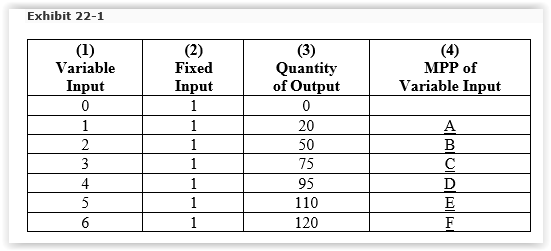
4Refer to Exhibit 22-1. The numbers that go in blanks A and B are, respectively,
- A20 and 30.
- B0 and 21.
- C20 and 25
- D1 and 2.
- E20 and 21.
5There are 30 students in a class. The average grade for 29 of the students is 87. The grade of the remaining student is 84. Given this student's grade, the average grade of the 30-student class will be
- A87.
- Bhigher than 87.
- Clower than 87.
- D84.
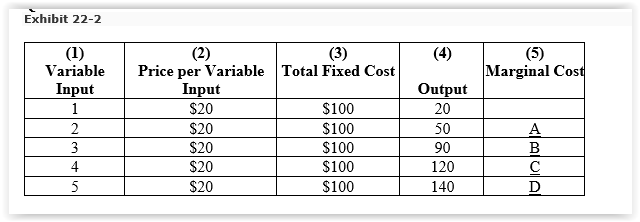
6Refer to Exhibit 22-2. What is the average total cost of producing 140 units of output?
- A$1.00
- B$1.43
- C$4.23
- D$10.00
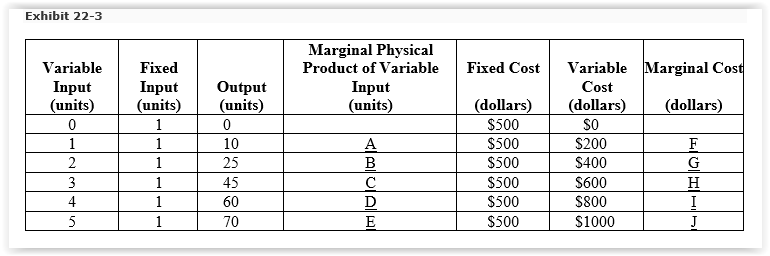
7Refer to Exhibit 22-3. The marginal cost figures in blanks F and G are, respectively,
- A$2.00 and $1.33.
- B$2.00 and $1.60.
- C$20.00 and $13.33.
- D$2.00 and $2.66.
8The main difference between the short run and the long run is that
- Afirms earn losses in the long run.
- Bthe long run always refers to a time period of one year or longer.
- Cin the long run, only one variable can be fixed.
- Din the short run, one or more inputs are fixed.
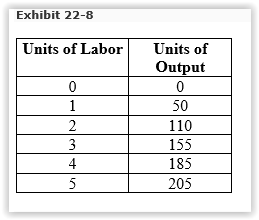
9Exhibit 22-8 shows how output varies with the only variable input used in its production. The table indicates that diminishing marginal returns set in with the hiring of which unit of labor?
- Afirst
- Bsecond
- Cthird
- Dfourth
- Efifth
10Refer to Situation 22-4. What are Joe's economic profits?

- A$0
- B$25,000
- C-$25,000
- D$40,000
- E$75,000
11A cost that is incurred when an actual monetary payment is made is a(n) __________ cost.
- AExplicit
- BImplicit
- CPositive
- DExpressed
12"As additional units of a variable input are added to a fixed input, eventually the marginal physical product of the variable input will decline." This is a statement of the
- Alaw of supply.
- Baverage-marginal rule.
- Claw of diminishing marginal utility.
- Dlaw of diminishing marginal returns.
13The marginal physical product (MPP) of a variable input is
- Atotal output divided by the quantity of the input used.
- Bthe change in total output that results from changing the variable input by one unit.
- Cthe change in total revenue that results from changing the variable input by one unit.
- Dthe change in total output that results from changing the fixed input by one unit.
- Ethe change in total costs that results from a change in output.
14Minimum efficient scale refers to the
- Asmallest plant size a firm can utilize and still maintain production.
- Blowest point on a given SRATC curve.
- Coutput level at which the LRATC curve touches each SRATC curve.
- Dlowest output level at which average total costs are minimized.
15The short run is
- Aa period of time in which all inputs are fixed.
- Ba period of time in which all inputs are variable.
- Ca period of time in which some inputs are fixed.
- Dalways less than a year.
- Ea and d
16Diseconomies of scale are present when the __________ average total cost curve is __________.
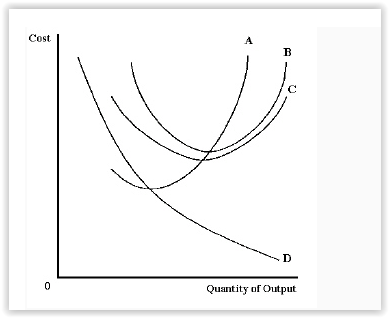
- Ashort-run; falling
- Bshort-run; rising
- Clong-run; falling
- Dlong-run; rising.
- Eb and d
17John purchases a baseball card for $10 that turns out to be so rare that a collector offers to buy it from him for $2,000. Instead, John decides to give the card to his sister (an avid baseball-card collector) as a birthday present. The opportunity cost of John's generosity is
- A$10, the purchase price.
- B$0, because at the time the decision is made, $10 are sunk cost, i.e., at that point there is no cost to John of giving the card away.
- C$2,000, the amount offered by the collector.
- D$1,005, the average of $10 and $2,000.
18The vertical distance between the AVC and ATC curves is equal to
- Amarginal cost.
- Baverage fixed cost.
- Caccounting profit.
- Deconomic profit.
19If output rises from 123 units to 143 units as another worker is hired, and the additional worker receives $15 in wages, it follows that marginal cost is
- A$15.00
- B$20.00
- C$1.33
- D$0.75
20Which of the following is true of average fixed costs in the long run?
- AAverage fixed costs start increasing.
- BAverage fixed costs are above average variable costs.
- CAverage fixed costs are equal to zero since there are no fixed costs in the long run.
- DAverage fixed costs intersect the marginal cost curve at its minimum point.
- Ea and b.
21The price at which a perfectly competitive firm sells its product is determined by
- Athe individual seller based on his costs of production and his profit margin.
- Ball sellers and buyers of the product, collectively.
- Cthe buyers of the product, because there are so many sellers that they cannot agree on a price.
- Dthe government, because there are so many buyers and sellers of the product that together they cannot agree on the price.
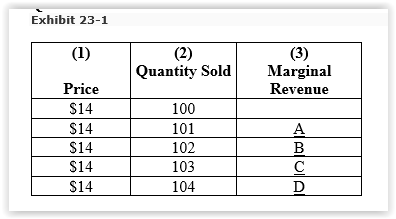
22Refer to Exhibit 23-1. The dollar amounts that go in blanks A and B are, respectively,
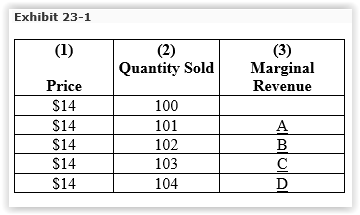
- A$1 and $14.
- B$14 and $14.
- C$0.139 and $0.137.
- D$14 and $7.
23Refer to Exhibit 23-2. What quantity does the profit-maximizing or loss-minimizing firm produce?
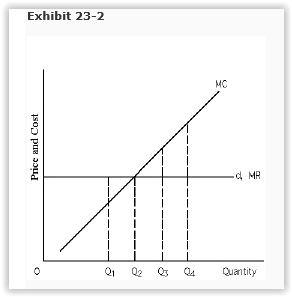
- AQ1, where "what is coming in" on the last unit is greater than "what is going out."
- BQ2, where the difference between "what is coming in" on the last unit and "what is going out" is zero.
- CQ3, where marginal cost is greater than marginal revenue.
- DQ4, which maximizes the excess of marginal cost over marginal revenue.
24Consider the following data: equilibrium price = $10, quantity of output produced = 100 units, average total cost = $13, and average variable cost = $7. What will the firm do and why?
- AShut down in the short run, because it is taking a loss of $200.
- BContinue to produce in the short run, because price is greater than average variable cost.
- CShut down in the short run, because average variable cost is less than average total cost.
- DContinue to produce in the short run, because firms are always stuck with having to produce in the short run.
25Resource allocative efficiency occurs when a firm
- Aminimizes costs of production yet charges the highest possible price.
- Bproduces the quantity of output at which price exceeds average total cost by the greatest amount.
- Cproduces the quantity of output at which price equals marginal cost.
- Dproduces the quantity of output at which price equals average total cost.
- Eproduces the quantity of output at which price equals average variable cost.
26Which of the assumptions in the theory of perfect competition assures us that economic profit will be zero in the long run?
- Abuyers and sellers having all relevant information
- Bfirms producing homogeneous goods
- Ctoo few buyers
- Deasy entry and exit
- Esmallness of firms with respect to the market
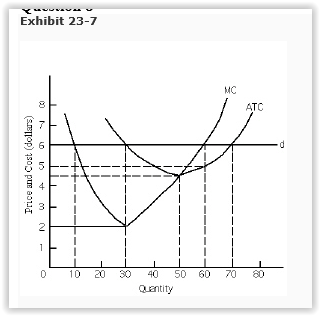
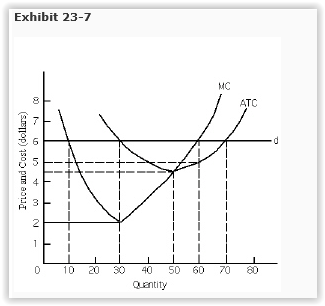
27Refer to Exhibit 23-7. The perfectly competitive, profit-maximizing firm will produce __________ units of output.
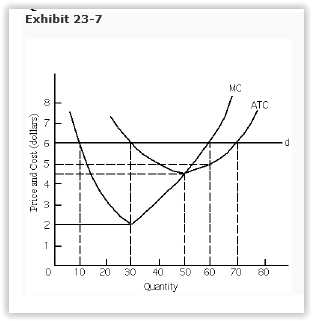
- A10
- B30
- C50
- D60
- E70
28Refer to Exhibit 23-7. At the profit-maximizing output level, the firm's total revenue is
- A$60.00.
- B$225.00.
- C$300.00.
- D$360.00.
- E$420.00.
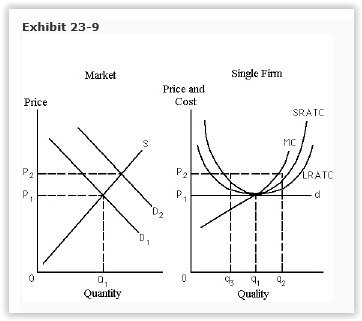
29Refer to Exhibit 23-9. Following an increase in market demand from D1 to D2, the firm's profits in the short run will
- Aremain the same at P1 times q1.
- Bremain the same at zero.
- Cincrease by less than (P2 - P1) times q2.
- Dincrease by (P2 - P1) times q3.
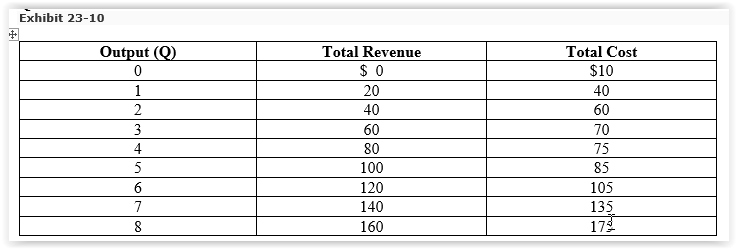
30Refer to Exhibit 23-10. What price does this firm charge for its product?
- A$10
- B$20
- C$15
- D$30
31A "price taker" is a firm that
- Adoes not have the ability to control the price of the product it sells.
- Bdoes have the ability, although limited, to control the price of the product it sells.
- Ccan raise the price of the product it sells and still sell some units of its product.
- Dsells a differentiated product.
32Refer to Exhibit 23-1. The data in this table are relevant to a perfectly competitive firm because
- Aits total revenue is different at different levels of quantities sold.
- Bits total revenue is the same at all levels of quantities sold.
- Cit doesn't have to lower price to sell additional units of the product.
- Dmarginal revenue is greater than price.
33A perfectly competitive firm will increase its production as long as
- Atotal revenue is less than total cost.
- Bthe total revenue curve is rising.
- Cmarginal revenue is greater than marginal cost.
- Dthe marginal revenue curve is rising.
34Consider the following data: equilibrium price = $8.50, quantity of output produced = 100 units, average total cost = $10, and average variable cost = $9. What will the firm do and why?
- AShut down in the short run, because price is below average variable cost.
- BShut down in the short run, because it will be taking a loss of $100.
- CContinue to produce in the short run, because price is greater than average variable cost.
- DContinue to produce in the short run, because firms are always stuck with having to produce in the short run.
35Why must profits be zero in long-run competitive equilibrium?
- AIf profits are not zero, firms will enter or exit the industry.
- BIf profits are not zero, firms will produce higher-quality goods.
- CIf profits are not zero, marginal revenue will rise.
- DIf profits are not zero, marginal cost will rise.
36Marginal revenue is defined as
- Athe difference between costs and revenues.
- Bthe change in total revenue caused by selling one additional unit of output.
- Cprice times quantity.
- Dtotal revenue divided by the level of output.
- Etotal revenue minus the level of output.
37Refer to Exhibit 23-7. At the profit-maximizing output level, average total cost is
- A$2.00.
- B$4.50.
- C$5.00.
- D$6.00.
38The profit-maximization rule is as follows:
- AProduce the quantity of output at which price equals average total cost (unit cost).
- BProduce as much output as can be sold.
- CProduce the quantity of output at which marginal revenue equals marginal cost.
- DProduce the quantity of output at which marginal revenue equals unit cost.
- EProduce the quantity of output at which total cost is minimized.
39In long-run competitive equilibrium, firms
- Aearn positive economic profits.
- Bhave no incentive to make any changes.
- Cearn losses on some units of the good they produce and sell.
- Ddo not produce the quantity of output at which MR = MC.
- Eb and c
40When an industry is described as a decreasing-cost, increasing-cost, or constant-cost industry, the "cost" that is being referred to is
- Amarginal cost.
- Baverage total cost.
- Caverage variable cost.
- Dsunk cost.
- Efixed cost.
41A monopoly may exist because
- Agovernment has refused to grant a public franchise.
- Bone firm has the exclusive ownership of a necessary resource.
- Cthe firm is so large and is currently experiencing such vast diseconomies of scale that it can out-compete all newcomers.
- Da and b
- Ea, b, and c
42If a monopolist wishes to sell an additional unit of the good, then
- Ait must raise its price to signal consumers that its product is now a more important part of their budget, and they will purchase more.
- Blike a competitive firm, it can simply make more output available and not lower price.
- Cit must lower price.
- Dit can raise price and not worry that sales will decrease.
- Ea and d
43Which of the following is not a necessary condition of price discrimination?
- AThe seller must be a price searcher.
- BThe seller must be able to distinguish between customers willing to pay different prices.
- CIt must cost the seller more to service some customers than others.
- DReselling the product must be extremely costly or must not be possible
44If a perfectly competitive firm and a single-price monopolist face the same demand and cost curves, then
- Athe competitive firm will attain resource-allocative efficiency, but the monopolist will not.
- Bthe competitive firm will attain resource-allocative efficiency, but the monopolist may or may not, depending upon the demand for its product.
- Cthe competitive firm will not attain resource-allocative efficiency, but the monopolist will.
- Dboth the competitive firm and the monopolist will attain resource-allocative efficiency.
- Eneither the competitive firm nor the monopolist will attain resource-allocative efficiency.
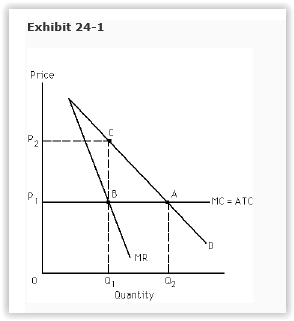
45Refer to Exhibit 24-1. If the product is produced under single-price monopoly, what quantity will be produced and what price will be charged in order to maximize profit?
- AQ2 units at P1
- BQ1 units at P1
- CQ1 units at P2
- DQ2 units at P2
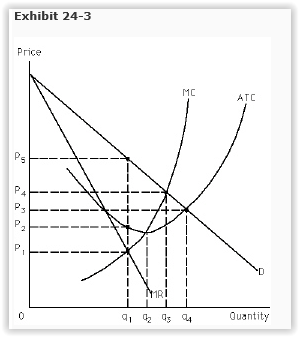
46Refer to Exhibit 24-3. The level of output the profit-maximizing perfectly price-discriminating monopolist produces is
- Aq1.
- Bq2.
- Cq3
- Dq4
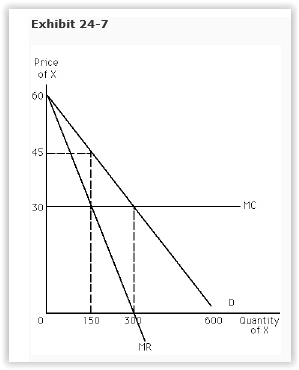
47Refer to Exhibit 24-7. Let D be the demand curve facing a perfectly price-discriminating monopolist. The lowest price this monopolist will charge is
- A$60.
- B$45.
- C$30.
- D$0.
48Refer to Exhibit 24-8. A profit-maximizing single-price monopolist will set the price at
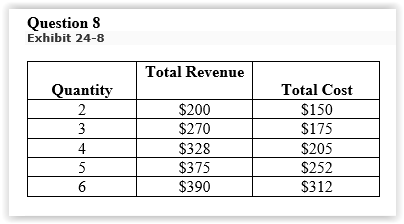
- A$90 per unit.
- B$82 per unit.
- C$65 per unit.
- D$75 per unit.
- EThere is not enough information provided to answer this question.
49Two economists are walking down the street. One sees a $10 bill lying on the sidewalk and asks, "Isn't that a $10 bill?" "Obviously not," says the other. "If it were, someone would have already picked it up." This joke tells us how economists think. Specifically, economists believe
- Athat money is the most important thing to people.
- Bthat if the opportunity for gain exists, it won't last for long; someone will grab it quickly.
- Cthat money is so important to people that no one would ever have dropped a $10 bill on the sidewalk.
- Dthat the marginal benefits of stooping down to pick up a $10 bill are less than the marginal costs of doing so.
- Esince no none has ever seen a $10 bill on the sidewalk, one can't exist there now.
50Which of the following is the best example of price discrimination?
- Aa cellular telephone company charging lower rates to weekend callers than weekday callers
- Ba gas station charging less per gallon to customers who pay cash than customers who use a credit card
- Can auto insurance company charging a higher premium to a seventeen year old boy with a driving record that includes three accidents than the premium charged to a middle-aged driver with a clean driving record
- Da private attorney charging higher fees to clients receiving special services than clients receiving regular services
51A natural monopoly exists when
- Aa monopolist produces a product, the main component of which is a natural resource.
- Beconomies of scale are so large that only one firm can survive and achieve low unit costs.
- Ca firm is the exclusive owner of a key resource necessary to produce the firm’s product.
- Dthere are no close substitutes for a firm's product.
52In maximizing profits, a single-price monopolist will charge a price that is
- Aless than marginal cost.
- Bequal to marginal cost.
- Cgreater than marginal cost.
- DThere is not enough information to answer the question.
53A monopolist can sell 16,000 units at a price of $100 per unit. Lowering price by $1 raises the quantity demanded by 500 units. What is the change in total revenue resulting from this price change?
- A$33,500
- B$12,500
- C$65,500
- D-$33,500
54If a monopolist practices perfect price discrimination, then it will have
- Aa greater total revenue and sell a greater output than if it were not practicing price discrimination.
- Ba smaller total revenue and sell a smaller output than if it were not practicing price discrimination.
- Cthe same total revenue but sell a larger output than if it were not practicing price discrimination.
- Dthe same total revenue but sell a smaller output than if it were not practicing price discrimination.
55"X-inefficiency" refers to
- Athe fact that a monopolist wastes resources searching for the price at which it will sell its product.
- Bthe fact that monopolists don't have to produce at the lowest possible costs in order to survive.
- Cthe fact that perfectly competitive firms do not earn a profit in the long run and are not a good investment.
- Dthe difference between what consumers would be willing to pay for additional output from a monopolist and the additional cost of providing that output.
56Which of the following is true of price and marginal revenue for the first unit of output sold by a monopolist?
- APrice is greater than marginal revenue.
- BPrice is less than marginal revenue.
- CPrice is equal to marginal revenue.
- DThis answer could be a or b, depending on whether it is a single-price or a price discriminating monopolist.
57Refer to Exhibit 24-8. A profit-maximizing single-price monopolist will produce which quantity of output?
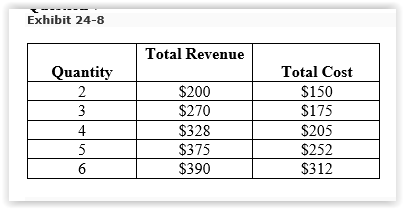
- A3 units
- B4 units
- C5 units
- D6 units
58One difference between a perfectly competitive firm and a monopoly firm is
- Aa perfectly competitive firm maximizes profit by producing the quantity of output at which MR = MC, and the monopoly firm does not.
- Ba monopoly firm is resource allocative efficient, and a perfectly competitive firm is not.
- Cthe monopoly firm charges the highest per-unit price for its product, and the perfectly competitive firm does not.
- Dthe demand curve and the marginal revenue curve are the same for the perfectly competitive firm, but they are not the same for the monopoly firm.
- Ec and d
59"Rent seeking" refers to
- Atrying to pay the lowest rent possible for an apartment or house.
- Btrying to lower rent that is paid on a factory in order to lower fixed costs.
- Cthe actions of individuals who spend resources to influence public policy in the hope of transferring income to themselves from others.
- Dthe fact that the deadweight loss triangle is a genuine cost of monopoly.
60The perfectly competitive firm produces the quantity of output at which __________, and the single-price monopolist produces the quantity of output at which __________. The perfectly price-discriminating monopolist is like the __________ in this regard.
- AP = MC; P > MC; single-price monopolist
- BP > MC; P = MC; perfectly competitive firm
- CP = MC; P > MC; perfectly competitive firm
- DP > MC; P = MC; single-price monopolist
61Some monopolistic competitors earn positive economic profits in the long run because
- Athere are high barriers to entry in monopolistic competition.
- Bthey have successfully differentiated their products from their competitors' products.
- Cthere is easy entry and exit.
- Db and c
62The demand curve facing a monopolistic competitor will be more elastic than the demand curve facing a monopolist because
- Athere are barriers to exit for the monopolist, but not for the monopolistic competitor.
- Bthe monopolistic competitor attains resource-allocative efficiency, but the monopolist does not.
- Cthere are substitute goods for what the monopolistic competitor produces, but not for what the monopolist produces.
- Dthe monopolist is a price searcher, but the monopolistic competitor is not.
63The excess capacity theorem states that a monopolistic competitor
- Awill produce an output level smaller than the one that would minimize its unit costs.
- Bwill produce an output level where MR > MC.
- Cgenerally does not attain long run equilibrium, and thus charges a higher price than it should.
- Dtypically produces too much of a good at too low a quality.
64Which of the following is an assumption of the theory of oligopoly?
- AThere are barriers to entry.
- BThere are many sellers and many buyers.
- CFirms produce and sell either homogeneous or differentiated products.
- Da and c
65Total industry sales are $30 million. The top four firms (A, B, C, and D) account for sales of $5 million, $3.2 million, $0.8 million and $0.4 million, respectively. What is the four-firm concentration ratio?
- A9.40
- B0.31
- C0.01
- D0.94
66The major economic objective of cartels is to
- Aimpose their political will on others.
- Brestrict output, push up price, and increase profits.
- Creduce costs.
- Ddevelop new ways of doing things.
- Eb and d
67Refer to Exhibit 25-3. Which of the following points represents the profit-maximizing quantity and price of a monopolistic competitor?
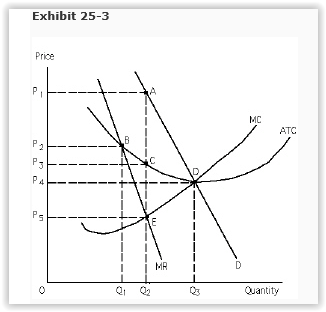
- AA
- BB
- CC
- DD
- EE
68Refer to Exhibit 25-3. What output is productively efficient?
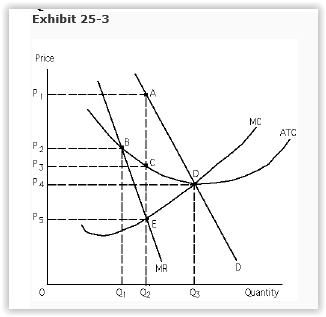
- AQ1
- BQ2
- CQ3
- DIt is not labeled on the diagram.
- EIt is not determinable without more information.
69One of the key characteristics of oligopoly is that
- Afirms are independent of each other.
- Bfirms face different cost conditions.
- Ceach firm is aware that its actions will influence other firms and that the actions of the other firms affect it.
- Dit is easy to enter the industry.
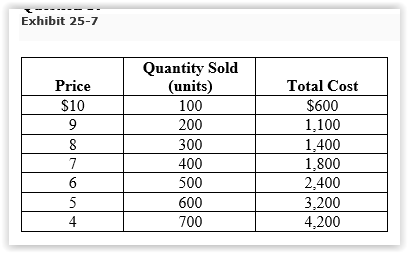
70Refer to Exhibit 25-7. A monopolistic competitive firm that seeks to maximize profits will sell __________ units and charge a price of __________ .
- A200;$ 9
- B400; $7
- C500; $6
- D100; $10
- E7; $400
71A significant difference between perfect competition and monopolistic competition is that
- Aa perfectly competitive firm is a price searcher, while a monopolistic competitive firm is a price taker.
- Ba perfectly competitive firm faces a downward-sloping demand curve, while a monopolistic competitive firm faces a perfectly elastic demand curve.
- Ca perfectly competitive firm sells a homogeneous product, while a monopolistic competitive firm sells a differentiated product.
- Da perfectly competitive firm sets price above marginal cost, while a monopolistic competitive firm sets price equal to marginal cost.
72A monopolistic competitor that seeks to maximize profits or minimize losses will produce the quantity of output at which
- Aits per-unit costs are the lowest.
- BMR = MC, and charge the highest possible per-unit price for it.
- CMC = ATC, and charge the highest possible per-unit price for it.
- DP = MC, and charge the highest possible per-unit price for it.
73What market structure allows the good being produced to be either homogeneous or differentiated?
- Amonopolistic competition
- Boligopoly
- Cmonopoly
- Dperfect competition
74As a result of easy entry and exit in the monopolistic competitive market, in the long run one may find that
- Aprice equals minimum average total cost.
- Bprice equals average total cost.
- Cprice equals marginal cost.
- Dprice equals marginal revenue.
- Edemand and marginal revenue are the same.
75The "prisoner's dilemma" game illustrates a case in which
- Aindividually rational behavior leads to a collectively inefficient outcome.
- Bwhat is irrational individual behavior turns out to be ultra-irrational group behavior.
- Cthe whole is greater than the sum of the parts.
- Dnone of the above
76A cartel is an organization of firms
- Adominated by one firm, which is usually referred to as the price leader.
- Bthat attempts to increase total (or industry) demand for their product.
- Cthat reduces output and increases price in an effort to increase joint profits.
- Dthat deliberately attempts to disrupt the market for political reasons.
77A concentration ratio indicates the
- Anumber of firms in an industry.
- Bnumber of large firms in an industry compared to the number of large firms in another related industry.
- Cpercentage of total sales accounted for by the (for example) four largest firms.
- Dpercentage of sellers in an industry relative to the number of buyers.
- Epercentage of sellers in an industry protected by barriers to entry relative to the number of sellers that wish to enter.
78Which of the following statements is true?
- AMonopolistic competitive firms will earn economic profits in the long run because of their ability to control the price of the product.
- BMonopolistic competitive firms that earn economic profits in the short run commonly will find their profits competed away in the long run.
- CMonopolistic competitive firms will earn zero economic profits in both the short and the long run.
- DMonopolistic competitive firms must earn economic profits in the long run, or they will shut down.
- EMonopolistic competitive firms must earn economic profits in the short run, or they will shut down.
79The monopolistic competitive firm produces the output at which
- Aprice equals marginal cost.
- Bmarginal revenue equals marginal cost.
- Cthere is resource allocative efficiency.
- Daverage total cost is at a minimum.
80In a monopolistic competitive industry,
- Aeach firm in the industry produces a slightly differentiated product.
- Bthere are barriers to entry.
- Cthere are barriers to exit.
- Dthere are few sellers.
Información
- Descripción
- 2 Micro Economics 202 Test sobre Econ Exam 2 - Chapter 8 - 12, creado por jlb2153 el 23/03/2016.
- Autor
- jlb2153
- Idioma
- English
- Visitas
- 9
- Etiquetas
- Valoración
- Aún sin valoraciones Valora este test