
Test
HEAD, NECK AND NEURO: Week 5 - Tongue & Vision
Este test tiene tipos de pregunta que se abren en el reproductor de siempre.
Preguntas del test (31)
1Label these lymph nodes and associated structures. There are 11 sets/specific lymph nodes altogether.

- AOccipital nodes
- BPosterior/retro-auricular nodes
- CDigastric muscle
- Djugulodigastric node
- Einternal jugular vein
- Fdeep cervical nodes
- Gjugulo-omohyoid node
- Homohyoid muscle
- Isupraclavicular nodes
- Jsuperficial cervical nodes
- Ksubmental nodes
- Lsubmandibular nodes
- Mparotid/pre-auricular nodes
2Complete the table outlining lymphatic drainage of the head and neck.
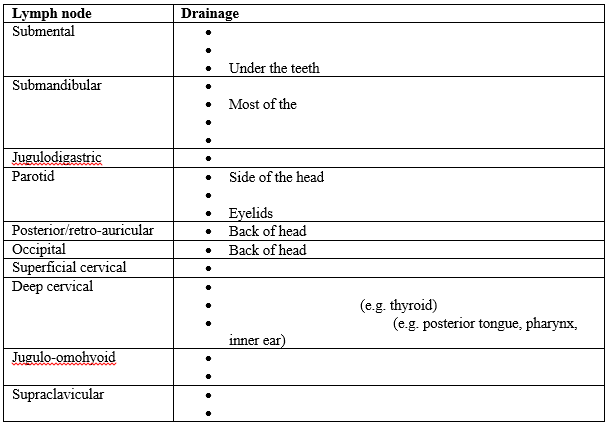
- ATip of the tongue
- BLips
- Clower part of face
- Dmouth
- ENasal cavity
- FMaxillary sinus
- GTonsils
- Hupper part of face
- Ineck structures
- Jsuperficial nodes
- Kneck structures
- Ldeep head structures
- MLingual tonsil
- NPosterior tongue
- OChest
- PAbdomen
3Label this diagram of the larynx from a lateral view.
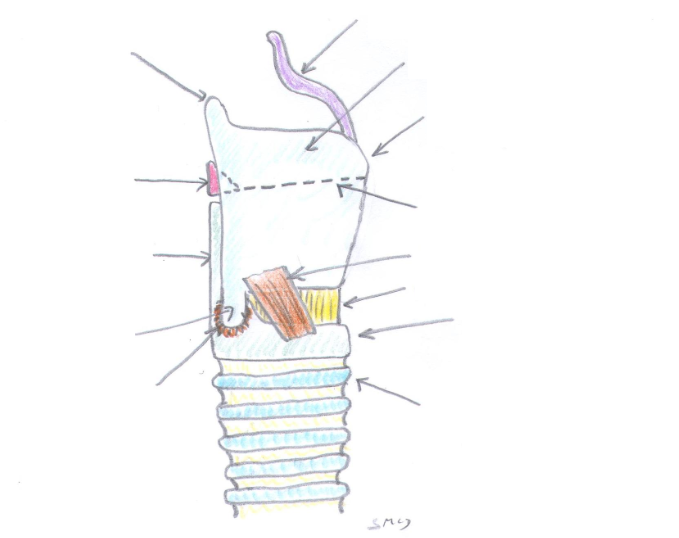
- Aepiglottis
- Bthyroid cartilage
- Claryngeal eminence
- Dposition of vocal fold
- Ecricothyroid muscle
- Fcricothyroid ligament
- Garch of cricoid cartilage
- Hfirst tracheal ring
- Icricothyroid joint
- Jinferior horn of thyroid cartilage
- Klamina of cricoid cartilage
- Larytenoid cartilage
- Msuperior horn of thyroid cartilage
4Label these diagrams of the larynx from an anterior and posterior view.
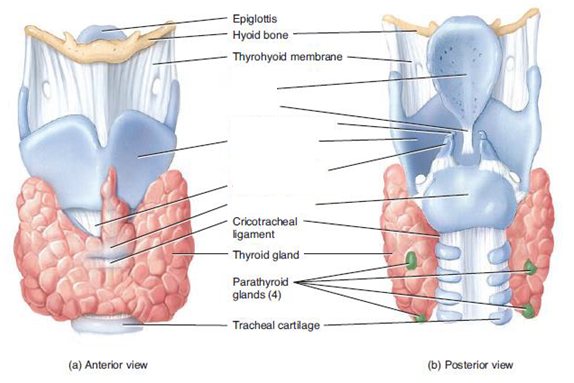
- Aepiglottis
- Bthyroid cartilage
- Ccricothyroid ligament
- Darytenoid cartilage
- Ecorniculate cartilage
- Fcricoid cartilage
5What is the function of the cricothyroid muscle?
- AContraction causes higher frequency vibration of the vocal fold - therefore increases pitch
- BContraction causes higher frequency vibration of the vocal fold - therefore decreases pitch
- CContraction causes lower frequency vibration of the vocal fold - therefore increases pitch
- DContraction causes lower frequency vibration of the vocal fold - therefore decreases pitch
6Where is an emergency tracheotomy carried out?
- ACricothyroid ligament
- B1st tracheal rings
- CRegion of 2/3/4 tracheal rings
- DAbove the sternum
7What are the 3 paired cartilages in the larynx?
1. [blank_start]Arytenoid[blank_end] cartilages
2. [blank_start]Corniculate[blank_end] cartilages
3. [blank_start]Cuneiform[blank_end] cartilages- AArytenoid
- BCorniculate
- CCuneiform
8At what (spinal) level is the larynx located?
- AC4-6
- BC2-4
- CC4-8
- DC2-6
- EC6-8
9What is the space between the ventricular folds of the larynx called?
- ARima vestibuli
- BRima glottidis
- CLaryngeal isthmus
- DVentricular isthmus
- ERima ventriculi
10What is the space between the vocal folds in the larynx called?
- ARima glottidis
- BRima vestibuli
- CRima ventriculi
- DLaryngeal isthmus
- EVocal isthmus
11What sort of epithelium does the larynx have above the vocal folds?
- ANon-keratinised stratified squamous
- BKeratinised stratified squamous
- CPseudostratified ciliated columnar
- DPseudostratified ciliated cuboidal
- ESimple squamous
12What sort of epithelium does the larynx have below the vocal folds?
- ASimple ciliated columnar
- BStratified ciliated columnar
- CSimple ciliated cuboidal
- DSimple squamous
- ENon-keratinised stratified squamous
13What is the motor innervation of the majority of the intrinsic laryngeal muscles?
- ARecurrent laryngeal nerve
- BExternal laryngeal nerve
- CInternal laryngeal nerve
- DSuperior laryngeal nerve
- EInferior laryngeal nerve
14What is the only instrinsic laryngeal muscle that is NOT innervated by the recurrent laryngeal nerve?
- ACricothyroid m.
- BCricoarytenoid mm.
- CTransverse arytenoid mm.
- DOblique arytenoid mm.
- EThyroarytenoid mm.
15What is the sensory innervation of the laryngeal cavity above the vocal folds?
- AInternal laryngeal nerve
- BExternal laryngeal nerve
- CSuperior laryngeal nerve
- DInferior laryngeal nerve
- ERecurrent laryngeal nerve
16What is the sensory innervation of the laryngeal cavity BELOW the vocal folds?
- AExternal laryngeal nerve
- BInternal laryngeal nerve
- CSuperior laryngeal nerve
- DInferior laryngeal nerve
- ERecurrent laryngeal nerve
17Describe the blood supply of the larynx.
1. [blank_start]Superior laryngeal artery[blank_end] (branch of superior thyroid artery)
2. [blank_start]Inferior laryngeal artery[blank_end] (branch of inferior thyroid artery)- ASuperior laryngeal artery
- BInferior laryngeal artery
18Describe the venous drainage of the larynx.
1. [blank_start]Superior laryngeal veins[blank_end] (drain into the internal jugular vein)
2. [blank_start]Inferior laryngeal veins[blank_end] (drain into the left brachiocephalic vein)- ASuperior laryngeal veins
- BInferior laryngeal veins
19Which lymph nodes are responsible for draining the larynx?
- ADeep cervical lymph nodes
- BSuperficial cervical lymph nodes
- CJugulo-omohyoid node
- DSubmandibular lymph nodes
- ESupraclavicular lymph nodes
20What are the 4 extrinsic tongue muscles?
1. [blank_start]Palatoglossus[blank_end] muscle
2. [blank_start]Styloglossus[blank_end] muscle
3. [blank_start]Genioglossus[blank_end] muscle
4. [blank_start]Hyoglossus[blank_end] muscle- APalatoglossus
- BStyloglossus
- CGenioglossus
- DHyoglossus
21Which of the following is the only one not innervated by the hypoglossal nerve?
- APalatoglossus muscle
- BStyloglossus muscle
- CHyoglossus muscle
- DGenioglossus muscle
- EIntrinsic tongue muscles
22Which nerve innervates the palatoglossus muscle?
- AVagus nerve
- BHypoglossal nerve
- CGlossopharyngeal nerve
- DFacial nerve
23What are the 4 intrinsic muscles of the tongue?
1. [blank_start]Superior longitudinal muscles[blank_end]
2. [blank_start]Vertical muscles[blank_end]
3. [blank_start]Transverse muscles[blank_end]
4. [blank_start]Inferior longitudinal muscles[blank_end]- ASuperior longitudinal muscles
- BVertical muscles
- CTransverse muscles
- DInferior longitudinal muscles
24What are the 4 types of papillae on the tongue?
1. [blank_start]Filiform[blank_end] papillae
2. [blank_start]Fungiform[blank_end] papillae
3. [blank_start]Vallate[blank_end] papillae
4. [blank_start]Foliate[blank_end] papillae- AFiliform
- BFungiform
- CVallate
- DFoliate
25Which of the veins draining the tongue runs deep to the hyoglossus muscle?
- ADorsal lingual vein
- BDeep lingual vein
26What is the sensory function of the glossopharyngeal nerve in the tongue?
- ATaste in the posterior 1/3
- BTaste in the anterior 2/3
- CGeneral sensation in anterior 2/3; rest of mouth
27What is the sensory function of the lingual nerve?
- ATaste from posterior 1/3
- BGeneral sensation in anterior 2/3; rest of mouth
- CTaste from anterior 2/3
28What is the sensory function of the facial nerve in the tongue?
- ATaste from anterior 2/3
- BTaste from posterior 1/3
- CGeneral sensation from anterior 2/3; rest of mouth
29Which nerve gives off the lingual nerve, which supplies the tongue?
- AMaxillary branch of trigeminal n. (V2)
- BMandibular branch of trigeminal n. (V3)
- COphthalmic branch of trigeminal n. (V1)
- DGlossopharyngeal n.
- EHypoglossal n.
30Describe the 2 stages of oral cancer.
1. Benign
a) [blank_start]Leukoplakia[blank_end]
b) [blank_start]Erythroplakia[blank_end]
2. [blank_start]Squamous cell carcinoma[blank_end]- ALeukoplakia
- BErythroplakia
- CSquamous cell carcinoma
31What are the 5 stages of oral cancer development?
1. Normal
2. Hyperplasia/[blank_start]hyperkeratosis[blank_end]
3. [blank_start]Mild/moderate dysplasia[blank_end]
4. [blank_start]Severe dysplasia/carcinoma in situ[blank_end]
5. Squamous cell carcinoma- Ahyperkeratosis
- BMild/moderate dysplasia
- CSevere dysplasia/carcinoma in situ
Información
- Descripción
- Lymph nodes
- Autor
- Melissa Denker
- Idioma
- English
- Visitas
- 124
- Valoración
- Aún sin valoraciones Valora este test