
Test
Understanding Mechanical Ventilation Quiz
Este test tiene tiempo límite, así que se abre en el reproductor de siempre.
Preguntas del test (43)
1The inspiratory flow limb of this pressure volume curve is indicated by which letter?
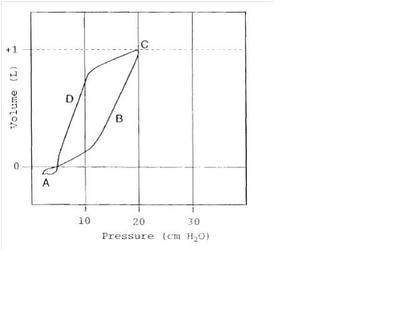
- Aa
- Bb
- Cc
- Dd
2Which of the below steps should improve ventilation and clearance of CO2?
- ALowering the tidal volume from 10 cc/kg to 8 cc/kg PBW in Volume Assist Control
- BDecreasing the flow rate from 80 L/min to 50 L/min in Volume Assist Control
- CIncreasing the Inspiratory time from 1 sec to 3 seconds in Pressure Assist Control ventilation
- DIncreasing the respiratory rate from 12 to 15
- EIncrease PEEP from 5 to 10
3Your patient has a baseline plateau pressure of 20, peak pressure of 23. Suddenly, his peak pressure alarms goes off. Now, his plateau pressure is 22 and his peak pressure is 33. Which of the following list of possibilities would cause these changes in peak and plateau pressures?
- AAcute Bronchospasm
- BPneumothorax
- CFlash pulmonary edema
- DRight Mainstem Intubation
- ELarge mucus plug causing complete Left lower lobe collapse.
4Based on the curve above, what minimum level of PEEP would be necessary to prevent alveolar collapse at end-expiration?
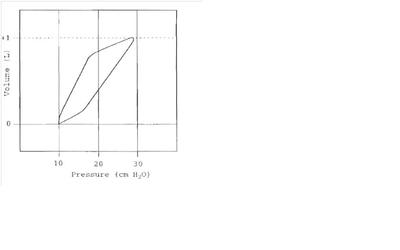
- A10
- B12
- C16
- D20
- E28
5How do you assess for increasing resistance in the ventilator circuit?
- AThe flow volume curve shows bird beaking
- BThe pressure volume curve changes angle
- CYour difference between Plateau pressure and PEEP increases
- DThe difference between Peak pressure and Plateau pressure increases
- EThe difference between Peak pressure and PEEP increases
6Your patient is recovering from severe ARDS with improving lung compliance and oxygenation over 4 days. Which of the below scenarios is expected if NO changes are made to the patient’s current ventilator settings?
- AIn Volume Assist Control, increased patient respiratory rate compared to set frequency on ventilator
- BIn Volume Assist Control , peak pressure decreasing from 40 to 30 but plateau pressure staying the same at 28
- CIn Pressure Assist Control ventilation, increasing tidal volumes over time
- DWorsening hypercapnia and lowering of the pH
- EIn Synchronized Intermittent Mandatory Ventilation, the number of control breaths decreases as the patient begins to trigger more frequent breaths
7A 34 y/o male patient with past medical Hx of asthma is brought to your ICU from an outside hospital intubated and on mechanical ventilation. His current settings are: Volume Assist Control - f: 10, PEEP: 5, Vt: 500 and FiO2: 60%. The patient’s vitals are: temp: 37.8, HR: 118, BP: 89/40, RR: 26, sat: 93%. His ABG shows: pH: 7.31/ 48/89/22/Sat: 91%. At the bedside, you note a young man who is sedated, has increased WOB, + decreased airflow with high pitched inspiratory and expiratory wheeze.
Which of the below interventions would most likely improve your patients clinical status?- ADecrease the inspiratory flow rate from 90 L/min to 60 L/min
- BCheck the ventilator for autopeep and increase the PEEP to 5 points higher than the calculated autoPEEP to reduce the effort for initiating respiratory triggering
- CChange the patient to Pressure Assist Control Ventilation and extend the Itime for each breath
- DIncrease the PEEP to 15 to improve oxygenation
- EDisconnect the patient from the ventilator for a few seconds to allow complete expiration
8Please choose the best answer that describes the relationship between both curves.
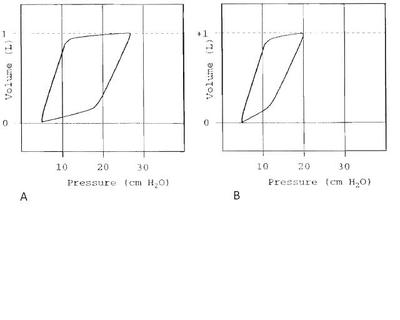
- AYou can’t define any differences in compliance or resistance from P/V curves
- BCurve A has increased compliance compared to curve B.
- CCurve B has increased compliance compared to curve A.
- DCurve A has increased resistance compared to curve B.
- ECurve A has a decreased resistance compared to curve B.
9Your patient has a baseline plateau pressure of 20, peak pressure of 23. Suddenly, the vent is alarming for high peak pressures. Now, his plateau pressure is 29 and his peak pressure is 33. Which of the following list of possibilities would cause this change in peak and plateau pressures?
- AThe patient biting down on the ETT
- BSquamous cell cancer at the level of the carina with endophytic mass causing acute large airway (R mainstem) obstruction with associated right lung atelectasis
- CThe ventilator tubing getting squished in the edge of the bed during movement, causing obstruction of flow
- DGradual worsening of ARDS with slowly worsening atelectasis on CXRs over 3 days
- EBronchitis patient requiring frequent suctioning due to copious secretions
10You have decided to use the stress index as a measure of the appropriate PEEP needed to prevent alveolar collapse while minimizing alveolar overdistension. What criteria below must all be met?
- APatient presents with a COPD exacerbation. He is on mechanical ventilation using Volume Assist Control, a decelerating ramp waveform, and the patient is sedating and not triggering his own breaths.
- BThe patient presents with diffuse ARDS due to sepsis, he is being ventilated on Volume Assist Control ventilation with a square waveform, he is awake and triggering his own breaths.
- CThe patient has focal ARDS with primary pneumonia, he is not triggering his own breaths, and he is on Volume Assist Control ventilation with a decelerating ramp waveform.
- DThe patient has focal ARDS with primary pneumonia, he is not triggering his own breaths, and he is on Volume Assist Control ventilation with a square waveform
- EThe patient has diffuse ARDS due to sepsis, he is not triggering his own breaths, and he is on Volume Assist control ventilation with a decelerating ramp waveform
1157 y/o F w/ hx of UIP with progressive dyspnea, now on 3L home O2, presents with low grade fever, worsening cough with minimal sputum production and hypoxemia with sats 84% on RA, 91% on 15L oxymask. Wt: 112 kg, ht: 5’5”. Vitals: temp: 38.6 C, RR: 30, HR: 134, BP: 90/55, MAP: 67. Her ABG shows: pH: 7.33/40/72/22/90% on ~80% FiO2. Pt is intubated and started on mechanical ventilation due to hypoxia.
As her physician, you must decide what ventilator settings to commence. Of note, she has evidence of mild to moderate honeycombing at the lung bases and evidence of diffuse bilateral ground glass patchy opacities. She fits criteria for restrictive lung disease with an FVC 57% normal and an FEV1/FVC ratio of 83%. Her DLCO is 48% predicted and her TLC is 62% predicted from PFTs more than 1 year prior.
Please select the most appropriate initial ventilation strategy for this patient.- ASynchronized Intermittent Mandatory Ventilation with f: 12, Vt: 500mL, PS: 20, PEEP:14, FiO2: 100%
- BVolume Assist Control with f: 18, Vt: 300 mL, Flow: 80 L/min, PEEP: 5, FiO2: 100%
- CPressure Support Ventialtion with PS: 24, PEEP: 10, FiO2: 100% with Vt ~ 510-520 mL/breath
- DVolume Assist Control with f: 18, Vt: 450, Flow 60L/min, PEEP: 10, FiO2: 100%
- EPressure Assist Control Ventilation with Pinsp: 20, PEEP:8, f: 22, FiO2: 100%, I time: 2 sec, ~ Vt 400-420 mL/breath
12Which of the below images shows a stress index below optimal recruitment?
- ASee Image
- BSee Image
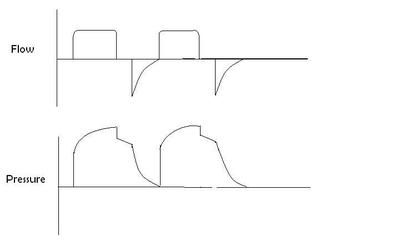
- CSee Image
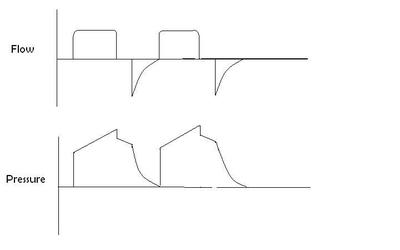
- ASee Image
13Your patient has returned from CT scanner and is noted to be more hypoxic than when he left the unit (sats decreasing from 94% on 40% FiO2 to 86-88% on 40%). You check a peak pressure which is increased from 28 to 34. Additionally, his plateau has increased from 24 to 30. Which of the below scenarios is most likely?
- AIncreased secretions requiring suctioning but no evidence of lobar collapse from mucus plugging
- BThe ventilator tubing has been partially obstructed during transfer
- CThe patient’s ETT has migrated causing Right mainstem intubation
- DThe patient’s ETT cuff has ruptured and the tube has migrated above the vocal cords
- EThe ventilator has accumulated water in the tubing circuit
14You wish to calculate a patient’s plateau pressure. Which set of steps below would allow you to calculate the plateau pressure (once you set the ventilator display to show plateau pressures)?
- AIn Pressure Support mode, minus the mean airway pressure from the peak pressure to get a plateau pressure
- BIn Volume Assist Control mode, add an inspiratory pause of 3 seconds to your settings; measure plateau pressure while the patient is initiating breaths
- CIn Volume Assist Control mode, during ventilator initiated breaths, press the inspiratory pause button until flow becomes zero and maintains steady state to get a plateau pressure
- DIn Volume Assist Control mode, during ventilator initiated breaths, press the expiratory pause button until flow becomes zero and maintains steady state to get a plateau pressure
- EIn Pressure Control Ventilation, during patient initiated breaths, press the inspiratory pause button until flow becomes zero and maintains steady state to get a plateau pressure
15Your patient with a new tracheostomy and PEG placed 2 days prior has had abnormal measurements of peak and plateau pressures when you review records over the last 48 hrs. You note that every shift the patient’s peak and plateau pressures decrease just after the patient has a bath, but increase again at the next check. Which is the most likely etiology for this change from the list below?
- AThe patient begins to cough more frequently post bathing
- BThe patient’s abdominal binder is removed during bathing and replaced by the subsequent check
- CThe patient has an distal XLT trach tube causing recurrent partial R mainstem intubation with turning to the right side during bathing
- DThe patient has significant secretions that cause partial airway obstruction whenever he is moved
- EThe patient receives a nebulized breathing treatment after every bath
1634 y/o female with history of drug abuse is admitted to the cardiac intensive care unit with confusion, chest pain, ST elevation in II, III and aVf with reciprocal depressions in the lateral leads, pulmonary edema and hypertensive emergency with BP if 230/125, MAP 160. Additional vitals: temp: 37.6 C, HR: 125, RR: 26, Sat: 87% on RA. ABG prior to intubation: 7.30, PCO2: 25, PaO2: 66, Bicarb: 18, Sat: 85% on RA. Wt: 60 kg, Ht: 5’3”. The patient was intubated in the ED and is still paralyzed from a dose of rocuronium prior to being taken to the cath lab. As the critical care fellow on call, you are asked to make recommendations for her ventilator settings.
The patient has moderate AKI with a creatinine of 2.6. A CT head does not show evidence of blood although assessment of neurological status is limited due to intubation and sedation. CXR here: diffuse bilateral opacities with small bilateral pleural effusions.
Which of the below ventilator settings would be appropriate?- APressure Assist Control Ventilation with Pinsp:16, PEEP:8, f: 20, FiO2: 100% with Vt ~ 350mL/breath
- BVolume Assist Control with Vt: 420 mL, f: 20, PEEP: 8, FiO2: 100%
- CPressure Support Ventilation with PS : 18, PEEP: 8, FiO2: 100% with Vt approx 400 mL/breath
- DSynchronized Intermittent Mandatory Ventilation with Vt: 580 mL, f: 14, PS : 10, PEEP: 8, FiO2: 100%
- EVolume Assist Control with Vt: 320, f: 20, PEEP: 8, FiO2: 100%
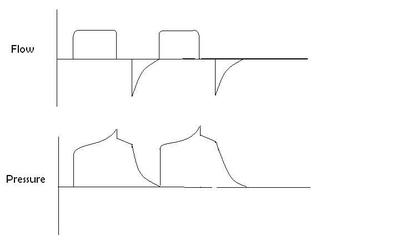
17From the above flow and pressure curves, calculated the appropriate AutoPEEP
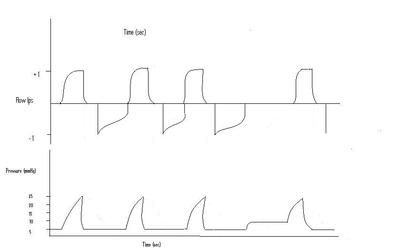
- A2
- B5
- C10
- D15
18You are walking on rounds getting sign out when you walk by the room of a patient with COPD and left lower lobe pneumonia. You peek inside the room and notice that the patient’s peak pressure is 34. You remember that this patient’s peak pressure was previously 28-30. You enter the room to investigate further. You perform an inspiratory pause maneuver and calculate a plateau pressure of 24. Which of the below scenarios would not cause these changes in peak and plateau pressure?
- AOn exam, you note that the patient is awake and biting on his tube; no bite block is present
- BOn exam you note that the patient’s HME is discolored and there is evidence of mucus coating its surface
- COn exam, you note that the patient is receiving a nebulized inhalation therapy through the ventilator
- DOn exam, you note that a humidifier has been added to the inspiratory limb of the circuit
- EOn exam, you note that the suction catheter is partially obstructing the endotracheal tube.
19A 49 y/o female with PMHx of severe pneumococcal pneumonia and associated ARDS is on her 12th day of mechanical ventilation. She is being managed on pressure assist-control ventilation with a respiratory rate of 16, PEEP of 8, Inspiratory pressure of 18, Itime: 2secs, FiO2: 40%. On day 12 of mechanical ventilation, it is noted that her average tidal volume size is 360 mL. On day 15, her tidal volume is now an average of 420 mL.
The respiratory therapist comes to tell you that the patient’s tidal volumes are no longer 6mL/kg predicted body weight. What do you do?- ATitrate down the Inspiratory Pressure to prevent high tidal volume ventilation
- BSwitch the patient to Volume Assist Control and place the patient on strict tidal volumes of 6mL/kg
- CDecrease the inspiratory pressure to minimize volumes, now that the patient’s compliance has worsened
- DDisconnect the patient temporarily from the ventilator to allow escape of air trapping and increased intrinsic PEEP
- EIncrease the set respiratory rate so the patient doesn’t have to pull such large volumes to be comfortable
2078 y/o female is admitted to the neurointensive care unit after suffering from a subarachnoid hemorrhage. Arrangements are made for CTA and interventional radiology. An area of extravasation is noted branching off the R MCA and a coil is placed with resolution. The patient is returned to the ICU for monitoring and blood pressure control. The patient has no evidence of parenchymal blood or intraventricular blood. At this time, the patient’s vitals are: Temp: 37.6, HR: 115, RR: 18, BP: 106/64, MAP of 78, wt: 74 kg, Ht: 5’8”.
Several hours after clipping, the patient is noted to be developing shortness of breath. The patient is currently on oxygen 2L NC but within the next few hours the patient becomes progressively more hypoxic . Her arterial blood gas, on 100% face mask/NRB at 15L is 7.35/35/55/20/sats 88% with a current RR of 25. The decision is made to intubate the patient and place her on mechanical ventilation (paralytics used during intubation).
Additionally, the patient’s BP has decreased and currently is 95/52, MAP of 66. A bedside echo is performed which shows evidence of wall motion abnormalities, apical ballooning and EF of 25%.
Please choose the most appropriate initial ventilator settings for this patient.- AVolume Assist Control, Vt: 550, f: 20, PEEP:10, FiO2% 100%
- BPressure Support ventilation, PS : 15, PEEP:10, FiO2: 100% with estimated tidal volumes ranging from 500-700 ml/breath
- CVolume Assist Control, Vt: 300, f: 16, PEEP: 10, FiO2: 100%
- DPressure Assist Control, PEEP: 10, Pinsp: 15, f: 16, FiO2: 100% with an estimated Minute Ventilation of: 4 L/min
- ESynchronized Intermittent Mandatory Ventilation, Vol: Vt: 675, f: 16, PEEP: 10, PS: 10, FiO2: 100%
21After 30 minutes, you obtain an ABG showing pH: 7.56/24/145/24/sat 100%. The patient is triggering her own breaths at a current respiratory rate of 32. The patient’s current ventilator settings are: Volume Assist Control, Vt: 500, f: 18, PEEP: 5 and FiO2: 100%.
What changes to the ventilator would you make at this time?- AIncrease the PEEP to 15
- BMatch the pt’s ventilator RR rate with her own rate by increasing f: 32
- CLower the FiO2 as tolerated to keep O2 sats > 95% but < 98%
- DDecrease the tidal volume the patient is receiving down to 250 mL
- EDecrease the ventilator rate to 10 breaths per minute
22What other interventions might you make to prevent the patient becoming more alkalotic?
- AGive normal saline to cause non-anion gap metabolic acidosis
- BNo need to treat, respiratory alkalosis is not harmful
- CSedate the patient to diminish respiratory drive; if this is not sufficient, consider starting paralysis
- DGive a carbonic anyhdrase inhibitor to interfere with proton losses
- EContinue hyperoxia to blunt the patient’s drive to breathe
2339 y/o male with morbid obesity presents with obtundation to the ED. He is intubated for airway protection with rocuronium and an ABG is drawn immediately post intubation showing pH: 6.9, PCO2: 120, PaO2: 72, Sat: 91% on 70% FiO2, Bicarb: 38. Vitals post intubation: Wt: 278 kg, Ht: 5’10. Temp: 38.7, HR: 130, RR:12, BP: 98/47, MAP: 64, sat: 92%. Blood cultures, urine cultures, and chest X-ray are done. Empiric antibiotic coverage with pipercillin-tazobactam and vancomycin is started for sepsis. Volume resuscitation is commenced for hypotension.
Which of the following ventilator settings would be appropriate for this paralyzed patient?- APressure assist control ventilation with Pinsp: 18, PEEP:10, Itime: 2 sec, RR: 15, FiO2: 70%, Vt ~ 550 mL/breath
- BAirway Pressure Release Ventilation: Thigh: 4.1 sec, Tlow: 0.9 sec, Phigh: 25, Plow: 0, PS: 8, FiO2: 70%
- CVolume Assist Control: Vt: 600 mL, f: 26, PEEP: 10, FiO2: 70%
- DPressure Support ventilation with PS : 16, PEEP:10, FiO2: 70%, Vt ~ 650 mL/breath
- ESynchronized Intermittent Mandatory Ventilation: Vt: 750 mL, f: 22, PEEP: 10, PS: 10, FiO2: 70%
24The patient has improved clearance of CO2 with a repeat ABG in 1 hr of pH: 7.32/71/112/37/Sat: 98% on ventilator settings of Volume Assist Control: Vt: 580, f: 24, PEEP: 10, FiO2: 70%.
5 hours later you are examining the patient, you notice that the patient’s peak pressures on the ventilator screen are ranging from 35-38. You decide to check a plateau pressure which is 34.
What is your next step in deciding what to do with this patient?- ADecrease the patient’s tidal volume to 350 or lower to decrease plateau pressure below 30
- BMeasure a bladder pressure
- CPlace an esophageal manometer to measure the change in transthoracic pressure with each breath
- DDecrease the patient’s respiratory rate to 15 to decrease the risk of autoPEEP
- ESince the patient’s PEEP is 10 and static compliance is: Vt/Pplat-PEEP, thus the effective plateau is 24 and nothing further needs to be done
25The transthoracic (trans respiratory system) pressure (34 mmHg) minus transpleural pressure (6mmHg) confirms a transpulmonary pressure of 28mmHg.
Over the next 6 hrs, however, the patient worsens with elevation of alkaline phosphatase, bilirubin and transaminases. You order an US of the liver and CT scan with IV contrast of the abdomen. Your tests show evidence of cholangitis with secondary gall stone pancreatitis. You begin aggressive hydration for pancreatitis, vasopressor support and continue symptomatic care of the patient.
Over the next 4 hours, you notice worsening hypoxia (10 hrs post intubation). Your plateau pressure has increased from 34 to an average of 40, with peak pressures increasing from 38 to 45. Your chest X-ray notes bilateral GGO with a moderate pleural effusion on the left. An ABG is performed which shows a pH: 7.21/72/63/20/Sat: 88% on FiO2: 100%. Current Vent settings are: Volume Assist Control: Vt: 550, f: 18, PEEP: 15, FiO2: 100%. Vitals are: temp: 38.7, RR: 30, HR: 136, BP: 84/42, MAP:56 with sats: 86%.
Which of these below causes would NOT be within the differential diagnosis?- AAbdominal compartment syndrome secondary to volume resuscitation and pancreatitis
- BDevelopment of pulmonary edema with occult heart failure
- CProgressive pneumothorax post placement of Internal Jugular central venous catheter
- DDevelopment of ARDS secondary to pancreatitis
- EBronchospasm due to anaphylaxis from pipercillin-tazobactam
26What ventilator settings would you consider changing at this time (current settings: Volume Assist Control: Vt: 550, f: 18, PEEP: 15, FiO2: 100%. Vitals are: temp: 38.7, RR: 30, HR: 136, BP: 84/42, MAP:56 with sats: 86%. ABG: pH: 7.21/72/63/20/Sat: 88% on FiO2: 100%. Vitals: temp: 38.7, RR: 30, HR: 136, BP: 84/42, MAP:56 with sats: 86%)?
- AIncrease respiratory rate to normalize PCO2 to 40mmHg, thereby preventing worsening of acidosis
- BChange the patient to Airway Pressure Release Ventilation with Thigh 9 sec, Phigh: 35, Tlow: 0.2 sec, Plow:0, PS: 0 and FiO2: 100%
- CIncrease ventilator set rate to match patient’s intrinsic respiratory rate to reduce work of breathing
- DDecrease PEEP to 10 due to concerns for elevated mean airway pressure in the setting of shock and autoPEEP
- EMinimize tidal volume to less than 450 while reducing plateau pressure below 36
27Based on clinical parameters, imaging etc., you define this patient as having severe ARDS. The patient’s abdomen has been opened, thus minimizing the additive effect of worsening chest wall compliance from the patient’s developing abdominal compartment syndrome. The patient is thrombocytopenic with evidence of DIC and has had continual oozing from his surgical site. He continues to have worsening hypoxia over the next 6hrs (Post ARDS ~ 16hrs). His current ventilator settings are: Vt: 410 mL, f: 25, PEEP: 22, FiO2: 100% with vitals: Temp: 37.9, HR: 129, RR: 35, BP: 89/56 with a MAP of 67 on Norepinepherine 0.2mcg/kg/min and Vasopressin 0.4 units/min, Sat: 87%. Plateau pressure is 32, Ppeak is 35. Current ABG shows 7.22/78/52/22/86%.
At this time, what additional therapy is indicated?- AParalyze the patient with cisatricurium (while receiving sedation)
- BProne the patient
- CTransition the patient to High Frequency Oscillator Ventilation
- DContinue current management without changes
- EArrange for the patient to be started on ECMO
2852 y/o male s/p kidney transplant 5 years ago is admitted from the ED for hypoxia, SOB and decreased mental status requiring intubation for airway protection. You get limited information about the patient’s history, only knowing that the patient has had delayed rejection of his kidney and has been receiving high dose steroids for treatment. Per the patient’s family, he has had fever with progressive dry cough for several days. He has been getting progressively worse and went to the ED due to his SOB and concerns for new onset confusion.
In the ED, a chest X-ray was performed showing normal appearing lungs. On admission to the ED, his vitals are: Temp: 38.3, RR: 32, HR: 119, BP: 113/74, MAP: 87, Sat: 72% on RA, ht is 6’1”, Wt: 87kg and his ABG drawn before intubation is: 7.5/20/52/20/70% sat on RA.
The patient is intubated with succinylcholine, etomidate, morphine and versed. The ventilator has been set at: Pressure Assist Control ventilation with Pinsp: 25, f: 18, PEEP:5, FiO2: 100%. After 30 minutes his ABG shows 7.45/28/80/20/94% on 100% FiO2 with a respiratory rate of 23. The patient is started on empiric antibiotics with cefepime and vancomycin, treatment dose bactrim and steroids for potential PJP infection.
Over the course of the next 24 hrs, the patient’s chest X-ray evolves to show bilateral ground glass opacities. Over the next 12 hours, his saturations dip to the low 80s while PEEP is up titrated to 14 on 100% FiO2. The patient’s ABG at this time shows: pH: 7.29/49/53/24/ 83%.
On Pressure Assist Control Ventilation, what do you expect to see happen?- AThe patient’s tidal volumes will increase as compliance worsens
- BThe patient’s tidal volumes will decrease as compliance worsens
- CThe patient’s flow will increase as compliance worsens
- DThe patient’s Plateau Pressures will decrease as compliance worsens
- EThe patient’s Peak Pressures will increase as compliance worsens
- AThe patient’s tidal volumes will increase as compliance worsens
29The patient’s ventilator is showing return volumes of 340-350 mLs.
Please select the appropriate changes that should be made with the ventilator in this situation.- AChanged to Volume Assist Control with a set tidal volume of 500 mL, f: 18, PEEP: 18, FiO2: 100%
- BContinue on Pressure Assist Control Ventilation with PInsp: 30, f: 20, PEEP: 18, Itime: 3 sec, FiO2: 100% however set tidal volume alarms to go off if Vt goes above 480
- CChanged to Synchronized Intermittent Mandatory Ventilation with Vt: 460, f: 15, PS: 25, PEEP: 18 and FiO2: 100%
- DSwitch to Airway Pressure Release Ventilation with Phigh: 30, Plow: 0, Thigh:2 secs, Tlow: 0.1 secs, PS:0 and FiO2: 100%
- EContinue on Pressure Assist Control Ventilation with Pinsp: 35, f: 25, PEEP 18, Itime 4sec, FiO2: 100% but set Vt alarm to 520ml
- AChanged to Volume Assist Control with a set tidal volume of 500 mL, f: 18, PEEP: 18, FiO2: 100%
30Your patient is currently on vent settings: Pressure Assist Control Ventilation with Pinsp: 30, f: 18, PEEP: 18, Itime: 3 secs with FiO2: 100%. (tidal volumes ~ 380mL, with minute ventilation of 8.4L) Vitals are Temp: 36.7, RR: 22, HR: 126, BP: 117/69, MAP of 85, sat: 89%.
On day 5 of admission, you are called emergently to the patient’s bedside to evaluate the patient. You are told by the nurse that he was doing fine until he was turned a few minutes ago. Now, his vitals are showing: temp: 36.8, RR: 26, HR: 145, BP: 92/48, MAP: 63, sat: 78% on 100% FiO2. His breath sounds are difficult to appreciate bilaterally but appear absent on the right. The patient is diaphoretic and on percussion you note hyper-resonance on the R side.
What do you do next?- ATake the patient off the ventilator and bag mask ventilating with a PEEP valve set at 15 cmH2O (maximum).
- BPlace an angiocath at the mid-clavicular line & 2nd intercostals space to relieve a tension pneumothorax
- CAssess Ppeak and Pplateau to determine if this is a change in compliance or resistance
- DPull the ETT back 1-2cm to assess for improvement in ventilation
- EOrder a stat CXR and await their arrival to evaluate for pneumothorax, mucus plug, or mainstem intubation.
- ATake the patient off the ventilator and bag mask ventilating with a PEEP valve set at 15 cmH2O (maximum).
3125 y/o male is in a motor vehicle accident. He was the front passenger and had significant trauma due to side and front impact from a speeding SUV. He is evaluated and treated for his traumatic injuries including hepatic rupture requiring intraabdominal surgery, comminuted left tibial fracture which underwent ORIF, & chestwall contusions. The patient has been stable post-operatively on mechanical ventilation with plateau pressures of 23-24, peak pressures of 26-27, sating 100% on Synchronized Intermittent Mandatory Ventilation, Vt: 550 mL, f: 12, PS: 10, PEEP:8, FiO2: 40% the first 6 hrs post admission. He has central access (subclavian), a neck brace (pt is sedated), closed abdominal incision and his left leg is bandaged and pinned. On the evening of his post-operatively day zero, the RN asks you to come evaluate the patient for hypoxia and peak alarms being triggered. At the bedside the patient is sedated, vitals show: 5’11’, wt: 91kg, temp: 37.6 C, HR: 120 and irregularly irregular, SBP: 105/72 with MAP: 83, RR: 32, pulse ox: 84%. His peak pressure is 33 on controlled breaths.
After increasing the FiO2 to 100%, the O2 saturation improves to 92%. What would you do next to clarify the source of this patient’s acute hypoxemia?- AExamine the patient, listen for bilateral breath sounds, check a plateau maneuver
- BSend the patient for an emergent CTA to rule out PE
- CHave the nurse draw blood cultures, sputum and urine cultures while you place the patient on low tidal volume ventilation
- DSilence the Peak alarms – they don’t mean anything and are just annoying
- EPerform an expiratory pause maneuver to determine if autoPEEP is the source
- AExamine the patient, listen for bilateral breath sounds, check a plateau maneuver
32You change the patient to Volume Assist Control mode with settings: Vt: 550mL, f: 12, PEEP: 8, FiO2: 100% to provide a saturation of 93%. Pt is sedated to RASS -2 to calm his anxiety and distress.
You decide to assess the patient’s plateau pressure. After confirming plateau pressure will be displayed on the screen, what steps do you take?- AYou press the expiratory pause button for 5 seconds during breaths with patient effort during inhalation
- BYou press the inspiratory pause button only on breaths without patient effort, hold for a minimum of 3 seconds and repeat this up to 3 times to confirm stability
- CYou dial in an inspiratory pause of 3 seconds as part of your ventilator settings and record the plateau of the next 3 breaths, without concern for whether the patient has spontaneous effort during inhalation
- DYou press the expiratory pause button only on breaths without patient effort, hold for a minimum of 3 seconds and repeat this up to 3 times to confirm stability
- EYou press the inspiratory pause button for 5 seconds during breaths with patient effort during inhalation
- AYou press the expiratory pause button for 5 seconds during breaths with patient effort during inhalation
33The patient’s plateau pressure is 27 (from 23-24). (Remember: peak pressures: 33 from 26-27)
What is the most likely etiology of the patient’s source of hypoxemia from the below options?- AAcute moderate to large pneumothora with lung collapse
- BMovement of the ETT causing incomplete R mainstem intubation
- CFlash pulmonary edema from A. fib with RVR
- DLarge mucous plug causing lobar airway collapse
- EETT cuff with significant airleak
- AAcute moderate to large pneumothora with lung collapse
34On your exam, the patient is noted to have minimally decreased breath sounds on the left. You check a CXR and note that the ETT is at or just below the carina towards the right. You pull back the ETT 3 cm and the patient’s peak pressures decrease back to 27. Over the next few hours you are able to titrate the patient’s FiO2 back to 40%.
Over the next 24 hrs, the patient begins to have increasing sputum production, fevers and is started on antibiotics for a right middle lobe consolidation. His ventilator settings are: Vt: 550mL, RR: 12, PEEP: 8, FiO2: 40% with oxygen saturation 93%. Over the next 12 hours, the patient’s compliance and oxygenation worsen, with the patient requiring PEEP:12, FiO2: 60% to maintain sats > 90%. On these settings, his Peak pressure is 35 and his plateau is 27. The patient has copious, thick secretions.
The night-shift nurse calls you at 2am in the morning because the patient is once again desaturating. Additionally, he has had an increase in his peak pressure to 43. You check his plateau and now it has increased to 35.
Which of the below actions would you take to reduce the patient’s elevated plateau and peak pressures?- AExchange the ETT over a tube exchanger as the ETT is clogged with dried mucus
- BInsert a bite block to prevent the patient blocking his airway
- CRemove the dirty HME from the ventilator circuit as it is causing obstruction of ventilation
- DSuction the patient to remove large mucus plug causing lobar collapse
- EProvide bronchodilators due to presumed bronchoconstriction on the ventilator
- AExchange the ETT over a tube exchanger as the ETT is clogged with dried mucus
3524 y/o male admitted to the ICU post ingestion of 35 tablets of seroquel. The patient is intubated in the ED for airway protection due to somnolence. Additionally, an OGT was placed and the pt was given 50g of activated charcoal as his ingestion occurred within 30 minutes of arrival to the ED. The patient is transferred to the ICU for monitoring of hemodynamics, cardiac arrhythmias and mental status.
On admission, the patient is on ventilator settings of: Volume Assist Control, Vt: 500, f: 12, PEEP: 5, FiO2: 100%. Vitals are: temp: 36.8 C, RR: 12, HR: 70, BP: 122/78 with MAP: 93, sat: 100%. Wt: 80 kg, ht: 5’6”. ABG shows: pH: 7.28/53/312/26/100% , peak pressure: 22, plateau: 16.
You wean the patient’s FiO2 to keep sats > 92%. Which other change to the ventilator is most appropriate at this time?- AContinue Volume Assist Control but decrease tidal volume to 400mL
- BContinue Volume Assist Control but increase f to 18.
- CChange the pt to Synchronized Intermittent Mandatory Ventilation with Vt: 500, f:12, PEEP:5, PS:10
- DChange the pt to Pressure Assist Control Ventilation with Pinsp: 20, PEEP:5, f: 12, Itime: 3 secs with an approximate Vt: 500mL to reduce dyssynchrony
- EPlace the pt on Pressure Support Ventilation with PS : 12, PEEP: 5
- AContinue Volume Assist Control but decrease tidal volume to 400mL
36The patient is waking up and begins triggering his breaths at a rate of 23-25 bpm. He is saturating 100% on 30% FiO2. On exam, breath sounds are clear without evidence of wheezes, rhonchi or rales.
Which scenario suggests the patient is stable for extubation?- AThe patient withdraws to stimulation in his lower extremities, does not open his eyes or follow command, has a positive cough and gag reflex. He is placed on a Pressure Support trial of 5/5 for 30 minutes and his tidal volumes are 250 with a respiratory rate of 42.
- BThe patient is only responsive to severe pain, he has no cough but + gag reflex. He is placed on a Pressure Support trial of 5/5 for 30 minutes and his tidal volumes are 500 with a respiratory rate of 18.
- CThe patient follows all commands, raises his head off the bed, has a + cough and gag. He is placed on a Pressure Support trial of 5/5 for 30 minutes and his tidal voThe patient follows all commands, raises his head off the bed, has a + cough and gag. He is placed on a Pressure Support trial of 5/5 for 30 minutes and his tidal volumes are 150 with a respiratory rate of 18.
- DThe patient follows all commands, raises his head off the bed, has a + cough and gag. He is placed on a Pressure Support trial of 10/10 for 30 minutes and his tidal volumes are 400 with a respiratory rate of 18.
- EThe patient withdraws to stimulation in his lower extremities, does not open his eyes but follows commands including lifting his head, has a positive cough and gag reflex. He is placed on a Pressure Support trial of 5/5 for 30 minutes and his tidal volumes are 300 with a respiratory rate of 18.
37A 76 y/o M with PMHx of tobacco use for > 45 pack years, hx of severe COPD with FEV1 42% predicted presents to the ED with low grade fever, cough with increased sputum production, SOB and hypoxia. On exam, the patient has poor air entry and pronounced end expiratory coarse polyphonic wheezes at the bases. His vitals are: temp: 38.2, RR: 34, SBP: 146/97, MAP: 113, HR: 123, Sat: 90% on 8L NC. Wt: 50kgs, ht: 5’10”. Pt is anxious, cannot speak 2 words without having to pause to breathe, mildly diaphoretic and complaining of chest tightness. CXR is clear with hyperinflation. An ABG is done which shows: 7.31/56/78/30/sat: 92%. You try to calm the patient and treat with BiPAP ventilation but the pt complains of claustrophobia and PTSD. You treat with inhaled beta-agonists and ipratropium, steroids and azithromycin. However, the patient does not improve, his vitals change with temp: 37.9, RR: 41, HR: 133, BP: 102/43, MAP: 63, sat: 87%. You get an ABG (7.22/73/65/30/sat: 86%) and the patient is intubated for impending respiratory failure with versed, fentanyl and rocuronium.
Which of the below ventilator settings would be appropriate to initiate at this time?- APressure Support ventilation with PS : 18, PEEP: 5, FiO2: 100% with Vt ~ 475mL/breath
- BVolume Assist Control with Vt: 575mL, f: 13, flow of 100L/min, PEEP: 5, FiO2: 100%
- CSynchronized Intermittent Mandatory Ventilation with Vt: 650 mL, flow 80 L/min, f: 12, PEEP: 5, PS: 10, FiO2: 100%
- DPressure Assist Control Ventilation with Pinsp: 18, PEEP: 5, Insp time: 2 sec, f: 20, FiO2: 100% with ~ Vt: 600mL
- EVolume Assist Control with Vt: 550, f: 25, flow of 100 L/min, PEEP: 5, FiO2 : 100%
- APressure Support ventilation with PS : 18, PEEP: 5, FiO2: 100% with Vt ~ 475mL/breath
38The patient’s blood pressure improves over the next hour back to 147/79, MAP: 102.
Which aspect of the process of intubation and mechanical ventilation caused the patient’s blood pressure to improve?- APositive pressure ventilation improves cardiac output by increasing preload.
- BSedation promotes improved exhalation and thereby decreasing intrathoracic pressure.
- CSympathetic stimulation from intubation caused resolution of the patient’s hypotension.
- DPositive pressure ventilation increases afterload and systemic venous resistance.
- EImproved aeration with mechanical ventilation reduces pulmonary vasoconstriction and thereby reduces end diastolic volume.
- APositive pressure ventilation improves cardiac output by increasing preload.
39A 57 y/o M with ESLD presents intubated for airway protection after large volume hematemesis in the field. He is stabilized with blood products and placement of a Blakemore tube prior to receiving emergent TIPS . The patient returns from IR on the ventilator. His current vitals show: temp: 36.3 C, HR: 121, RR: 18, BP: 91/51, MAP 64 on 0.1 mcg/kg/min of Norepinepherine. Wt: 80 kgs; ht: 5’9”. His ventilator is set on Volume Assist Control with Vt: 560mL, f: 16, PEEP: 5, FiO2: 50%. His current ABG shows: 7.3/39/121/18/96%. The patient’s current Hgb: 8.6.
Over the course of the next 12 hrs, the patient appears to be improving hemodynamically and is weaned off Norepinepherine. Sedation has been minimized but there is significant evidence of confusion and encephalopathy. The patient is triggering all his own breaths at a rate of ~ 19 breaths per min. He has minimal secretions. He has a positive gag and a cough, but cannot follow any commands.
Which of the below scenarios regarding mechanical ventilation would you choose for your patient at this time?- ATransition the patient to Synchronized Intermittent Mandatory Ventilation with Vt: 560, f:12, PS: 15, PEEP:5, FiO2: 40%
- BTransition the patient to Pressure Support Ventilation with PS: 12, PEEP:5, FiO2: 40% to keep Vt: 300-350 mL/breath
- CTransition to Pressure Assist Control Ventilation with Pinsp: 15, PEEP:5, f: 20, I time: 3 sec, FiO2:40% with Vt: 450-460 mL/breath
- DTransition the patient to Pressure Support Ventilation with PS: 19, PEEP:5, FiO2: 40% to keep Vt: ~ 475-500 mL/breath
- EPerform an SBT; if the patient’s rapid shallow breathing index is below 120 at 30 minutes, extubate the patient.
- ATransition the patient to Synchronized Intermittent Mandatory Ventilation with Vt: 560, f:12, PS: 15, PEEP:5, FiO2: 40%
40The patient has been doing well and is currently on Pressure Support Ventilation with PS: 11, PEEP:5, & FiO2: 28%. A spontaneous breathing trial is performed on PS 5/PEEP 5.
Which of the selections below would make you comfortable to proceed with extubating the patient?- APt is Sitting up in bed, intermittently agitated but eyes open, tracking, mostly following commands, + cough and gag, minimal secretions, 5 minute RSBI of 40, 30 minute RSBI of 80.
- BPt is Somnolent, responds to pain and touch, intermittently to voice, not following commands, + cough and gag, minimal secretions, RSBI at 5 min: 45, 30 min: 90.
- CPt is Awake, alert, following commands, + cough, + gag, requiring suctioning every 1 hr with thick secretions, RSBI at 5 min: 60, RSBI at 30 min: 90
- DPt is Awake, following commands but agitated. Gesticulating that he wants the tube removed. + cough, gag, scant secretions, elevates head off the bed. RSBI at 5 minutes: 120, unable to tolerate 30 minute due to RR > 40.
- EAwake, comfortable on vent, following all commands, + cough and gag, minimal secretions. RSBI at 5 min: 90, at 30 minutes: 170
- APt is Sitting up in bed, intermittently agitated but eyes open, tracking, mostly following commands, + cough and gag, minimal secretions, 5 minute RSBI of 40, 30 minute RSBI of 80.
41A 67 y/o female is transferred from an outside hospital for failure to wean from the ventilator. On your review of her history, you note that she was initially admitted for septic shock secondary to E. coli bacteremia and UTI (1 week ago). She was intubated on the second day of her admission to the OSH after developing hypoxemic respiratory failure which was later diagnosed as ARDS. The patient was in renal failure, as well, and continues to receive HD daily for diuresis. She is now 6 days post intubation. She has received appropriate antibiotics, steroids for her shock and ARDs. She did not receive paralytics and was not proned during the course of her OSH hospitalization. She has been off vasopressor support for > 48hrs. Her current vitals are: temp: 37.1, RR: 23, HR: 87, BP: 143/86, MAP: 105, Sat: 97%, wt: 52kg, Ht: 5’4” on vent settings Volume Assist Control with Vt: 320mL, f: 18, PEEP: 15, FiO2: 50% with an ABG showing: pH: 7.28/49/114/18/ Sat: 98%. Ppeak: 23, Pplat: 20.
What ventilator changes would you make at this time?- ADecrease FiO2 to 30% as patient is not a candidate for extubation while FiO2 is > 30%
- BDecrease the patient’s respiratory rate to allow for permissive hypercapnea.
- CDecrease the PEEP as the patient is no longer significantly hypoxic on a FiO2 of only 50%.
- DIncrease the patient’s tidal volume to improve CO2 clearance
- EStart daily spontaneous breathing trials without changing current ventilator settings between trials
- ADecrease FiO2 to 30% as patient is not a candidate for extubation while FiO2 is > 30%
42Over the next 2 days, the patient slowly improves and she is weaned down to PEEP 10 with FIO2 50%. You decide to extubate the patient and perform a spontaneous breathing trial.
Which of the below components is NOT recommended when performing an SBT?- AHolding patient sedation or limiting sedation to keep the patient awake but not anxious
- BPerforming a breathing trial for a minimum of 30 minutes
- CMaking sure that the patient doesn’t have a contraindication for extubation, such as post-reconstructive tracheal surgery or obtundation
- DChecking a cuff leak on all patients
- EPlacing the patient on the T-piece trial with no ventilator support (only oxygen flow)
- AHolding patient sedation or limiting sedation to keep the patient awake but not anxious
43The patient failed her SBT at this time, however, she is awake and breathing on her own. She appears uncomfortable on the ventilator so you decide to transition her to Pressure Support Ventilation.
Which factor should you consider in transitioning the patient to Pressure Support Ventilation?- AIn Pressure Support Ventilation, if the patient’s tidal volumes are < 200, consider increasing the patient’s PEEP
- BThe practitioner is required to titrate the Pressure Support to provide a tidal volume sufficient to clear CO2 from the patient’s alveoli (ventilation > dead space)
- CIf the patient has a RR >30 on controlled ventilation, he/she will not tolerate Pressure Support Ventilation
- DIf the patient is hypoxic, requiring more than 50% FiO2 or PEEP > 8, Pressure Support Ventilation is contraindicated
- EIf your patient’s intrinsic RR < 10, Pressure Support Ventilation is contraindicated as the patient will be at risk of hypercarbic respiratory failure
- AIn Pressure Support Ventilation, if the patient’s tidal volumes are < 200, consider increasing the patient’s PEEP
Información
- Descripción
- Test sobre Understanding Mechanical Ventilation Quiz, creado por hansendi el 21/02/2014.
- Autor
- hansendi
- Idioma
- English
- Visitas
- 3.334
- Etiquetas
- Valoración
- 5,0 de 5 · 1 valoración Valora este test