
Test
Method study
Este test tiene tipos de pregunta que se abren en el reproductor de siempre.
Preguntas del test (28)
1The basic procedure for method study is as follows:
- [blank_start]Select[blank_end] the work to be studied;
- [blank_start]Record[blank_end] all the relevant facts about the present method by direct observation;
- [blank_start]Examine[blank_end] those facts critically and in ordered sequence;
- [blank_start]Develop[blank_end] the most practical, economic and effective method;
- [blank_start]Define[blank_end] the new method so that it can always be identified;
- [blank_start]Install[blank_end] that method as standard practice
- [blank_start]Maintain[blank_end] that standard practice by regular checks- ASelect
- BRecord
- CExamine
- DDevelop
- EDefine
- FInstall
- GMaintain
2The selection of work to be studied can arise from many sources.
- Obvious areas are [blank_start]bottlenecks[blank_end] - where a particular operation is restricting output
- [blank_start]Labour[blank_end] intensive operations
- Operations involving much [blank_start]material handling[blank_end]
- Operations wth high [blank_start]scrap[blank_end] or [blank_start]wastage[blank_end], etc.
- A [blank_start]pareto[blank_end] analysis of operations cost or labour requirement can help in the selection- Abottlenecks
- BLabour
- Cmaterial handling
- Dscrap
- Ewastage
- Fpareto
3In the recording step, diagrams, charts and pictorial methods are widely used to:
- improve [blank_start]understanding[blank_end]
- facilitate [blank_start]communication[blank_end].
An [blank_start]operations[blank_end] chart is a graphical and symbolic representation of the operations used to produce a product. It involves two types of operation:
- [blank_start]Processing[blank_end] and [blank_start]assembly[blank_end] operations;
- [blank_start]Inspection[blank_end] operations
[blank_start]Process[blank_end] charts are a representation of the processing activities performed on something or by somebody. The principle types of process charts are:
- [blank_start]Material[blank_end] process chart, which uses [blank_start]5[blank_end] symbols;
- [blank_start]Worker[blank_end] process chart.
A [blank_start]two handed[blank_end] process chart is used for the detailed analysis of an operator. This uses [blank_start]4[blank_end] symbols.
[blank_start]Activity[blank_end] charts are a listing of the activities of one or more subjects plotted against a [blank_start]time[blank_end] scale to indicate hoe much time is spent on each activity.
[blank_start]Layout[blank_end] charts and [blank_start]string[blank_end] diagrams are used to look at the layout of [blank_start]plant[blank_end] and [blank_start]equipment[blank_end] on scale diagrams.- Aunderstanding
- Bcommunication
- Coperations
- DProcessing
- Eassembly
- FInspection
- GProcess
- HMaterial
- I5
- JWorker
- Ktwo handed
- L4
- MActivity
- Ntime
- OLayout
- Pstring
- Qplant
- Requipment
4What kind of chart is this?
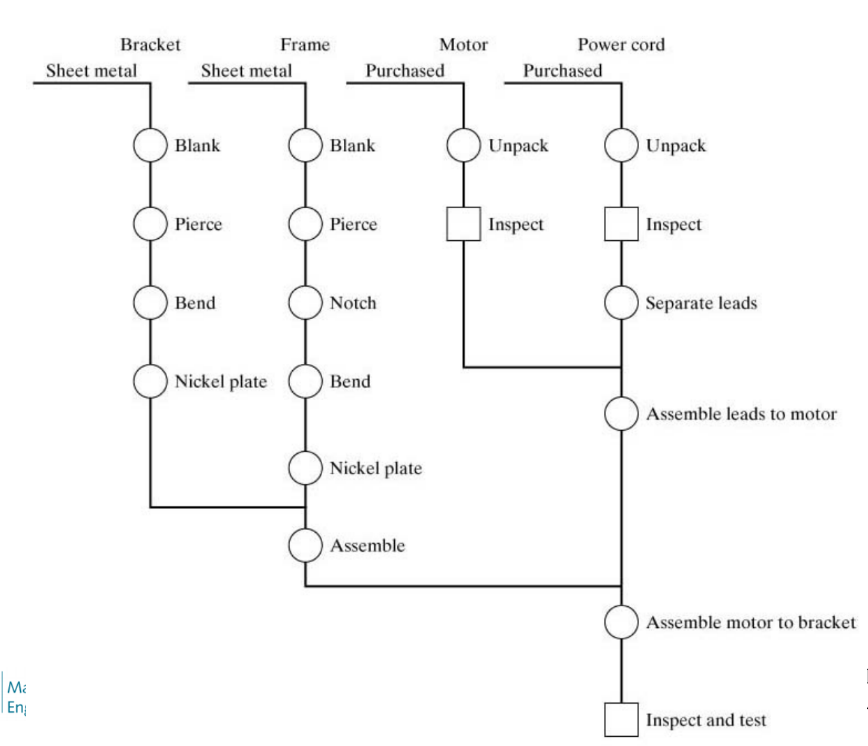
- Aoperations chart
5What kind of chart is this?
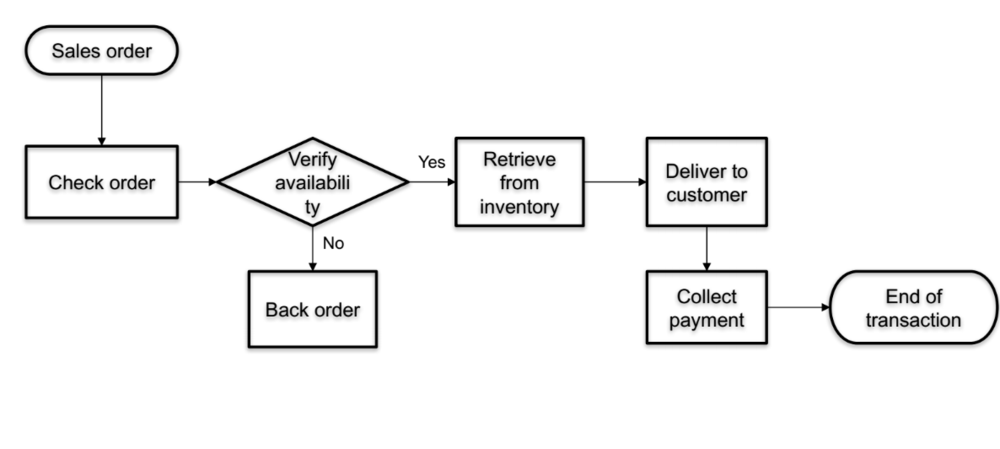
- Aprocess map
6What stage does this represent on a process map?

- ABeginning or ending process
7What stage does this represent on a process map?

- ATask or activity
8What process does this represent on a process map?

- ADecision point
9wtf is this
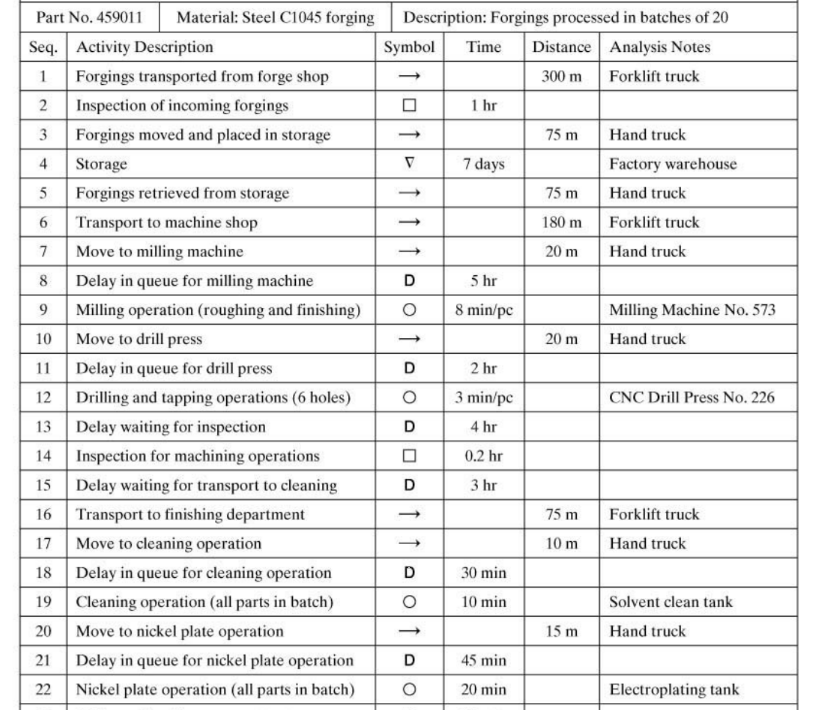
- Aflow process chart
10What does this represent on a flow process chart?

- AOperation
11What does this represent on a flow process chart?

- AInspection
12What does this represent on a flow process chart?

- AMove
13What does this represent on a flow process chart?

- Adelay
14What does this represent on a flow process chart?

- AStorage
15wtf is this
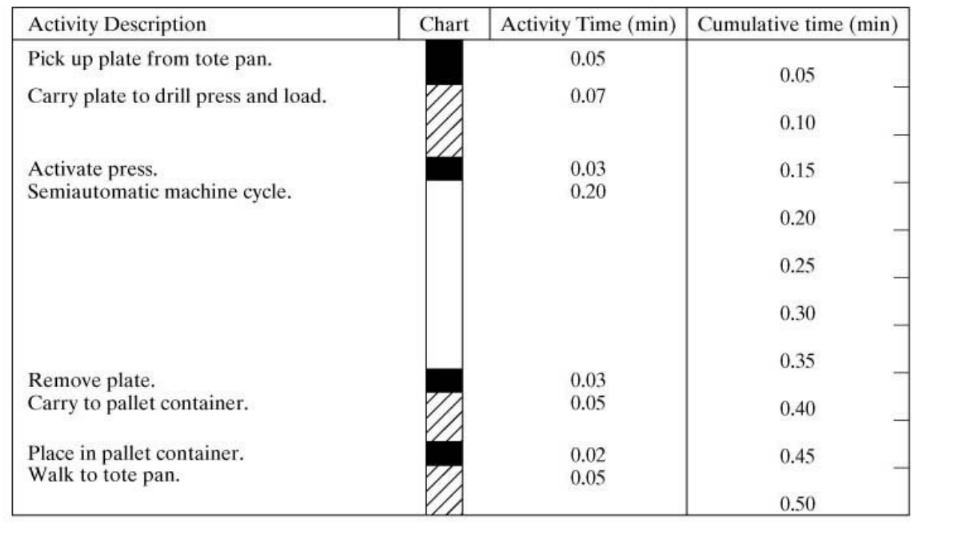
- Aactivity chart
16wtf is THIS
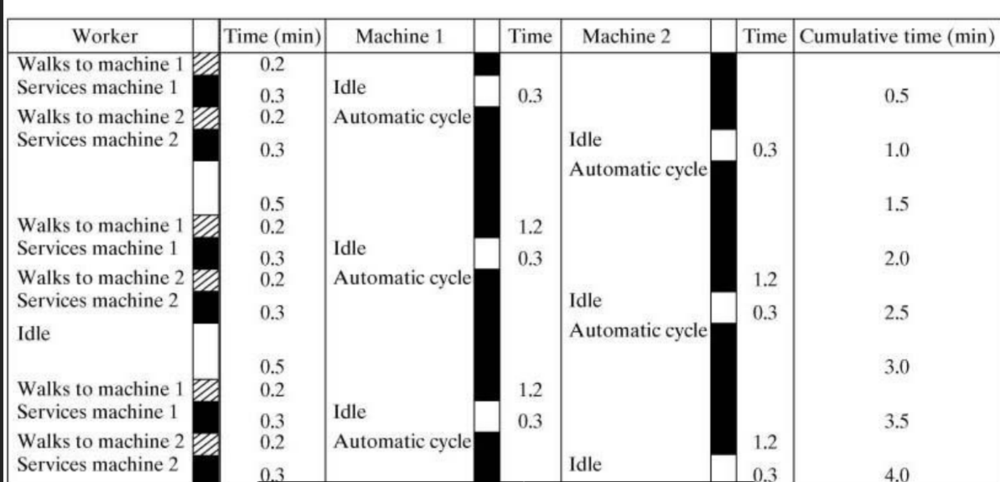
- Amultiple activity chart
17What do these colours represent on an activity chart?

- Aoperation
18What do these colours represent on an activity chart?

- AInspection
19What do these colours represent on an activity chart?

- AIdle time
20What do these colours represent on an activity chart?

- AMoving
21What do these colours represent on an activity chart?

- AHolding
22Activities recorded on a flow process chart fall into two main categories:
- Those in which the material is being [blank_start]worked[blank_end] on, [blank_start]moved[blank_end] or [blank_start]examined[blank_end];
- Those in which the material is not being [blank_start]touched[blank_end].
The activities in the first category may be further subdivided into three groups:
- [blank_start]MAKE READY[blank_end] activities required to [blank_start]prepare[blank_end] the material or work;
- [blank_start]DO[blank_end] activities in which some [blank_start]transformation[blank_end] is made to the material;
- [blank_start]PUT AWAY[blank_end] activities during which the work is moved from the workplace; this may include inspection.
The aim is to maximise the ratio of [blank_start]DO[blank_end] operations as these are the only things that [blank_start]add value[blank_end] to the product.
All activities should be subjected to a systematic questioning technique:
- Query [blank_start]purpose[blank_end] with the initial view of [blank_start]elimination[blank_end];
- Query [blank_start]place[blank_end], [blank_start]sequence[blank_end] and [blank_start]person[blank_end] with the view of [blank_start]combining[blank_end] or [blank_start]rearranging[blank_end];
Query [blank_start]means[blank_end] with a view to [blank_start]simplifying[blank_end].- Aworked
- Bmoved
- Cexamined
- Dtouched
- EMAKE READY
- Fprepare
- GDO
- Htransformation
- IPUT AWAY
- JDO
- Kadd value
- Lpurpose
- Melimination
- Nplace
- Osequence
- Pperson
- Qcombining
- Rrearranging
- Smeans
- Tsimplifying
23The principles of motion economy govern:
- Use of the [blank_start]human body[blank_end]
- Design of the [blank_start]workplace[blank_end]
- Design of [blank_start]tools[blank_end] and [blank_start]environment[blank_end].
There are five basic principles governing the use of the human body.
1. Both [blank_start]hands[blank_end] should be fully utilised.
2. The two hands should [blank_start]begin[blank_end] and [blank_start]complete[blank_end] their movements at the same [blank_start]time[blank_end].
3. Arm motions should be [blank_start]symmetrical[blank_end] and [blank_start]simultaneous[blank_end].
4. The work should be designed to emphasise the worker's [blank_start]preferred hand[blank_end].
5. The two hands should not be [blank_start]idle[blank_end] at the same [blank_start]time[blank_end] except during periods of rest.
The next five principles attempt to utilise the laws of physics.
6. Continuous [blank_start]curved[blank_end] movements are to be preferred.
7. [blank_start]Momentum[blank_end] should be used to help the worker, but should be minimised whenever it has to be overcome by muscular effort.
8. [blank_start]Gravity[blank_end] should be taken advantage of.
9. The work should be arranged to permit easy and natural [blank_start]rhythm[blank_end] wherever possible.
10. Hand and body motions should be made at the [blank_start]lowest[blank_end] possible [blank_start]classification[blank_end].
The last two principles are recommendations for using body parts other than the hands and arms.
11. The method should utilise the worker's [blank_start]feet[blank_end] and [blank_start]arms[blank_end] wherever appropriate.
12. Work should be arranged so that [blank_start]eye[blank_end] movements are within a comfortable area, without the need for frequent changes of [blank_start]focus[blank_end].- Ahuman body
- Bworkplace
- Ctools
- Denvironment
- Ehands
- Fbegin
- Gcomplete
- Htime
- Isymmetrical
- Jsimultaneous
- Kpreferred hand
- Lidle
- Mtime
- Ncurved
- OMomentum
- PGravity
- Qrhythm
- Rclassification
- Slowest
- Tfeet
- Ulegs
- Veye
- Wfocus
24Label this image.
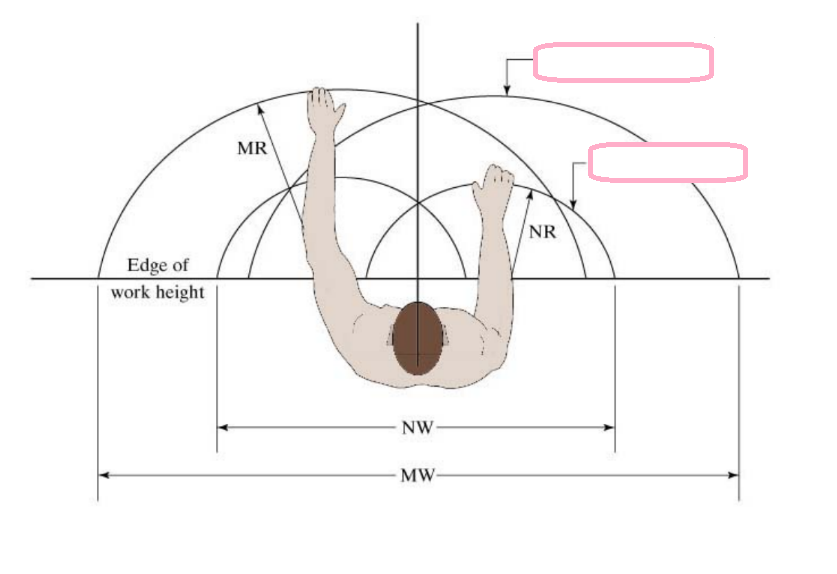
- AMaximum work area
- BNormal work area
- CNormal reach
- DMaximum reach
- ENormal width
- FMaximum width
25The second stage of development is arrangement of the workplace.
- [blank_start]Definite[blank_end] and [blank_start]fixed[blank_end] stations should be provided for all tools and materials to permit [blank_start]habit formation[blank_end] and reduce [blank_start]searching[blank_end].
- [blank_start]Gravity[blank_end] feed should be used to deliver materials as [blank_start]close[blank_end] to the point of use as possible.
- All necessary items should be located within the [blank_start]maximum working area[blank_end] and as [blank_start]near[blank_end] to the worker as possible.
- Materials and tools should be arranged [blank_start]logically[blank_end] and to permit the best [blank_start]sequence[blank_end] of motion.
- There should be adequate [blank_start]lighting[blank_end] and [blank_start]colour contrast[blank_end].
- A good [blank_start]chair[blank_end] and workplace [blank_start]height[blank_end] should permit good [blank_start]posture[blank_end] and allow alternate [blank_start]standing[blank_end] and [blank_start]sitting[blank_end].- ADefinite
- Bfixed
- Chabit formation
- Dsearching
- EGravity
- Fclose
- Gmaximum working area
- Hlogically
- Isequence
- Jnear
- Klighting
- Lcolour contrast
- Mchair
- Nheight
- Oposture
- Pstanding
- Qsitting
26The last stage of development is design of tooling and equipment.
- All [blank_start]holding[blank_end] of the workpiece should be done by a [blank_start]jig[blank_end] or [blank_start]fixture[blank_end] where this is possible.
- Two or more tools should be [blank_start]combined[blank_end] wherever possible.
- The [blank_start]hands[blank_end] should be relieved of any work elements that can be performed by the [blank_start]feet[blank_end].
- Multiple operations should be performed [blank_start]simultaneously[blank_end] instead of [blank_start]sequentially[blank_end] if possible.
- Operations should be performed on [blank_start]multiple[blank_end] parts [blank_start]simultaneously[blank_end] if possible.
- Equipment and controls should be designed for [blank_start]operator convenience[blank_end] and [blank_start]error avoidance[blank_end].
- Manual operations should be [blank_start]mechanised[blank_end] or [blank_start]automated[blank_end] wherever feasible.- Aholding
- Bjig
- Cfixture
- Dcombined
- Ehands
- Ffeet
- Gsimultaneously
- Hsequentially
- Imultiple
- Jsimultaneously
- Koperator convenience
- Lerror avoidance
- Mmechanised
- Nautomated
27wtf is this
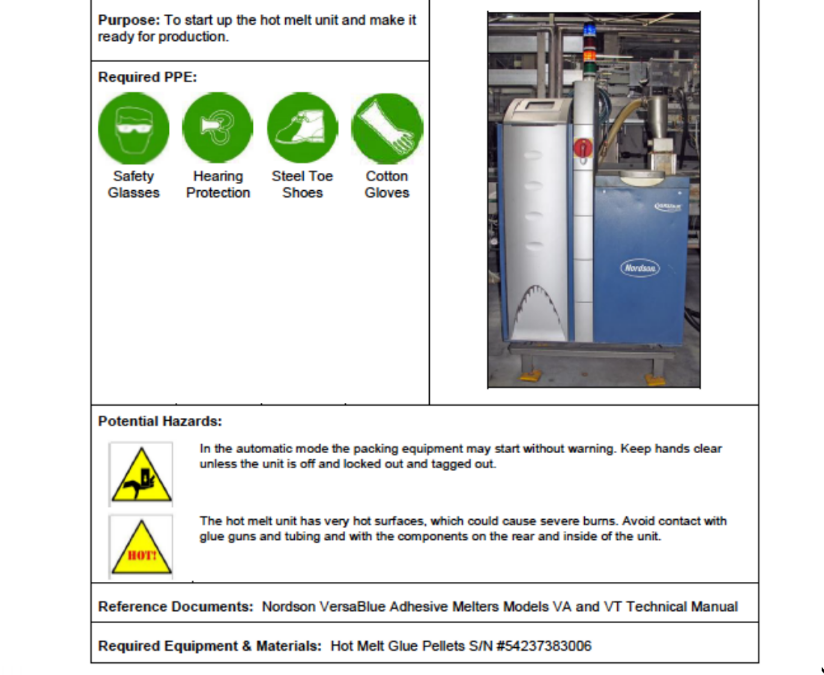
- Astandard operating procedure
28The aim of standard operating procedures is to ensure that tasks are always performed in [blank_start]the same way[blank_end]. This will:
- Reduce variations in [blank_start]operation time[blank_end]
- Reduce variations in [blank_start]quality[blank_end]
- Provide a basis for [blank_start]training[blank_end]
- Allow [blank_start]variations[blank_end] to be easily identified
- Form a fixed basis for [blank_start]further improvement[blank_end].
Having defined the improved method then it is necessary to:
- [blank_start]Install[blank_end] it as standard practice and
- [blank_start]Maintain[blank_end] that standard practice with regular checks.- Athe same way
- Boperation time
- Cquality
- Dtraining
- Evariations
- Ffurther improvement
- GInstall
- HMaintain
Información
- Descripción
- Test sobre Method study, creado por Lizzie O el 21/03/2017.
- Autor
- Lizzie O
- Idioma
- English
- Visitas
- 0
- Valoración
- Aún sin valoraciones Valora este test