
Test
Henry VII - Quiz (unfinished)
Este test tiene tipos de pregunta que se abren en el reproductor de siempre.
Preguntas del test (86)
1What years did Henry VII reign for?
- A1485-1501
- B1495-1509
- C1485-1509
2What house did Henry VII belong to?
- ALancaster
- BYork
3How did Henry establish his power in 1485? (Select all that are true.)
- ADeclaring his reign to begin the day after the Battle of Bosworth.
- BDeclaring his reign to begin the day before the Battle of Bosworth.
- CExecuting all of Richard III's men.
- DHolding a huge coronation to impress both Englishmen and foreigners.
- EImmediately marching into London to claim his throne.
- FWaiting before marching into London.
- GUsing his first Parliament to pass Acts of Attainder and declare his title.
- HUsing his first Parliament to pardon those who had fought against him, so they owed him their loyalty.
- IMarrying Elizabeth of York.
4In 1485 there were still a number of important Yorkists alive with a strong claim to the throne:
• The most direct male representative of the family was Richard III’s 10 year-old nephew, [blank_start]Edward[blank_end] (the Earl of [blank_start]Warwick[blank_end]). Henry removed this threat by sending him to the Tower of London. He lived there in relative comfort but without the freedom to come and go as he pleased.
• Richard III had named his heir as another nephew – [blank_start]John de la Pole[blank_end]. He was the Earl of [blank_start]Lincoln[blank_end] (the son of Richard’s sister Elizabeth). Henry considered both [blank_start]John[blank_end] and his father (the Duke of Suffolk) as enemies but both pledged their loyalty which Henry accepted. Lincoln was invited to join the King’s council.- AEdward
- BJonathan
- CHenry
- DWarwick
- ESuffolk
- FSomerset
- GJohn de la Pole
- HEdmund de la Pole
- IJohn Colet
- JLincoln
- KNorfolk
- LJohn
- MEdmund
5Recap: Who were the two main Yorkists alive with a claim to the English throne?
- AJohn de la Pole
- BEdmund de la Pole
- CEdward, the Earl of Warwick.
- DJonathan, the Earl of Warwick
6In which regions of the country did Henry experience minor uprisings in 1485-1486?
- AMidlands/North
- BCornwall
- CYorkshire
- DWales
- EEast Anglia
7As Henry travelled north, [blank_start]Lord Lovel[blank_end] and the [blank_start]Stafford[blank_end] brothers (Thomas and Humphrey) broke their sanctuary in Colchester. [blank_start]Lovel[blank_end] headed north in an attempt to waylay the King, while the [blank_start]Staffords[blank_end] travelled to [blank_start]Worcester[blank_end] in an attempt to start a rebellion. Henry carried on with his progress but sent soldiers to offer the choice of surrender and reconciliation or excommunication and death.
- ALord Lovel
- BLord Clifford
- CStafford
- DStanley
- ELovel
- FGrey
- GStaffords
- HStanleys
- IWorcester
- JLincoln
8Recap: Where were the Stafford brothers being held in sanctuary?
- AColchester
- BWorcester
- CWarwick
- DLondon
9The rebellion in the Midlands and the North was easily controlled.
- AVerdadero
- BFalso
10What did Lovel do in the aftermath of the rebellion in the Midlands & North?
- ASought sanctuary in London.
- BSurrendered and was taken to the Tower.
- CFled to Flanders.
11What did the Stafford brothers do in the aftermath of the rebellion in the Midlands and North?
- ASurrendered themselves.
- BFled to Flanders.
- CAttempted to seek sanctuary again.
12The Stafford brothers were arrested and sent to the Tower. Humphrey was [blank_start]executed[blank_end] but Thomas was [blank_start]pardoned[blank_end] and [blank_start]remained loyal thereafter[blank_end].
- Aexecuted
- Bpardoned
- Cbanished
- Dremained loyal thereafter
- Eexcommunicated
13What was the plan in the rebellion in Wales?
- ATo replace Henry with Rhys ap Thomas.
- BTo kill Henry and seize Brecon castle.
- CTo replace Henry with any Welsh Yorkist.
14The rebellion in Wales was led by the [blank_start]Vaughans and Herberts[blank_end]. They were [blank_start]Yorkists[blank_end] who wanted to kill Henry and seize Brecon castle. The rebellion however was put down by [blank_start]Rhys ap Thomas[blank_end], who had been knighted by Henry after the Battle of Bosworth.
- AVaughans and Herberts
- BBeauforts and de la Poles
- CNevilles
- DYorkists
- ELancastrians
- FRhys ap Thomas
- GStanley
15Henry's policy towards rebellions were severity towards the ringleaders but showing mercy to the lower ranks.
- AVerdadero
- BFalso
16When was Henry's first son, Arthur, born?
- A1485
- B1486
- C1489
17When did the Yorkshire rebellion take place?
- A1487
- B1489
- C1495
- D1497
18The Yorkshire rebellion was provoked by [blank_start]Henry's demands for money.[blank_end]
- AHenry's demands for money.
- Bdynastic concerns.
19Henry had planned a campaign in [blank_start]Brittany[blank_end] which was being threatened by [blank_start]France[blank_end]. Parliament granted a subsidy of [blank_start]£100,000[blank_end] to pay for it, but the collection caused widespread discontent. It was collected as a [blank_start]type of income tax[blank_end] and the King only received [blank_start]£27,000[blank_end] of it. Opposition was particularly strong in Yorkshire as people had suffered [blank_start]a bad harvest.[blank_end]
- ABrittany
- BFrance
- CFrance
- DSpain
- E£100,000
- F£20,000
- Gtype of income tax
- Hseizing of property
- I£27,000
- J£11,000
- Ka bad harvest.
- Lan influenza outbreak.
20Why did the people of Yorkshire resent those from the north (Northumberland?)
- AThey were not suffering a bad harvest and yet they were taxed last.
- BThey were not taxed at all as they were expected to defend should the Scottish invade.
- CThey were taxed at a lower rate.
21Henry negotiated a tax reduction with the Earl of Northumberland (Henry Percy.)
- AVerdadero
- BFalso
22When the Earl of Northumberland returned from attempting to negotiate with the King, he was murdered. The subsequent rebellion was led by [blank_start]Sir John Egremont[blank_end] and it was defeated just outside of [blank_start]York.[blank_end]
- ASir John Egremont
- BThomas Percy
- CYork.
- DNorthumberland.
23What did Egremont do in the aftermath of the Yorkshire rebellion?
- AAttempted to seek sanctuary.
- BFled to Flanders.
- CSurrendered himself.
24Henry captured Egremont and he was executed.
- AVerdadero
- BFalso
25Henry did not collect any more of the £100,000 of income tax he was supposed to receive.
- AVerdadero
- BFalso
26The new Earl of Northumberland was a [blank_start]ward of the Crown[blank_end] and so posed no opposition.
- Award of the Crown
- Bsupporter of Henry at Bosworth
27The Yorkshire rebellion was the last major rebellion Henry faced in the North.
- AVerdadero
- BFalso
28When was the rebellion in Cornwall?
- A1490
- B1493
- C1497
- D1499
29The rebellion in Cornwall was provoked by [blank_start]financial concerns.[blank_end]
- Afinancial concerns.
- Bdynastic concerns.
30In 1497 Parliament had voted for another heavy tax. This was to finance an expedition [blank_start]north[blank_end] to confront an expected invasion from [blank_start]James VI and Warbeck.[blank_end]
- Anorth
- Bsouth
- CJames VI and Warbeck.
- DCharles VIII of France.
31The Cornish had a long history of independence and did not want to contribute to this tax.
- AVerdadero
- BFalso
32In May the rebels set out from Bodmin and marched through the western counties. Their only leader of notes was the impoverished [blank_start]Lord Audley[blank_end] but by June they had reached Blackheath in London and numbered [blank_start]15,000.[blank_end] They were met by the King’s forces under the command of [blank_start]Lord Daubeney[blank_end]. In the battle (or more accurately slaughter) [blank_start]1000[blank_end] rebels were quickly killed and the rest fled.
- ALord Audley
- BLord Stafford
- C15,000.
- D3,000
- ELord Daubeney
- F1000
- G2500
33How did Henry react to the Cornish rebels?
- AHe executed approximately 30 leaders.
- BHe showed mercy and only executed Audley and two other leaders.
34Which of these were shown by the Cornish rebellion?
- AIt proved that Henry had firm control of all regions of the country.
- BIt showed that Henry was still in a weak position.
- CIt showed that few were prepared to oppose rebels - they had made it to London before encountering any opposition.
- DIt showed that Henry could not afford a serious northern campaign.
- EPeople were not prepared to finance war to defend the Tudor regime.
- FIt made Henry consider carefully what regions he taxed.
35What years was Lambert Simnel an active threat to Henry?
- A1485-89
- B1486-89
- C1486-87
36It was eventually decided that Simnel should impersonate [blank_start]the Earl of Warwick[blank_end], due to fresh rumours about him.
- Athe Earl of Warwick
- BRichard of York
- CEdward of York
37Symonds took Simnel to [blank_start]Ireland[blank_end] as this had been a centre of Yorkist support. The current Lord Lieutenant was Lord Kildare and, he along with other leading Irish nobles, proclaimed Simnel as [blank_start]Edward VI[blank_end]. He was also supported by [blank_start]Margaret of Burgundy.[blank_end] She sent money and 2000 soldiers to Ireland to support Simnel. These troops were led by Martin Schwartz. This support led to Simnel being crowned as Edward VI in Dublin in [blank_start]May 1487.[blank_end]
- AIreland
- BSpain
- CScotland
- DEdward VI
- EEdward VIII
- FMargaret of Burgundy.
- GCharles VIII of France.
- HAnne of Brittany.
- IMay 1487.
- JSeptember 1486.
38The real Earl of Warwick was sent to Ireland to expose Simnel as an impostor.
- AVerdadero
- BFalso
39The situation was made worse when the [blank_start]Earl of Lincoln[blank_end] fled to join [blank_start]Lovel[blank_end] at the court of Margaret in Flanders. [blank_start]Lincoln and Lovel[blank_end] then accompanied Schwartz when he went to [blank_start]Ireland[blank_end] in May 1487. Henry was concerned at these events and did not know how many Yorkists would join with Simnel. This is shown by him granting a pardon to Thomas Broughton, who had been among [blank_start]Richard III’s[blank_end] most loyal supporters in the north-west.
- AEarl of Lincoln
- BThe Duke of Norfolk
- CLovel
- DAudley
- ELincoln and Lovel
- FNorfolk and Lovel
- GLincoln and Audley
- HIreland
- ISpain
- JRichard III’s
- KSimnel's
40The army from Ireland landed on the [blank_start]4th June[blank_end] in Lancashire. They began marching south, however they gained [blank_start]less[blank_end] support than they expected. The King was prepared to confront the invasion and met the rebels outside Newark.
- A4th June
- B21st May
- Cless
- Dfar more
41What date did the battle between Simnel and Henry's armies take place?
- A4th June 1487
- B21st May 1487
- C16th June 1487
42Simnel's armies far outnumbered Henry's.
- AVerdadero
- BFalso
43Symonds was [blank_start]imprisoned for life.[blank_end] Simnel was made a [blank_start]turnspit in the royal kitchen[blank_end] and was later promoted to be the King’s falconer as a reward for good service. Henry recognised he had merely been a pawn in the hands of ambitious men and as the real ringleaders were now dead, he could afford to show mercy.
- Aimprisoned for life.
- Bexecuted.
- Cturnspit in the royal kitchen
- Dward
44Who is this? (Full name)
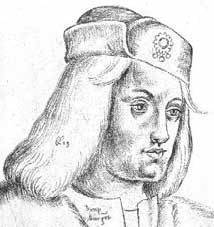
- APerkin Warbeck
45During what years was Warbeck an active threat to Henry?
- A1489-1496
- B1491-1499
46In the autumn of [blank_start]1491[blank_end] Perkin Warbeck (a 17 year-old from Tournai in France) arrived in [blank_start]Cork, Ireland[blank_end]. He claimed to be [blank_start]Richard, Duke of York[blank_end] – the younger brother who was supposedly murdered in the Tower. While the men behind the plot seem to be of humble origins, there is much suggestion that [blank_start]Charles VIII of France[blank_end] & Margaret of Burgundy were also involved in the plot. At this time, [blank_start]Charles[blank_end] was trying to force [blank_start]Brittany[blank_end] to become part of his kingdom and saw Warbeck as a useful pawn to put pressure on Henry.
- A1491
- B1490
- CCork, Ireland
- DKiltimagh, Ireland
- ERichard, Duke of York
- FEdward, Duke of York
- GCharles VIII of France
- HPhilip of Spain
- ICharles
- JPhilip
- KBrittany
- LPortugal
47What did Henry do after Warbeck landed in Ireland?
- APreparing an army in London, to be ready if he invaded.
- BSent a small army to Ireland.
48Where was Warbeck forced to flee in 1492?
- AScotland
- BDublin
- CFrance
49Warbeck was welcomed at the French court.
- AVerdadero
- BFalso
50However, Henry outmanouvred Warbeck by negotiating the Treaty of [blank_start]Etaples[blank_end] with Charles.
- AEtaples
51Which of the following were negotiated in the Treaty of Etaples?
- ANo wars fought between England and France for the following 20 years.
- BCharles promised no further French aid to English rebels.
- CIf Warbeck sought sanctuary in France, Charles was to execute him or surrender him to Henry.
- DFrance to pay the costs of intervening in Brittany.
- ECharles would pay the arrears of the Treaty of Picquigny .
- FEngland accepted the loss of Brittany.
52Where was Warbeck forced to flee next?
- ASpain
- BScotland
- CFlanders
- DIreland
53Henry was unhappy about Warbeck being sheltered by Margaret of Burgundy, so sent an army to Flanders.
- AVerdadero
- BFalso
54Which of the following was Henry's tactic for dealing with Burgundy while they were supporting Warbeck? (1493)
- AThreats of invasion if they did not end their support for Warbeck
- BPlacing an embargo on English cloth trade with Burgundy
55By [blank_start]1494[blank_end] Warbeck had found a new and more influential backer anyway. This was [blank_start]Maximilian[blank_end], the new Holy Roman Emperor.
- A1494
- BMaximilian
56Maximilian had plentiful time and resources to finance an invasion of England.
- AVerdadero
- BFalso
57Maximilian had his attention diverted away from Warbeck when [blank_start]France[blank_end] invaded [blank_start]Italy[blank_end] in 1494.
- AFrance
- BItaly
58When did Warbeck attempt his invasion of England?
- AJune 1493
- BJune 1494
- CJuly 1495
- DJuly 1496
59In July 1495 Warbeck attempted an invasion of England when he sailed from [blank_start]the Netherlands[blank_end] and attempted to land in Kent. His small force was easily dealt with by Henry’s forces because they knew beforehand that he would invade. Sir Robert Clifford was a royal agent among Warbeck’s supporters and also implicated [blank_start]Sir William Stanley[blank_end] in the plot. This was the man that had changed the course of the Battle of Bosworth and was one of Henry’s most trusted officials. His execution showed that Henry would spare no traitor, no matter how eminent.
- Athe Netherlands
- BIreland
- CItaly
- DSir William Stanley
- ERobert Cecil
- FJohn de Vere
60Warbeck's invasion attempt was disastrous.
- AVerdadero
- BFalso
61Where did Warbeck go after his failed invasion attempt in England?
- AIreland
- BScotland
62How was Warbeck recieved when he went to Ireland?
- AHe was given sanctuary.
- BHe failed to land due to lack of support.
63The next place on Warbeck's journey was [blank_start]Scotland[blank_end] - however he was welcomed by [blank_start]James IV[blank_end] who gave him shelter, money and a royal wife as he wished to stir up trouble in England,
- AScotland
- BFrance
- CJames IV
- DCharles VIII
64When did Warbeck attempt his second invasion?
- A1495
- B1496
- C1497
65James was considering changing his tactics of support for Warbeck, and signed a seven year truce with England - the Truce of [blank_start]Ayton[blank_end]. He saw this as more beneficial for Scotland than supporting Warbeck.
- AAyton
66When was the Truce of Ayton signed?
- A1497
- B1498
- C1499
67Warbeck was no longer welcome in Scotland. Where did he go next?
- AFlanders
- BSpain
- CThe Holy Roman Empire
- DIreland
- EPortugal
68Warbeck made one final invasion attempt, in south-west England.
- AVerdadero
- BFalso
69Warbeck's final invasion attempt was just as unsuccessful as his previous attempts.
- AVerdadero
- BFalso
70Warbeck finally sought sanctuary at [blank_start]Beaulieu[blank_end] Abbey in Hampshire, but by August 1497 had given himself up and made a full confession.
- ABeaulieu
71Warbeck was executed immediately after he made his confession.
- AVerdadero
- BFalso
72Warbeck foolishly tried to flee again after Henry had allowed him to remain at court. He was recaptured and publicly humiliated. However, he was soon found to be plotting with the [blank_start]Earl of Warwick[blank_end] - this time Warbeck was [blank_start]hanged[blank_end] and Warwick was [blank_start]also executed.[blank_end]
- AEarl of Warwick
- BDuke of Norfolk
- Changed
- Dalso executed.
- Epardoned.
73Recap: Track the movement of Perkin Warbeck.
He first went to Ireland.
Then he went to [blank_start]France.[blank_end]
Then he fled to [blank_start]Burgundy.[blank_end]
Then he was backed by the [blank_start]Holy Roman Empire.[blank_end]
He then sailed from the [blank_start]Netherlands[blank_end] to invade.
He returned to [blank_start]Ireland[blank_end] again.
Then he went to [blank_start]Scotland.[blank_end]
Then he returned a final time to [blank_start]Ireland.[blank_end]
He then invaded England a final time.- AFrance.
- BBurgundy.
- CHoly Roman Empire.
- DNetherlands
- EIreland
- FScotland.
- GIreland.
74In the aftermath of Warbeck's plot, the main Yorkist claimant was [blank_start]Edmund[blank_end] de la Pole.
- AEdmund
75Edmund de la Pole was the Earl of Suffolk. While on the surface Suffolk appeared to be loyal to the King, it was clear that there was underlying tension between the two men.
In July [blank_start]1499[blank_end], Suffolk took flight to Guisnes, near Calais in France. Henry feared that this would lead to another foreign-backed invasion and persuaded Suffolk to return. He remained in amicable terms with Henry until [blank_start]1501[blank_end] when he once again fled – this time to the court of [blank_start]Maximilian.[blank_end]
Henry was in a vulnerable position as Yorkist support once again gathered. He only had one male heir, Prince [blank_start]Henry[blank_end] who was only 10 and was not considered to be physically strong at this stage.
Any of Suffolk’s relations who remained in England were imprisoned. When parliament met in January 1504 51 men, many of whom were connected to Suffolk were attained.
Henry gained the upper hand in this struggle in 1506 when [blank_start]Philip of Burgundy[blank_end] was forced by a storm to take refuge in England. Henry persuaded [blank_start]Philip[blank_end] to hand Suffolk over to him as he had seized him from Maximilian. Philip did this on the assurance that Suffolk would not be executed, a promise Henry kept.- A1499
- B1503
- C1501
- D1506
- EMaximilian.
- FMargaret.
- GHenry
- HEdward
- IPhilip of Burgundy
- JFerdinand of Spain
- KPhilip
- LFerdinand
76Some remnants of the feudal system were still apparent in fifteenth-century England, despite the growth of a professional and mercantile bourgeoisie.
- AVerdadero
- BFalso
77The nobility dominated land ownership, despite comprising no more than around [blank_start]60[blank_end] men.
- A60
- B15
- C180
- D600
78The [blank_start]gentry[blank_end] came immediately below the nobility. These were men who could be great landowners, and often sought knighthoods.
- Agentry
- Bfarmers
- Cknights
79The Church was important as a great landowner as well as a religious institution.
- AVerdadero
- BFalso
80Henry only appointed men to clerical positions who had an aristocratic background.
- AVerdadero
- BFalso
81Henry VII had control over the Church and used this influence to appoint men who had [blank_start]legal training,[blank_end] as being a [blank_start]competent administrator[blank_end] was the most important thing.
- Alegal training,
- Bdevout spirituality,
- Ccompetent administrator
- Dstaunch Catholic
82The Black Death had led to a dramatic fall in the population and had reduced the demand for land – the resulting drop in the price of land had enabled the emergence of the group sometimes described as the ‘peasant aristocracy’
- AVerdadero
- BFalso
83The most powerful nobles in the country were known as [blank_start]magnates[blank_end].
(Hint: it begins with an M.)- Amagnates
84Henry’s problem was ‘how to suppress the magnates’ abuse of their power while preserving the power itself’.
- AVerdadero
- BFalso
85Which of the following are true about Henry's relations with the nobility?
- AHe created many new peers in order to stabilise his position - these men were guaranteed to give loyal service.
- BHenry deliberately refrained from creating new Lords.
- CHenry used patronage to guarantee the loyalty of the nobility.
- DIf Henry created a large number of peers, his income would drop considerably, as they would receive lands from crown lands. This is why he did not create many.
- EThe King controlled the marriages of his nobles to ensure that leading magnates did not link themselves to great heiresses to create dangerous power blocks.
- FPowerful families were kept under close surveillance.
- GHenry trusted the small number of powerful families and did not feel the need to monitor them.
- HHenry did not try to buy the loyalty of the nobility through the use of patronage.
- ILoyalty and ability were Henry’s sole requirements for receiving patronage.
86Acts of [blank_start]Attainder[blank_end] were a method of punishing the nobility. It involved the loss of rights when a man was convicted by parliament of treason or any other serious crime. It was applied to a man’s heirs too and meant the loss of the family estate.
- AAttainder
Información
- Descripción
- Test sobre Henry VII - Quiz (unfinished), creado por Chloe Adams el 11/05/2017.
- Autor
- Chloe Adams
- Idioma
- English
- Visitas
- 135
- Etiquetas
- Valoración
- 5,0 de 5 · 1 valoración Valora este test