
Test
Lectures 1-3: Cartilage, Bone - Anatomy & Physiology
Este test tiene tipos de pregunta que se abren en el reproductor de siempre.
Preguntas del test (29)
1Which of the following are considered flat bones?
- AScapula
- BParietal
- CNasal
- DHumerus
- ELacrimal
- FC2
- GMetacarpals
2Bones are comprised of two types of bone tissue. [blank_start]Trabecular[blank_end] Bone which is porous and [blank_start]Cortical[blank_end] Bone. Periosteum lines the surface of bones except for at [blank_start]articular[blank_end] surfaces. The Growth plate of long bones occurs in the [blank_start]Metaphysis[blank_end], with the [blank_start]Diaphysis[blank_end] being the shaft and the [blank_start]Epiphysis[blank_end] being either the distal or proximal end of the bone.
- ATrabecular
- BCortical
- Carticular
- DMetaphysis
- EDiaphysis
- FEpiphysis
3Which of the following act as a direct arterial supply for long bones.
- ANutrient Artery
- BMetaphyseal Artery
- CEpiphyseal Artery
- DDiaphyseal Artery
- EArticular Artery
4Bone is composed primarily of
- AType 1 Collagen
- BType 2 Collagen
- CGlycoproteins that bind to Calcium
- DHydroxyapatite
- EGAGs
5Which of the following does not arise from Mesenchymal Stem Cells
- AOsteoblast
- BOsteoclast
- CBone Lining Cell
- DOsteocyte
- EPreosteoblast
- FChondrocytes
- GAdipocytes
- HMyocytes
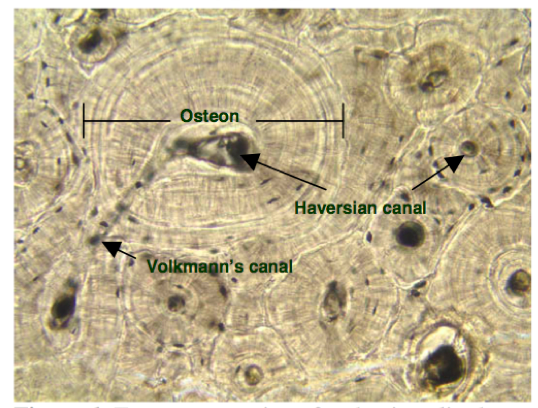
6Histologically this could represent Trabecular Bone
- AVerdadero
- BFalso
7Which of the following cells are multi-nucleate?
- APre-osteoblast
- BPre-osteoclast
- COsteoclast
- DOsteoblast
- EOsteocyte
8Which of the following processes are involved in the formation of the Temporal Bone but not the Femur
- AIntramembranous Ossification
- BEndochondral Ossification
- CFormation of spicules of woven bone through secretion of osteoid
- DResorption of Cartilage Matrix by Osteoclasts
- EReplacement of Cartilage with Bone
- FOsteoclastic breakdown of spongy bone to form a medullary cavity
- GSecretion of Osteoid
- HSecretion of Osteoid directly over mesenchymal tissue
9The Extracellular Matrix in Cartilage is composed of
- AType 1 Collagen
- BType 2 Collagen
- CProteoglycans
- DHyaluronan
- EGlycosaminoglycan Side Chains
- FHydroxyapatite
10Which part of the extracellular matrix of Cartilage is strongly hydrophilic, due to a high negative charge
- AProteoglycan
- BType 1 Collagen
- CType 2 Collagen
- DGlycosaminoglycan Side Chains
- EHyaluronan
- FHydroxyapatite
11Which of the following statements are true of Hyaline Cartilage
- APresent in the Rings of the Trachea
- BPresent in the Articular Cartilage between Femur and Tibia
- CPresent in the Growth Plate of the Humerus
- DFound in the Arytenoid Cartilages
- ECollagen Fibres distinguishable in matrix
- FChondrocytes placed sparsely and randomly in matrix
- GHas a High Ratio of GAGs:Collagen
- HHas a Low Ratio of GAGs:Collagen
- ICan have a Perichondrium
- JFound in Intervertebral Discs
12Which of the following are true of Elastic Cartilage
- APresent in the growth plate of the Humerus
- BPresent in the articular cartilage between Femur and Tibia
- CPresent in the rings of the trachea
- DHas a High ratio of GAGs:Collagen
- EHas a Low ratio of GAG:Collagen
- FCollagen Fibres distinguishable
- GCan have a Perichondrium
- HPresent in the Arytenoid Cartilages
- IPresent in the Intervertebral Discs
- JChondrocytes in lines between bundles of fibres
13Which of the following are true of Fibrocartilage Cartilage
- AIs present in the growth plate of the Humerus
- BIs present in the articular cartilage between Tibia and Femur
- CIs present in the rings of the Trachea
- DIs present in the Arytenoid Cartilages
- EIs present in the Intervertebral Discs
- FHas a low ratio of GAGs:Collagen
- GHas a high ratio of GAGs:Collagen
- HCollagen fibres are distinguishable
- IChondrocytes arranged randomly throughout the matrix
- JCan have a Perichondrium
14Order the following steps of Endochondral Ossification correctly
A: Death of Hypertrophic Chondrocytes
B: Invasion of Cartilage by Osteoclasts, blood vessels, osteoblasts and bone marrow precursors
C: Hypertrophy of Chondrocytes Mid-diaphysis
D: Resorption of Cartilage Matrix by osteoclasts
E: Formation of Periosteal Bone Collar
F: Deposition of Bone on cartilage remnants of osteoblasts
[blank_start]CEABDF[blank_end]- ACEABDF
15At the conclusion of puberty what DOES NOT occur
- AGrowth Plate Fusion
- BFusion of Epiphysis and Metaphysis
- CThe inability to preform Endochondral Ossification
- DThe inability to further increase length of long bones through new bone growth
- EThe absence of Hyaline cartilage in long bones apart from Articular Cartilage
16Which of the following chemicals does NOT promote either proliferation and hypertrophy of chondrocytes or cartilage matrix secretion
- AParathyroid Hormone related Peptide
- BGrowth Hormone
- CInsulin Like Growth Factor 1
- DBone Morphogenic Proteins
- EThyroid Hormone
17Which of the following are chemicals involved with promoting Chondrocyte Proliferation that are also released locally
- AGH
- BIGF-1
- CBMPs
- DFGF3
- EPTHrP
- FThyroid Hormone
18Chondrocyte Proliferation can be inhibited through activation of the [blank_start]D[blank_end]. [blank_start]A[blank_end], secreted locally by chondrocytes and by the liver, stimulates chondrocyte proliferation. This same chemical also promotes Cartilage Matrix Secretion along with [blank_start]C[blank_end].
Chondrocyte Hypertrophy is inhibited by local production and binding of [blank_start]B[blank_end]
Options:
A = IGF-1
B = Parathyroid Hormone related Peptide
C = BMPs
D = Fibroblast Growth Factor 3 Receptor- AD
- BC
- CB
- DA
- EA
- FB
- GC
- HD
- IC
- JB
- KA
- LD
- MB
- NA
- OC
- PD
19Which of the following diseases is caused by a mutation in the gene encoding for a cartilage proteoglycan
- ABull Dog Dwarfism in Calves
- BRickets
- COsteosarcoma
- DScoliosis
- ESpider Lamb Syndrome
20During Endochondral Ossification, angiogenesis is promoted by the growth factor [blank_start]VEGF[blank_end]. [blank_start]BMPs[blank_end] are responsible for Osteoblast differentiation and [blank_start]RANKL[blank_end] stimulates osteoclast differentiation.
Options:
VEGF
RANKL
IGF-1
BMPs
FGF-3
PTHrP
GH
Thyroid Hormone- AVEGF
- BBMPs
- CRANKL
21Expansion of the Epiphsysis is through proliferation of chondrocytes in the articular epiphyseal growth cartilage. This process is faster in the Epiphysis than the Physis.
- AVerdadero
- BFalso
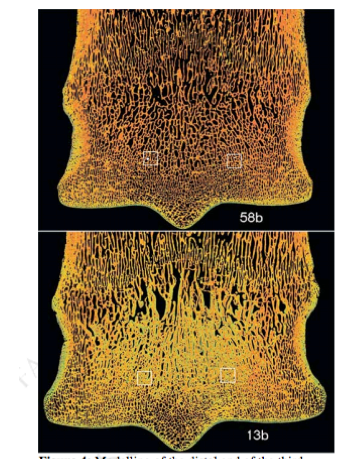
22A bone experiencing a significant amount of loading and strain over a long period of time would look more like:
- AUpper Picture
- BLower Picture
23Bone Remodelling occurs in
- AAdult Bones
- BIn response to fracture, as part of fracture repair
- COn Endosteal Surfaces
- DIn Cortical Bone
- EOn Periosteal Surfaces
- FInvolves Osteoblasts
- GInvolves Osteoclasts
24Which of the following is correct?
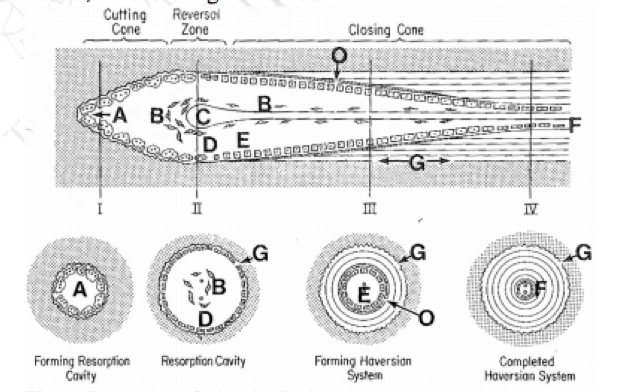
- AThis process occurs in Trabecular Bone
- BThis process involves the action of Osteoblasts in the cutting zone
- CThis process involves Osteoclasts which have arisen from haematopoeitic stem cells
- DDoes not result in a Haversian System
- EWhen complete will leave no space for blood vessels
25Which of the following stimulates Osteoblast activity during Bone remodeling, repair or pathology?
- AOestrogen
- BTestosterone
- CBMPs
- DMechanical Loading
- EMechanical Unloading
- FInflammatory Cytokines and Prostaglandins
- GParathyroid Hormone
- HThyroid Hormone
26Order the following steps of fracture repair correctly
A: Hard Callus
B: Soft Callus
C: Inflammation
D: Remodelling
[blank_start]CBAD[blank_end]- ACBAD
27formation of a Haematoma and granulation tissue occurs during which part of fracture repair
- AInflammation
- BSoft Callus
- CHard Callus
- DRemodelling
28Which of the following is true of soft callus formation
- AMay not be present during fracture repair
- BInvolves formation of fibrocartilagenous tissue
- CInvolves osteoblastic differentiation
- Dprovides permanent stability
- Eprovides temporary stability
- FInvolves Chondrocyte Hypertrophy
- GInvolves Endochondral Ossification
29Which of the following statements is FALSE regarding Hard Callus Formation
- AThe process always involves replacement of fibrocartilagenous tissue with Bone Matrix
- BThe process involves differentiation of mesenchymal stem cells into osteoblasts
- CPromoted by BMPs
- DHigh Oxygen Tension is critical
- Ewoven bone is most likely produced through osteoid secretion
Información
- Descripción
- Veterinary Bioscience: Locomotion Test sobre Lectures 1-3: Cartilage, Bone - Anatomy & Physiology, creado por Daniel Mosele el 15/05/2017.
- Autor
- Daniel Mosele
- Idioma
- English
- Visitas
- 9
- Etiquetas
- Valoración
- Aún sin valoraciones Valora este test