
Test
Atomic Structure Quiz 2 - Edexcel
Este test tiene tipos de pregunta que se abren en el reproductor de siempre.
Preguntas del test (19)
1Isotopes are atoms of the same element that contain different numbers of electrons.
- AVerdadero
- BFalso
2The mass number is always a whole number.
- AVerdadero
- BFalso
3How a mass spectrometer works:
Produces positive ions that are deflected by a [blank_start]magnetic[blank_end] field according to their mass-to-charge ratio (known as their [blank_start]m/z[blank_end] ratio)
Calculates the relative [blank_start]abundance[blank_end] of each ion
Displays abundance as [blank_start]percentage[blank_end]- Amagnetic
- Bm/z
- Cabundance
- Dpercentage
4Chlorine is an example of a [blank_start]diatomic[blank_end] molecule.
- Adiatomic
5Molecular ion peak: The peak with the [blank_start]highest[blank_end] m/z ratio, the [blank_start]M[blank_end] peak. This peak is helpful in figuring out the relative molecular mass of a compound using a mass [blank_start]spectrum[blank_end]
- Ahighest
- BM
- Cspectrum
6Orbital: A region within an atom that can hold up to [blank_start]two[blank_end] electrons with [blank_start]opposite[blank_end] spins
- Atwo
- Bopposite
7[blank_start]J.J. Thomson[blank_end] discovered the electron.
[blank_start]Ernest Rutherford[blank_end] discovered proton.
[blank_start]James Chadwick[blank_end] discovered the nucleus- AJ.J. Thomson
- BErnest Rutherford
- CJames Chadwick
8[blank_start]Atomic number(Z):[blank_end] The number of protons in an element
[blank_start]Mass number:[blank_end] Number of protons and neutrons in an atom
[blank_start]Isotopes:[blank_end] Atoms of the same element with different numbers of neutrons- AAtomic number(Z):
- BMass number:
- CIsotopes:
9Drag and drop the labels onto the following diagram:
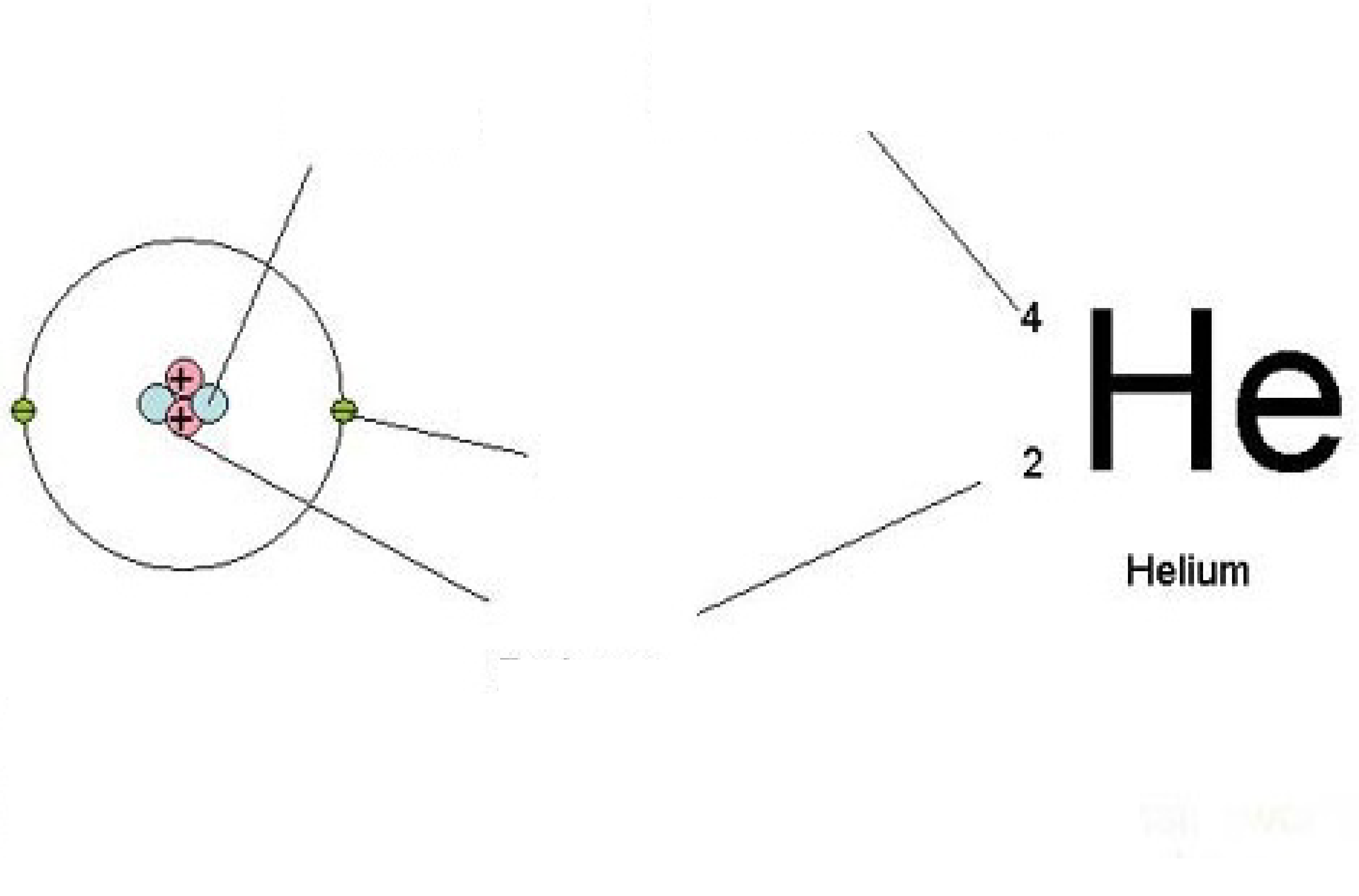
- AProton
- BMass number
- CNeutron
- DElectron
10When atoms in the gaseous state are given energy - either heat or electrical - the electrons move to higher [blank_start]energy levels[blank_end].
These higher energy levels are unstable, so the electrons soon fall back to their original energy levels. When they fall back, they emit energy in the form of [blank_start]electromagnetic radiation[blank_end].
This radiation can be analysed using a [blank_start]spectroscope[blank_end], which produces a line emission spectrum.
The line emission spectrum shows that only specific frequencies of electromagnetic radiation are released by the atoms.
The line spectrum of each element is [blank_start]unique[blank_end].
This is compelling evidence for the face that the energy of electrons in atoms can only have certain, fixed values and not a continuous range - we say that the energy levels are [blank_start]quantised[blank_end].- Aenergy levels
- Belectromagnetic radiation
- Cspectroscope
- Dunique
- Equantised
11For all electron subshells, [blank_start]s[blank_end]>[blank_start]p[blank_end]>[blank_start]d[blank_end]>[blank_start]f[blank_end], in terms of energies.
- As
- Bp
- Cd
- Df
- Es
- Fp
- Gd
- Hf
- Is
- Jp
- Kd
- Lf
- Ms
- Np
- Od
- Pf
12The diagram shows a number of ways of representing
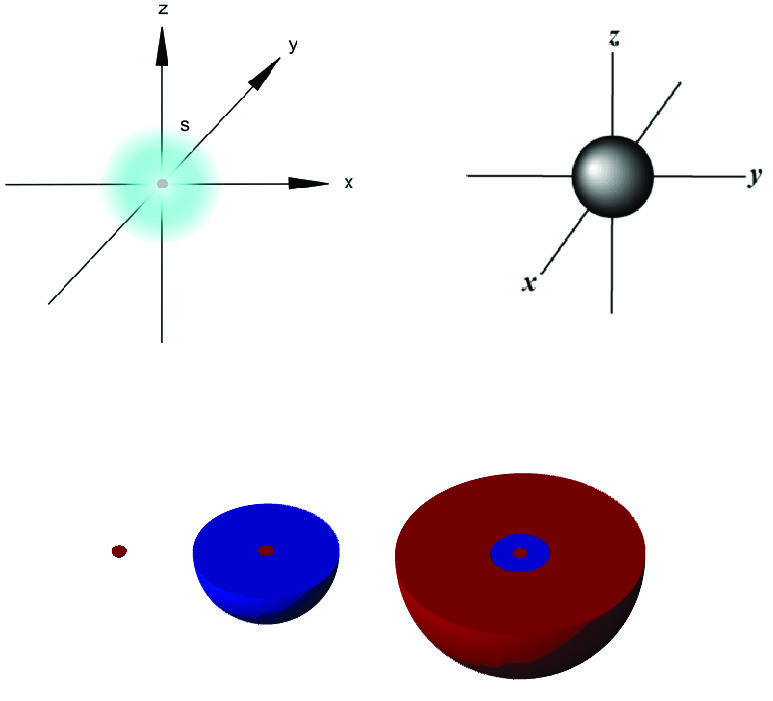
- AAn s oribital
- BA p orbital
- CA d orbital
- DAn f orbital
13The size and shape of the orbitals is such that there is a [blank_start]90[blank_end]% probability of finding the electron within their boundaries
- A90
14P orbitals are elongated and shaped like [blank_start]dumbbells[blank_end].
They have non-uniform charge [blank_start]density[blank_end].
There are 3 p orbitals in each p subshell - these are sometimes labelled as \(p_x\), \(p_y\) and \(p_z\) according to the axes along which they are oriented.
The p orbitals within a subshell differ only in their orientation - they are at mutual [blank_start]right angles[blank_end].- Adumbbells
- Bdensity
- Cright angles
15This is a way of representing
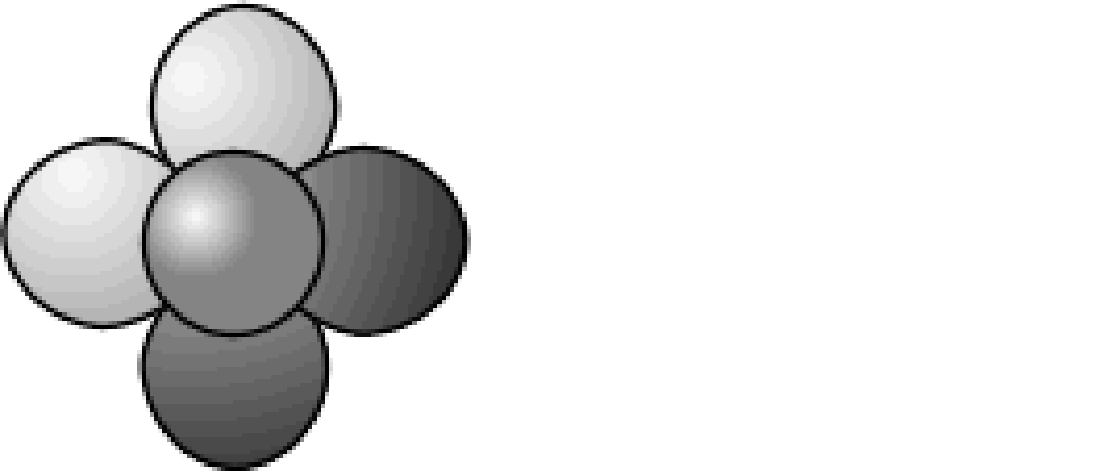
- Ap orbitals
- Bs orbitals
- Cd orbitals
- Df orbitals
16The first quantum shell can have [blank_start]2[blank_end] electrons.
The second quantum shell can have [blank_start]8[blank_end] electrons .
The third quantum shell can have [blank_start]18[blank_end] electrons.
The fourth quantum shell can have [blank_start]32[blank_end] electrons.- A2
- B8
- C18
- D32
17"Completely removing" an electron involves moving it an [blank_start]infinite[blank_end] distance away from the atom that it no longer experiences any attractive force from the nucleus - this involves an [blank_start]increase[blank_end] in energy.
If the energy of the electron is already high, then this increase will not be large.
If the electron is in a low energy quantum shell, then a [blank_start]large increase[blank_end] in energy is required to move the electron away from the nucleus
This increase in energy is the [blank_start]ionisation energy[blank_end],- Ainfinite
- Bincrease
- Clarge increase
- Dionisation energy
18In general, ionisation energies [blank_start]decrease[blank_end] moving down a group.
Moving down the group, the nuclear charge [blank_start]increases[blank_end] as more protons are added to the nucleus. This increases the attractive force of the nucleus felt by each electron, decreasing its energy.
However, each electron is added to a new quantum shell. Each quantum shell is higher in energy and electrons in higher shells also experience more [blank_start]repulsion[blank_end] from electrons in lower shells. These two factors lead to an increase in the energy of the electron.
However, the effect from the new quantum shell is [blank_start]greater[blank_end] than the increase in nuclear charge, so overall there is an increase in electron energy and a decrease in ionisation energies moving down the group- Adecrease
- Bincreases
- Crepulsion
- Dgreater
19[blank_start]Covalent radius[blank_end]: Half the distance between the nuclei when two atoms of that element are covalently bonded together in a homonuclear diatomic molecule
[blank_start]Van der Waals radius[blank_end]: Half of the distance between the closest approach of two non-bonded atoms of a given element- ACovalent radius
- BVan der Waals radius
Información
- Descripción
- El usuario ha eliminado su información de asignaturas Test sobre Atomic Structure Quiz 2 - Edexcel, creado por Usuario eliminado el 14/08/2017.
- Autor
- Usuario eliminado
- Idioma
- English
- Visitas
- 15
- Etiquetas